
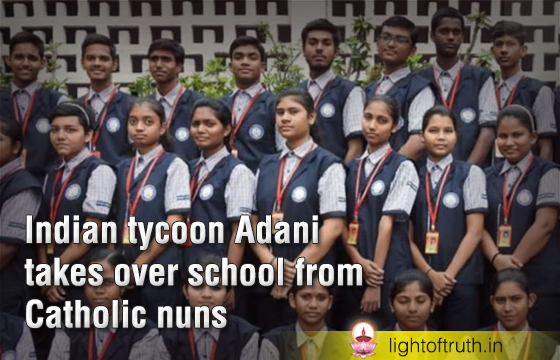
India’s leading industrialist, Gautam Adani, has taken over a well-known high school in western Maha-rashtra state that Carmelite nuns ran for over five decades. Adani Founda-tion, the charity arm of the billionaire with business interests from apples to aviation, took over the management of Mount Carmel Convent Senior Secondary School in Cement Nagar in Chandrapur district from the Congregation of the Mother of Carmel (CMC) in September, a CMC nun told on October 1. Since 1972, the CMC nuns have managed the school, owned by India’s leading cement maker, Associated Cement Company (ACC), which Adani Group acquired from Switzerland-based Holcim in 2022. The ACC built the school with its funds for Corporate Social Respon-sibility and entrusted the management to the nuns.
Category Archives: From The States

Vatican Appoints Indian Youth to International Advisory Body
The Vatican has appointed Dr. Freya Francis (27), from Coimbatore, India, to the International Youth Advisory Body (IYAB). This appointment, announced on September 25, 2024, by the Dicastery for Laity, Family and Life, represents a signi-ficant move in the Church’s efforts to embrace diverse global perspectives. Dr. Freya belongs to the Jesus Youth Move-ment will represent India during her three-year term. A graduate in homeopathy, Dr. Freya is currently a unit doctor in a private hospital in Coimbatore, Tamil Nadu. Raised in a devout Catholic family, her faith journey was shaped by her invol-vement with the Jesus Youth Movement. Starting with her campus prayer group, she steadily rose to leadership roles, honing her skills in working with diverse commu-nities and developing her compassionate approach to ministry. Today, she serves as the regional assistant coordinator for Tamil Nadu. Apart from her ministry work, Dr. Freya is also a passionate freestyle dancer, guitarist, and avid reader. She has been a member of her campus choir and enjoys playing table tennis in her leisure time. “She has a deep commit-ment to Catholic teachings and continu-ously strives to expand her knowledge. Her pro-life stance is admirable, and she is a strong advocate for the sanctity of human life. She has also contributed acti-vely to the Unbound healing ministry,” said Fr. Vignan Das, Associate Director of Communio and a fellow member of the Jesus Youth Movement. The IYAB, esta-blished by the Dicastery, includes 20 young people from various regions and faith backgrounds. They will focus on youth ministry and other pressing issues within the Church. Dr. Freya’s role will help strengthen the dialogue between the Church and its youth worldwide. This appointment highlights the Vatican’s commitment to youth engagement in ecclesiastical matters and recognizes the growing significance of Indian voices in global Catholic discussions. As the Church adapts to modern challenges, young advi-sors like Dr. Freya represent a forward-thinking approach to leadership and community involvement.
The Church in India congratulates Dr. Freya and wishes her continued success.
Supreme Court bars controversial remarks on religious conversions
The Supreme Court has barred remarks made by the Allahabad High Court regard-ing religious conversions and their impact on the country’s demographics, deeming them inappropriate. The apex court’s September 27 decision came as it granted bail to Kailash, a Christian from Hamirpur in the northern Indian state of Uttar Pradesh. The case dates back to December 2023 when Kaila-sh invited a group of about 20 people to a prayer meeting. Among them was Ramkali and her brother, who was strugg-ling with mental health challenges. Following the gather-ing, Ramkali’s brother went missing. While Kailash expre-ssed concern and searched for him, Ramkali remained un-fazed, explaining that her brother often wandered off and returned after a few days. By May 2023, when the brother had still not returned, religious extremists in the village pre-ssured Ramkali to file a com-plaint against Kailash, accusing him of her brother’s disappear-ance. The police had initially found no basis for the allega-tions and released Kailash, but they arrested him on May 21, 2023, under the Uttar Pradesh Anti-Conversion Act, allegedly under pressure from the radical groups. Kailash was accused of forcibly converting the atten-dees of the prayer meeting. In July, Kailash’s lawyers filed for Kailash’s bail, but the Allahabad High Court rejected the plea, citing concerns over rising religious conversions. Justice Rohit Ranjan Agarwal warned that “…if this process is allowed to continue, the majority population of this country would one day become a minority.” In a subsequent hearing on September 27, the Supreme Court granted bail to Kailash. It held that the general observations made by the High Court had no bearing on the facts of the present case and were, therefore, not required for the disposal of the case. The apex court also added that these remarks should not be cited in any future cases or proceedings in the High Court or any other court.
Indian Church urges state govt to allay people’s ‘eviction fears’
Church leaders have urged the communist-led government in a southern Indian state to clear doubts over the likely evi-ction of people, most of them Christians, in the eco-sensi-tive Western Ghats mountain range. The Kerala government did not take into consideration people’s concerns about the proposed declaration of areas within a kilometre of protected forest areas as eco-sensitive zones (ESZs) in the hilly and forested areas of Idukki and Wayanad districts, they said. Many Catholic dioceses and parishes are located in these districts, which are part of the Western Ghats. Nearly 3 milli-on people, mainly Christians, living in 121 villages fear they may be evicted if they end up being marked as ESZs. ”We are confused and the people are confused. Unless we pre-sent a correct picture, our villa-ges with human habitation will be declared ecologically sensi-tive areas and people will su-ffer,” said Fr Jins Karakkat, director of the media commi-ssion at the Idukki Diocese of the Eastern Rite Syro-Malabar Church. Church leaders alleg-ed that the government did not involve the public in identifying the ESZs as directed by the federal forest ministry in its official notification. Karakkat hinted at launching a public agitation if the government continued to be evasive and did not respond to the people’s concerns. “The government has not yet responded to the demand of the Church,” he told.
More than 50% (approx 20,000 sq km) of the total land area of Kerala, which is India’s most densely populated state, falls in the Western Ghats. The mountain range has witnessed ecological damage and erosion due to increasing human acti-vity over the past few decades.
An expert committee appointed by the Kerala go-vernment had recommended limiting the ESZs to 9,993.7 square kilometres, which included 9,107 sq. km of forest and 886.7 sq. km of non-forest areas.
In recent years, heavy rainfalls and landslides have caused the loss of human life and property in the districts of Idukki and Wayanad.
India’s Supreme Court in its order on June 3, 2022, declared all areas within a kilometre of protected forest areas as ESZs and forbade construction of new permanent structures within them. This left the people living in those areas for generations with no other option but to face eviction from the ecologically sensitive zones.
The federal forest ministry has accepted the suggestion of the expert committee. According to media reports, Kerala is planning to reduce the extent of the ESZs further and may submit a new draft proposal to the federal forest ministry after it sought its suggestions and objection to the proposed ESZs within 60 days through a July 31 notification.
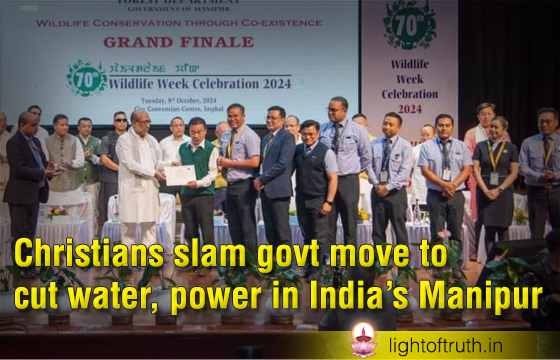
Christians slam govt move to cut water, power in India’s Manipur
Indigenous Chri-stians in India’s strife-torn Manipur say they are worried over the state government’s move to deny power, water, and welfare schemes to “un-registered” villages in the hilly north-eastern state.
Manipur Chief Minister N. Biren Singh on Oct. 8 instructed the authorities not to provide essential services like water and power and benefits of various government welfare schemes to villages in the hilly districts if they are unregistered. Though Singh did not clarify what he meant by “unregistered villages,” media reports said the chief minister was referring to villages that have emerged in the Kuki-dominated areas since 2006. ”This move is yet another attempt to target indigenous Christians who are mostly from the Kuki-Zo community, living in the state’s five hilly districts,” said a Church leader based in the capital, Imphal. He requested that his name not be revealed for security reasons. Another church leader based in a hilly district said that many people lost their houses and businesses during the ongoing sectarian violence and took shelter in other villages. “A few of them have set up temporary houses in other villages. If the government does not recognize them, it will be like adding insult to injury,” he said on the condition of anonymity. Singh, a leader of the Hindu right-wing Bharatiya Janata Party (BJP), has repeatedly blamed “illegal migrants” from neighbouring civil war-hit Myanmar for the ongoing violence in the state and accused the Kuki-Zo communities of giving shelter to them. Singh belongs to the majority Meitei community, which is at loggerheads with the predominantly Christian Kuki-Zo tribal people. ”The government decision to disconnect water or electricity supply will lead to further hostilities between the warring groups,” noted the Church leader. He said the Meiteis and the Kuki-Zo communities cannot co-exist anymore.
Among the 3.2 million people in the state, 41 percent are indigenous Kuki_zo people, mostly Christians, and the influential and wealthy Meiteis Hindus who live in the valleys account for 53 percent. Their feud over granting tribal status to the Meitei Hindus to avail reservation benefits under India’s affirmation action policy has seen the death of nearly 230 people and the uprooting of nearly 60,000, most of them Christians. Christians allege that the official tribal status will allow the influential Meitei community to buy land in Indigenous areas in the districts of Senapati, Tamenglong, Churachandpur, Chandel, and Ukhrul. Christians have been seeking the resignation of Singh over his failure to contain the sectarian violence that started on May 3 last year.
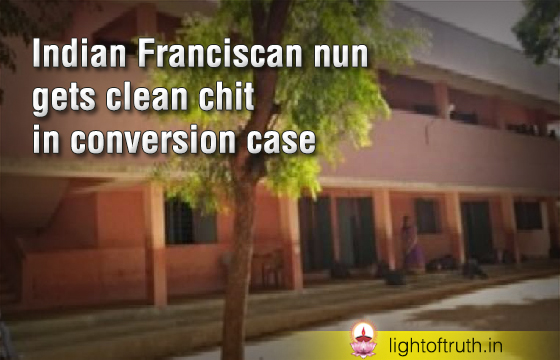
Indian Franciscan nun gets clean chit in conversion case
India’s premier investigation agency has exonerated a Franciscan nun in a case that accused her of causing a 17-year student’s suicide by attempting to convert her in a southern state. The Central Bureau of Investigation (CBI), in its report, ruled out religious conversion as the cause of the January 2022 suicide by the student of Sacred Heart Higher Secon-dary School in Michaelpatti under Kumbakonam Diocese in Tamil Nadu. The federal agency informed the Ma-durai bench of Madras High Court on Sept. 18 that it had interrogated 141 individuals and scanned through some 265 documents in connection with the case. It found no substantiating evi-dence to support the allegation of religious conversion and urged the court to dismiss the charge, it added. The CBI, however, said that the girl may have taken the extreme step as she was made to do domestic chores in the school hostel. The girl’s Hindu parents alleged she was forced to commit suicide after nuns harassed her for not converting to Christianity. Tamil Nadu police disputed this, saying the girl had not made any such revelation either to the police or the magistrate who took her dying statement.

Indian pastor, 4 others jailed for religious conversion
Five people, including a pastor, have been jailed for religious con-version in the northern Indian state of Uttar Pradesh. Police said Pastor Gerald Massey Mathews of the Dasna Church, and the others were arrested for converting people under the pretext of curing their illnesses and offering their children a quality education. Uttar Pradesh is ruled by the Bharatiya Janata Party, which enacted a sweep-ing anti-conversion law in 2020.”
The police arrested Pastor Ma-thews and others on Sept. 23 and kept them in custody for more than 24 hours and on Sept. 25 sent them to jail in Dasna without giving any details,” Christian activist Minakshi Singh told on Sept. 25. “The police have kept us in the dark,” said Singh, general secretary of Unity in Compa-ssion, a charity based in Uttar Pradesh. The Christian lay leader said the sweeping anti-conversion law was enacted by the right-wing government without “proper study.” According to news reports, the complaint against the pastor and the others was filed by Naveen Singh, coordinator of the Dharam Jagaran Samanvay Samiti (Forum for Hindu Awakening).
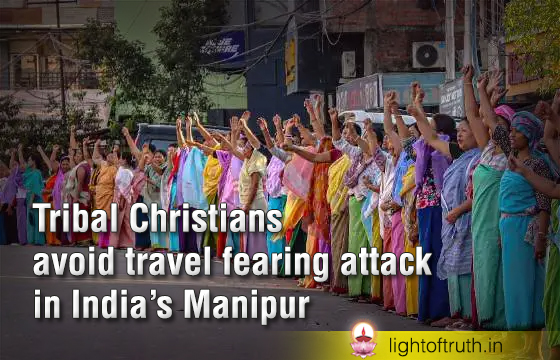
Tribal Christians avoid travel fearing attack in India’s Manipur
A tribal body in India’s strife-torn Manipur has announced a four-day travel advisory for Christians, cautioning them against an impending attack by their rival Hindu group. The Indigenous Tribal Leaders’ Forum (ITLF) on Sept. 24 urged Kuki-Zo tribal Christians in the hilly state in north-eastern India not to venture out of their areas as the Hindu Meitei commu-nity may launch an attack between Sept. 26 and 29. The ITLF has put all village volunteers on high alert, especially in its stronghold in Churachandpur district, where tribal students started a riot 16 months ago. The tribal body also announ-ced the closure of schools, other institu-tions and offices from Sept. 27-29 and a total shutdown on Sept. 28. In a statement on Sept. 24, ITLF said the Manipur gov-ernment recently accumulated highly advanced Medium Machine Gun (MMG) MK 2A1 weapons, and state security advi-sor Kuldiep Singh hinted at an impending “attack” on Sept. 28. “Previously, an assault on Kuki-Zo occurred shortly after the Manipur government issued a warning of an attack by 200 Kuki militants,” it noted. “This is their strategy to target us. They use the media to blame the Kuki-Zo for everything and Meitei militants attack us,” a Church leader who did not want to be named told on Sept. 25.
He said if the government has infor-mation about an impending attack by Kuki militants why not check them. “This announcement is a smokescreen to target us,” he added. We need to be cautious as the state government, led by the Bharatiya Janata Party is backing the Meiteis. “Mani-pur Chief Minister N Biren Singh is a Meitei himself,” added the Church leader. Singh has accused Christians of a role in the narcotic trade because many among them have ethnic and family ties in neighbouring Myanmar.

Catholic psychologists meet at Kolkata
A convention of psychologists has stressed the need for mental health workers caring for themselves while attending to other people’s mental health. As many as 75 Catholic psychologists from 12 Indian states attended the 25th annual convention of the Conference of Catholic Psychologists of India (CCPI) in Kolkata. Archbishop Thomas D’Souza of Kolkata presided over the opening of the September 20-22 convention at Seva Kendra that explored the theme, “Fostering Wellness – Innovative Approaches to Therapist Self-Care and Client Engagement.” Christian Brother Sunil Britto, the conference coordinator who introduced the theme: “Self-Compassion for Our Self-Care,” asked the participants to reflect on how they care for themselves while attending to the needs of their clients. Priya Puri, chief Clinical Psychologist and founder of “The Healing Space,” addressed the opening session on “The Therapist Dilemma.” She addressed the tension of being fully present for others while balancing one’s own needs. Shatabhisha Chatterjee, consultant Clinical Psychologist attached to Mental Health Foundation Kolkata who addressed trauma-informed care, introduced the therapists to Internal Family Systems theory, encouraging them to heal from vicarious trauma.
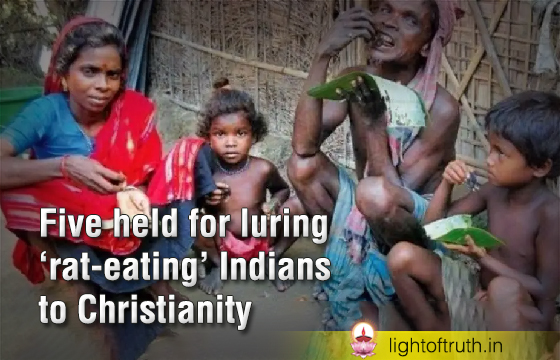
Five held for luring ‘rat-eating’ Indians to Christianity
Three Nepali nationals and two Indians have been arrested by police in the northern Indian border state of Uttar Pradesh for allegedly luring a “rat-eat-ing,” socially backward and marginalized community to embrace Christianity.
Police raided a Sunday prayer service in Bhedihari, a village on the Indian-Nepalese border and arrested Bhim Ba-hadur Gurung, his wife, Vishnu Gaya Devi, and Meena Ksha-triya, all Nepali citizens, and local residents Mangal and Ja-garnath on Sept. 22. According to news reports, Christian orga-nizations involved in religious conversion are active in the Musahar settlement area in Uttar Pradesh, India’s most populous and largest state. According to India’s national human rights commission, the Musahars, a declared schedu-led caste of Dalits (former untouchables) under the Indian constitution, are living in the northern Indian states of Bihar, Madhya Pradesh and Uttar Pradesh. They are reported to be the poorest among the Dalits. Musahar means “rat eater” in the Bhojpuri lang-uage, spoken in Bihar where they constitute 2.2 million of the state’s 104 million people. “We came to know about it through news reports and local sources. The matter is under investigation. Hence, it is too early to say anything,” said Pastor Jiya Lal, based in Sul-tanpur district in Uttar Pradesh. In February, the police arrested four Christians from the same locality, Lal added. “However, we have no updates in that case,” the pastor told.
on Sept. 23.
Religious conversion is banned in Uttar Pradesh, where Christians constitute a mere 0.18 percent of its 200 million people. Ruled by the Bharatiya Janata Party (BJP) since 2017, the Hindu-majority state enacted the Uttar Pradesh Prohibition of Unlawful Conversion of Religion Act in 2020 introduced by monk-turned-politician Yogi Adithyanad’s government. His right-wing government amended the draconian law in July this year which was passed by the state assembly in August. Under the amended legislation anyone will be able to file a police complaint, unlike before when only conversion victims, their parents and other close blood relatives could do so. Penalties will also get tougher with life imprisonment now a possibility in cases of forced conversions. The law will come into force once the state governor Anandiben Patel gives her nod, which is just a formality. “Since the [original] anti-conversion bill was passed in 2020, violence against the Christians has increased,” Uttar Pradesh-based Pastor Dinesh Kumar told UCA News on Sept. 23. Often allegations of religious conversion against Christians have proved false, he said. The BJP and its parent paramilitary outfit the Rashtriya Swayamsevak Sangh (RSS) are against missionary activities of the Indian Church among India’s Dalits and indigenous people who are currently grouped under Hinduism. Dalits and indigenous people make up more than 25 percent of the South Asian nation’s mammoth 1.4 billion people. Uttar Pradesh ranks second among states with regard to anti-Christian violence, according to the United Christian Forum, an ecumenical group based in New Delhi