
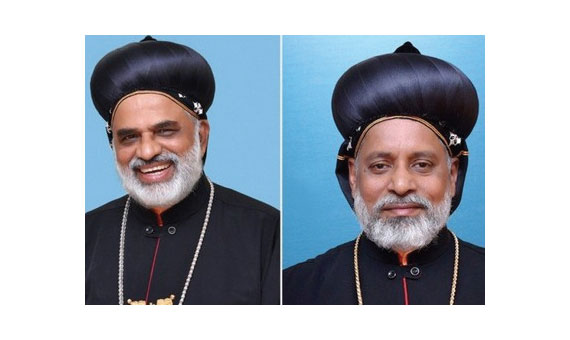
The Synod of Bishops of the eastern- rite Syro-Malankara Catholic Church, headquartered in Kerala, has elected coadjutor bishops to the dioceses of Pathanamthitta and Muvattupuzha Auxiliary Bishop Samuel Mar Irenios (Kattukallil) of Trivandrum has been elected Coadjutor Bishop of Pathanamthitta, while Bishop Yoohanon Mar Theodosius (Kochuthundil), the Curial Bishop of the Major Archdiocese of Trivandrum has been elected the Co- adjutor of the Diocese of Muvattupuzha.
Category Archives: From The States

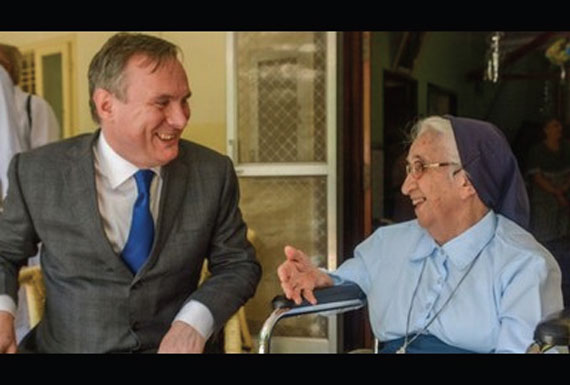
NEW FILM TELLS STORY OF IRISH NUN TEACHING IN INDIA FOR 70 YEARS
Sister India, a documentary produced by Irish film-maker Myles O’Reilly and currently being screened at a number of film festivals in Ireland and India, is the story of an Irish Presentation nun who has spent 70 years teaching in India.
Sr Loreto Houlihan, born Peg Houlihan in Ireland’s Co Tipperary in 1927, reached India in 1944. Recently she celebrated her 91st birthday at St Joseph’s Anglo-Indian School in Perambur in north Chennai where she has spent most of her life as a primary school teacher.
O’Reilly said that he is not very religious but was invited to follow Sr Loreto Houlihan, and found her deep love of India and its people absolutely heart- warming and deeply resonant. “I learned from her that India and its culture retains more of the life she left 70 years ago in Ireland than the country of her birth today, and so she chooses to live the rest of her days in India for that natural famili- arity,” he said.
The idea for the film was sparked by another Irish woman, Áine Edwards, who has been living in India since 2003 where she runs a business consultancy service. “The adults I meet nowadays who attended schools, where Irish brothers and sisters were teachers, talk fondly of them and their education. The late chief minister of Tamil, Nadu Jayalalitha, has spoken of her school days at Church Park as being the happiest of her life,” she added.

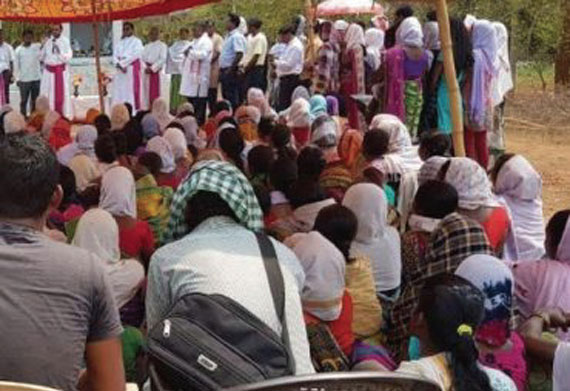
SAY NO TO DIVISIVE FORCES: BISHOPS
The Catholic Bishops’ Conference of India (CBCI) and Odisha Bishops have urged people of Sundargarh district not to give in to divisive forces.
On 1, April 2018, in the late night of Easter Sunday, some miscreants vandalized a grotto outside the compound of St. Thomas Church, Salangabahal in Raurkela diocese, Odisha, mutilated the statue of Our Lady, and broke the head of the statue of Child Jesus in the grotto. They smashed a statue of Our Lady in another Grotto in Gyanpali village and attempted to burn the Church of the Victory of the Cross in Bihabandh.
The antisocial elements had also chopped off the head of a statue of a bull at the Shiva Temple in the vicinity.
On April 7, a delegation of Bishops which comprised of Bishop Theodore Mascarenhas SFX, the Secretary-General of the CBCI, Archbishop John Barwa SVD, Regional Chairman of the Odisha Catholic Bishops’ Council, Bishop Kishor Kumar Kujur of Rourkela, Bishop Telesphore Bilung SVD of the Archdiocese of Ranchi, Bishop Emeritus Alphonse Bilung of Rourkela, visited the affected areas.
ODISHA BISHOPS, CHURCH LEADERS TO DISCUSS ON DALITS
As members of the Dalit caste were protesting the Supreme Court order that prevented the immediate arrest of those being violent towards them across India on April 2, the Bishops of Odisha and other church leaders have planned to deliberate on the Dalits of Odisha on April 4.
The Indian church published the ‘Catholic Bishops’ Conference of India Dalit Policy,’ on 13 December 2016, as an ethical imperative and the Gospel-mandate for the Catholic Church in India for the empowerment of the Dalits.
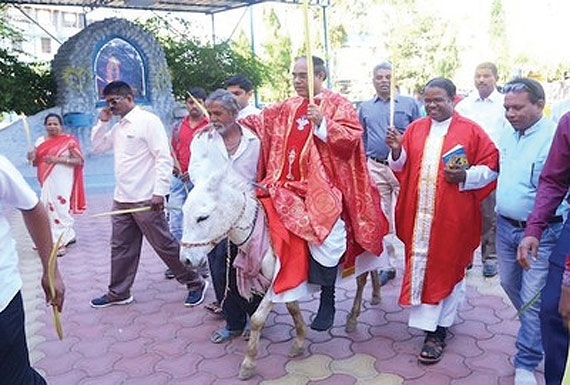
Indian priest rides on donkey to enforce Palm Sunday message
Mounted on a donkey, the priest moved slowly as boys and young men waved palm branches and sang hymns to Jesus during a Palm Sunday procession in a central Indian parish.
Fr Thomas Rajamanikyam and his parishioners at St Joseph Church in Nanda Nagar, Indore Diocese enacted the biblical account of Jesus’ entry to Jerusalem, an event Catholics commemorate on Palm Sunday, which this year fell on March 25.
The parish priest on a donkey leading the Palm Sunday procession surprised many. Kanti Kumrawat, a grandmother and parishioner, said it was first time they had such a procession and never heard of any other parish in the vicinity having commemorated the event in such a way.
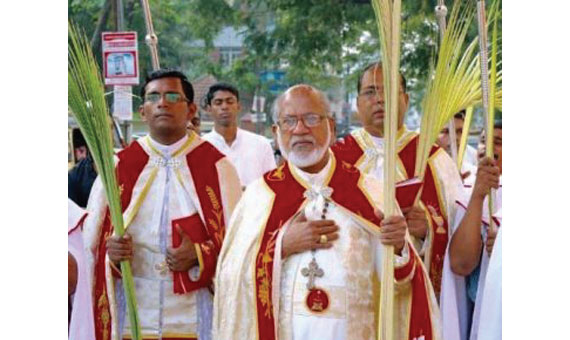
Alencherry breaks silence, stresses purification for all
Cardinal George Alencherry, the head of the Syro-Malabar Church, on March 25 shared with lay people his views on the land deal row that has pitted him against the priests of the Archdiocese of Ernakulam-Angamaly.
“Whatever I and the auxiliary bishops have given out in a statement on the sale of land belonging to the church earlier, is true. It is correct and other news doing the rounds on the land row shouldn’t be believed,” the cardinal said leading the Palm Sunday ceremony at the St Mary’s Basilica, in Kochi, Kerala.
On March 24, the cardinal and his two junior prelates – Bishops Sebastian Edayanthrath and Jose Puthenveettil – released a press release expressing their happiness in resolving the land sale controversy that has reached even the Supreme Court of India.
The statement said a meeting of the priests’ council earlier in the day had decided to resolve the problem amicably.
Addressing the Sunday Mass, the cardinal acknowledged power and money make people impure. “All are impure in one way or the other. You and I are also among those who are impure. Individuals, families and the Church need to be purified,” the cardinal told the faithful.
The land controversy had raised doubts about the cardinal leading the Palm Sunday ceremonies in the cathedral as some priests and lay people reportedly were opposed his presence.
While some of the laity claimed the Mass participation was comparatively less, others said the cathedral had the usual attendance.
The cardinal had in a YouTube video uploaded on March 24 said each Palm Sunday initiates a purification process. He referred to Jesus expelling the merchants and the money changers from the Temple in his address.
“We should purify ourselves and purification at the time of Palm Sunday should be a deep one,” he asserted.
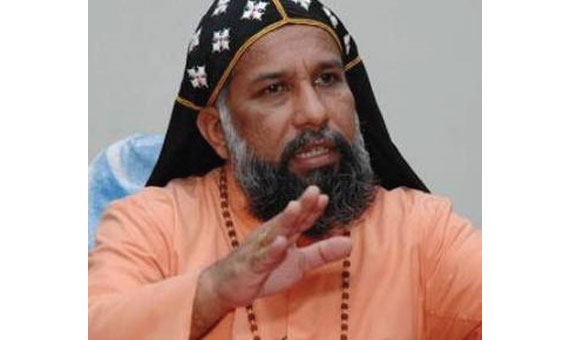
Church land row: Mediator “extremely happy” with outcome
One of the two prelates, who brokered peace in troubled Ernakulam-Angamaly archdiocese in Kerala, says he is “extremely happy” with the outcome of their efforts.
“It was indeed divine intervention that the priests and bishops could agree to resolve their problems in true Christian spirit just before the Holy Week,” Cardinal Baselios Mar Cleemis Cardinal Cleemis, heads the Syro-Malankara Church, told Matters India on March 26.
Cardinal Cleemis and Archbishop Maria Calist Soosa Pakiam of Trivandrum met five times with the priests and bishops of Ernakulam-Angamaly to resolve the land sale dispute that alleged caused huge financial loss to the Syro-Malabar archdiocese.
Archbishop Pakiam is the president of the Kerala Catholic Bishops’ Council and a top leader of the Latin Church in the southern Indian state.
Cardinal Cleemis said the two volunteered to intervene in the matter out of concern for a “Sister Church” embroiled in a controversy causing serious damage to the mission of the entire Church in India.
Several priests of Ernakulam-Angamaly archdiocese had demanded the resignation of Cardinal George Alencherry, their bishop and head of the Syro-Malabar Church. They accused the cardinal of lack of transparency in financial matters and misleading the priests’ council. Some lay people had approached even the Supreme Court to press for police case against.
Cardinal Cleemis, the immediate past president of the Catholic Bishops’ Conference of India, said he and Archbishop Pakiam met separately with the protesting priests and Cardinal Alencherry and his two junior prelates.
After a day-long negotiation on March 23, the two groups agreed to settle the matter amicably. Cardinal Alencherry met the priests to express his regrets over the controversy.
Cardinal Alencherry’s address to the priests helped break the ice as he had been avoiding such a meeting since the controversy arose. “Lack of communication between the cardinal and the priests was a major problem,” Cardinal Cleemis explained.
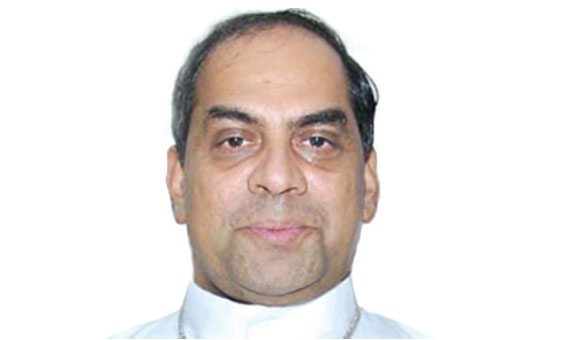
Faridabad archbishop lambastes social media manipulations
Archbishop Kuriakose Bharani-kulangara of Faridabad has asked social media not to indulge in manipulations and urged the fourth estate to maintain conventional moral standards.
“When such ethical criteria are not respected, the credibility of the writers is shaken and journalism becomes like gossip and soap opera,” the archbishop told Matters India on March 24 commenting on some recent developments in the Vatican as well as in his Indian diocese. Underscoring media as the “fourth estate” for being society’s conscience, the archbishop bemoaned that many “conscienceless individuals” have assumed the role of “agents of fake news.”
The prelate’s name had appeared in some recent controversies in the Syro-Malabar Church. The archbishop, a former Vatican diplomat, cited the case of Monsignor Edoardo Viganò, Prefect of the Vatican Secretariat for Communication, who resigned after being caught in a scandal about a letter from retired Pope Benedict XVI. The monsignor was accused of mischaracterizing the letter in public and then digitally manipulating a photograph sent to the media.

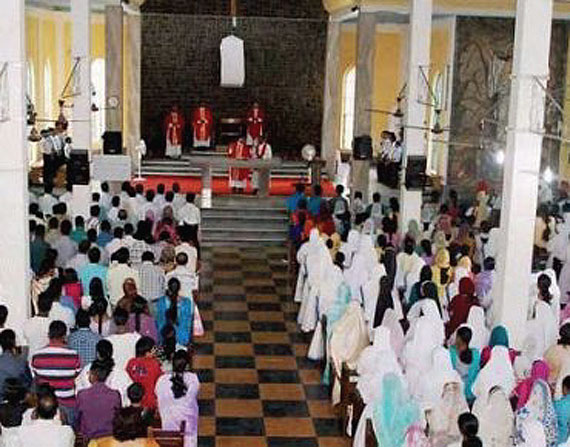
Nagaland churches not interested in Rio govt’s ‘Holy Land’ package
In keeping with its electoral promise, the (PDA) govern-ment, of which BJP is a major partner, has announced the introduction of a new progra-mme called ‘Holy Land tours and pilgrimages.’ But the Church is not impressed.
Presenting the maiden budget of the new dispensation, Chief Minister Neiphiu Rio, who also holds the finance portfolio, announced that detailed guidelines will be set up to enable citizens to visit the ‘Holy Land.’ Once such guidelines are in place, the government will part-sponsor the pilgrimage to Jerusalem.
In the run up to the 13th Nagaland Legislative Assembly election, religion had for the first time emerged as a major electoral plank. BJP faced flak from church leaders who cautioned people against what they perceived as the party’s Hindutva agenda. To counter the ‘anti-Christian’ tag and woo voters in the Christian dominated state, the saffron party promised trips to Jerusalem if it was voted to power. In it’s manifesto, the BJP had promised to ‘set up senior citizen board which will annually select around 50 members through lucky draw for a free trip to Holy Land of Jerusalem.’ Before BJP, the Congress in its manifesto had assured to set up a board ‘to facilitate minorities to visit Holy Land at a subsidised cost.’
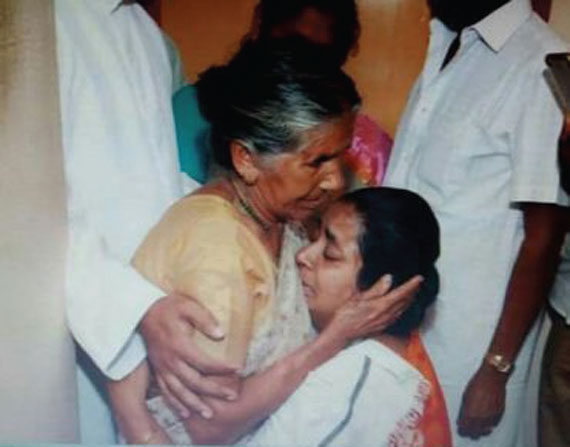
Slain priest’s mother pardons killer
Kerala on March 4 witness-ed a rare gesture of forgiveness when the mother of a slain Catholic priest visited the killer’s family to pardon him.
“I forgive him,” Thressia Thelakkat told media persons after comforting the wife and family members of Johny Vattaparampil, a former church sexton. Pictures of the elderly woman comforting Annie, Vattaparampil’s wife, have gone viral on social media.
“Vattaparampil’s family was isolated and lived in misery and dejection. The visit has brought great relief to them,” reported News Vision, a local TV channel.
The visit came a day after Cardinal George Alencherry, head of the Syro-Malabar Chur-ch, pardoned Vattaparambil. The cardinal led the priest’s funeral in Cheranalloor East parish of Ernakulam-Angamaly archdiocese.
Father Thelakkat was the rector of famous of St Thomas pilgrimage centre in Mala-yattoor where Vattaparambil worked as sexton for the past 37 years. The priest sacked him three months ago allegedly for coming drunk to duty.