Category: From The States

  • INDIAN INNOVATOR SHOWS ‘ENDLESS POSSIBILITIES’ FOR CHANGE

    INDIAN INNOVATOR SHOWS ‘ENDLESS POSSIBILITIES’ FOR CHANGE

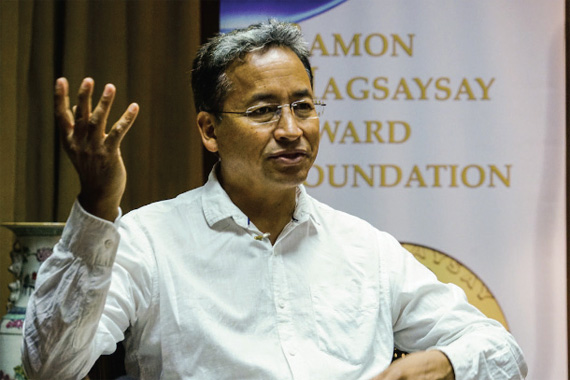
    He was born in the mountains, up in the northern Indian State of Jammu and Kashmir, where the air was then still fresh and the trees were green.

    Up there, in the small,
remote village of Ulaytokpo
in Ladakh, Sonam Wangchuk
went to school with other tribal children.

    Education was difficult, he recalled, because minorities were discriminated against, and schools were lacking and poorly-equipped.

    Teaching standards were abysmal during those days and what was written in textbooks was irrelevant to the lives of mountain people.

    “I had a very rough education in the mountains,” Wangchuk told ucanews.com during an interview in Manila. “Not much with what you got from the textbooks made sense,” he said.

    He was then too young to understand, but when he got older and was confronted with financial difficulties to continue his own education, he opened his eyes.

    “I had to teach other students to support myself,” he said.

    “It did not make much sense, even to people in New Delhi, and even in London,” he said with a smile.

    He stressed the need for spiritual and religious leaders who should preach about “a new form of non-violence and peace with air, water and all living beings on this planet.”
“We need to update our religion,” Wangchuk told ucanews.com.
“Our religion is somewhat outdated from the time when people were killing with guns and daggers, our leaders are still talking about peace of that kind whereas the current problem is not the peace of guns and daggers,” he said.

    Wangchuk said the “main causes of violence and deaths these days are environmental in nature [and] lifestyle related.”

    He said he looks forward to “new ways of seeing religion” where Hindus and Muslims, for instance, would not only say that they would not eat this or that kind of meat but would say that “we don’t use plastic bottles, we don’t use cars for no reason, we use public transport, we use steps rather than escalators.”
  • UNIFORM CIVIL CODE UNDESIRABLE: LAW COMMISSION

    UNIFORM CIVIL CODE UNDESIRABLE: LAW COMMISSION

    The Law Commission has suggested certain changes in marriage and
divorce laws that should be uniformly
accepted in the personal laws of all
religions, while holding that the
uniform civil code “is neither necessary
nor desirable at this stage” in the
country. The Commission, headed by
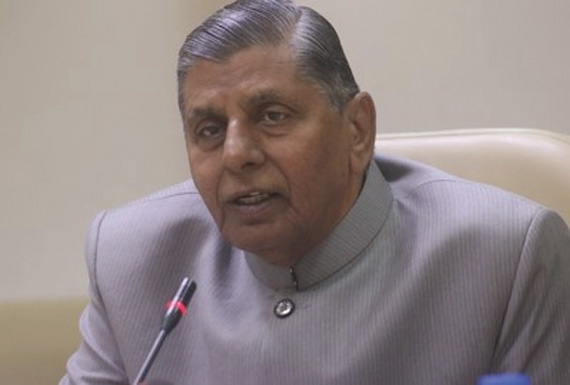
former Supreme Court judge Justice B.S. Chauhan whose tenure ended on August 31, has come out with a 185-page consultation paper on “Family Law Reforms’ said a unified nation does not necessarily need to have “uniformity.”

    It said the best way forward was to preserve diversity of personal laws even while ensuring they did not contradict fundamental rights guaranteed under the Constitution.

    Saying, secularism cannot contradict the plurality prevalent in the country, the Commission said in the paper that: “Cultural diversity cannot be compromised to the extent that our urge for uniformity itself becomes a reason for threat to the territorial integrity of the nation.”

  • RANCHI JESUIT CALLS TREASON CHARGE ‘FABRICATED’

    RANCHI JESUIT CALLS TREASON CHARGE ‘FABRICATED’

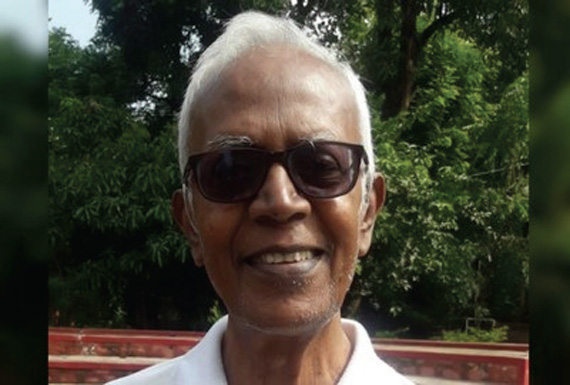
    Indian Jesuit Father Stanislaus Lourdusamy says a treason charge linking him with militant Maoists is a fabrication being used to discredit his work for prisoners and tribal people.

    The 82-year-old Jesuit, popularly known as Stan Swamy, was charged along with eight other rights activists on Aug. 28 for alleged links to a banned Maoist group in the western State of Maharashtra.

    Police have also linked the activists with violence between Dalit and upper-caste Maratha people in the state earlier this year. “It is nothing but a complete concoction and absolute falsehood that is being propagated by Maharashtra police,” Father Swamy said in a Sept. 3 statement.

    Father Swamy said he has been convener of an organization called Persecuted Prisoners Solidarity Committee (PPSC) which assists under- trial prisoners.

  • CATHOLIC PRIEST SURPRISES MUSLIMS SPEAKING AT KERALA MOSQUE

    CATHOLIC PRIEST SURPRISES MUSLIMS SPEAKING AT KERALA MOSQUE

    For a change, a Catholic priest in Kerala chose a mosque to deliver his sermon.

    Father Joseph (Sanu) Puthussery on August 31 visited the Juma Masjid at Vechoor in Kottayam district during Jum’ah (Friday prayers) and delivered a thanksgiving speech at the masjid prayer hall.

    The Muslims had fed the flood victims who had taken shelter at his church that comes under Ernakulam-Angamaly archdiocese. St Antony’s Church at Achinakom in Kottayam district had sheltered more than 580 people rendered homeless by unprecedented floods that affected 12 of Kerala’s 14 districts mid August. The church authorities had faced shortage of food and water to feed them.
“I straightaway went to the masjid, appraised the Maulavi about our difficulty and requested his help. After the day’s prayers, Muslim brothers came to the church with a large quantity of food and water as per his direction,” Fr Puthussery told media persons.

    The Muslim supplied essential articles to the relief camp at the church for several days. Besides food and water, essential medicines were also brought by the youths attached to the Masjid, Father Puthussery said.

  • India comes together for Kerala flood victims

    India comes together for Kerala flood victims

    Transgressing all barriers of religion and caste, rich and poor, high and low, Indians have joined hands to provide succour to people reeling under the worst flood in five decades in Kerala.

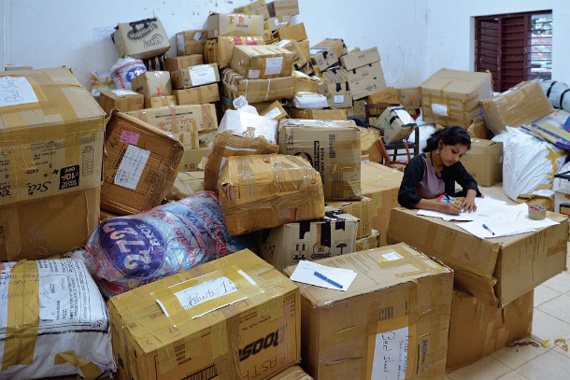
    Justice Kurien Joseph, a Supreme Court judge, Catholic and Kerala native, worked until late at night in New Delhi to help pack and label boxes containing relief materials for flood victims.

    “It was heartening to see people unite in love for their suffering brethren casting aside all boundaries of religion and region,” Joseph said as he assisted children and women packing materials.

    The flood in the southern state washed away hundreds of houses and submerged villages, killing at least 370 people and displacing about 800,000 to relief camps.

    Not only Kerala people living in New Delhi “but people from other parts of India have gathered here. It just goes to show that goodness has not disappeared from humans,” Joseph said.

    A group of lawyers launched the initiative through social media. Despite the short notice, people gathered with clothing and food to be packed and sent to the flood-hit state 2,500 kilometers away.

    In Kerala, fishermen took out their boats on their own to rescue people. According to reports, they refused remuneration from the government for their voluntary work, saying they did not do it for money.

    Twitter Ads info and privacy

    “Jesus’ love thy neighbor philosophy has never been so evident in our country,” said Lucy John, a teacher from New Delhi’s Mayur Vihar area, where a collection drive was organized by an association of Kerala people.

    Organizations, agencies and resident associations are all busy collecting relief material in cash and kind in the capital.

  • Minorities must not be in awe of majority: Amartya Sen

    Minorities must not be in awe of majority: Amartya Sen

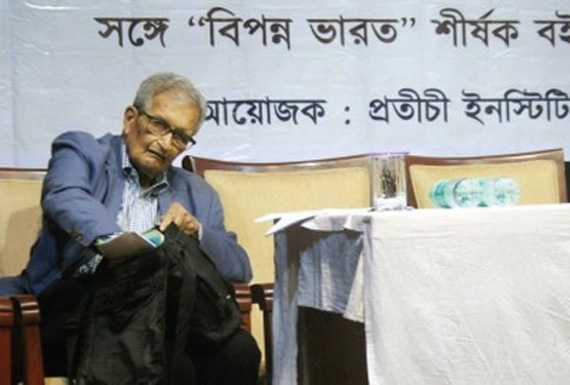
    Nobel laureate economist Amartya Sen said the minori-ties and the liberal forces in India, who oppose the divi-sive politics of the present day, need to be more vocal and assertive. Discussing the present scenario in India, Sen said those ruling the country do not constitute a majority, but they are in power by virtue of their ability to skilfully use the tools of the political system.

    “I think in modern days, the majority and minority cannot be decided based on who is a Hindu or who is a Muslim, as it is not really clear who is a Hindu.

    “Definitely, the number of Dalits and other minorities is very less. But the fact is that those who are ruling the nation they are not the majority in terms of number, but the reason of their power is that they are aptly using the tools of our political system,” Sen said at a discussion on where the Indian democracy is heading. According to Sen, if the census is considered then the number of Hindu popula-tion is quite high.

    “The result of 2014 only reflects that the victorious party was successful in that particular system,” said Sen. Answering a question regarding the fear factor among Muslims residing in India, he said: “This very state of mind that if we are minority we will be deprived and will have to suffer, is very weakening in itself.”

    “The result will not depend on numbers, but on the reach of electoral procedure and the political system. The important fact for victory would be the ability to strongly raise the issues that need immediate attention and deserve thorough discussion,” Sen said.

  • Mass readings from Gita, Quran: Jesuit priest apologizes

    Mass readings from Gita, Quran: Jesuit priest apologizes

    A Jesuit parish priest in Mumbai has apologized for including verses from other religious scriptures in Mass readings after some Catholics protested calling him Anti-Christ. “I realize that the verses were not appropriate as part of the readings of the Mass and I apologize for this. However, to attribute this to the Antichrist is very shocking,” said Father Frazer Mascarenhas, pastor of St Peter’s Church in Bandra, a western suburb of India’s commercial capital, on August 21.

    Father Mascarenhas issued a statement explaining his action. “St Peter’s has been making efforts to build human communities in our neighbourhood, as encouraged by the archdiocese. In this context, on the dual feast of the Assumption, and Independence Day, at the traditional Indian liturgy we hold at the 10 am mass, I took the theme, ‘Giving Jesus to the world as Mary did.’”

  • Indian Catholic Bishops facilitate Indigenous youth achievers

    Indian Catholic Bishops facilitate Indigenous youth achievers

    The Catholic Bishops Conference of India (CBCI) Office for Tribals recognized 15 tribal youth for their hard work, brilliance and enthusiasm in achieving standards of excellence.

    In a first of its kind, the CBCI Office for Tribals organized an event to congratulate, encourage and felicitate them for their achievements.

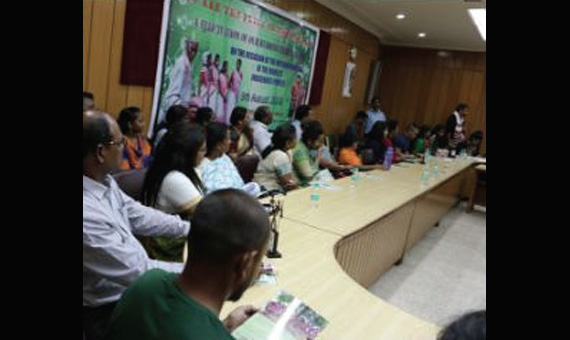
    At a function held at the CBCI Centre, New Delhi, on August 10, on the occasion of 24th International Day of the World’s Indigenous Peoples, tribal youth from different streams such as music, singing, acting, scholarship, airplane pilot, bodybuilding, writers, and publishers were acclaimed.

    Bp Theodore Mascarenhas, secretary general of CBCI, who was the chief guest felicitated the young tribals with a rose flower, a memento and a Certificate of Excellence. “You are not simply the pride of your tribal communities but the pride of whole humanity because you have had the courage and the perseverance to break through barriers and shine forth,” the bishop told the youth.

    The prelate reminded them that it was important that the tribals preserve their land, culture, language and unity. Otherwise, they will be swamped out of their existence.

  • Filipino nun returns home after serving India for 41 years

    A Filipina nun, who served India for 41 years, has returned to her native country. Sister Linda Gomez of Daughters of the Charity, a congregation founded by St Vincent De Paul, worked among the poor mostly in Odisha, eastern India, has returned to the Philippines. Sister Martha Pradhan, who heads the congregation’s North India province, in a ceremony in Berhampur on August 25, thanked Sister Gomez for her service to the Church and society in India. Sister Gomez worked also among the poor in West Bengal and other parts of the country. She was among the first to volunteer to work among the victims of the Orissa Super Cyclone 1994, Sister Pradhan recalled.

  • Activists protest death of children “rescued” from Teresa home

    Human right activists gathered at a busy junction in Ranchi on August 21 to protest the death of two infants who were “rescued” from a Missionaries of Charity centre by a Jharkhand government department.

    “The two children died of dehydration within six weeks of them being forcibly removed from the Missionaries of Charity centre,” Gopinath Ghosh, an activist associated with “Jan Awaz” (people’s voice), told Matters India on August 22. Jan Awaz, an umbrella body for various human rights groups working in the eastern Indian state, organized the protest march at Albert Ekka Chawk.

    The children, just six months old, died on August 19 at a centre managed by Sahayog Village, an NGO favoured by the Child Welfare Committee (CWC), a Jharkhand government’s department, at Khunti district.

    The two infants were among 22 children the CWC took away on July 6 from Nirmala Shishu Bhavan (Immaculate home for children), managed by the Mother Teresa nuns at Hinoo, a Ranchi suburb. Out of them, 12 children belonged to Khunti, some 35 km south of Ranchi.