Category Archives: From The States

Goa High Court Quashes FIR Against Christian Pastor Accused of Forced Conversion

The Goa Bench of the Bombay High Court on September 23 dismissed a 2022 FIR against Pastor Dominic D’Souza and his wife, Joan D’Souza, founders of the Five Pillars Church in Siolim, Goa. The case, which alleged that the couple had coerced two individuals into converting to Christianity, was dropped after the additional public prosecutor admitted there was no evidence to support the claims.

The FIR in the case was filed in May 2022 by a man named Prakash Khobrekar, who alleged that the couple had induced two people to give up their faith and convert to Christianity, offering cash and promising to cure them of their ailments. The pastor was arrested after the complaint was filed and released on bail the same day. With the passing of the High Court’s judgement, the case has now been proved false.  The Five Pillars Church in Siolim village has been facing trouble since the present state government, led by the Bharatiya Janata Party, was re-elected to power in 2022. In January 2024, Pastor Dominic was arrested in a separate case filed by Balasubramaniam Vadivel, who accused him of attempted conversion. The pastor was subsequently granted bail, and the FIR related to the case has been contested by the pastor and his spouse in the High Court, with a hearing scheduled for next month. In December 2022, the then North Goa District Collector Dr. Sneha Gitte had passed an order banning all activities of the church following complaints of alleged illegal conversions against it. However, the church successfully appealed the decision, and the Bombay High Court at Goa quashed and set aside the ban in May 2024.

Archbishop John Moolachira Unveils Communio Sunday 2025 Poster

Archbishop John Moolachira of Guwahati officially unveiled the poster for Communio Sunday 2025 at the Archbishop’s House, Guwahati. This year, Communio Sunday will be observed across India on 30 November 2025, the first Sunday of Advent. In his message, Archbishop John Moolachira underlined the heart of the Church’s vocation: “Mission is the very life and identity of the Church. Every baptized person is called to live and witness Christ in the world, carrying His light to those in the peripheries. Through Communio, we are reminded that mission is not optional but essential to our Christian life.” The projects supported by Communio are strengthening parishes, communities, and especially the marginalized, enabling the Church to remain a beacon of hope.” Observed annually, Communio Sunday invites the faithful to renew their missionary zeal through prayer, solidarity, and contributions. It is a reminder that every Catholic is a missionary disciple, called to live out communion and share the Good News in daily life. The release of the Communio Sunday 2025 poster in Guwahati marks the beginning of this year’s celebrations and reaffirms the Church’s commitment to being a Communion in Mission. With the blessing of Archbishop John Moolachira and the leadership of Communio, the faithful are encouraged to embrace this call and actively participate in the evangelizing mission of the Church in India.

Calcutta archbishop retires; to assist parish

Pope Leo XIV has accepted the resignation of Archbishop Thomas D’Souza from the pastoral governance of the Archdiocese of Calcutta, effective September 20. With this, Coadjutor Archbishop Elias Frank has automatically succeeded him as the tenth archbishop of the archdiocese, based in Kolkata, the capital city of West Bengal state. He is the sixth Indian prelate of the archdiocese.

In a message, Archbishop D’Souza thanked the archdiocese’s priests, religious and laity for their support during his tenure that began on February 23, 2012. He also shared that he would assist in Our Lady of Lourdes Parish, Barasat, from September 29. “I will reside in the parish presbytery,” he added. The parish is in North 24 Parganas district, some 25 km northeast of Kolkata.

Four New Ecclesiastical Provinces Announced in the Syro-Malabar Church

His Beatitude Mar Raphael Thattil, the Major Archbishop of the Syro-Malabar Church, issued decrees erecting four new ecclesiastical provinces in the Syro-Malabar Church—Faridabad, Ujjain, Kalyan, and Shamshabad—and appointing Mar Kuriakose

Bharanikulangara, Mar Sebastian Vadakel MST, Mar Sebastian Vaniyapurackal, and Mar Prince Antony Panengadan respectively as the Metropolitan Archbishops. These decisions were announced on 28 August at a public meeting held at the Major Archiepiscopal Curia at Mount St. Thomas, Kakkanad, in the presence of the Synod Fathers, and were also made public at 12 noon (Italian time) in the Vatican.

The Eparchies of Bijnor and Gorakhpur will be suffragan eparchies of Faridabad Province. The Eparchies of Sagar, Satna, and Jagdalpur will be suffragan eparchies of Ujjain Province. The Eparchies of Chanda and Rajkot are included in Kalyan Province.The Eparchy of Adilabad will be suffragan eparchy of Shamshabad Province. Additionally, the Eparchy of Hosur in Tamil Nadu will now be the suffragan eparchy of the Archeparchy of Trichur.

New Bishops Appointed for Adilabad and Belthangady Eparchies

His Beatitude Mar Raphael Thattil, the Major Archbishop of the Syro-Malabar Church, announced the appointments of new bishops for the Eparchies of Adilabad and Belthangady on 28 August, during a public meeting held at the Major Archiepiscopal Curia at Mount St. Thomas, Kakkanad, in the presence of the Synod Fathers.

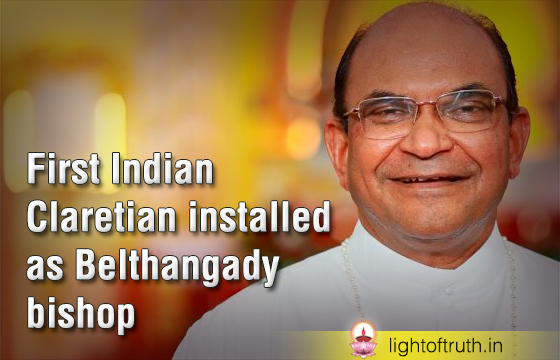
Rev. Fr. James Patteril CMF, presently serving as the Provincial Procurator of the Würzburg Province of the Claretian Congregation in Germany, has been appointed Bishop of Belthangady. He succeeds Bishop Mar Lawrence Mukkuzhy, who resigned due to health reasons.

Rev. Fr. Joseph Thachaparambath CMI, serving as the Provincial Superior of the CMI Chanda St. Thomas Province, has been appointed Bishop of Adilabad. He succeeds Mar Prince Antony Panengadan, who has been transferred from the Eparchy of Adilabad to the then Eparchy of Shamshabad.

Clergy Explore Role of Artificial Intelligencein Church Ministry at Chikmagalur

The Diocese of Chik-magalur organised a one-day seminar on “Artificial Intelligence and its Rele-vance for Pastoral Mini-stry” for the clergy on 27th August at St. Joseph’s School, Cathedral Cam-pus, Chikmagalur. The seminar aimed to help the clergy understand the growing significance of Artificial Intelligence (AI) in today’s world and to explore how it can be effectively integrated into the Church’s mission, particularly in the areas of pastoral care, evangelisation, and administration. The sessions were led by two distinguished experts from St. Aloysius Deemed-to-be University, Manga-lore. Mr. Royal Praveen D’Souza, an Assistant Professor with 12 years of experience, specialising in Artificial Intelligence and Management Systems and Dr. Reji P. John, Assistant Professor of Economics. The seminar proved to be an enriching and thought-provoking experience. It enabled the clergy to recognise the potential of Artificial Intelligence as a valuable tool to support and strengthen pastoral ministry, while reaffirming that the essence of the Church’s mission continues to rest on human touch, compassion, and spiritual discernment.

Flood-triggered landslide kills 32 in India’s Jammu

At least 32 people, mostly Hindu pilgrims on their way to a famed mountainous temple, were killed and 20 sustained injuries following a massive landslide triggered by four days of torrential rain in India’s northern Jammu-Kashmir region. Government officials warned the death toll may rise as many, mostly Hindu pilgrims to Mata Vaishno Devi temple in Jammu, are feared to be trapped under the debris. The disaster site was located near Ardhkunwari, a midway cave temple situated on the steep climb to the Vaishno Devi shrine, one of the holiest destinations for Hindus in India. The landslide struck near a restaurant, along the mountain path carved into the Trikuta Hills in Jammu. Authorities immediately suspended the pilgrimage and rushed army units, disaster response teams and local officials to the site. Continuous rainfall and the unstable slopes of the mountains, however, have slowed the rescue effort. Millions of pilgrims trek to the Vaishno Devi shrine annually, walking 12 kilometers uphill, and the route is usually thronged with devotees chanting hymns and carrying offerings. The pilgrimage route is now full of heavy machinery and soldiers frantically searching for survivors.

Syro-Malabar Church Announces Reorganisation of 12 Eparchies

His Beatitude Mar Raphael Thattil, the Major Archbishop of the Syro-Malabar Church, announced the reorganisation of the territories of twelve eparchies outside Kerala on 28 August, during a public meeting at the Major Archiepiscopal Curia at Mount St. Thomas, Kakkanad, in the presence of the Synod Fathers.

The Syro-Malabar Church obtained all-India jurisdiction with the erection of the Eparchy of Shamshabad on 9 October 2017. At that time, all territories in India not yet assigned to any Syro-Malabar eparchy were made part of the newly erected Eparchy by Pope Francis. Spread across twenty-three states, four union territories, and two islands, this vast jurisdiction required further administrative decisions in subsequent Synodal sessions to ensure effective pastoral care. As a result, the Synod decided to reorganize the territories of eleven eparchies by redistributing certain areas of the Shamshabad Eparchy. With the approval of the Apostolic See, the Major Archbishop has issued decrees redefining the territories of the following eparchies: Adilabad, Bijnor, Chanda, Gorakhpur, Kalyan, Jagdalpur, Rajkot, Sagar, Satna, Shamshabad, and Ujjain.

Chhattisgarh’s proposed law sparks debate on tribal identity and religious freedom

The Chhattisgarh government’s recent announcement to bar tribals who convert to another religion from accessing Scheduled Tribe (ST) welfare schemes has stirred intense debate across political, legal, and faith-based communities. The proposed legislation, expected to be introduced in the winter session, seeks to replace the existing Chhattisgarh Dharma Swatantrata Adhiniyam, 1968, with a more stringent framework. It mandates a 60-day advance notice to district authorities before any religious conversion and imposes prison terms of up to 10 years for violations. The bill also broadens the definition of inducement, including promises of education, healthcare, or employment.

Chief Minister Vishnu Deo Sai has voiced support for “delisting” converted tribals from the ST category, citing concerns over cultural erosion and dual entitlements. “India is secular, but tribal identity must be preserved,” he said, echoing calls from tribal groups in Bastar and Surguja. Faith leaders and civil society activists have expressed alarm over the implications for religious freedom and minority rights. “This move risks criminalizing personal faith journeys and deepening social divides,” said a spokesperson from the Chhattisgarh Christian Forum.

Former Chief Minister Bhupesh Baghel criticized the proposal as politically motivated. “Existing laws are sufficient. What we need is enforcement, not exclusion,” he said. However, tribal organizations like the Sarva Adivasi Samaj have welcomed the initiative, arguing that conversion often leads to cultural alienation and loss of traditional practices. “This is about safeguarding our heritage,” said Arvind Netam, a senior tribal leader. Legal experts caution that any attempt to redefine ST eligibility based on religion must align with constitutional protections and national jurisprudence. The state government has indicated plans to consult the Centre to ensure broader applicability.

Syro-Malabar Church Announces Reorganisation of 12 Eparchies

His Beatitude Mar Raphael Thattil, the Major Archbishop of the Syro-Malabar Church, announced the reorganisation of the territories of twelve eparchies outside Kerala on 28 August, during a public meeting at the Major Archiepiscopal Curia at Mount St. Thomas, Kakkanad, in the presence of the Synod Fathers.

The Syro-Malabar Church obtained all-India jurisdiction with the erection of the Eparchy of Shamshabad on 9 October 2017. At that time, all territories in India not yet assigned to any Syro-Malabar eparchy were made part of the newly erected Eparchy by Pope Francis. Spread across twenty-three states, four union territories, and two islands, this vast jurisdiction required further administrative decisions in subsequent Synodal sessions to ensure effective pastoral care. As a result, the Synod decided to reorganize the territories of eleven eparchies by redistributing certain areas of the Shamshabad Eparchy. With the approval of the Apostolic See, the Major Archbishop has issued decrees redefining the territories of the following eparchies: Adilabad, Bijnor, Chanda, Gorakhpur, Kalyan, Jagdalpur, Rajkot, Sagar, Satna, Shamshabad, and Ujjain.