

The Kerala Region Latin Catholic Bishops’ Council (KRLCBC) has called for discussions by the government with Dalit as well as other backward communities in connection with the implementation of reservation for economically weaker sections (EWS) among forward communities.
Category Archives: From The States
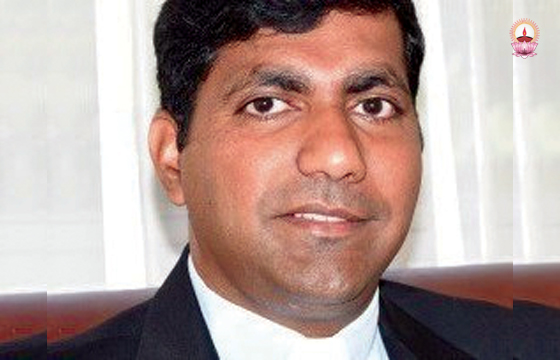
Pope appoints Mangalore priest as ‘Chaplain to His Holiness’
Pope Francis has appointed Mangalore diocesan priest Father Alfred Rayan D’Souza as “Chaplain to His Holiness. A Chaplain of His Holiness is a priest to whom the Pope has granted this title. They are addressed as monsignor and have certain privileges, such as regards ecclesiastical dress. Presently, Father D’Souza is serving as second secretary at the Apostolic Nunciature in the Republic of Croatia. He hails from Pangala in Udupi district.
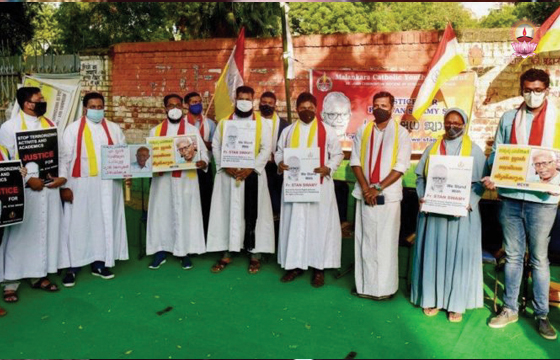
Father Swamy’s confreres condemn ‘fabricated’ charges against him
The Jesuit congregation is hopeful that the case against 83-year-old Father Stan Swamy will be shattered in the court, as there is no evidence to establish that he was in some way connected with the violence against Dalits at Bhima Koregaon.
The imprisoned priest’s close associate, Fr Joseph Xavier, alleges that Swamy hasn’t visited Pune for the last 15 years. Fr Swamy, a member of the Jesuit’s Jamshedpur province, was on October 8 arrested by the National Investigation Agency (NIA), India’s counter-terror task force for his alleged links with Maoists.
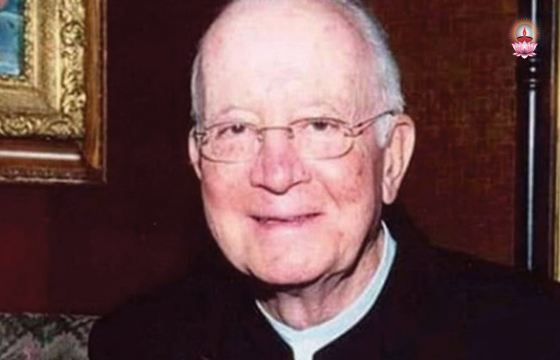
Prime Minister Modi mourns death of Jesuit savant
Prime Minister Narendra Modi was among those mourning the death of a Spanish Jesuit who contributed a new style of writing in Gujarati and translated many mathematical concepts into that Indian language.
Father Carlos Gonzalvez Valles died on Novem. 9 in Madrid, capital of Spain. The priest, who was popularly known as Father Valles, had turned 95 on November 4.
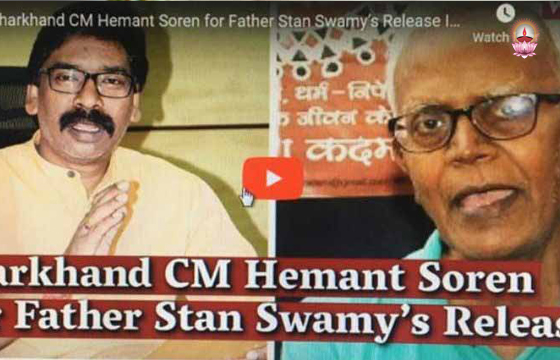
Opposition parties demand release of Jesuit priest, activists
Opposition leaders on October 21 expressed solidarity human rights activists such as Jesuit Father Stan Swamy and lawyers arrested under the Unlawful Activities (Prevention) Act, and demanded the repeal of the stringent law.
Addressing a webinar organized by the People’s Union for Civil Liberties (PUCL), they urged the public to break their silence on the government’s efforts to “chip away the rights of the people.”
The National Investigation Agency arrested Father Swamy, 83, and others in connection with the Bhima Koregaon case.
Father Swamy was arrested on Oct. 8 from his residence near Ranchi, capital of Jharkhand State in eastern India. Next day, it took the priest, a patient of Park-inson’s disease, to Mumbai, some 1,710 km west of Ranchi, and presented him before a court that sent him to judicial custody until on October 23.
Addressing the webinar, Jharkhand Chief Minister Hemant Soren alleged that the federal government was trying to silence the voices of marginalized commu-nities. He also alleged that the country’s unity, integrity and democratic structures were under attack under the National Democratic Alliance (NDA) government.
Communist Party of India (Marxist) general secretary Sitaram Yechury as well as the DMK’s Kanimozhi urged civil society groups and the public to break their silence over the “government’s attacks on the rights of the people.”
Yechury said entire UAPA law needs to be repealed, as it is prone “gross misuse.” He said that UAPA, sedition law and National Security Act need to be seen together as part of the “larger plan of the BJP and RSS” to pave the way for a “fascistic, intolerant and authoritarian Hindutva nation.” The Centre, he alleged, is using central agencies to undermine the Constitution, while shielding the real perpetrators of violence.
A total of 16 people have been arrested under the UAPA in the case, which include three cultural activists of the Kabir Kala Manch (KKM) – Ramesh Gaichor, Sagar Ghogre and Jyoti Jagtap – as well as rights activists, writers, lawyers, and academics Anand Teltumbde, Gautam Navlakha, Shoma Sen, Hany Baby, lawyers, Sudha Bharadwaj, Surendra Gadling, Vernon Gonsalves, Sudhir Dhawale, Mahesh Raut, Rona Wilson and Arun Ferreira.
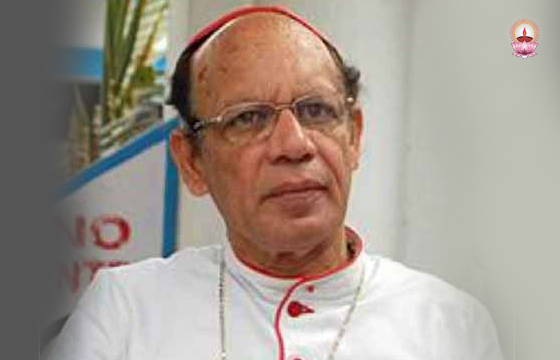
Pope’s comments on gay civil union misinterpreted: Gracias
Pope’s Francis’ recent comments on gay civil union are misunderstood and misinter-preted, says Cardinal Oswald Gracias, the head of the Catholic Church in India and one of the seven advisers of the pontiff.
“There is no change in the Church doctrine at all. The Holy Father’s comments are in full consonance with what he has repeatedly said: Show compassion, reach out to the peripheries, protect the weak etc.,” explains the cardinal in a press release issued on October 27 in response to “enquiries from several quarters” in connection with the Pope’s comments.
The Indian cardinal said he has received enquiries from several quarters in connection with the Pope’s comments incorporated in a film “Francesco” that was just released.
The Pope’s “remarks got wide publicity and there have been different reactions. I considered it necessary to issue a clarification from the Catholic Bishops’ Conference of India,” Cardinal Gracias says.
According to him, the Pope said homosexual persons have a right to a family. “It is clear that the Holy Father is referring to the family of birth. This is further clarified when he later states that such a person should not be thrown out of’ the family, just because of the sexual orientation,” the Indian cardinal explains.
Cardinal Gracias also asserts that Pope has not called for the recognition of call marriages when he said some protection should be given to those living together. The comment is “certainly” not the Catholic Church’s recognition of them. “Church doctrine drawing from Sacred Scripture and Tradition, is clear and has not in any way been diluted,” explains Cardinal Gracias was on October 21 re-nominated to the seven-member Council of Cardinals to advise the Pope.
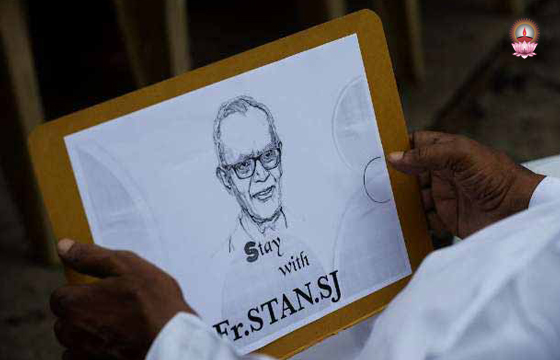
Asian bishops stand in solidarity with arrested Jesuit
The Federation of Asian Bishops’ Conferences (FABC) has said it stands in solidarity with Indian Jesuit priest Father Stan Swamy and all who support the rights of indigenous people. “It is with great shock and agony the FABC heard of the arrest of the 83-year-old Father Swamy and his incarceration and we are surprised at the charges brought against him,” Cardinal Charles Bo of Yangon, president of the FA-BC, said in a statement.
“The arrest and cold-hearted incarceration of Father Swamy reminds us of the treatment meted out to Mahatma Gandhi when he stood up for the rights of the Indian people.”
He said Father Swamy was following Gandhi’s non-violent path to realize his dream.
“The arrest is symptomatic of the treatment meted out to indigenous people in various parts of Asia,” Cardinal Bo said in an appeal on Oct. 26.
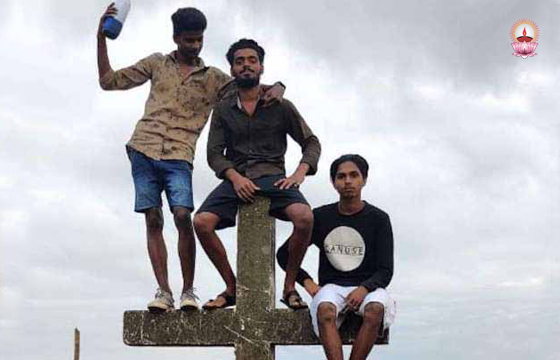
Indian Christians pardon cross desecration amid political suspicions
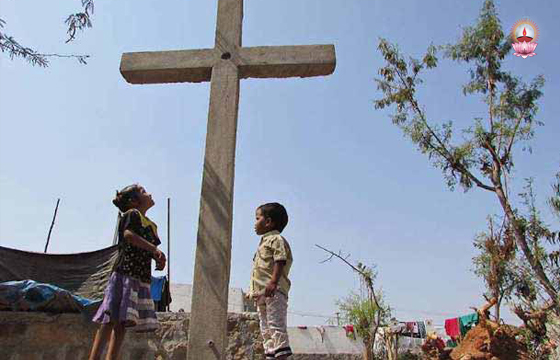
Catholics in a southern Indian diocese have pardoned vandals who desecrated a Christian cross, but some suspect the divisive move aimed to create religious discord ahead of state elections in Kerala next year.
The incident, the second of its type in a month, took place on Oct. 24 in Thamarassery Diocese, where five young men climbed over a 12-feet-high concrete cross on a hilltop, took pictures and circulated them on social media.
The cross was erected on the Catholic parish property in 1979. Parishioners overpower-ed the young men, took them to a police station and filed a desecration complaint.
But the diocese intervened and withdrew the complaint to help the release of the young men from police custody, said Father Benny Mundanattu, diocesan chancellor.
India’s BJP begins targeting minority schools
In India’s Assam State hundreds of Muslim cleric-run schools, popularly called Madrasas, now face an existential crisis.
Assam’s Minister for Education Himanta Biswa Sarma has announced from November onward, the government in the north-eastern state will stop financing the Madrasas.
“Teaching Quran cannot happen at the cost of government money. If we have to do so, then we should also teach both the Bible (of Christians) and Bhagavad Gita (of Hin-dus). We want to bring uniformity and stop this practice,” he said.
India’s Bharatiya Janata Party (BJP), which runs the federal government as well as the Assam State government, has never been shy of taking up pro-Hindu causes. Its new move against Muslim schools shows it has taken the next step – a crackdown on education – in its effort to make India a Hindus-only nation.
Christian shot dead inside Indian church as persecution intensifies
A Christian man was shot dead and three people were injured when assailants entered a Pentecostal Church and opened fire indiscriminately in India’s Punjab State. Police arrested three persons connected with the attack and are searching for four others who escaped, Christian leaders told. The attack happened as Christians were leaving the church after a special prayer meeting on Oct. 23.