Category Archives: Asian

POPE WILLING TO MEET NORTH KOREAN LEADER: VATICAN OFFICIAL

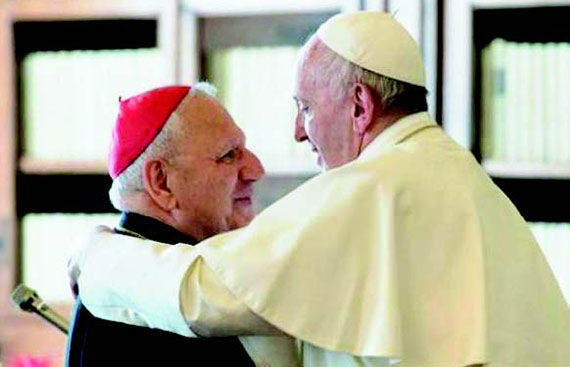
Pope Francis is considering an unprecedented visit to North Korea, according to a Vatican official. An invitation from Kim Jong Un was relayed to the Pope by South Korea President Moon Jae-in during a meeting in the Vatican on October 18.

It would be the first visit by a Pope to the reclusive East Asian state, which is known for severe restrictions on religious practice and does not allow priests to be permanently stationed there.

Vatican secretary of state Cardinal Pietro Parolin said the Pope was considering the visit. He told reporters: “The Pope expressed his willingness. We have to wait for it [the invitation] to be formalized.”

Cardinal Parolin said North Korea would have to meet certain conditions ahead of any potential visit by the Pope.

“This will come later,” he added. “Once we start thinking in earnest about the possibility of making this trip, then we will have to think about conditions in which the trip can take place. “[The Pope] is willing to make the trip, but a trip of this kind will need serious preparation.”

Beyond a small number of state-controlled places of worship, including a Catholic Church in the capital of Pyongyang, no open religious activity is allowed in North Korea. Authorities have repeatedly jailed foreign missionaries.

BIBLE STILL MOST READ BOOK IN PHILIPPINES

Centuries after Spanish missionaries first introduced it in the Philippines, the Bible remains to be the most widely read book in the country in the last year, according to the state-run National Book Development Board (NBDB).

During his presentation of the results of the 2017 NBDB Readership Survey in Quezon City on September 28, UP School of Statistics Dean Dr. Dennis S. Mapa said 72.25% of the Filipino adults polled picked the Bible as their most read book, climbing from 58% in the agency’s previous poll in 2012.

The Scriptures are also the top choice of those in the 25-to-34 (72.4%), 35-to-44 (75.1%), 45-to- 54 (72.1%) and 55-and-older (78.4%) age groups.

Picture books and storybooks for children ranked second among those surveyed at a distant 53%, followed by short stories for children at 52.08%. Both were added as survey choices only last year.

Books about romance and love scored 48.17 percentage, compared with 25% in 2012; reference books (encyclopaedias, almanacs, dictionaries, thesauri, atlases and maps)— the top genre among 18-to- 24-year-olds (70.4 percent- age)—47.92 percentage; and leisure, and entertainment and hobby books, 46.25 percentage.

Cookbooks and books on food and drinks got 42.83%, compared with 21% six years ago; books on health, wellness and medicine, 38.58% graphic novels and comics, 37.67% and short stories and novels for young adults, 33%.

Conducted by the Philippine Statistical Research and Training Institute, the survey involved the participation of 1,200 Filipino adults—18 years old and older—divided according to region: Luzon, Visayas, Mindanao (excluding the Autonomous Region in Muslim Mindanao), and the National Capital Region (Metro Manila).

VIETNAM UPHOLDS CATHOLIC ACTIVIST’S HARSH SENTENCE

An appeals court in central Vietnam has confirmed a harsh sentence imposed on a Catholic activist accused of trying to overthrow the nation’s communist government. Attorney Dang Dinh Manh said on Oct. 18 that the Superior People’s Court upheld John Baptist Le Dinh Luong’s sentence of 20-years’ imprisonment to be followed by five years of home detention.

Attorney Manh, one of two lawyers who acted for Luong in court, said the defendant, aged 53, was also deprived of the right to government employment. During the quick trial, the court building in Vinh City was tightly guarded and surrounding streets were blocked off.

IN VIETNAM’S CENTRAL HIGHLANDS FAITH IS SPREADING

Every Sunday, Paul Rmah Bral and a partner, along with other friendly men in pairs, travel around on motorbikes in Vietnam’s Central Highlands region introducing villagers to Catholic values.

Bral is a 60-year-old ethnic Jarai, part of a wider group known as Montagnards, who speak a Malayo-Polynesian language related to other tongues in the Asia-Pacific region spoken from Indonesia to far-away Fiji.

A French Catholic missionary made contact in the mid-1800s with the traditionally animist Jarai.

During the Vietnam War, many Jarai joined with clandes- tine American forces and later resettled in the United States.

Bral and other lay missionaries, known as giao phu, have for the past two decades been bringing more villagers into their fold in Kontum Diocese.

“It is the happiest thing in life to know that God creates and loves us, and to bring His love to our brothers and sisters,” said

Bral, a former Vietnamese language teacher who embraced Catholicism in 1995 and was baptized in 2000.

He and dozens of other villagers, including his wife and son, attended weekend catechism classes held at the Redemptoristrun Evangelization Centre.

Local communist authorities in the Central Highlands, which borders with Cambodia, pressured locals into withdrawing from their study sessions.

CHINA ECONOMICS SPURS MYANMAR RELIGIOUS REPRESSION

In recent months there has been a crackdown on religious practices by an ethnic militia force in a remote region on Myanmar’s mountainous border with China.

Churches in northern Shan State have been closed, crosses torn down and pastors and other Christian leaders detained by the United Wa State Army (UWSA).

On October 9 about 100 Christians were released, but as many as 92 remained in custody, Christian leaders said.

The UWSA, the military wing of the United Wa State Party (UWSP), dominates the population of about 500,000 in the self- proclaimed Wa Self-Administered Division of Myanmar.

According to various researchers, the UWSA is the largest standing militia in the country with a force of up to 30,000 troops. The enclave has long been widely seen to be backed by China as it is the implementation of the now intensified crackdown on religious practice.

The militia and its political arm are remnants of the Burmese Communist Party and retain very close links with authorities in China. China is conducting a fresh campaign of internal repression of religion, but its motives in northern Myanmar are essentially economic.

AUTHORITIES SHUT DOWN SIX MORE CHURCHES IN GUIYANG


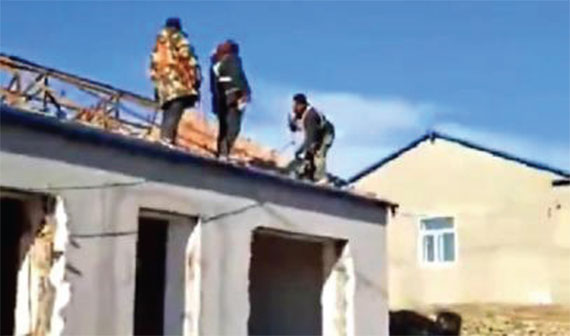
At least six unregistered Protestant churches in Guiyang city, Guizhou Province in Southwest China were shut down by authorities on 8 October. All six churches are from the same district and it is believed that similar forced closures are occurring in other districts in the city.

The churches, which have a total of around 300 members, were accused of being “illegal religious venues,” an accusation often levelled at unregistered churches, sometimes referred to as ‘house’ or ‘family’ churches. Unregistered churches in the area have been under pressure from authorities to join the state- sanctioned Three Self Patriotic Movement (TSPM). Authorities have harassed church members, and some congregations have lost up to 40% of their members due to this kind of pressure.

These closures follow the introduction of revised Regulations on Religious Affairs which continue and place fresh emphasis on the requirement that group religious activities take place in specifically designated registered sites, outlined in Chapter IV. Lawyers familiar with the issues say that in practice, the only way for a church to register as a religious site is through the state-sanctioned TSPM. However, TSPM churches have also been closed down and even demolished in some areas, leaving a shortage of registered religious venues.

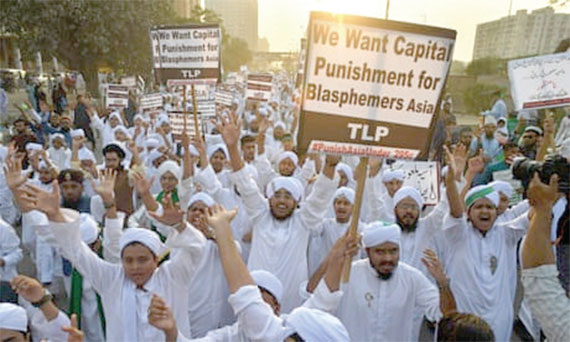
Pakistani Islamists issue warning over Asia Bibi


A hard-line Islamic group known for supporting Pakistan’s tough blasphemy law has warned against any release on bail of jailed Catholic woman Asia Bibi.

The nation’s Supreme Court earlier announced that it would consider the issue of bail pending hearing of an appeal by the Catholic mother of five against a death sentenced imposed by a trial court in 2010.

She was found guilty of making derogatory remarks about Prophet Mohammed during an argument with a Muslim woman while working in a field.

In 2014, the High Court in Lahore, capital of Punjab province, upheld the death penalty.

Two high-profile politicians, then Punjab governor Salmaan Taseer and minorities minister Shahbaz Bhatti, were assassinated in 2011 after calling for reforms to the blasphemy law.

According to a media release issued by the Supreme Court of Pakistan on October 5, a three-member bench headed by Chief Justice Mian Saqib Nisar and comprising Justice Asif Saeed Khosa and Justice Mazhar Alam Khan Miankhe, would begin hearing Asia Bibi’s appeal this week.

If her appeal is rejected by the Supreme Court, she is expected to ask the nation’s president for clemency.


Update: Pakistan court rules on Catholic’s blasphemy charge, defers announcement

A court in Pakistan has reached a decision on whether a Catholic woman will become the first person to hang to death under the country’s controversial blasphemy laws.

A special bench of the Supreme Court, sitting in Islamabad, reached a verdict on October 8 on the fate of Asia Bibi, but publication has been deferred until a later, unspecified date, according to the British Pakistani Christian Association. In an Oct. 8 news release sent by email to Catholic News Service, Mehwish Bhatti, an officer of the BPCA who was in the courthouse during the proceedings, said the three judges “have come to a decision, but it has been reserved.”

Christians in Pakistan are conscious of the threat of an outbreak of rioting by Muslim mobs if Bibi is acquitted by the court, the BPCA said in an Oct. 7 press release, even though they are praying ardently for her release. Bibi has been held in solitary confinement since November 2010, when she was sentenced to hang for insulting Muhammad, the founder of Islam.

Ashiq Masih, her husband, told Catholic News Service in an Oct. 5 interview that if Bibi is released she and her family will immediately seek sanctuary in one of several countries that have offered them exile, because it was too dangerous for them to remain in Pakistan.

They said when they visited Bibi in Multan Prison on Oct. 1 that she was in good health, contrary to speculation that she was developing dementia. During the interview at St Columba’s Church, Ashiq said Bibi was praying constantly and that she deeply believed she would win her freedom.

“She is psychologically, physically and spiritually strong,” Ashiq told CNS. “Having a very strong faith, she is ready and willing to die for Christ. She will never convert to Islam.

“She also wanted to deliver a message to the international community that they must remember her in their prayers. These prayers will open the door of the prison, and she will be released very soon,” he said.

Indonesian Christians seek solace in Church

Indonesian Christians sought solace on October 7 in churches in the city of Palu, hard hit by an earthquake and a tsunami that roiled central Sulawesi, killing 1,649 people and seriously injuring some 2,500 people.

Indonesia is the world’s most populous Muslim country, but there are Christian communities throughout the archipelago.

During a service in front of the Santa Maria Church in Palu, a priest encouraged locals to have faith in God and stay in Palu to rebuild the city.

“If we all leave, then who will welcome those who come here to help us?” Yohanes Salaki asked his congregation, speaking from outside the church as the inside remains unsafe because of damages caused by the earthquake and tsunami.

Palu resident Etna Rorimpande told VOA’s Indonesian service that “we have to give ourselves to God, have faith on Him, and believe that God will always take care of us.”

Another Palu resident I Nyoman Sarna said that though he is sad and worried about his fate, he think he and his family will stay in the city.

“We have to rebuild our town. Who else will do that?” he said. The United Nations said in a statement that 113 people remain missing after the twin disasters. About 70,000 people have been displaced.

China: Christian schoolchildren forced to tick ‘no religion’ box

More than 300 Christian children in two high schools in Zhejiang province, which has been referred to as the “Jerusa-lem of the East” for its strong Christian presence, have been asked to fill out a form stating that they did not follow a religion, World Watch Monitor has been told by a trusted local source.

While “it is normal for a school to ask parents to fill out a form which includes questions of faith when a child is first enrolled in school, for many years this hasn’t been an issue,” our source, who wished to remain anonymous, explained.

Schools in China are government-controlled and financed and therefore communist in ideology, and Christian children have sometimes faced “shaming” incidents, “but the extent of such shaming was to prevent them from joining the Communist Youth League, thereby denying them any of the perks that come with a progression to Communist Party Member later in life,” World Watch Monitor was told.

“In this case, however, the children were handed a question-naire in class about faith, which is not normal. It seems this is part of the new push to identify Christians and give them pressure of one sort or another.

“Children in this part of China would write ‘Christian’ because of their innocence and they come from families of fervent believers who do not compromise their faith.”

In the first school, which has around 200 Christian students, the teacher demanded they rewrite the questionnaire, stating that they had “No religion.” But when filling out the next questionnaire, half of the children maintained that they were Christians. According to our source, following further warnings, in the end all but one child complied.

In the other school, which has around 100 children, it was the class prefect who forced the Christians to resubmit their papers, stating that they had “no religion.”