Category Archives: Asian

Protecting Aasia Bibi is state’s duty, says top judge

Chief justice of Pakistan (CJP) Mian Saqib Nisar has said blasphemy accused Aasia Bibi ‘was trapped’ without any proofs and that sending her abroad for protection would be tantamount to failure of the state. The CJP, who is currently in London, expressed these views on November 22 while visiting the British Parliament where he was welcomed by British lawmakers of Pakistani origin – Afzal Khan and Faisal Rasheed.

According to a TV channel, the CJP said Aasia Bibi – who was absolved of blasphemy charges by the apex court on October 31 – should get full protection in Pakistan rather than abroad.

“Providing her security is responsibility of the government; it is responsibility of the state of Pakistan to protect life and property of every citizen. If Aasia Bibi is sent abroad or given asylum in any other country it will be failure of the government and the state,” he said.

The CJP, who headed the bench that set the Christian woman free, said every possible effort should be done to provide Bibi more and more protection in Pakistan. “If we set such an example, the chain will continue,” he added.

To a question about putting her name on the Exit Control List (ECL), he said it is not a suitable time to express his thoughts on this question as the case could be brought to his court. “I assure you, however, that our law has no such provision. The judiciary will not give any illegal judgement about it,” he added.

When asked as to why the Supreme Court did not take notice of the recent sit-ins and protest that erupted in the wake of its October 31 verdict in Aasia Bibi case, he said: “Just wait for a few days and you will get the answer to this question.”

Saudi school textbooks teach violence, anti-Semitism, ADL report says

Textbooks for high school  students in Saudi Arabia promote hatred against Jews, Christians, women, homosexual men and other Muslim sects despite repeated promises to return the country to a more moderate form of Islam, according to a report released.

The Anti-Defamation League highlighted that some text books include anti-Semitic stereotypes.

Among the goals of Zionism is a “global Jewish government to control the entire world,” one excerpt states.

Another example reads: “The hour will not come until Muslims fight the Jews, so that the Muslims kill them, until the Jew hides behind rock and tree, so the rock or the tree says: ‘Oh Muslim, oh servant of God, this Jew is behind me, so kill him.’”

A third passage suggests that “beating [women] is permitted when necessary.”

Saudi Arabia is the birthplace of Islam and for decades has exported a strict Wahhabi form of Sunni Islam that views Shiite Muslims as heretics.

Intolerance in the kingdom came under particular scrutiny after the Sept. 11, 2001, attacks when it emerged that 15 out of the 19 hijackers were Saudi.

Protecting Aasia Bibi is state’s duty, says top judge

Chief justice of Pakistan (CJP) Mian Saqib Nisar has said blasphemy accused Aasia Bibi ‘was trapped’ without any proofs and that sending her abroad for protection would be tantamount to failure of the state. The CJP, who is currently in London, expressed these views on November 22 while visiting the British Parliament where he was welcomed by British lawmakers of Pakistani origin – Afzal Khan and Faisal Rasheed.

According to a TV channel, the CJP said Aasia Bibi – who was absolved of blasphemy charges by the apex court on October 31 – should get full protection in Pakistan rather than abroad.

“Providing her security is responsibility of the government; it is responsibility of the state of Pakistan to protect life and property of every citizen. If Aasia Bibi is sent abroad or given asylum in any other country it will be failure of the government and the state,” he said.

The CJP, who headed the bench that set the Christian woman free, said every possible effort should be done to provide Bibi more and more protection in Pakistan. “If we set such an example, the chain will continue,” he added.

To a question about putting her name on the Exit Control List (ECL), he said it is not a suitable time to express his thoughts on this question as the case could be brought to his court. “I assure you, however, that our law has no such provision. The judiciary will not give any illegal judgement about it,” he added.

When asked as to why the Supreme Court did not take notice of the recent sit-ins and protest that erupted in the wake of its October 31 verdict in Aasia Bibi case, he said: “Just wait for a few days and you will get the answer to this question.”

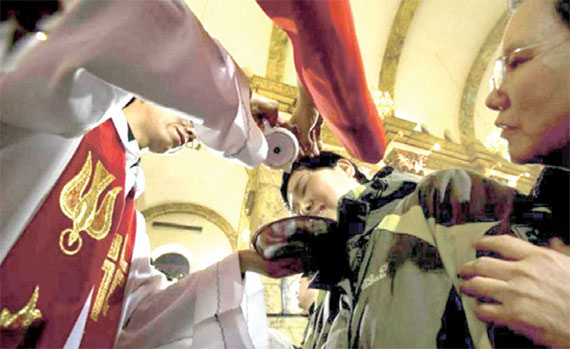
Church demolition in a Liaocheng parish sparks members’ outrage

Government authorities in the city of Liaocheng (Shandong province) demolished several buildings that date back to 1930, officially because they lacked the necessary certificates. The structures belonged to the Catholic parish of Chaocheng. Church members did not stand idly by but moved into the remaining building to prevent its demolition. The forced demolition took place on 11 November when local officials came with a demolition team without prior notice. Catholics protested at government offices but did not get any answers. Peacefully, Church members hung a banner on the machinery used in the demolition. It read: “Vehicle of illegal demolition, Come one detain one, Never back down.”

Jesuit youth movement marks 12 years in Bangladesh

Magis Bangla, the Bangladeshi chapter of an international Catholic youth movement sponsored by the Society of Jesus (Jesuits), is marking its 12th anniversary in the country.

The Nov. 8-10 celebrations at Jesuit-run Novojyoti Niketan (Home of New Light) in Gazipur district near capital Dhaka include a gathering of more than 150 current and former members of the movement, meditation, formation sessions and cultural programs. “Go for the Greater” is the theme of the celebrations.

Over the years, Magis Bangla has aimed to transform and transmit Christian values and spirituality with cultural and intellectual foundations for Bangladeshi Catholic youth, said Father Pradeep Perez, the movement’s coordinator.

“Our aim is to embody and present Christian life and living in an alternative and extraordinary way, which breaks away from traditional classroom formation but is close to our daily living of life. Our formation is based on the teachings of Jesus with an emphasis on knowledge and culture,” Father Perez told ucanews.com.

Year-long Magis programs including youth camps, a carol and photography competition, musical drama on the life of Jesus, and celebrations of national and cultural festivals encompass the true spirit of Christian values, he said.

“Magis wants young people to have a better life, a life in fullness, for the greater glory of God,” Father Perez added.

Magis Bangla members say the movement has changed their lives for the better.

“I have made some great friends since I joined the movement more than four years ago. Magis has taught me essential values including equal respect for everyone including women,” photographer Amit Leonard, told.

Manila welcomes impunity index ranking on press freedom

The Philippines welcomed what officials described was the country’s “improved ranking in this year’s Global Impunity Index on press freedom based on a report by the New York-based Committee to Protect Journalists (CPJ). The Global Impunity Index report, which was released in time for the observance of International Day to End Impunity for Crimes against Journalists on Nov. 2, calculates the number of unsolved murders of journalists as a percentage of each country’s population.

The Philippines ranked fifth this year on an index topped by Somalia followed by Syria, Iraq and South Sudan. It remains ahead of Afghanistan in sixth spot, followed by Mexico, Colombia, Pakistan, Brazil, Russia, Bangladesh, Nigeria and India. Joel Sy Egco, head of the government’s Presidential Task Force on Media Security welcomed the Philippines’ “improved status,” saying that it was “an interesting development.”

“We note with optimism that the Philippines, while remaining at its 2017 ranking as fifth, was noted to have improved its status,” said Egco. From 2011 to 2014, the Philippines ranked third on the list before improving to fourth in 2015 and 2016. Last year, the country moved into fifth place.

The CPJ report noted that at least 324 journalists have been killed worldwide in the past decade with 85 percent of the cases remaining unsolved.

“The fact that impunity continues to thrive in many of these countries year after year is a disturbing sign of how deeply rooted the problem is,” according to Elisabeth Witchel, author of the report and CPJ’s consultant for the Global Campaign Against Impunity.

The report noted the ratings got worse in Syria, Mexico, Brazil and India but improved in the Philippines, Somalia, Iraq, South Sudan, Pakistan, Russia and Nigeria.

Sri Lankan Church urges nation to resolve political crisis peacefully

The Catholic bishops of Sri Lanka are calling on the nation’s government, political parties and the people to resolve the political and constitutional crisis peace-fully, keeping in mind the good of the people. The political turmoil engulfed Sri Lanka after Sri Lankan President Maithripala Sirisena sacked Prime Minister Ranil Wickremesinghe and swore in ex-president Mahinda Rajapaksa to replace him.

Wickremesinghe said his sacking was illegal and he maintained that he was still prime minister, leading to a standoff between his party and labour unions loyal to Sirisena.

The following day, Sirisena suspended Parliament until November 6, in an apparent move to give Rajapaksa time to muster enough support to survive any no-confidence vote.

“Everyone should keep in mind that, if there is instability in the country, it is the people who suffer,” said a statement signed by Bishop Winston S. Fernando of Badulla, the President of the Catholic Bishops’ Conference of Sri Lanka. “We sincerely appeal to all political parties to put aside their interests and respect the Constitution of the Republic of Sri Lanka to resolve the ongoing conflict,” Bishop Fernando wrote in the statement which he forwarded to the Vatican’s Fides news agency.

Two Chinese priests placed in detention

Two priests of the under-ground Catholic Church in China have been detained by authorities in Hebei Province, a source told.

The priests from Xuanhua Diocese are Father Su Guipeng and Father Zhao He.

The source said Father Zhao, who serves in the Dongcheng Catholic Church, was taken away by the personnel of the United Front Work Department of Yan-gyuan County on Oct. 24.

Seven unidentified people who went to the church said that they would take the priest to talk to local government officials, but the priest had not returned.

The source said that the priest had been placed in detention at a hotel. His mobile phone had been confiscated and he was under constant guard.

The priest was reportedly asked to study newly revised regulations on religious practice and to recognize the state-controlled Chinese Catholic Patriotic Association (CCPA).

The government officials were said to have warned that the Catholic Church in China was required to be autonomous from the Vatican. This was not withstanding a provisional Vatican-Beijing agreement signed two months ago, covering sensitive issues such as the appointment of new bishops in China.

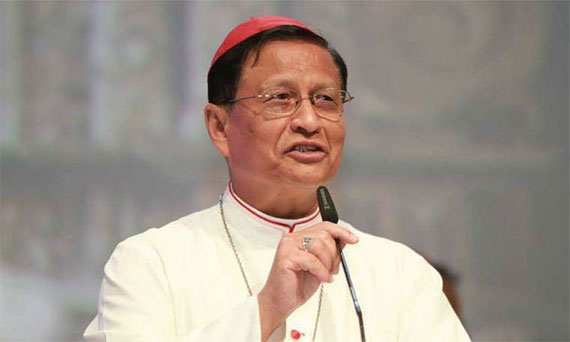
Zen presents letter to pope warning him on China

The Hong Kong emeritus bishop on Nov. 8 told ucanews. com that underground clerics have cried to him since the Vatican-China deal on the appointment of bishops.

“They said officials have forced them to become open, to join the Chinese Catholic Patri-otic Association and to obtain a priest’s certificate with the reason that the Pope has signed the Sino-Vatican provisional agreement,” said Cardinal Zen.

He said some parts of the agreement had not been made public, meaning that brothers and sisters of the underground church did not know what they should do. “Some priests have escaped, and some have disappeared because they do not know what to do and are annoyed. The agreement is undisclosed, and they do not know if what officials say is true or not,” he said.

Cardinal Zen said the China Church was facing new persecution and the Holy See was helping the Chinese Communist Party suppress the underground community.

He flew to Rome from Oct. 29 to Nov. 1 to hand his letter to the Pope. “I want to talk to the Pope again and hope he will consider again, but this may be the last time,” he said.

In his letter he described how the underground church had seen money confiscated, with clergy having relatives disturbed by the authorities, going to jail or even losing their lives for the faith.

“But the Holy See does not support them and regards them as trouble, referring to them causing trouble and not supporting unity. This is what makes them most painful,” said Cardinal Zen.

The letter also stated that the Chinese Church did not have the freedom to elect bishops.

“The pope has said that members of the Chinese Church should be the prophets and sometimes criticize the government. I feel very surprised that he does not understand the situation of the Chinese Church,” Cardinal Zen said.

On Sept. 26, four days after the provisional agreement was signed, the pope wrote a message to Chinese Catholics and the universal church explaining the reasons for signing the agreement: to promote the proclamation of the Gospel, and to establish unity in the Catholic community in China.

In addition, after his pastoral visit to Lithuania, Latvia and Estonia from Sept. 2-25, the pope told the media on his flight home that people should “pay tribute to those who suffered for faith,” especially in those three countries brutally trampled by the Nazis and the Communist Party.

Cardinal Zen told ucanews.com that the pope’s words made him feel that “he does not seem to know that their history is also the history of the Chinese Church and the current situation.” He suspects the pope was deceived by people around him who did not tell him the real situation faced by the Chinese church.

Cardinal Zen criticized the Vatican secretary of state, Cardinal Pietro Parolin, who negotiated with the Chinese government.

Myanmar to repatriate first round of Rohingya from Bangladesh

Myanmar will soon accept the first batch of over 2,000 Rohingya who fled to Bangladesh as part of a repatriation deal signed with Dhaka last year. AungKyawZan, deputy permanent secretary at Myanmar’s foreign affairs ministry, said they will accept over 2,260 Rohingya at a rate of 150 per day beginning from Nov. 15. “As a next phase, another 2,000 people will be repatriated. We will steadily work out the repatriating process,” AungKyawZan told.