

The Diocese of Shanghai on July 27 issued a circular saying that Catholic priests who officiate funeral prayers at the city’s Longhua Funeral Parlour should produce their identity cards to prove they are state-recognized priests. Across the globe, a Catholic priest’s approval comes from the Church and its Sacrament of Holy Orders. But in China Catholics face an absurd situation. The recognition of priests come from the state administration that functions under the atheistic communist party.
Members of the underground church, who do not submit themselves to the state administration, are not eligible to use the Shanghai funeral parlour because their priests cannot enter it. But if some among them insist on using the parlour, they will have to seek the help of a priest from the state-approved open church.
For many who are unfamiliar with communist machinations, it is a simple issue of limited funeral options. They would say the underground Catholics can use other funeral parlours in the city or have funeral prayers at home. “What is the big deal?” they might ask.
However, it not easy for an underground priest to conduct funeral prayers in a Chinese home. Several regulations and restrictions prevent them from holding prayer rituals in the homes of Catholics openly and honestly. It deprives the deceased of their right to have a decent funeral and burial or cremation.
The notice is even more devastating from another point of view. It has stirred up the conflict between the underground and open Catholic communities in the diocese. The notice came from state-approved diocesan officials, and naturally the underground community is upset by it. But those who are angry about it are falling into the trap of the government.
Category Archives: Asian
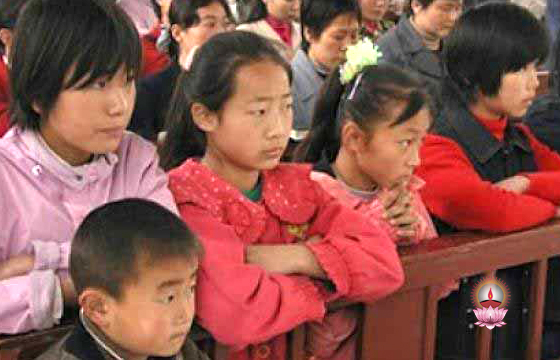
Sino-Vatican deal two years later: Priest calls on Holy Father ‘not to renew the Agreement’
“I call on the Holy Father not to renew the Agreement with China, because this could thre-aten the survival of the Church in China, driving us onto the path of despair,” writes Benedict, an underground Catholic in northern China. He and Fr John, a priest in northern China, have added their voices to AsiaNews‘s investigation into the situation of the Church in China a few months before the provisional agreement between China and the Holy See comes to an end.
Benedict’s bitter cry is complemented by the clergyman’s sober thoughts. The latter says he understands the motive behind the pontiff’s move, which is to show mercy towards the priests and bishops in the official Church, who are caught between the need to show obedience to the regime and their allegiance to the Church.
Two other elements emerge from these two stories. The first one is that the state’s repression against the Church is directed towards other religions as well, in particular Protestants. The second is that the crackdown is not uniformly applied across this vast country. Fr John notes that government officials, following their conscience, have protected the freedom of some communities, at their own risk and peril.
“In my opinion, Sino-Vatican talks and negotiations reflect the Pope’s concern and care for the Church in China. He has tried every way possible to break the chains that tie our bodies and hearts. For some, this makes sense because they no longer have to endure the problems of [legal or illegal] consecration or sacramental communion caused by China.”
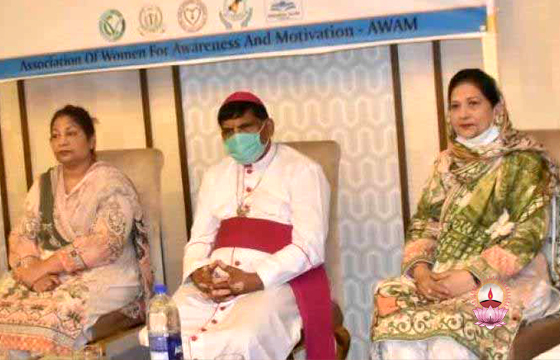
Bp of Faisalabad: Unjust laws and policies do not ensure equality in the country
A conference on ‘Collective efforts for advancing diversities’ was held, eve of Pakistan’s Mi-norities Day.
A number of speakers representing religious and civil society groups addressed the ga-thering. One of them was Bishop Indrias Rehmat of Faisalabad who said that “disparities of rights in policies and laws can never ensure equality of status and treatment.”
For the prelate and the other participants, the government has failed to take seriously the pro-blems minorities face, noting that quotas for minorities are a futile attempt to ensure political, reli-gious, social and economic equa-lity if they do not have proper enforcement mechanisms.
According to various sources, Ahmadis, Christians, Hindus, Sikhs and Shias are the most discriminated in Pakistan, a country of 212 million inhabi-tants, in which ethnic Punjabis and Sunni Muslims are the largest groups.
Catholics and Protestants number around 2 million each (just under 1 per cent of the popu-lation respectively).
Rizwan Ullah Kokab, who teaches history at the Government College University, points out that Pakistan is a land of many religions and different cultures. For this reason, the authorities’ “ethnocentric” approach is not useful to the cause of national unity.
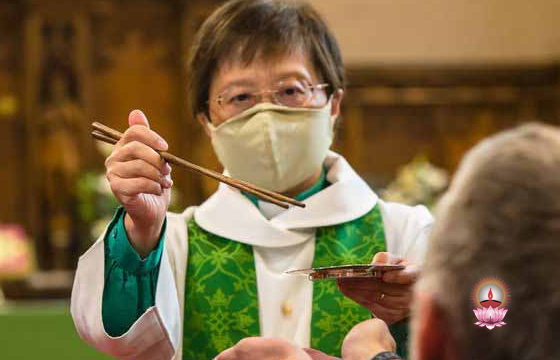
Anglican priest uses chopsticks to distribute communion
A Church of England vicar has tapped in to her Chinese cultural heritage and is using chopsticks to give bread to parishioners during Holy Communion.
The Rev Eileen Harrop took the unusual approach to the challenge faced by clergy who are reopening churches for public worship while sticking to Covid-19 safety protocols. The vicar of St Mary’s in Gainford and St Andrew’s in Winston, County Durham in North East England, decided that the best way to administer the bread at the Eucharist was to use extra-long serving chopsticks.
She has Chinese heritage, grew up in Singapore and has an enduring love of Asian cuisine, so felt confident in using the utensils for the sacred act and has now carried out services using them at both churches she serves.
Rev Harrop said: “Many of my parishioners were quite anxious at the thought of taking communion, even though we are only permitted to do so under strict guidelines to ensure that there is no chance of transmission of the virus.
I thought ‘Why can’t I use a long pair of chopsticks, real bread rather than wafers, and drop it into the communicants’ hands?”
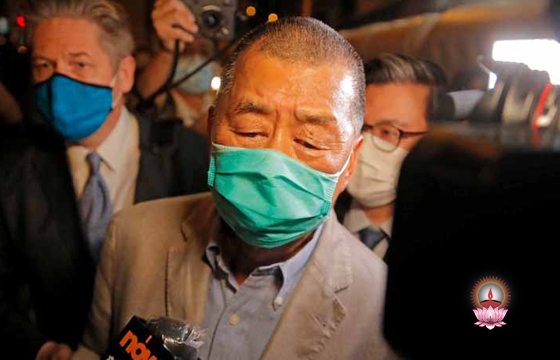
Catholic Hong Kong media tycoon’s arrest sparks fear Church could be next
Earlier prominent Catholic millionaire and media tycoon Jimmy Lai was arrested in Hong Kong along with two of his sons and two executives of his Next Media company on charges of collusion with foreign forces and conspiracy to defraud under China’s new national security law. The three were released on bail late on August 10 night and Lai was cheered as he walked into the offices of his Apple Daily paper.
Lai, 72, made his initial fortune through the fashion chain Giordano before investing his money into media organizations, Next Media and Apple Daily, Hong Kong’s most notorious anti-Beijing paper.
A Catholic, Lai is also a known supporter of prominent Catholic personalities in Hong Kong who have been outspoken in criticizing China over the new law, which went into effect June 30, as well as human rights abuses and limits to religious freedom, prompting speculation that these people could be next on Beijing’s blacklist.
One of the prominent figures Lai has supported is Cardinal Joseph Zen, bishop emeritus of Hong Kong.
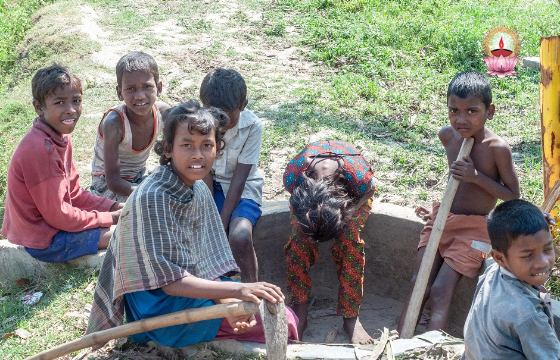
Church seeks rights for indigenous Bangladeshis
A Catholic official and activists have called for equal rights and justice for indigenous people in Bangladesh as millions of ethnic minorities marked UN-designated International Day for World’s Indigenous Peoples on August 9. They urged the government to ensure the basic constitutional rights of ethnic communities including recognition as Adivasi (indigenous peoples) and equal rights to food, employment, education in their mother language, healthcare and justice for abuse including torture, killing and sexual harassment.
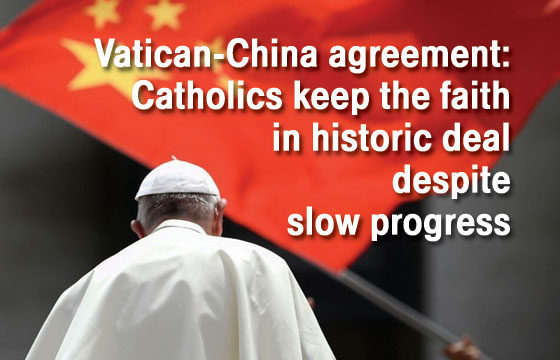
Vatican-China agreement: Catholics keep the faith in historic deal despite slow progress
This is the last in a three-part series examining the role of the Roman Catholic Church in China and how the difficult and complex relationship between the Vatican and Beijing has shifted and evolved since the Communist Party broke diplomatic ties in 1951. This instalment looks at how Catholics continue to be persecuted despite a landmark deal being signed between the Vatican and Beijing in 2018.
If James Su Zhimin is still alive, he would have turned 88. While he has not been seen for 17 years, Su is still listed by the Holy See, the worldwide govern-ment of the Catholic Church, as the Bishop of Baoding in China’s Hebei province.
Between 1956 – five years after the Vatican and Beijing broke off diplomatic relations – and 1997, Su was arrested at least eight times, spending more than 30 years in prisons and labour reform facilities for refusing to switch allegiance from the Pope to China’s state-sanctioned Catholic Church.
He was last seen in 2003, when he was in hospital. Since then, no one has had any news about him and the authorities have been silent about his whereabouts and status. Many fear he might already be dead. Hopes rose that the Chinese government might be more willing to share information about so-called underground bishops like Su.
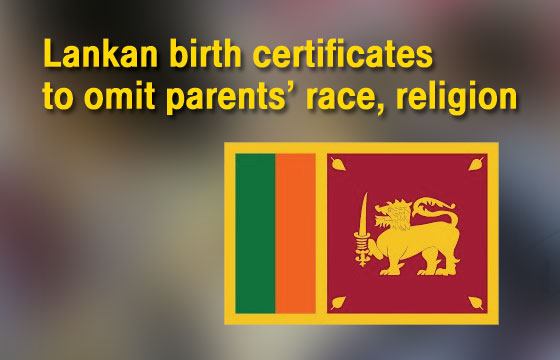
Lankan birth certificates to omit parents’ race, religion
Sri Lankan authorities on July 22 announced that birth certificates for new born children in future will not mention their parents’ race, religion or the marital status. Registrar General of the Registrar General’s Department, N.C. Vithanage told local media that all details pertaining to marriage, ethnic group and religion will be removed from the application form for the registration of a birth in Sri Lanka although this was mandatory earlier.
Local media reports said that the decision was taken after many children in the country were reportedly facing issues due to the details of the marriage of parents, especially when enrolling a child in school. Under the new system, a 12-digit serial number is to be issued for all new birth certificates and this number can be used to obtain a national identity card when a child completes 15 years of age, Vithanage said.

Low birth rate in South Korea could destroy the economy in 80 years
If current trends are not reversed, the South Korean popu-lation will be halved in 80 years. At the same time, the “Asian tiger” will see its GDP drop to 20th place, this according to a study by the prestigious medical journal Lancet.
The birth rate is hot issue in the Asian country, beset by wage discrimination against women and an unfettered capitalism that leads young couples not to have children in order not to have career problems.
At present, the total popula-tion is around 53 million. It should peak in 2031 at 54.29 million, before plunging to 26.78 million by 2100. At the same time, the economy is likely to take huge steps backwards.
According to Lancet, fewer people “might reduce innovation in economies and fewer workers in general might reduce domestic markets for consumer goods, because many retirees are less likely to purchase consumer durables than middle-aged and young adults.”
Experts estimate that high-income countries with low fertility rates will be forced to adopt more liberal immigration policies and prepare their socie-ties to assimilate newcomers. Otherwise, they can expect economic, fiscal and geopolitical collapse.
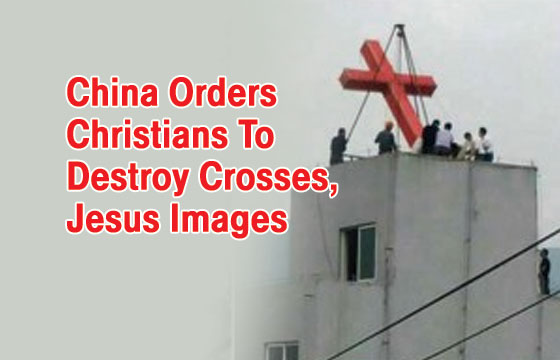
China Orders Christians To Destroy Crosses, Jesus Images
In continuation with its religious repression, Chinese authorities have reportedly ordered Christians to renounce their faith and replace the crosses, images of Jesus in churches with portraits of Chairman Mao and President Xi Jinping or risk losing welfare benefits. According to a report published in Daily Mail, a concerted attempt is being made by the Chinese officials to suppress the manifestation of religion in the country. In what appears to be state-sanctioned persecution against the Christian minorities, Chinese officials have recently demolished religious symbols by force in churches in multiple provinces, including Anhui, Jiangsu, Hebei and Zhejiang.
The report claims that when the Chinese officials arrived at the location to dismantle the cross, they faced stiff resistance from dozens of believers, who had gathered to stop the authorities from knocking down the cross.