In 2015, when Father Hwang Seokmo ended his term as the director of the headquarters of his religious order in Seoul, he requested the superior send him as a missionary to Timor-Leste.
The 57-year-old priest, a member of the South Korea-based Clerical Congregation of the Blessed Korean Martyrs, said the tiny Catholic-majority country, also known as East Timor, drew his attention as “a fertile land” to cultivate the spirit and spirituality of the congregation.
“East Timor caught my eye. It was an area that was planned to contribute to the Asian region with the spirit and spirituality of the Clerical Congregation of the Blessed Korean Martyrs and to develop vocations,” Father Hwang told the Catholic Peace Broadcasting Corporation of Korea (CPBC).
Since his arrival in Timor-Leste, Father Hwang has overseen the Sebastiao Gomes Monastery and serves some 8,000 Catholics in Aileu parish in the Alieu Requidoe region, about 1,500 meters above sea level.
Category Archives: Asian
The Filipino shepherd has spoken but will the sheep listen
Filipino Catholic bishops led by the Archbishop of Manila have urged church-goers not to forget the atrocities during the martial law era. But will the people heed their advice?
The Catholic Church’s hierarchy had gone silent after the presidential election results in May. It was perhaps a painful realization for them that very few Catholics listened to their call to support opposition candidate and for-mer Vice President Leonor Robredo.
The Catholic Church had not involved itself in national politics since the Church-supported 1986 People Power Revolution, which removed Dictator Ferdinand Marcos from power.
During the presidential election, clergy-men wore pink masks and shirts — the color adopted by Robredo supporters. Pastoral letters were issued against martial law and election frontrunner Ferdinand Marcos Jr’s purported effort to revise Philippine history.
Despite accusations of electioneering by conservatives, priests formed associations to support Robredo. The Canon law’s provision for the Church’s non-partisanship was stretched to the limit. But still, Robredo lost. Marcos, Jr. won by an overwhelming majority with 31 million votes.
What happened to the Catholic consci-ence? Do Catholics in the Philippines still listen to their bishops and priests? Or have they pushed them aside while they themselves decide on matters that directly affect the nation?
On the 50th anniversary of martial law, the Catholic prelates spoke.
Perceived to be a clergyman who doesn’t engage in politics, Archbishop Cardinal Jose Fuerte Advincula broke his silence on martial law. Now the stance of the Archbishop of Manila is clear. His statement should silence any critics. He’s not an archbishop sitting in an ivory tower while looking at his flock in the old walled city of Intramuros in the capital.
Cardinal Advincula is still a pastor who does not want to erase the atrocities of martial law from Philippine history, and I suppose, from the history of the Catholic Church in the Philippines.


Japan’s ruling party concedes Unification Church ties
Around half of Japan’s ruling party law-makers have had dealings with the Unification Church, an official said on September 8, after the assassination of ex-premier Shinzo Abe heightened scrutiny of the religious organization also sometimes known as the Moonies.
The man suspected of shooting Abe dead in July allegedly targeted the former prime minister believing he was linked to the sect.
Liberal Democratic Party Secretary-General Toshimitsu Motegi said a probe found some lawmakers had accepted support for election campaigns from the church and its spin-off groups.
Other LDP lawmakers had attended meetings or paid fees to the organization, whose members are sometimes colloquially referred to as “Moonies” after Korean found-er Sun Myung Moon.
Of 379 elected LDP lawmakers, 179 “had some sort of links” with the Unification Church, Motegi told reporters.
“We take the results seriously. We honestly feel sorry, and we’ll make sure the party no longer has any relationship at all” with the church, he said.
Last week, Japan’s Prime Minister Fumio Kishida said LDP members must cut ties with the group, following controversial revelations of its links with a raft of Japanese politicians.
The Unification Church has condemned Abe’s murder and denied accusations of coer-cive fundraising tactics among its members, but Kishida’s government has seen its approval ratings drop in recent weeks as more de-tails have emerged.
“Nearly 90%” of LDP lawmakers that attended gatherings hosted by organizations linked to the church told the probe they were not aware of the hosts’ affiliation, Motegi said. “Our awareness was lacking, and that’s all the more reason that more efforts need to be made to raise awareness” of the issue, he added.
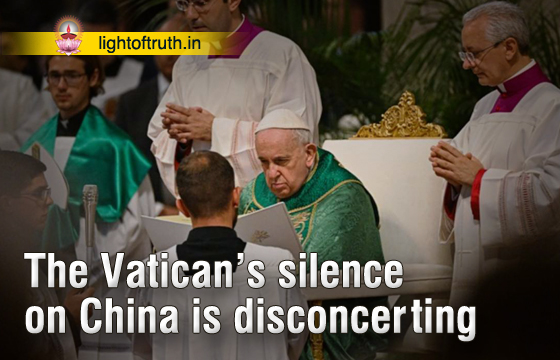
The Vatican’s silence on China is disconcerting
On September 3 , as a new consistory began in Rome, Pope Francis created 20 new Cardinals. Six came from Asia — Singapore, Mongolia, Timor-Leste (East Timor), South Korea, and two from India.
New cardinals came from five continents, ensuring that the universality of the Church is really, truly, global. And three new religious members were appointed, from the Congregation of Jesus and Mary (Eudists), the Consolata Missions Institute and the Legionaries of Christ.
Among religious orders re-presented in the College of Cardinals, the largest are the Salesians, who now number ten.
This is all very good news and I applaud the Holy Father for these appointments. I began my human rights work in Timor-Leste, during Indonesia’s brutal and bloody occupation, and worked there throughout and beyond its transition to independence.
I have had the privilege of meeting the current Bishop of Dili, Virgilio do Carma da Silva, and am so pleased he has been made his country’s first cardinal. It is a signal of solidarity and respect for that beautiful, benighted and often forgotten half-island that fought for freedom and human dignity for a quarter of a century with immense sacrifice and has risen from the ashes over the past two decades in an inspiring way.
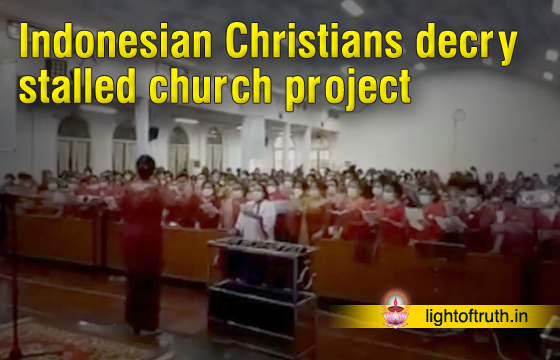
Indonesian Christians decry stalled church project
The denial of building permit to a Protestant church in Cilegon city in Indonesia’s westernmost province of Banten goes against the spirit of religious moderation, Christian leaders say.
The Communion of Churches in Indonesia (PGI) criticized the refusal of permit for the construction of a church by the Batak Society Christian Church (HK-BP) Maranatha in Geram village.
“This incident harms the 1945 Constitution, which guarantees equality of every citizen to adhere to a certain religion and to worship freely in accordance to their own religions,” Reverend Jeirry Sumampow, a spokesman of PGI, said in a statement on Sept-ember 9.
He said the politics of identity had become worse and was threatening religious tolerance. “It is sad to see that there are still groups of people who hurt their brothers and sisters,” he added.
The opposition to the church came from a group of Muslims calling themselves the Committee of Local Wisdom Savior in Cilegon. They staged a protest on Sept. 7 demanding denial of per-mission based on then Serang district head’s 1975 decree providing for the closure of Christian places of worship in the area.
They later met with Cilegon Mayor Helldy Agustian in his office and pressured him to sign on the dotted line. A video of the incident went viral on social media.
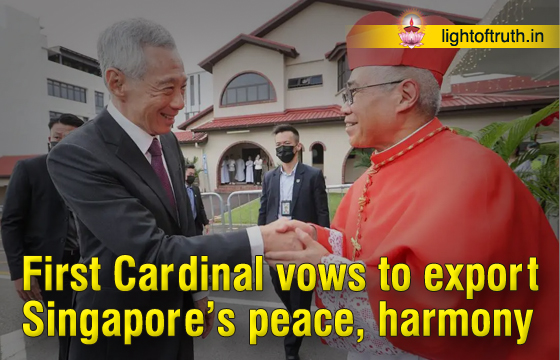
First cardinal vows to export Singapore’s peace, harmony
Cardinal William Goh has vowed to promote the model of Singapore’s peace and harmony among religions in Asia and the world during a thanksgiving Mass celebrating his elevation as a cardinal by Pope Francis.
“Singapore is an icon for religious harmony in the world, where religious leaders and government work hand in hand for the good of the society, instead of being at odds with each other,” Cardinal Goh, 64, said during his homily at St. Joseph’s Church at Bukit Timah on Sept. 8.
Goh said that his appointment as a cardinal was “beyond his expectation” and “a very humbling experience.”
He said he wants “to spread such peace and unity to the rest of Asia by fostering dialogue between different religions.”
Top government ministers and officials including Prime Minister Lee Hsien Loong, some 23 leaders of various religions and religious organizations, and more than 3,500 Catholics attended the event. Bishops representing Catholic Bishops’ Conference of Malaysia, Singapore, and Brunei also participated in the pro-gram.
A commemorative booklet — “That They May Live” — was released to mark the occasion. The book outlines four thrusts of Cardinal Goh’s pastoral view for his cardinalate: Faith in Asia, Aid to the Poorest and the Least, Climate Action and a New Way of Inter-religious Dialogue for Human Fraternity, says a press release from Singapore Archdiocese.
The Singapore prelate was among 20 new cardinals of the Catholic Church created by Pope Francis in a consistory at the Vatican on Aug. 27. He is among the six new cardinals from Asia. “He doesn’t take it as a personal honour, he does it as service.” Premier Lee said he was happy to join the event to celebrate Archbishop William Goh becoming a cardinal, a rank second only to the pope in the Church hierarchy.
“I wish Cardinal Goh all the best in his new appointment and am confident he will continue working with fellow religious leaders in our multi-religious landscape, to maintain our unity and harmony, especially as we build a new social compact for the country,” Lee posted on his official Facebook page after the event.
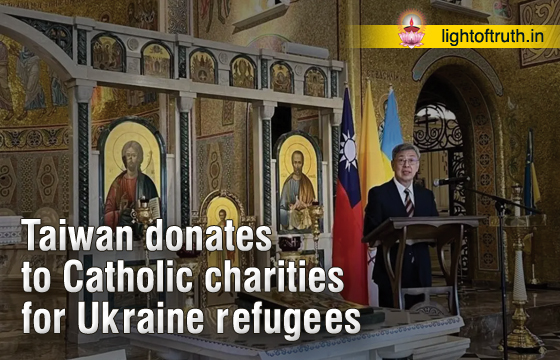
Taiwan donates to Catholic charities for Ukraine refugees
Taiwan has donated a total of US$ 89,600 to various Catholic groups in Europe to support humanitarian aid to refugees who fled Russia’s invasion of Ukraine.
Former Taiwanese Vice President Chen Chienjen handed over the donation on behalf of the government following a Mass for peace in Ukraine at the Minor Basilica of Santa Sofia, a Ukrainian Church in Rome on September 5, Focus Taiwan reported. Chen, 71, a Catholic and member of the Vatican’s Pontifical Academy of Sciences, donated the funds to three Catholic groups and the Minor Basilica of Santa Sofia. During his address after the Mass, Chen praised Ukrainians for their unyielding resistance against Russia’s aggression. He stated that Taiwan deeply sympathized with the suffering of Ukrainians and would learn from Ukraine’s example to firmly defend themselves in the face of “China’s intimidation and military threats.”

Japan’s blind probe against Unification Church must stop
Support for Prime Minister Fumio Kishida’s government in Japan has dropped to its lowest level since his election amid a quest to investigate lawmakers suspected of entertaining “connections” to the Unification Church.
Kishida’s support has fallen to 36% from 52% a month ago, according to a survey. As much as 87% of the survey participants said the Unification Church was either an “extreme problem” or “somewhat a problem” for the ruling Liberal Democratic Party.
It’s easy to figure out why. The Unification Church’s name has been essentially rendered synonymous with a religious scam following an unrelenting media campaign.
Thousands of Unification Church followers rallied in the South Korean capital Seoul last week protesting the negative Japanese media coverage of their religion. The protesters, mostly Japanese believers who moved to South Korea, say the Japanese media, in its improbable attempt to rationalize Shinzo Abe’s assassination, has unduly targeted their church.
Church members fear that the social persecution, on top of family pressure, will force them to recant their faith.
However, the social pressure could have nothing to do with the actual belief as the church in question is a sort of esoteric cult whose main surreptitious undertaking is to convince their faithful into donating all their savings to the organization.
“The mere suspicion of being in the wrong is already a sentence in East Asian countries”
What is important, particularly in East Asian culture, is the shame family members feel on being seen as relatives of someone who is part of a group whose public image is forever tarnished. That is what matters.
The mere suspicion of being in the wrong is already a sentence in East Asian countries. The substance of the claim doesn’t matter when evaluating reputation.
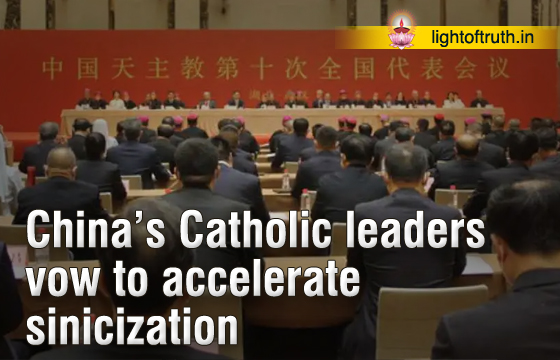
China’s Catholic leaders vow to accelerate sinicization
Two state-sponsored Church bodies in China have elected new leaders during a five-yearly national conference who promised to invigorate the Catholic faithful pastorally in line with the socialist principles of the Chinese Communist Party (CCP).
The three-day 10th National Congress of Catholicism in China ended in Wuhan, the capital of Hebei province in central China, on Aug. 20. Senior officials from the CCP also attended the gathering and delivered speeches.
The meeting attended by some 345 Catholic bishops, clergy, and religious from across China ended with the election of new leaders of the Chinese Catholic Patriotic Association (CCPA) and the Bishops’ Conference of the Catholic Church in China (BCCCC), says a report on the BCCCC website.
Archbishop Joseph Li Shan of Beijing was elected chairman of the CCPA and Bishop Joseph Shen Bin of Haimen was voted in as the new BCCCC chairman.
The delegates also unanimously accepted the Work Report of the 9th Standing Committee on Church efforts and activities in the promotion of patriotism, socialism, and sinicization in the Catholic Church as outlined by President Xi Jinping.
The new leaders have issued a statement to commit themselves to engaging priests, religious, and laypeople including elders across the country for pastoral evangelization and further promotion of sinicization for “truth, pragmatism and inspiration” to move ahead toward a “bright future.”
“It is important to adhere to the direction of sinicization of Catholicism in China”
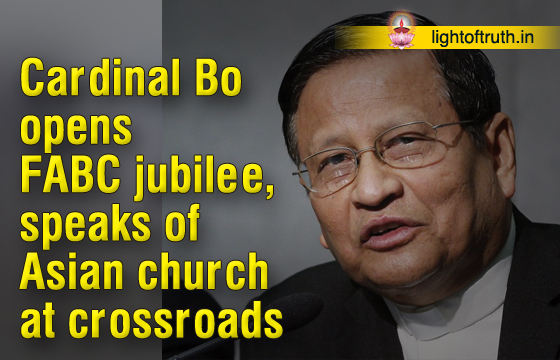
Cardinal Bo opens FABC jubilee, speaks of Asian church at crossroads
The Catholic Church in Asia stands at the crossroads of history amid poverty, climate change, political conflicts, disagreements and economic collapse, said a leading Asian church leader.
Cardinal Charles Bo of Myanmar, president of the Federation of Asian Bishops’ Conferences, made the comments during his address at the opening of the federation’s golden jubilee celebrations August 22. The jubilee programs will conclude Oct. 30, with a two-week FABC gathering in Bangkok.
“We gather amidst suffocating clouds of conflict and displacements, the collapse of the economy, frightening climate change, pandemic and starvation of millions. Secularism is on the ascendency in the traditionally Christian world,” said Bo.
Authoritarian leadership is also becoming the norm in too many countries, he added.
“Democracy faces stiff challenges. Fundamentalism and religious violence threaten global peace. We are called upon to examine ourselves as to what could be the role of Asian churches in these challenging moments,” the cardinal said.
“Asia is a virtual mosaic of cultures; the church reflected that diversity,” Bo said.
He said Asian Christianity is in the process of shedding its alien baggage and becoming truly indigenous to the region.
“The incorporation of the cultural and the religious is what theologians refer to as inculturation,” he said.
Cardinal said much had been achieved in the past 50 years, and he thanked the theologians and others who provided the intellectual identity to the FABC.