
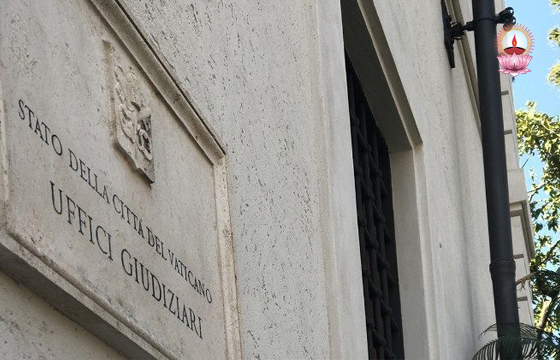
Cardinals and Bishops accused of criminal offences by Vatican magistrates, can now be tried by the Tribunal of the Vatican City State instead of the Court of Cassation presided over by a cardinal, as had been the case until now. Pope Francis made the change in an Apostolic Letter issued motu proprio, which amends the judicial system of the Vatican State promulgated in March 2020. However, trials will still require the Pope’s prior authorization before they can proceed.
The change in legislation comes after Francis himself had addressed the issue at the inauguration of the judicial year in the Vatican on 27 March. In Friday’s motu proprio, Pope Francis, citing his own words on that occasion, recalls “the overriding need for the current procedural system — also by means of appropriate changes in the law — to ensure the equality of all members of the Church and their equal dignity and position, without privileges that date back to earlier times and are no longer in keeping with the responsibilities that each person has in building up the Church.”
Pope Francis’ decision to abolish Article 24 of the law “on the judicial order of the Vatican City State,” — which provided for Cardinals and Bishops accused of criminal offences within Vatican City State to have recourse to the Court of Cassation — is therefore based on the principle of the equality of all members of the Church. The Court of Cassation is the Vatican’s Supreme Court, and in such cases would consist of three Cardinals and two or more associate judges.
All posts by Light of Truth
German legislators consider ending state payments to churches
Germany’s lower house of Parliament is considering re-placing state payments to the nation’s two largest churches. The Catholic and Protestant churches received combined state benefits of more than $650 million in 2020.
At a hearing in the interior affairs committee of the Bundestag, or lower house of parliament, they welcomed in principle the intention of legislation by the opposition liberal Free Democratic Party, the Greens and the Left Party and pointed out that it was in line with a constitutional mandate to abolish the payments, which date back to a 19th-century provision. By contrast, a number of legal experts said an alternative bill by the Alternative for Germa-ny party to simply phase out the benefits was unconstitutional, reported the German Catholic news agency KNA.
The bill by the three parties aims to create the necessary framework for agreements between the federal states, which currently make the payments, and the Catholic dioceses and Protestant regional churches.
Most of the state payments date back to 1803, when German imperial princes received expropriated church property as compensation for a loss of territory. In return, the princes paid the churches money on a regular basis.
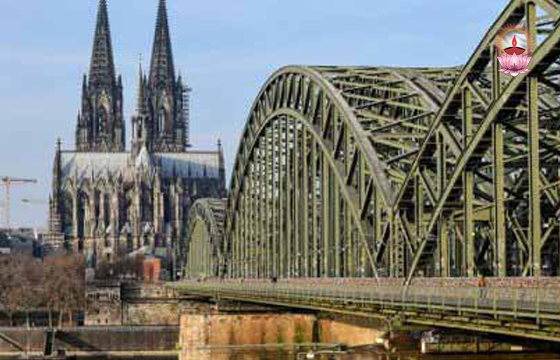
Laypeople in Cologne Archdiocese demand local synod
Catholic laypeople in the Archdiocese of Cologne have called for a local synod to address the ongoing crisis in Germany’s most populous diocese.
“We must make every effort to reestablish a genuine dialogue between the cardinal, senior members of the diocesan leader-ship and the grassroots of the church,” said Tim-O. Kurzbach, president of the Cologne arch-diocesan council of Catholics.
New Bible translation will use inclusive language
The translation of the Bible to be used in the new edition of the lectionary for Mass in England and Wales is being amended to use gender-inclusive language where contextually appropriate, The Tablet can reveal.
For 18 months, the Depart-ment of Christian Life and Wor-ship of the Bishops’ Conference of England and Wales has been adapting the text of the English Standard Version Catholic Edi-tion so that inclusive translations are used whenever translators’ footnotes in the original text of the ESV-CE indicate they are appropriate, for example when the Greek word adelphoi (bro-thers) refers to both men and women.
The wording of the ESV-CE has been adapted to make it more inclusive approximately 142 times in the two volumes of the lectionary already prepared.
The Archbishop of Cardiff, George Stack, chair of the Department of Christian Life and Worship, told The Tablet: “We can’t change the language of the Bible, but we can adapt it so that it speaks powerfully to people in this age.”
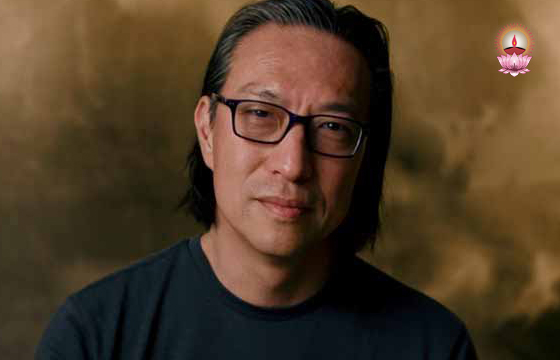
Makoto Fujimura Sings with God, Carries His Cross, and Awaits the New Creation
One of the most formative moments early in my artistic journey was hearing Andrew Peterson’s song “Let There Be Light.” I was in my late teens at the time, just beginning to grapple with the musical gifts that would eventually lead me to a career in composition. But as Peterson crooned the lyrics, “When your spirit is hovering over the deep / In the image of God just look into that darkness and speak,” I remember the light bulb illuminating in my mind: My creativity is an act of faith.
That singular notion has stayed with me throughout my life, fueling my creative work and giving me a sense of purpose. And I can think of numerous musicians, authors, poets, artists, and theologians who have similarly encouraged me along the way.
Fine artist Makoto Fujimura is undoubtedly such a figure. While his stunning work has captivated countless people around the world, the way he has lived out his vocation far exceeds the bounds of his artistry. Throughout his public life, he has promoted the interaction of art, culture, and faith through founding the International Arts Movement, establishing his own Fujimura Institute, and, more recently, serving as the director of the Brehm Center for Worship, Theology, and the Arts at Fuller Theological Seminary. He has also come alongside many other artists, advocating for them and supporting their efforts, as he did for me in writing the foreword to my first book.
In each of these pursuits, Fujimura has sought to promote a vision of what it means to create and how acts of creativity relate to our faith. Now, in his engaging book Art and Faith, Fujimura gathers the many themes from each corner of his vibrant career into a single volume that persuasively articulates a “theology of making” (to quote the book’s subtitle) while communicating that vision in a contemplative style that itself radiates the very creativity he advocates throughout the book.
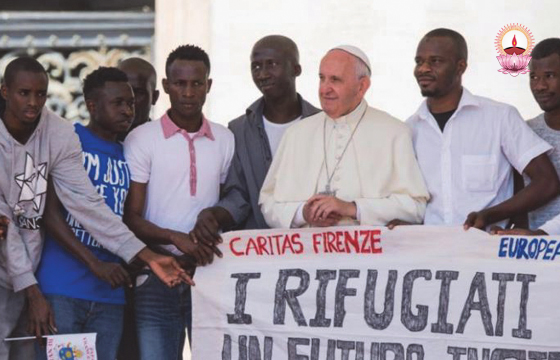
Pope: Borders that are not walls, but places of encounter
Borders that are no longer walls, but “privileged places of encounter “ between all the components of a “colourful” society, capable of “dreaming together” to build a common future through “more sustainable development, balanced and inclusive.”
This is the vison of Pope Francis contained in his message for the 107th World Day of Migrants and Refugees – which will be celebrated on Sunday 26 September 2021 – entitled “Towards an ever wider we”, made public today.
The title chosen for the message, explained during the presentation of the document Father Fabio Baggio, CS, under-secretary of the Migrants and Refugees Section of the Dicastery for integral human development, is “an appeal to ensure that” there may be more ‘others’, but only one ‘we’ “(Fratelli tutti, 35). And this universal ‘we’ must become a reality first of all within the Church, which is called to make communion in diversity”.
“It is an invitation to everyone, because we are committed to restoring our human family”. Thus the Pope, in the video on the next day, shown for the first time today in the Vatican press office on the occasion of the presentation of the message. “We are like many grains of sand, all different and unique but which together can form a beautiful beach, a true work of art”.
The “we”, Francis writes, is that of God’s creative plan who “created us male and female, different yet complementary, in order to form a “we” destined to become ever more numerous in the succession of generations”.
“The present time, however, shows that this “we” willed by God is broken and fragmented, wounded and disfigured. This becomes all the more evident in moments of great crisis, as is the case with the current pandemic. Our “we”, both in the wider world and within the Church, is crumbling and cracking due to myopic and aggressive forms of nationalism (cf. Fratelli Tutti, 11) and radical individualism (cf. ibid., 105). And the highest price is being paid by those who most easily become viewed as others: foreigners, migrants, the marginalized, those living on the existential peripheries.”
“In reality, we are all in the same boat and we are called to commit ourselves so that there are no more walls that separate us, no more others, but only one us, as big as all of humanity”. Hence a twofold appeal. The Pope asks believers to commit themselves to making the Church more and more Catholic, to “all men and women of the world” to transform walls into bridges.
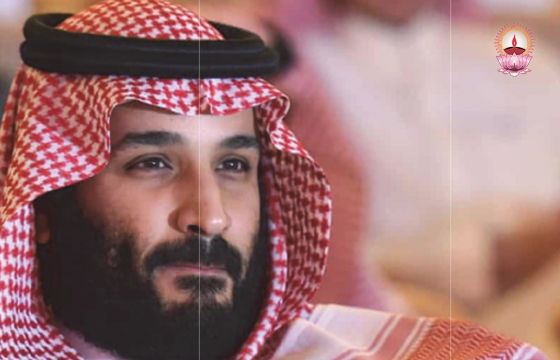
Mohammed Bin Salman attempts to reform Islam
On April 27 Saudi Arabian Crown Prince, Mohammed Bin Salman (Mbs), gave a long television interview to the Saudi channel “Al-Arabiya”[i], dedicated to his economic and social program for a new country in the framework of the 2030 vision, first unveiled in 2015.
In the interview he spoke of moderation in the application of Islamic laws, challenging Wahhabism, an ideology developed by Mohammed ben Abdelwahhab, an 18th century Saudi preacher, who reigned for a long time in the country and elsewhere, after promoting it for many decades in the Muslim world.
It would seem that MBS has come out in favour of the reform of Islam, when he stated: “All Muslim jurists and scholars have been talking about the concept of moderation for over a thousand years. So, I do not think I am in a position to clarify this concept, as much as I can … abide by the Saudi constitution, which is the Quran, the Sunnah, and our basic governance system and to implement it fully in a broad sense that is inclusive of everybody.” Until a few years ago, such a speech would have been unimaginable and [even that evening] it was hard to believe it, if broadcast live on the television channel.
MBS also declared that “the Constitution of Saudi Arabia is the Koran” and that his country is “obliged to implement the Koran in one form or another”; that is: all citizens will be respected as such and in their differences. To be more explicit, he stressed that only what is only said “unequivocally” in the Koran should be applied: “In social and personal affairs, we are obliged to implement only the stipulations clearly enunciated in the Quran. Thus, I cannot apply a sharia punishment without a clear or explicit Koranic stipulation of the Sunna.”
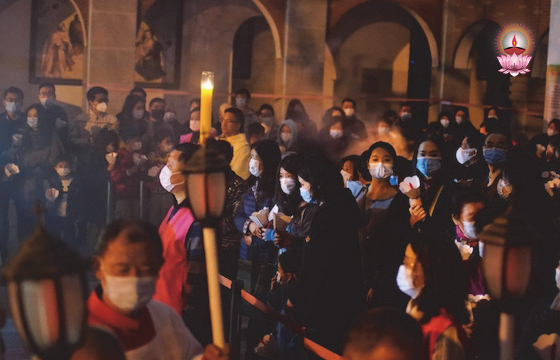
China moves to censor Christians online
Authorities in China have removed online Bible apps from app stories in China, as well as taking down prominent Christian chat accounts.
According to Father Francis Liu of the Chinese Christian Fellowship of Righteousness, those logging in to see Christian chat accounts in China saw the following message: “[We] recei-ved report that [this account] vio-lates the ‘Internet User Public Account Information Services Management Provisions’ and its account has been blocked and suspended.”
“Sadly, this doesn’t come as a surprise,” said Dr David Landrum, head of advocacy for Open Doors UK and Ireland. “Since President Xi Xinping came to power we have seen a concerted and strategic wave of persecution against Christians, with the use and abuse of technology at the forefront of this religious cleansing.”
Pakistan minorities await implementation of ‘historic’ ruling
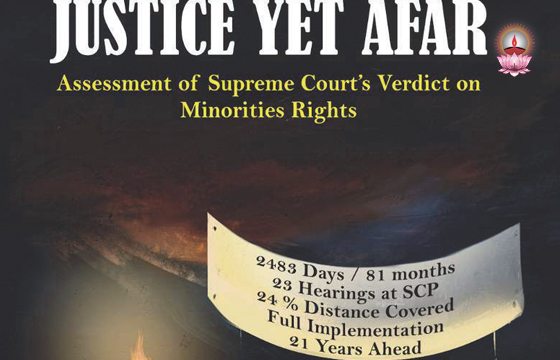
New research assessing the Pakistan Supreme Court’s 2014 judgment to protect minority rights predicts its implementation will take more than two decades.
“During this period, a Supreme Court bench has conducted 23 follow-up hearings and passed nearly six dozen orders, yet Pakistan stands 21 years away from the finish line of full implementation, considering the existing pace of compliance,” the study states.
“The federal government reported the least number of compliance reports. No report had been submitted from Gilgit-Baltistan and Azad Jammu and Kashmir. Reportage from the Ministry of Religious Affairs and Interfaith Harmony and Ministry of Federal Education was in particular missing.”
Peter Jacob, executive director of the Centre for Social Justice (CSJ), virtually inaugurated his research titled “Justice Yet Afar” in Lahore on April 30. Speakers expressed concerns at the state’s lack of compliance with the 2014 Supreme Court judgment that mandated the federal government to create a national council for the rights of minorities and provincial governments to create task forces for religious tolerance, protect places of worship and crack down on hate speech, among other measures.
Malaysia: ‘Christians Are Enemies of Islam’
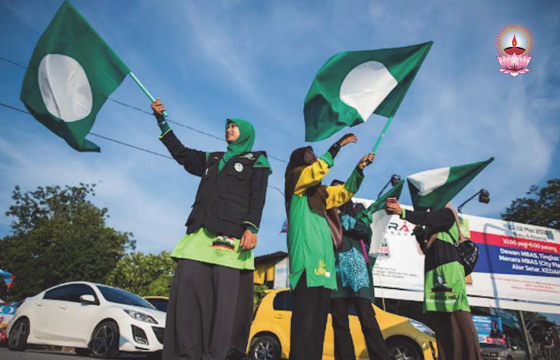
A malicious book accusing Christians of a grand conspiracy to undermine Islam has gone viral in Malaysia, even as fresh allega-tions are being brought against Kuala Lumpur’s archbishop for spewing anti-Muslim propaga-nda.
The Islamic book, Pendeda-han Agenda Kristian (Exposing the Christian Agenda), labels the “Nasrani” (Christians) as “ene-mies of Islam who are always malicious and display a negative attitude towards Muslims,” and who “will try their best to cause heartache among Muslims.”
Church Militant obtained a copy of the 130-page book from the official portal of the Selangor Islamic Religious Council (SIRC), which has a gov.my internet address — linking it to the government of Malaysia.
First published in hardback in 2014 and now made available in digital format in the Malay language, the publication accuses Catholics and evangelicals of adopting missionary schools and “contextualization” as a conver-sion strategy, especially by using the term “Allah” in the Malay-language Bible.
Ironically, the accusations come in the light of Pope Francis’ categorical rejection of efforts to convert people of other religions and in the wake of the pontiff’s Abu Dhabi Catholic-Muslim concordat with Sunni Grand Imam of al-Azhar Ahmed al-Tayyeb in 2019.
It gives the lie to Pope Fran-cis’ fond hopes that his ‘interfaith dialogue’ will lead to harmony and peace between Muslims and Christians.