
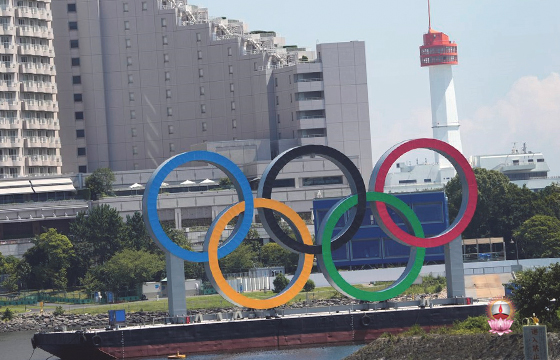
In the early days of the Olympics, religion played a starring role. Faith leaders had front-row seats to the events and many athletes dedicated their triumphs to the gods. “Even the prizes were religious — crowns of olive leaves made from trees in a sacred grove dedicated to Zeus,” Religion News Service reported in 2016.
Religion still matters to many modern Olympic athletes, but its influence on the Games is harder to spot. You’ll have to pay close attention to Olympics coverage over the next few weeks to catch athletes praying before their events or champions thanking God during their media interviews. I, for one, feel up to the challenge and, to prepare, I did some research over the weekend into what religion-related storylines to follow during the Olympics this year.
Here are my favourite discoveries: Grace McCallum, from the women’s gymnastics squad, and Katie Ledecky, from the swimming team, are two of the many American athletes competing in this year’s Games who have talked about drawing on faith to prepare for competition. Both women are Catholic and believe their church has given them the tools to stay calm and humble in the face of a seemingly overwhelming challenge. “My dad is sending me a couple of prayers to say before each practice in the morning. I think that will be really helpful to keep me at peace,” McCallum said earlier this month.
Speaking of Catholics, the Archdiocese of Tokyo announced last week that Olympic athletes and support staff will not be allowed to attend church in-person during their stay due to COVID-19 concerns. The archdiocese will, instead, offer online worship services and other devotional video content to the athletes, Religion News Service reported.
All posts by Light of Truth
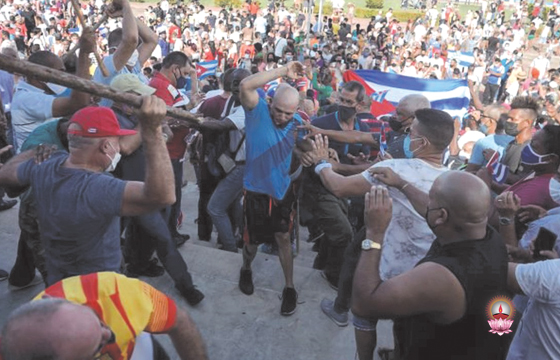
‘Enough is enough’ of how Cuba treats its people, Bishop Cruz says at vigil
Bishop Manuel A. Cruz, a Cuban-American and an auxiliary of the Newark Archdiocese, told the congregation at a West New York Catholic church that “the hour has come to say ‘ENOUGH.’” “Our people, the Cuban people, helpless as they are, are being massacred by the tyranny of the Cuban regime. Today we say ‘enough is enough’ to that genocide,” he said.
Cruz joined more than a dozen clergy from the Arch-diocese of Newark and the Diocese of Paterson, New Jersey, along with the Cuban and Latino community, at St. Joseph of the Palisades Church for a July 18 prayer vigil in solidarity with the people of Cuba.
The service was for the brothers and sisters of the island of Cuba who continue to go through the trials and tribulations of their nation or, as one of the priests mentioned in his prayer, “for the people who cross their desert” to achieve above all the freedom that Jesus promised.
Cardinal Joseph W. Tobin of Newark presided. Also in atten-dance were Auxiliary Bishops Gregory J. Studerus and Michael A. Saporito of Newark and Bishop Kevin J. Sweeney of Paterson. The Catholic leaders expressed their support for the Cuban people of the island, along with the Cuban diaspora found in the United States.
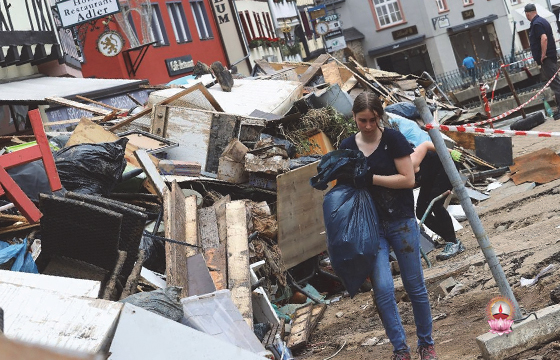
German churches pray, provide aid as European flooding death toll climbs
German Catholic churches offered spiritual and financial support to survivors of devasta-ting flooding in two regions of the country.
At Masses July 18, bishops, priests and parishioners prayed for those who died, emergency workers who continued to clear mud-lined streets and residents seeking to salvage what they could from damaged and destroy-ed homes, the German Catholic news agency KNA reported.
Officials recorded at least 196 deaths July 19 in western and southern Germany, eastern Bel-gium and parts of the Nether-lands. Hundreds more were missing. In a visit to the region July 18, German Chancellor Angela Merkel called the cata-strophe the worst natural disaster in the country in 60 years.
Pope Francis reiterated his sympathy for the victims of the flooding in the three countries, asking that God to receive those who died, comfort survivors, and strengthen rescue workers as he addressed the crowd in St. Peter’s Square at the Vatican July 18.
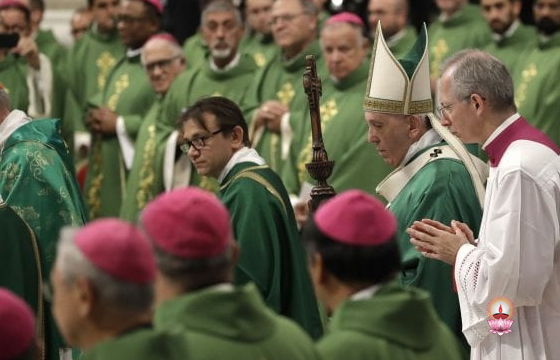
The nine questions that sealed the fate of the Latin Mass
Pope Francis rolled back what some considered his predecessor’s olive branch to traditionalist Catholics by severely restricting celebration of the old Latin Mass. The move essentially reversed a liberalization of the older rite decreed by Pope emeritus Benedict XVI in 2007.
The Congregation for the Doctrine of the Faith, the Vatican’s doctrinal watchdog agency, sent a questionnaire, at the pope’s request, to bishops’ conferences last year.
The survey contained nine questions:
1. What is the situation in your diocese with respect to the extraordinary form of the Roman Rite?
2. If the extraordinary form is practiced there, does it respond to a true pastoral need or is it promoted by a single priest?
3. In your opinion, are there positive or negative aspects of the use of the extraordinary form?
4. Are the norms and conditions established by Summorum Pontificum respected?
5. Does it occur to you that, in your diocese, the ordinary form has adopted elements of the extraordinary form?
6. For the celebration of the Mass, do you use the Missal promulgated by Pope John XXIII in 1962?
7. Besides the celebration of the Mass in the extraordinary form, are there other celebrations (for example Baptism, Confirmation, Marriage, Penance, Unction of the sick, Ordination, Divine Office, Easter Triduum, funeral rites) according to the liturgical books prior to Vatican Council II?
8. Has the motu proprio Summorum Pontificum had an influence on the life of seminaries (the seminary of diocese) and others formation houses?
9. Thirteen years after the motu proprio Summorum Pontificum, what is your advice about the extraordinary form of the Roman Rite?
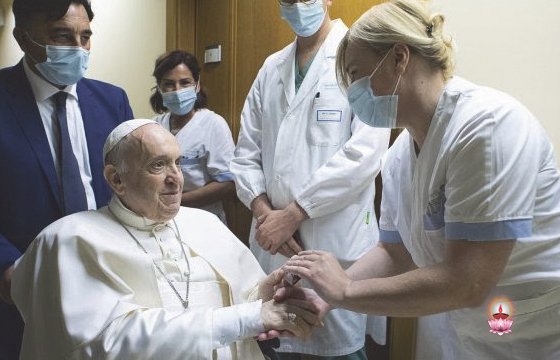
The beginning of the end of the Francis papacy?
Pope Francis seems to be recovering nicely from his July 4 surgery, when the 84-year-old pontiff underwent a three-hour procedure for diverticular stenosis. A Vatican spokesman says he will remain “a few more days in order to optimize his medical and rehabilitation therapy.”
But even with the best prognosis, age is catching up to Francis. Barring a miracle, he will only be expected to continue as pope for five or six years. We may look back at his hospitalization as the moment that marked the beginning of the end of his papacy.
If that’s the case, we will also be able to count incredible achievements.
As a pastor, Francis has caught the imagination of the world with his compassion and openness to all people. He has put love, especially love for the poor, center stage in his preaching of the gospel.
As a world leader, he has put his papacy squarely on the side of migrants and refugees. And he has been a prophetic voice against global warming and the excesses of capita-lism.
And within the church, he has encouraged dialogue and a more consultative style of governance: Put bluntly, the Congregation for the Doctrine of the Faith no longer acts like the Inquisition it once was.
In short, Francis has rebranded the papacy for the 21st century with a pastoral, prophetic and inclusive voice.
Where he has been less successful is in winning over the clerical establishment to his vision for the church. In his eight years as pope, Francis has hardly dented the clerical establishment that he inherited.
Many bishops and priests in the Roman Curia and around the world think his election was a mistake and they are hoping for a return to what they regard as normalcy in the next papacy. They feel he has not emphasized dogma and rules enough, so they are not cooperating.
Facebook’s Next Target: The Religious Experience
The social media giant had a proposition, Sam Collier, the pastor, recalled in an interview: to use the church as a case study to explore how churches can “go further farther on Facebook.”
For months Facebook developers met weekly with Hillsong and explored what the church would look like on Facebook and what apps they might create for financial giving, video capability or livestreaming. When it came time for Hillsong’s grand opening in June, the church issued a news release saying it was “partnering with Facebook” and began streaming its services exclusively on the platform.
Beyond that, Mr. Collier could not share many specifics — he had signed a nondisclosure agreement.
“They are teaching us, we are teaching them,” he said. “Together we are discovering what the future of the church could be on Facebook.”
The company’s effort to court faith groups comes as it is trying to repair its image among Americans who have lost confidence in the platform, especially on issues of privacy. Facebook has faced scrutiny for its role in the country’s growing disinformation crisis and breakdown of societal trust, especially around politics, and regulators have grown concerned about its outsize power. Over the past week, President Biden has criticized the company for its role in the spread of false information about Covid-19 vaccines.
“I just want people to know that Facebook is a place where, when they do feel discouraged or depressed or isolated, that they could go to Facebook and they could immediately connect with a group of people that care about them,” Nona Jones, the company’s director for global faith partnerships and a nondenominational minister, said in an interview.
Last month, Facebook executives pitched their efforts to religious groups at a virtual faith summit. Sheryl Sandberg, the company’s chief operating officer, shared an online resource hub with tools to build congregations on the platform.
“Faith organizations and social media are a natural fit because fundamentally both are about connection,” Ms. Sandberg said.
“Our hope is that one day people will host religious services in virtual reality spaces as well, or use augmented reality as an educational tool to teach their children the story of their faith,” she said.
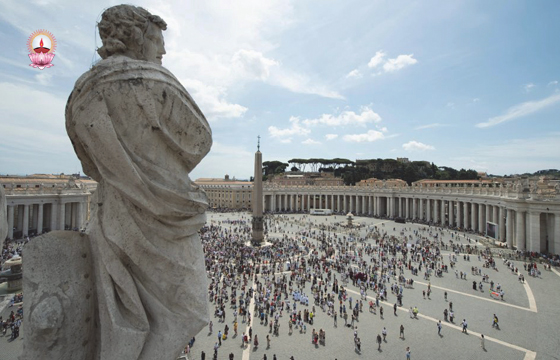
Synod of Bishops publishes list of commission members
The Vatican released the names of members of two commissions charged with assisting the leaders of the Synod of Bishops’ general secretariat in reviewing documents, drafting resources and developing best practices.
According to the synod we-bsite, the theological commission and the methodology commission will include religious and lay experts from around the world.
The theme chosen by the pope for the next synod is: “For a synodal church: communion, participation and mission.”
Cardinal Mario Grech, se-cretary-general of the Synod of Bishops, told Vatican News in May that, although originally scheduled for 2022, the synod will take place in October 2023 to allow for broader consultation at the diocesan, national and regional level.
In revisions to the synod process announced in May, Pope Francis has asked that it begin with consultations with laypeople on the diocesan level before the discussion and discernment moved to a national level and then the 2023 synod assembly itself.
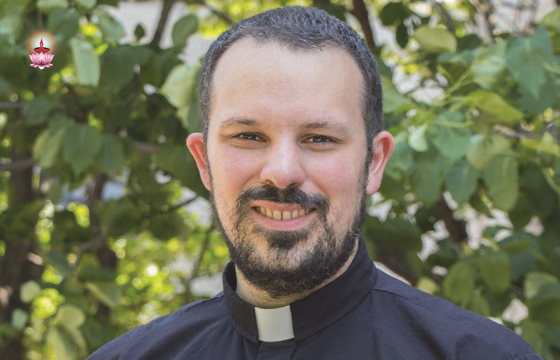
Former Anglican priest says God helped him find way to Catholic priesthood
For Father Stephen Hilgen-dorf, it has been a long journey from his role as a priest in the Anglican tradition.
It included a desire to be in full communion with the Catholic Church that was so strong he was willing to give up ministry altogether. But God had other plans for him. He and his family were received into Catholic Church, then some years later he was accepted to become a Catholic priest.
After studying, working and ministering in the Twin Cities the past six years, he was ordain-ed a priest for the Houston-based Personal Ordinariate of the Chair of St Peter June 29. His next assignment will be in Omaha, Nebraska. The ordinariate is equivalent to a diocese for Roman Catholics who were nurtured in the Angli-can tradition. Created by the Vatican Jan. 1, 2012, it serves Catholic parishes and communities across the United States and Canada.
“I had to come to grips with the thought, ‘I may never be a priest again,’” Hilgendorf, 33, said after his ordination. “After becoming Catholic, I found it very difficult going to Mass. I was not sure who I was any-more.”
For Iraqi Christians, scenes of both horror and hope
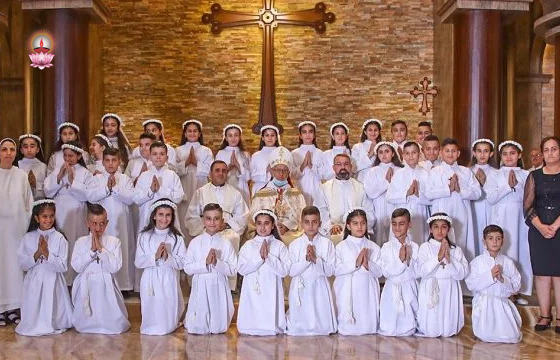
As Iraqis sort through the rubble of the latest terrorist attack Tuesday, an attack on a busy market in downtown Baghdad that left at least 30 people dead, one Catholic priest in Iraq says it’s important not just to focus on the horror of life in the country but also the hope. As it happens, the bombing came four days after 70 children received their first communion in the city of Telskuf in the Nineveh Plains, a region in northern Iraq that borders with the Kurdistan region, and which was invaded by IS in 2014.
A thousand churches may collapse in Russia in the next ten years
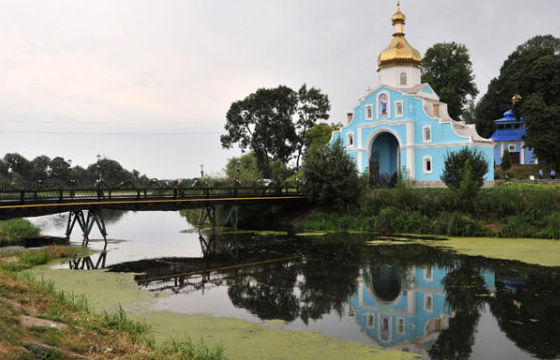
The register of damaged and ruined church buildings of Russia has almost 4 thousand objects already, the website of the Moscow Patriarchate reported on July 1. At the same time, it was noted that, according to the total estimates of the diocesan tree keepers, about a thousand churches have a high risk of collapse in the next decade.
Two years ago, the Supreme Church Council approved the concept of creating an electronic and digital archive for all ruined churches in a short time.