

Pope Francis said on October 7 that he plans to declare St. Irenaeus of Lyon a Doctor of the Church with the title “Doctor unitatis,” meaning “Doctor of Unity.”
The Pope made the announ-cement in a speech to the St. Irenaeus Working Group, a group of Catholic and Orthodox theologians who conducted a study together on synodality and primacy. “Your patron, Saint Irenaeus of Lyon — whom soon I will willingly declare a Doctor of the Church with the title Doctor unitatis — came from the East, exercised his episcopal ministry in the West, and was a great spiritual and theological bridge between Eastern and Western Christians,” Pope Fran-cis said on Oct. 7.
St. Irenaeus was a second-century bishop and writer revered by both Catholics and Orthodox Christians and known for refu-ting the heresies of Gnosticism with a defence of both Christ’s humanity and divinity.
All posts by Light of Truth
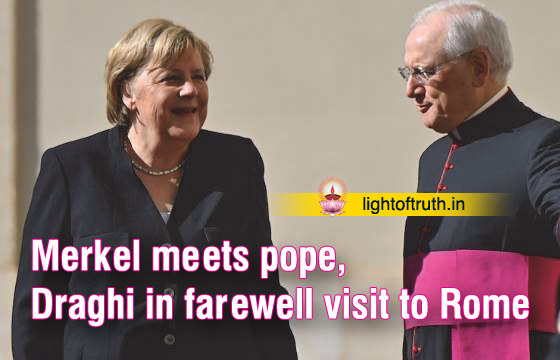
Merkel meets Pope, Draghi in farewell visit to Rome
German Chancellor Angela Merkel discussed climate change and clerical abuse with Pope Francis on October 7 in a fare-well trip to Rome that included talks with Italian Prime Minister Mario Draghi. Merkel, who is bowing out after 16 years in power, also visited St Peter’s Basilica and will lunch at a restaurant in central Rome before giving a speech at a peace conference at the Colosseum.
She was honoured with a ceremonial welcome by the Swiss Guards at the Vatican before meeting and exchanging gifts with the Pope, whom she has met several times before.
She said afterward they dis-cussed climate change – an issue on which Francis has been out-spoken – and the sexual abuse by children of clergy, a problem that has rocked the Catholic Church in Germany and else-where.
“We had important discuss-ions about child abuse,” Merkel, the daughter of a Lutheran clergyman, told reporters.
“I wanted to underline with my visit that we think that the truth must come to light, and the topic must be dealt with.”
Earlier, Merkel visited the site of a new institute within the Vatican’s Gregoriana university dedicated to child protection and met with Hans Zollner, the Vatican’s leading expert on measures to safeguard minors.
She was later due to meet with Draghi, with whom she has worked closely for years, notably when he was head of the European Central Bank — and where they did not always see eye-to-eye.
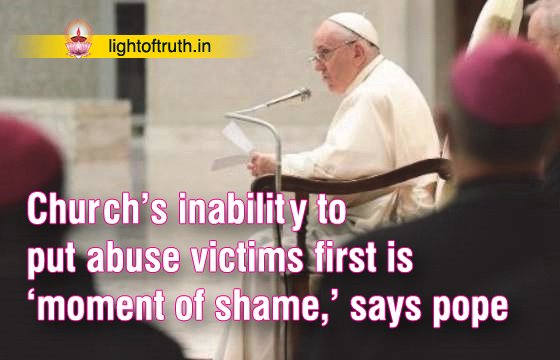
Church’s inability to put abuse victims first is ‘moment of shame,’ says pope
The Catholic Church’s inability to make victims of sexual abuse its top concern is a cause for intense shame, Pope Francis said.
In the wake of a major report investigating the extent of sexual aggression and abuse against minors in the church in France, the Pope said, “I wish to express to the victims my sadness, my grief, for the traumas they have endured, and also my shame.” This deep sense of shame, “our shame, my shame,” he said, was for “the too lengthy inability of the church to put (victims) at the center of its concerns.”
The pope made his remarks at his general audience in the Vatican’s Paul VI hall, in the presence of a group of bishops and a cardinal from France who had been in Rome for their “ad limina” visit. Just before the audience, the Pope and four of the bishops gathered privately for a moment of silent prayer for victims.
After delivering his main catechesis, the pope highlighted a recent report published by an independent body commissioned by the French bishops’ conference.
According to the four-year investigation, an estimated 216,000 children were abused by priests since 1950, and more than 100,000 others were abused by lay employees of church institutions.
This history of unchecked abuse extending over the course of generations challenges our comprehension of how innocent persons could have suffered so terribly
The Pope commented on the “considerable number” of known victims revealed in the report.
Assuring victims of his prayers, the pope asked everyone to pray with him: “To you, Lord, the glory; to us, the shame. This is the moment of shame.” He encouraged the country’s bishops and superiors general of religious orders “to continue to do their utmost so that similar tragedies are not repeated.”
Pope Francis also expressed his closeness to the priests in France, assuring them of his “paternal support before this ordeal, which is arduous but beneficial.”

Pope warns against ‘closed’ groups claiming righteousness
Pope Francis has warned against those doing the work of the devil by claiming “exclusive” rights over Jesus and the King-dom of God.
Referring to September 26 gospel reading from St Mark, Pope Francis cited Jesus’ warning that “instead of dividing people into good and bad, we are all called to watch over our hearts, so that we do not succumb to evil and give scandal to others”.
Jesus had criticised the disciples for wanting to prevent someone who was not in their group from taking certain actions in the name of Jesus.
The disciples wanted to prevent a good work because the one who did it did not belong to their group, the Pope said. “They think that they have exclusive rights over Jesus and that they are the only ones authorised to work for the Kingdom of God.”
But in this way, they consider others as strangers, to the point of becoming hostile towards them. Pope Francis warned that the temptation to keep those who do not think like us at a distance “is the root of many evils in history, of absolutism that has often generated dictatorships and of so much violence against those who are different.”
The devil, who is the “divider” – the word’s roots are in division – insinuates suspicion to divide and exclude people. “Sometimes we too, instead of being humble and open communities, can give the impression that we are ‘at the top of the class’ and keep others at a distance; instead of trying to walk with everyone, we can show our ‘believers’ licence.”

Public schools can display crucifix when decided democratically, court rules
Italy’s highest court of appeal has ruled that public school classrooms can approve the presence of the crucifix because it does not discriminate against anyone.
The court specified, however, that all religious symbols can also be “welcomed” as long as it is decided in a democratic, civil and “gentle” manner by students and faculty together.
That means, it said, all decisions regarding their presence must never be imposed and must seek “reasonable accommodation” between the different positions or convictions of people in the school community that includes respecting a per-son’s freedom of and from religion; in essence, decisions can-not come by a “tyranny” of the majority or the veto-power of one individual.
Italy’s Supreme Court of Cassation — the country’s court of last resort — released its 65-page brief explaining its decision Septem. 9 concerning an appeal against the display of the cruci-fix in the classrooms involving an Italian high school teacher whose claims were first rejected in a lower court in 2013 and in a court of appeals in 2014.
The full-time Italian literature teacher said his freedom of conscience was violated and he wanted the freedom to teach without the presence of a crucifix on the wall behind him.
According to court proceedings, the teacher would enter the classroom, take the crucifix down from the wall for the duration of his lesson and then rehang it when he was done teaching.
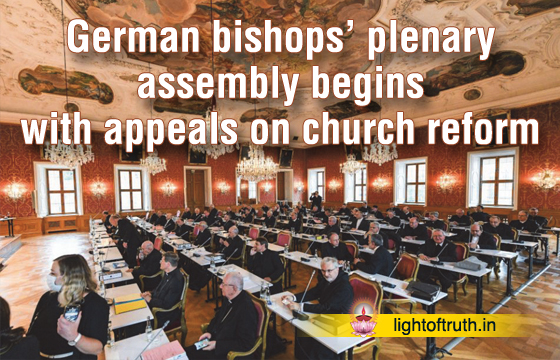
German bishops’ plenary assembly begins with appeals on church reform
The German bishops’ plenary assembly began with urgent appeals for church reform and a reminder to heed admonitions from Pope Francis.
Bishop Georg Bätzing, conference president, called on all bishops to embrace radical change, reported the German Catholic news agency KNA. He said visible changes were need-ed soon in the Synodal Path German church reform project, which could be a “door opener” for the worldwide synodal process launched by the Pope.
Meanwhile, Archbishop Ni-kola Eterovic, the Pope’s ambassador to Germany, repeatedly urged the bishops to preserve the unity of the church and to follow the Pope’s directives.
At the start of the Sept. 20-23 assembly, Catholic reform groups and women’s associations held demonstrations demanding rapid and fundamental reforms, warning that this was the only way for the church to restore its credibility.
Bätzing called on his fellow bishops to agree radical changes are needed in the way they work and in their understanding of their ministry. In his sermon at the opening service, the Limburg bishop criticized the way some bishops have acted in preparation for the Sept. 30-Oct. 2 Synodal Assembly, part of the Synodal Path, an attempt to revitalize the church and restore trust follow-ing a September 2018 church-commissioned report that detailed thousands of cases of sexual abuse by Catholic clergy over six decades.
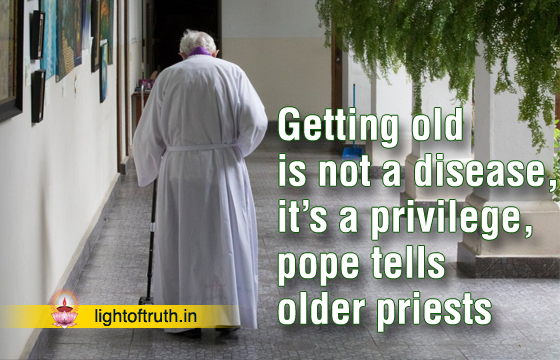
Getting old is not a disease, it’s a privilege, pope tells older priests
Getting to be a ripe old age is a privilege, Pope Francis told older priests. If facing an illness, that too, becomes a privilege in that one resembles Jesus, “who suffers, and one carries the cross, just like him,” he said in a written letter. “Pray for me as I am a little old and a little sick, but not a lot!” he added. The letter was read aloud to priests from the northern Italian region of Lombardy taking part in a “Day of Fraternity” Sept. 16 with their bishops in the town of Caravaggio.
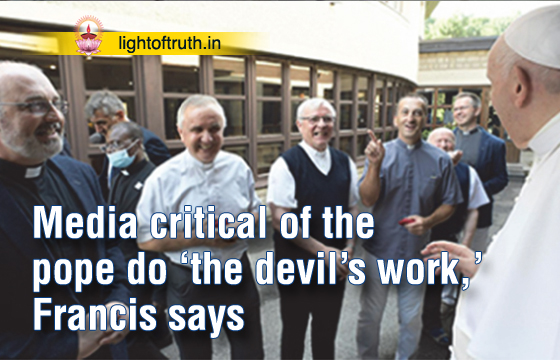
Media critical of the pope do ‘the devil’s work,’ Francis says
In his conversation with Slovakian Jesuits while visiting the country, Pope Francis took a swipe at his media critics, saying he sometimes loses patience with people who insult without know-ing the facts. He also criticized members of the Church who he said are too nostalgic for the past, such as priests who are more attached to the Old Latin Rite of the Mass than they are to their parish communities, which he said is a sign that the Church is going backwards.
Asked how he was doing at the opening of the Sept. 12 encounter, which took place as part of a broader apostolic visit to Hungary and Slovakia, Francis said he was, “Still alive, even though some people wanted me to die.”
His visit to Hungary and Slovakia was the first international trip he has made since he had colon surgery July 4, in which a large portion of his lower intestine was removed due to a stenotic diverticulitis, or a hardening of the tissue in his colon.

Armenian bishops elect former U.S. pastor as patriarch
The bishops of the Armenian Catholic Church elected Archbishop Raphaël François Minassian, the ordinary for Armenian Catholics in Eastern Europe, to be their church’s new patriarch.
Upon his election, the 74-year-old patriarch took the name Patriarch Raphaël Pierre XXI Minassian, the Vatican said in an announcement Sept. 23.
The patriarch-to-be and his 11 confreres began meeting in Rome Sept. 20 to begin their second attempt at electing a patriarch.
The bishops had met in Lebanon for two weeks beginning June 22, but no candidate had garnered the two-thirds vote necessary to succeed Patriarch Grégoire Pierre XX Ghabroyan, who died in Beirut May 25.
In accordance with church law, after the unsuccessful election, the bishops turned to Pope Francis. He asked them to gather in Rome and begin the electoral process again Sept. 22 after two days of prayer and reflection.
Patriarch Minassian was born in Beirut Nov. 24, 1946, and prepared for the priest-hood at the patriarchal semi-nary in Bzommar before studying philosophy and theology at Rome’s Pontifical Gregorian University and doing special studies in educational psychology at the Pontifical Salesian University.
Ordained to the priesthood in 1973, he served as pastor in Armenian parishes in Lebanon and as secretary for five years to Patriarch Jean Pierre XVIII Kasparian.
After serving as a judge in the Armenian church tribunal in Beirut and teaching Armenian at a Catholic university, he was transferred to the United States where he served as a pastor in New York before serving as pastor of Armenian Catholics in California, Arizona and Nevada.
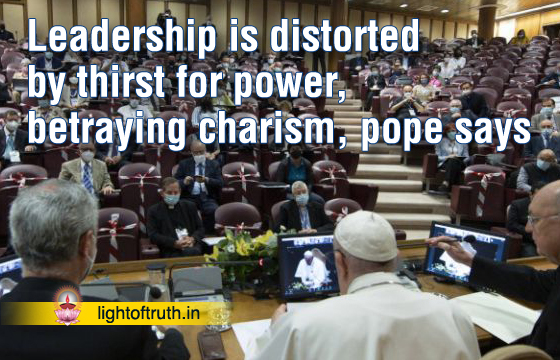
Leadership is distorted by thirst for power, betraying charism, pope says
Pope Francis praised Catholic lay movements and associations for living out the Gospel in their everyday lives and for promoting education, social support and evangelization in the world’s peripheries.
They show how “we don’t have to wait for a priest to come, for the priest to evangelize or a missionary,” he said, applauding the way many movements have reawakened the understanding that all the baptized have the duty to evangelize and be a missionary church.
However, just like the world’s religious orders and congregations, the Pope said, lay movements and associations of the faithful are just as susceptible to abuses and problems, all of which stem from an abuse of power.
All associations, not just some or just the large ones, must learn what good governance entails, he added.
The Pope spoke Sept. 16 in the Vatican’s synod hall to people taking part — online and onsite in Rome — in a meeting organized by the Dicastery for Laity, the Family and Life, focusing on the issue of responsible governance in lay movements and associations. Participants included “moderators” of associations of lay faithful, movements and new communities.
The Pope told them: “To govern is to serve. The exercise of governance within associations and movements is a topic that is particularly close to my heart, especially considering – what I said before – the cases of different kinds of abuse which have occurred in these situations, too, and that they always find their roots in the abuse of power.” “This is the cause — the abuse of power,” the pope said.
The issue of abuse of power and good governance is so close to his heart that the Pope’s already lengthy original talk of four pages became five pages as his off-the-cuff remarks expanded on particular points, offered explanations and provided colorful examples.
The study is showing that it has not just been happening with the larger groups, but also small institutes, he said, and that the scandals are not just the more well-known ones but include things groups “have done in order to feel like a separate church, they seem like saviors!” He said he knows of three religious institutes in his native country of Argentina that have already been suppressed after ending up in some “dirty” or dishonest situations.