
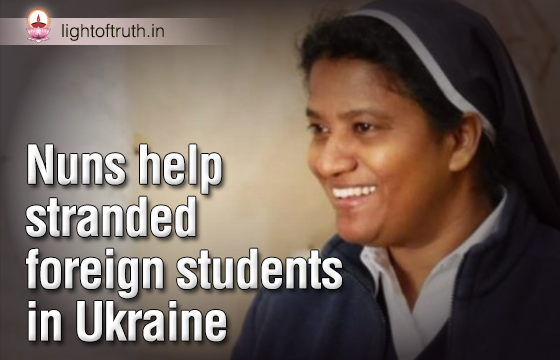
An Indian Catholic nun and her associates are working round-the-clock to help stranded students and others fleeing war-torn Ukraine.
“God is using me to save people from death in Ukraine,” said Sister Ligi Payyappilly, the 48-year-old superior of the Sisters of St. Joseph of Saint-Marc in Ukraine.
Payyappilly, who is Indian, and 17 sisters of her congregation are giving shelter and food to the distressed students, besides helping them cross the Ukrainian border to escape to countries including Hungary, Ro-mania and Slovakia.
“Being in Ukraine for over 20 years, I have a lot of contacts and networks that helped me carry out this mission so far,” Payyappilly told GSR by phone after midnight March 3, just before her scheduled two-hour sleep. Her convent is in Mukachevo in western Ukraine, some 480 miles southwest of the national capital of Kiev.
People helped by Payyappilly’s team profusely thanked the nuns.
“We never thought we would be alive now,” said Vignesh Suresh, a third-year student of medicine who hails Payyappilly as “God’s angel who came to help us when we were totally lost.”
Speaking to GSR en route to Bucharest by train, Suresh said he and 45 other Indian students were stranded at the Polish border for 15 hours when Sisters Payyappilly and Christina Tymurzhina, a Ukrainian, came to help them.
“The sisters took us to their convent in their vehicles, hugged each of us with their love and warmth, gave us food, a warm hall to sleep in and escorted us in the morning to cross the Romania border,” Suresh said as his friends slept on the train.
All posts by Light of Truth
JAMSHEDPUR JESUIT PROVINVCE’S – PLATINUM JUBILEE
On Saturday, 12th March, 2022, the Jamshedpur Province JESUIT family members gathered together to thank the Almighty God for the numerous blessings received by the Province and for guiding the Province over these seventy five years- 1947 to 2022. The concelebrating of the Holy Eucharist was led by His Excellency Most Reverend Felix Toppo, S.J, Archbishop of Ranchi. Archdiocese – Jamshedpur Province’s very own Jesuit, assisted by Rt. Rev. Telesphore Bilung, SVD, Bishop of Jamshedpur, Rev. Fr. Raphael Hyde, S.J. Provincial of Calcutta Province, Rev. Fr. Ajit Kumar Xess, S.J. Provincial of Ranchi Province and Rev. Fr. Jerome Cutinha, S.J, Provincial of Jamshedpur.
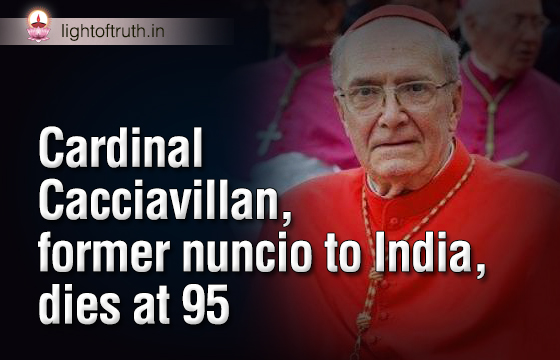
Cardinal Cacciavillan, former nuncio to India, dies at 95
Italian Cardinal Agostino Cacciavillan, a former papal nuncio to India who delicately handled the rivalry between the three rites in the country, died on March 5 at the age of 95. The long-time Vatican diplomat was also a nuncio to the United States and headed the Vatican investment office.
He served in Washington as nuncio to the United States and Vatican re-presentative to the Organization of American States from 1990 to 1998.
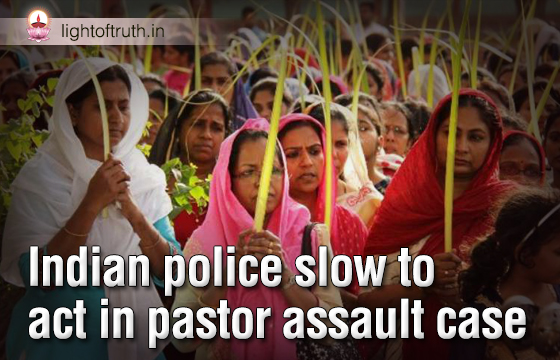
Indian police slow to act in pastor assault case
Police in India’s national capital New Delhi took four days to file an offense against unknown attackers of a tribal Christian pastor who was manhandled and forced to chant a slogan hailing Hindu gods.
Pastor Kelom Tete was attacked by a mob in South Delhi’s Fatehpuri Berri area on Feb. 25. He was accused of being involved in religious conversion activities and forced to chant “Jai Shri Ram” (Hail Lord Ram), according to the offense registered on March 3.
BIBLE QUIZ IN TELUGU RELEASED
“Ignorance of the Bible is ignorance of Christ!’ (Saint Jerome). The book BIBLE QUIZ (Telugu edition) is an extremely useful means in banishing this ignorance and imparting true knowledge of the entire Bible to our young generation in the twin States of Andhra Pradesh and Telengana.” said Most Rev. Thelagathotti Raja Rao, Bishop of Vijayawada and Chair-man of the Andhra-Telangana Bible.
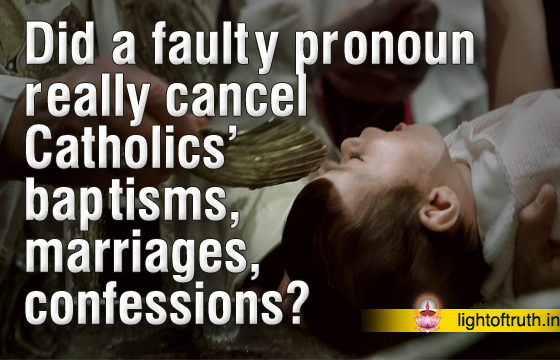
Did a faulty pronoun really cancel Catholics’ baptisms, marriages, confessions?
The Rev. Andres Arango for decades said “We baptize you in the name of the …” instead of “I baptize you in the name of …” After diocesan officials found that out, they said last month that people who Arango baptized aren’t technically Catholic. That means they weren’t eligible, from a Catholic point of view, for other sacraments.
The story made news around the world. Some wondered how what appears to have been an innocent mistake over pronouns could threaten people’s very sense of religious security. Others saw evidence of a long time debate among Catholics about who holds power, laypeople or the clergy. Cases of priests whose own childhood baptisms had the word “we” started to surface.
Looking for more information, The Washington Post this week interviewed the Rev. Thomas Reese, a political scientist and long time journalist who has written several books about the inner workings of the Catholic Church. Reese first wrote about the baptism wording issue in 2020, in an article whose headline began: “Vatican causes chaos.”
“ The [Vatican’s doctrine-enforcing arm] that year issued a document saying any baptism using “we” vs. “I” is not only illicit but invalid; the baptism doesn’t happen. I said then that this will cause absolute chaos in the Church. There were priests doing this out of the feeling it might make [the baptism ceremony] more colloquial. No one thought anything serious about it. Maybe it’s against the rules but the baptisms were still valid, people thought. When the [Vatican] did this in June 2020, I felt it was a pastoral disaster for the Church and for people. I thought: “They have to pull this rule, to reverse this.” said Rev. T. Reese. “They issued what’s called a “doctrinal note,” which are usually responses to questions they get from bishops or priests. I don’t think the use of “we” was widespread. It was one of those things that happened after the Second Vatican Council [in the 1960s] when people were a little looser with liturgical rules. Some Catholics wanted to be more inclusive and less clerical, and some felt using “we” would do that.” Pope Francis talks about synodality, but that’s what this is – it’s about consulting and talking and listening to all kinds of voices in the Church.
“My strong feeling is, if the Church wants us to say “I,” I will. But then to say that if someone says “we,” that the baptism is invalid? I think it’s nuts.”

Indian minorities hail Supreme Court relief for protesters
Indian Christian and Mu-slim leaders have hailed a Supreme Court judgment directing a refund of fines collected by the Uttar Pradesh state government from those protesting against the Citizenship Amendment Act (CAA) Bill.
The fines amounting to 2.24 million rupees (US$29, 900) were imposed on more than 800 protesters alleging they had damaged public property during the nationwide agitation in 2019.
In a landmark judgment, the apex court directed authorities in the northern state to refund the entire amount, saying the proceedings were contrary to the law and cannot be sustained.
The state authorities were pushed on the back foot after being accused by the apex court of being the “complainant, adjudicator and prosecutor” and arbitrarily recovering the fines from elderly people over 90 years of age, women, students and activists.
The authorities had accused these protesters of vandalizing public property while participating in protests held nationwide against a legal amendment to the citizenship law that was based on religion and discriminatory.
The controversial bill sought to amend the Citizenship Act, 1955, to make illegal migrants who are Hindus, Sikhs, Buddhists, Jains, Parsis and Christians from Afghanistan, Bangladesh and Pakistan eligible for Indian citizenship. The bill relaxed the requirement of residence in India from 11 years to six years for these mi-grants but excluded Muslims.
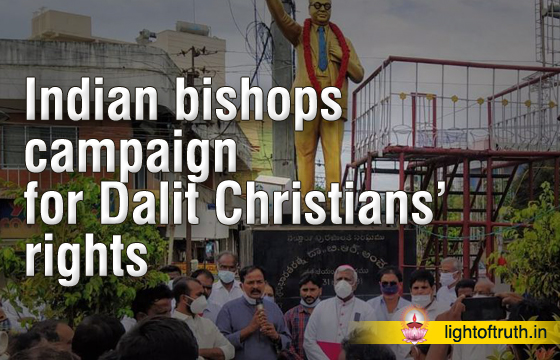
Indian bishops campaign for Dalit Christians’ rights
Catholic bishops in a southern Indian state have launched a campaign to mobilize political support to end discrimination against Dalit Christians in the country.
“We have already handed over memoranda to all federal ministers, parliamentarians and state legislators from Kerala state seeking their support to end discrimination against Dalit Christians,” Aux. Bishop Jacob Muricken of Pala told on Feb. 23.
Kerala’s bishops want India’s political leadership to help them improve the conditions of Dalit Christians who still bear the brunt of social discrimination and economic back-wardness.
“We know our Dalit Christian brothers and sisters are discriminated on the basis of their faith despite the fact that the Indian constitution is religion-neutral,” Bp Muricken said.
Dalits (formerly untouchables), who constitute the lowest stratum of the Hindu caste system, have converted to various other religions including Buddhism, Sikhism, Christianity and Islam. They are officially categorized as scheduled castes (SCs) and entitled to special welfare benefits.
However, Dalits among Christians and Muslims are denied SC status and are thus deprived of welfare schemes such as reservations in government jobs, educational institutions and electoral politics.

India’s tribal Christians wary of marrying, converting outsiders
The Christian-majority state of Mizoram in northeast India has been rocked by a marriage leading to a religious conversion and granting of tribal status to an outsider.
At the center of the heated controversy is the scheduled tribe (ST) certificate issued by the Aizawal district administration in 2018 to Kamrul Islam Laskar, a non-tribal man who married a local Mizo woman. Laskar converted to Christianity and even adopted a local name – Kamlova Chhangte – but the nativist organizations who are dead against outsiders marrying into the predominantly Christian tribes want nothing of it.
The Mizo people are known to be inseparably knitted together by their strong ethnic, familial and religious bonds.
A coordination committee steered by the Young Mizo Association (YMA), arguably the most influential student body in the state, now wants state authorities to cancel the ST certificate issued to Laskar.
The YMA has long demanded a law to ensure that Mizo women who marry a non-tribal man should lose their ST status, robbing them of special privileges guaranteed in the Indian constitution including reservations in education and employment.
It has been joined by other influential student organizations like the Mizo Zirlai Pawl (MZP), known for administering an oath to school students across the state to not marry outside the Mizo tribes.
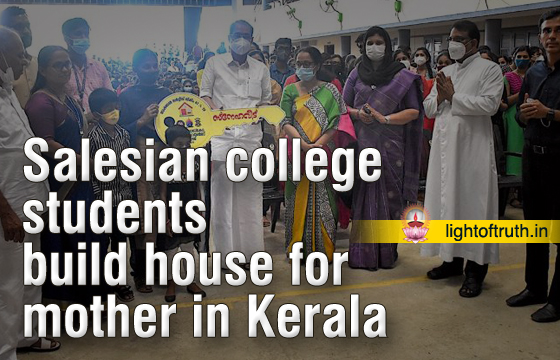
Salesian college students build house for mother in Kerala
A homeless mother with two children received a new house, thanks to the volunteers of Don Bosco Arts and Science College at Angadikadavu in Kerala’s Kannur district.
The project began when Lucy George, a Salesian cooperator, heard during a bus journey Jessy talk about her problems of being homeless.
George mentioned this to the students at Don Bosco Arts and Science College, who along with their teachers and management took up the challenge of constructing a house.
The 600-square-feet house has two bedrooms, a kitchen, a living room and a work area. The cost was provided for by donations from students, staff, management and well-wishers. It is the fourth house constructed by the college’s volunteers, reports Salesians Mission “Newswire.”