
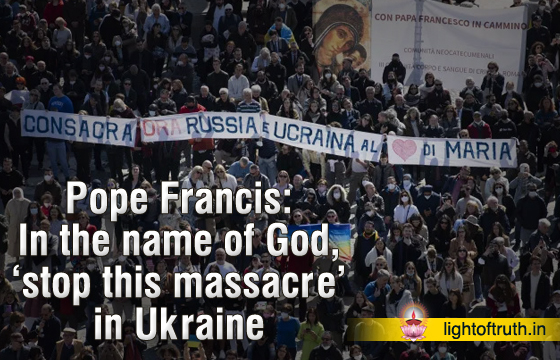
Pope Francis on March 13 called for an end to the “harrowing war” in Ukraine, condemning in particular the “barbarism” of Russia’s reported attacks last week on civilians— including pregnant women and children— in the eastern city of Mariupol.
“With an aching heart I add my voice to that of the common people, who implore the end of the war,” the Pope said March 13, addressing the crowd gathered in St. Peter’s Square in Rome following the Angelus, a Marian prayer.
“In the name of God, listen to the cry of those who suffer, and put an end to the bombings and the attacks! Let there be real and decisive focus on the negotiations, and let the humanitarian corridors be effective and safe. In the name of God, I ask you: stop this massacre!” The Pope’s words come following numerous reports last week of civilian casualties in Mariupol, amid Russia’s attempt to seize the strategically-located city as part of its ongoing invasion of Ukraine, which began on Feb. 24.
On March 9, a Russian strike on a maternity hospital in Mariupol killed at least three people and injured at least 17, according to local officials. Amid heavy loss of life in the city, there have been reports of civilians being buried in mass graves.
Pope Francis said that Mariupol, a city of 400,000 which was founded and named for the Virgin Mary, “has become a city martyred” amid the assault.
“Faced with the barbarism of the killing of children, and of innocent and defenseless citizens, there are no strategic reasons that hold up: the only thing to be done is to cease the unacceptable armed aggression before the city is reduced to a cemetery,” the Pope said. The Pope’s words echoed those of a prominent Catholic leader in Ukraine, Major Archbishop Sviatoslav Shevchuk, who lamented March 10 what he described as the “mass murder” of Ukrainians following Russia’s full-scale invasion. The following day, March 11, Shevchuk said the assault is “becoming a war primarily against the civilian, peaceful population.”
All posts by Light of Truth
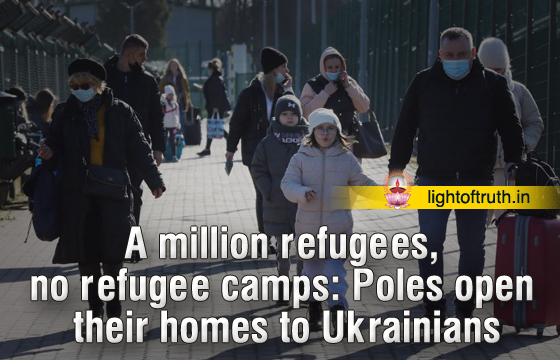
A million refugees, no refugee camps: Poles open their homes to Ukrainians
It was March 5 , three days into the Russian invasion of Ukraine when a friend called Jerzy Donimirski, a hotel owner from Kraków.
“He told me that while half of the country stands in the line at the border to pick up a Ukrainian family, there are people that have nowhere to go, no friends, no relatives,” he told Crux.
So Donimirski decided to open his four-star hotel in the heart of Kraków, by the Floriañska historical gate, to refugees.
“It is war everyone fears. I just had to do it.”
Last Monday, the first 20 people – six adults and 11 children – occupied rooms in his hotel.
“I thought it’s not too much of a burden for our hotel to take 20 more,” so he sent another bus to the border with Ukraine. Today, he has 45 refugees in Hotel Polski.
It is because of people like Donimirski, a Catholic and member of the Order of Malta, that Poland has a million refugees in its territory and not a single refugee camp.
As the Polish Ambassador to the United States, Marek Magierowski, told: “This is probably the first migration crisis in Europe’s history, in which the host country doesn’t need to build refugee camps.”
“Here in Poland, I really felt what fraternity is,” Olga Panivnyk told Polish Television on Sunday. She escaped Ukraine a week ago.
“It was scary – there were planes flying over our heads” she recalled. “Some of our friends had to stop on the way because there was a shooting in the fields.”
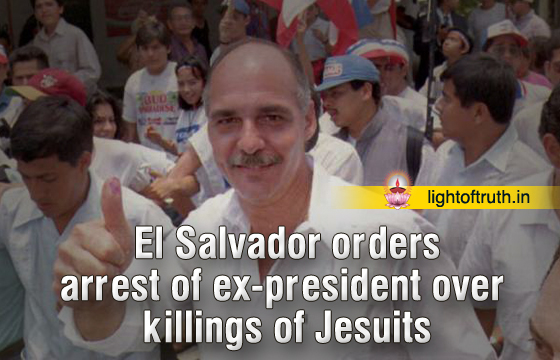
El Salvador orders arrest of ex-president over killings of Jesuits
A judge in El Salvador order-ed the arrest Friday of former president Alfredo Cristiani for alleged links to the murder of six Jesuit priests and two co-workers by the army during the country’s civil war, prosecutors said.
On November 16, 1989, Salvadoran troops from the now-banned Atlacatl battalion shot dead the Jesuits, five of them Spanish, at the Central American University in San Salvador. They also killed a woman who worked as their housekeeper and her 16-year-old daughter.
On February 25, prosecutors filed charges against Cristiani, who was president in 1989-1994, and a group of soldiers for alleged involvement in the murder.
Prosecutors said on Twitter Friday that a judge has ordered Cristiani, who is outside the country, former lawmaker Rodolfo Parker and four colonels to be put “under provisional detention.”
The former president, whose whereabouts are unknown, denied the charges and attacked Attorney General Rodolfo Delgado in a statement.
“The attorney general, in bad faith and with a clear disregard for the truth, has publicly accused me of omission and cover-up,” said Cristiani, who, in his capacity as president, was also commander-in-chief at the time of the killing. “The truth is that I never knew of the plans they had to commit those murders.”
He said that the military “never informed me or asked me for authorization because they knew that I would never have authorized Father Ellacuria or his brothers to be harmed.”
Cristiani also asserted that “at this time there are no procedural guarantees in El Salvador” be-cause most prosecutors and judges are controlled by the president.
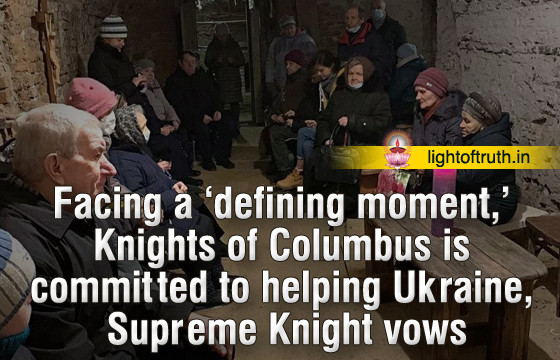
Facing a ‘defining moment,’ Knights of Columbus is committed to helping Ukraine, Supreme Knight vows
Much like 9/11 was a defining moment for the United States, “the brutal invasion of Ukraine will be a defining moment for the world,” and “the Knights of Columbus will have to be here for the long haul,” Supreme Knight Patrick Kelly told in an exclusive interview.
Since Russian forces launch-ed a large-scale military invasion of Ukraine on Feb. 24, members of the Knights of Columbus in Ukraine, Poland, and the United States have launched an unprecedented humanitarian effort to help the growing number of refugees displaced by the largest conventional military attack in Europe since World War II.
“Many Europeans were not ready to believe that a land war could happen again in Europe, so the Russian attack has not only been shocking, but a game-changer that will have long-lasting consequences for Europe and for the world,” Kelly told on March 4.
Kelly has conferred with the Knights of Columbus’ state deputy for Ukraine, Yuriy Malecki, to assess the situation. The Knights of Columbus started in Ukraine in 2012 and now has 40 councils there totaling some 2,000 members. “I can say that I have met those members, and that they are very solid Catholics, very enthusiastic in how they stand for charity, unity and fraternity — the true Knights’ spirit,” Kelly explained.
Kelly sent a video message to all Ukrainian Knights “telling them that I was praying for them, that I was asking God for assistance, and recalling for them that several proud moments in the history of the Knights of Columbus have come in the midst of tremendous challenge, such as the response of the Knights during the First and Second World Wars,” he told.
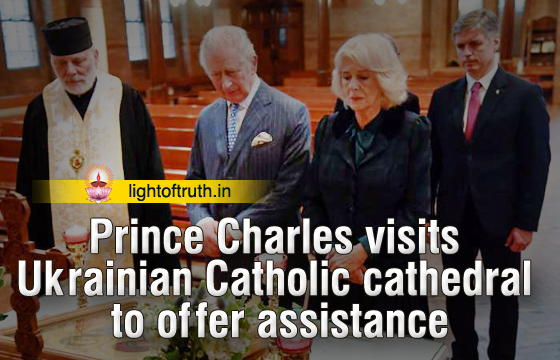
Prince Charles visits Ukrainian Catholic cathedral to offer assistance
Prince Charles, the heir to the British throne, visited the Ukrainian Catholic Cathedral in London to find out how he could assist in the humanitarian crisis emerging from the war in Ukraine. The prince and his wife, Camilla, the Duchess of Cornwall, were welcomed by Bishop Kenneth Nowakowski of the Ukrainian Catholic Eparchy of the Holy Family at the cathedral in London March 2 along with Vadym Prystaiko, the Ukrainian Ambassador to the UK, and his wife, Inna Prystaiko.
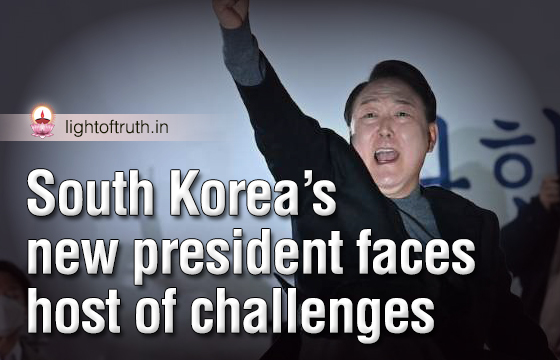
South Korea’s new president faces host of challenges
Yoon Suk-yeol, a conservative former top prosecutor, was declared winner in South Korea’s presidential polls on March 10, defeating a liberal rival in one of the most closely fought polls in the country’s history.
With more than 98 percent of the ballots counted, Yoon managed to secure 48.6% of votes against his rival Lee Jae-myung’s 47.8%. Both candidates spent months mocking and demonizing each other in a bitter political campaign.
Yoon will take office in May as leader of the world’s 10th-largest economy to serve a single five-year term.
In his first public action, after he became the presidential candidate for the People Power Party last October, he visited Yoido Full Gospel Church in Seoul on a Sunday, sang hymns and prayed with the congregation. Media reports said the move was to attract Christian votes and silence critics who said he followed shamanism.
He was baptized with the name Ambroise in the Catholic Church but he does not practice his faith life in any parish community, according to Church sources.
Christianity has emerged as the largest religion in South Korea and is followed by some 28% of its 51 million people, according to the 2015 national census. A larger group, some 56%, follows no religion at all. Some 15% follow Buddhism, making it the second-largest religion in the country.
In the run-up to the election, Yoon promised to deal sternly with provocations by North Korea and to boost trilateral security ties with Washington and Tokyo.

Myanmar conflict turns 16 parishes into ghost towns
Some 16 parishes in Loikaw Diocese in Myanmar’s Kayah state have been totally abandoned with the escalation of the conflict between military and rebel forces.
The green and mountainous eastern region bordering Thai-land was relatively peaceful for decades but has seen intense fighting since May 2021.
Parish priests, nuns and parishioners from these parishes have fled to safe areas, according to church officials.
Nearly two-thirds of the 90,000 Catholics in Kayah state have been forced to flee their homes, they added.
The junta has unleashed airstrikes and artillery shelling, forcing thousands of people including women, children, the elderly and the infirm to flee their homes to seek refuge in nearby jungles or churches in neighboring villages and towns.
At least seven Catholic churches have been hit by artillery shelling and airstrikes by Myan-mar’s military in Loikaw Diocese, with 16 out of 38 parishes severely affected by the intensifying fighting.
More than 650 houses and other civilian properties including churches, monasteries and schools have been burned or destroyed in Kayah since May 2021, according to reports cited by the UN.
Meanwhile, some parishes in Pekhon Diocese that covers Shan state and border areas of Kayah state have also been affected by the conflict.
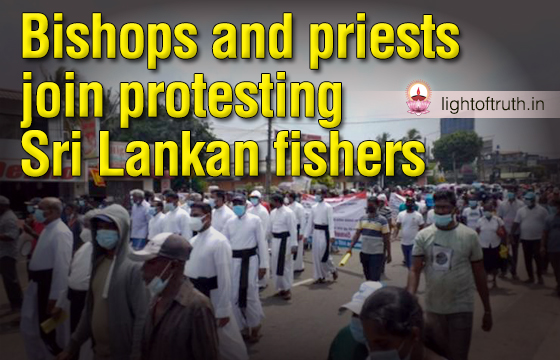
Bishops and priests join protesting Sri Lankan fishers
Bishops and priests joined fisher people in Sri Lanka on March 3 to demand protection of their livelihoods from destructive development projects that were harming the coast and the sea. Sebastian Fernando, a leader of local fishers, said: “The sea bed has been eroding for years. The people are constantly complaining but the authorities have not paid attention to their demand for a permanent solution.”
He said the sand being pump-ed to fill the east and west jetties of Colombo port was having a huge impact on fishing in the country. Seaweed and ornamental fish are greatly affected.
“The disaster-struck X-press Pearl ship also caused great damage to our marine environment but fishermen did not receive fair compensation,” said Fernando, referring to the environmental disaster unleashed by a cargo ship carrying chemicals that caught fire off the coast of Sri Lanka in May 2021.
Several containers have washed ashore from the X-press Pearl and nitrogen oxides have been released into the air and sea in large quantities, exposing the island nation to acid rain in the future, say experts.
Environmentalists have warn-ed that the chemicals inside the containers could enter the sea-water and pose a threat to the marine life system in the short and long term. The Catholic Church in Sri Lanka has repeatedly urged the government to compensate fishing families for their loss of livelihood and restore the environment.
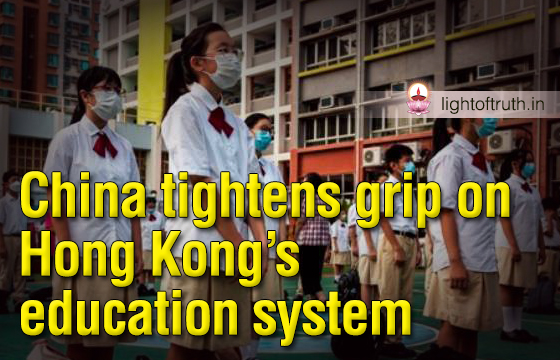
China tightens grip on Hong Kong’s education system
School education, the last bastion of the pro-democracy movement in Hong Kong, is falling asunder like the beads of a broken necklace.
The blood-red flag with five yellow stars flutters in the air on campuses in Hong Kong as it did in mainland China following the Tiananmen Square protest in 1989.
Students in Hong Kong are getting familiarized with patriotism with Chinese characteristics because there are still black sheep in universities and schools whose capitalist hearts have to be won over before they initiate the long march to socialism.
University and high school students made up the majority of protesters in 2019 and teenagers represented almost a fifth of the 10,000 arrests made as part of the crackdown, according to data by Bloomberg.

A karate trainer’s journey of faith in Hong Kong
Eddie Lo grew up in a religionless Chinese family and never considered practicing a religion despite his schooling under Catholic priests and brothers. But the Covid-19 pandemic and Hong Kong’s democracy struggle helped him change.
The 55-year-old professional karate trainer says “the seed of faith” he received at Hong Kong’s St Antony’s Primary School, run by the Salesians, has matured after four decades.
He is now a catechumen preparing to be baptized Ignatius Lo on Easter Saturday in St. Patrick’s Parish in Lok Fu under Hong Kong Diocese.
Lo is among some 1,550 adults under-going catechumen classes in 52 parishes and territories of the diocese, readying themselves to be baptized this Easter season.
Each year several thousand adults join Hong Kong Diocese. During Easter 2019, before the pandemic hit, some 2,800 adults were baptized. The number of adult baptisms has dwindled since then.
Lo grew up in a traditional family “with Dad and Mum following Confucius thinking but without any religion,” he recalled. He followed no religion until a year ago.
The isolation of the pandemic restrictions and the chaos of Hong Kong’s pro-democracy campaign guided him to the Catholic Church, he says.
As a martial arts trainer, his focus was on physical energy and techniques to control mind and body. But social disruption since 2019 as well as the pandemic made him “think and feel differently, especially with my students.”
Lo recalls that he was “harsh and tough” with his students to help them win competitions and gain recognition.
“But after what happened in Hong Kong, I began to appreciate young people with independent thinking and changed the way I teach them,” he says.
Young university students have been spearheading the pro-democracy movement with thousands taking to the streets protesting what they called their shrinking freedoms. It continued until the Chinese government suppressed protests with a sweeping new security law in June 2020.
As Covid-19 lockdowns and isolation continued, Lo wanted a change. He began to think about the meaning and purpose of life and even tried new things like making bread and practicing iaido, a Japanese martial art. “At the same time, I wanted someone to guide me for the future. I began to think that I needed more mental support and someone to rely on,” he says.