
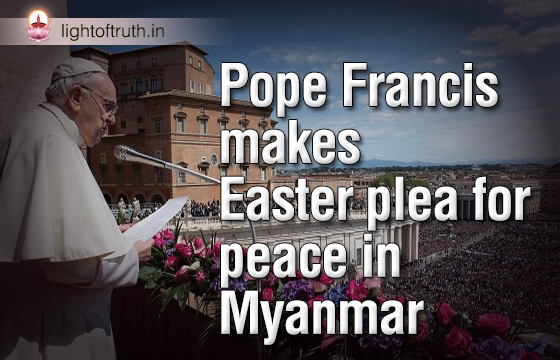
Pope Francis has again plead-ed for peace and reconciliation in conflict-torn Myanmar where millions of people including Christians have been oppressed by the brutal military junta.
During his Easter plea for peace around the world, he cited the Southeast Asian nation where violence has persisted for more than a year after the military ousted the civilian government.
“I pray that God grants re-conciliation for Myanmar, where a dramatic scenario of hatred and violence persists,” he said. “We need the crucified and risen Lord so that we can believe in the victory of love, and hope for reconciliation.”
His attention to the people of Myanmar comes as the world is focused on the war in Ukraine.
Pope Francis has spoken several times about the crisis in Myanmar, which he regards with much affection after visiting the country in November 2017.
He has repeatedly called for military leaders to stop the violence, release all detained people and pursue dialogue to seek peace and reconciliation.
“Let our families be healed, let our nation be healed, let our world be healed. We greet the families that are coming out of many challenges”
All posts by Light of Truth
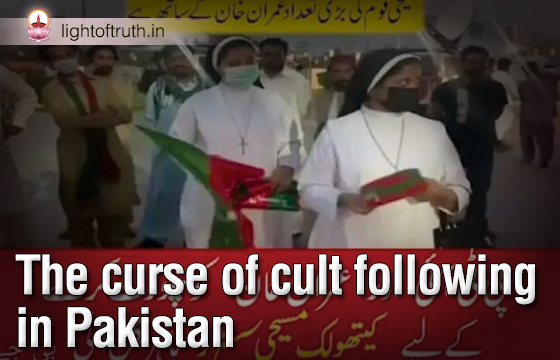
The curse of cult following in Pakistan
Ever since losing a vote of confidence moved by a united opposition this month, Pakistan’s former prime minister Imran Khan has divided the nation with his aggressive campaign — on the ground and online.
You either agree with him or risk being called a traitor to the country, a thief or lifafa (a journalist accepting bribes). The space keeps shrinking for free thinkers. However, nothing compares to the controversial content posted by his followers last week.
“Peace be upon him,” stated a Khan sticker on the back wind-shield of a car whose photo was shared on Facebook.
The Islamic honorific, commonly used by Sunni Muslims, follows specifically after uttering the name of the Prophet Muhammad.
One can easily dismiss the image as being photoshopped. Well, guess again after reading the comments from diehard followers of Khan’s Tehreek-e-Insaf (PTI) party.
“Peace be upon you, brother. Peace be upon everyone. It’s a prayer for safety, everyone should give it to each other,” stated Mohammad Bahoo Sarwar, president of Bahoo Films Corporation. All hail the cricketer hero who led the national team to its first and only World Cup win on March 25, 1992. A cult of personality was born that day.
Sadly, most people in the Islamic republic are neither as liberal nor moderate as Sarwar thinks. Media outlets in Pakistan follow a strict editorial policy of using this expression whenever mentioning the Prophet Muhammad. Religious minorities can be easily accused of blasphemy for using the same title with their names.
C. Raja Mohan, a contributing editor on international affairs for The Indian Express, even compared Khan to the Biblical character Samson determined to bring down the house of Pakistan, dominated until now by the army.
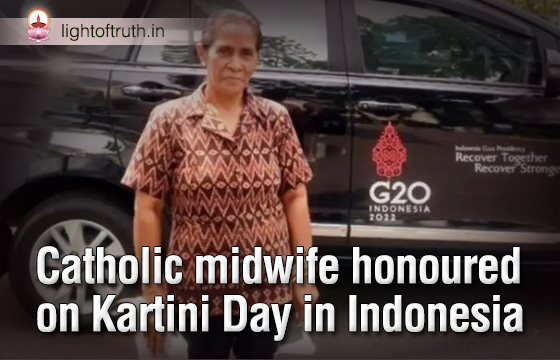
Catholic midwife honoured on Kartini Day in Indonesia
A Catholic midwife who has served a remote Indonesian province for more than three decades was among 10 women honoured by the government during its 144th Kartini Day celebrations.
Yovita Mariati, a midwife from Sikka district in East Nusa Tenggara province, received the award at the state palace in Jakarta on April 21.
Indonesians celebrate the day annually to commemorate the birth of their national heroine Raden Ajeng Kartini, hailed as a symbol of women’s empowerment for promoting gender equity and women’s rights during the Dutch colonial era.
Mariati has served new mothers and children as a midwife in Sikka district’s Nangalimang villages for the past 34 years.
The 54-year-old is a mother of four children who was widowed in 1999. She doesn’t get paid for her work and survives by selling hand-woven fabrics.
But that hasn’t stopped her from working for and advocating medical interventions to prevent diseases such as dengue fever, malaria and tuberculosis in the villages.
“I am crying and touched because it turns out that someone cares about what I have been doing all this time. I never thought that one day I would be rewarded like this”
An emotional Mariati, who received the award from First Lady Iriana Widodo, said: “I am crying and touched because it turns out that someone cares about what I have been doing all this time. I never thought that one day I would be rewarded like this.” She said she had only tried to do what she could for her fellow humans based on her high school education and the training and experience she had gained while being on the job.
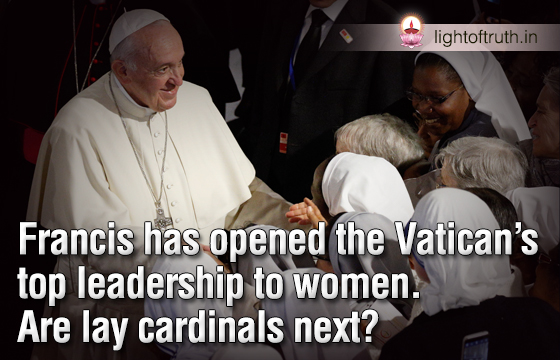
Francis has opened the Vatican’s top leadership to women. Are lay cardinals next?
Pope Francis is reorganizing the Vatican Curia — the church’s administrators and his senior staff — and may name new cardinals in June. Francis’ new apostolic constitution, “Praedicate Evangelium” (“Preach the Gospel”), issued last month, noted that the heads of dicasteries and other offices that manage the church need not be ordained. This highlighted Francis’ stated aim to give “more space” to women in the church.
Most of the important dicasteries are as a matter of fact headed by cardinals. But if any Catholic can head a curial office, the question becomes, does the title come with the job? More importantly, is the title needed to do the job?
If the main duty of a cardinal is to be an adviser to the pope, and there is no ordination required, it could make sense to restart the tradition of lay cardinals and to include women in the mix. Since the 16th century, cardinals have come mostly from the ranks of priests and bishops, but this has not always been the case. Some Spanish and Italian royals were created cardinals in the medieval church. More recently, Pope Pius IX named the curial lawyer Teodolfo Mertel a cardinal, two months before ordaining him deacon in 1858.
Mertel was not exactly a lay cardinal — he received clerical tonsure, a rite just short of ordination, in his late 30s — but he remained a cardinal deacon for the rest of his life. As auditor of the papal treasury, he oversaw a good part of the Vatican’s money.
There is even historical evidence of female deacons doing much the same. A sixth-century inscription recalls the Deacon Anna, who, with her brother, appears to have served as the treasurer of Rome.
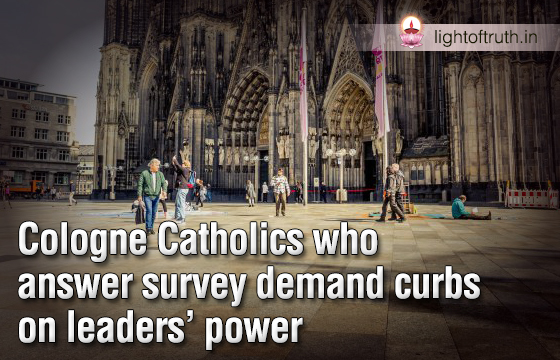
Cologne Catholics who answer survey demand curbs on leaders’ power
Archdiocesan Catholics who responded to a survey preparing for the 2023 worldwide Synod of Bishops on synodality called for some big changes in the church. The German Catholic news agency KNA reported that a statement on the archdiocese’s website noted a majority of respondents called for the faithful to be given greater self-determination and demanded major curbs on the power of the church leadership and priests. Offices, ministries and functions should be assigned on a temporary basis, they said. In addition, church members should have a democratic say in matters such as the election of bishops.
The Archdiocese of Cologne has just under 1.9 million Catholics, KNA reported. More than 1,700 people — about .09 percent of archdiocesan Catholics — took part in the non-representative online survey, “Tell the pope — what should the future of the church look like?” They submitted more than 5,400 contributions and 1,200 comments.
The survey results were summarized by an agency in accordance with social science standards. The findings showed that respondents favoured a “separation of powers as in democracies” instead of “priest-center-edness.” In addition, people of all sexual orientations and those who had been married several times should feel fully accepted in the faith community, respondents said.
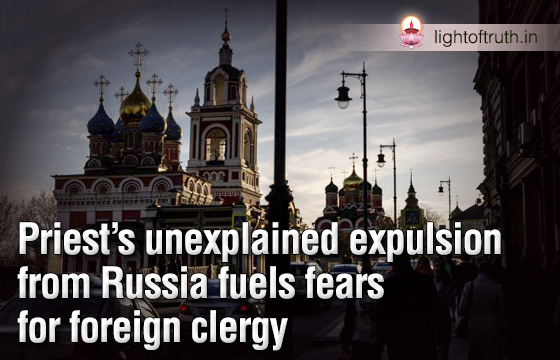
Priest’s unexplained expulsion from Russia fuels fears for foreign clergy
A Catholic priest was expelled from Russia without explanation, amid fears for the well-being of other clergy ministering in the country.
Father Fernando Vera, a Mexican member of Opus Dei, left Russia in mid-April after being told his residence permit was revoked.
Father Kirill Gorbunov, spokesman for the Russian bishops’ conference, told Catholic News Service April 21 no reason had been given for the priest’s expulsion, adding that the Catholic Church had “no reason” to believe it was connected with the conflict in Ukraine.
“All he did was relay to people what our bishops had already said – there’s no indication he went beyond that,” Gorbunov told. “The letter he received states that a person has the right to appeal, so we hope he’ll reapply for a visa and have a chance to resume his service here.”
“Although I haven’t listened to his church homilies, I know him personally as a balanced, reasonable person, who wouldn’t take radical positions. …Most priests and religious order members here are foreigners, and their superiors abroad are growing worried about them, with some suggesting they should consider leaving Russia for their own safety.”

Old folks really are happier, kinder thanks to abundance of ‘love hormone’
New study reveals that people who spent much of their lives volunteering, giving to charity, or helping others have higher levels of oxytocin
Seniors really are kinder than younger generations thanks to the “love hormone” released in older people’s brains, according to new re-search. People who release more of the neurochemical oxytocin are kinder to others and tend to be more satisfied with their lives, say scientists.
The amount of oxytocin released in the brain increases with age, showing that on average, people are more caring as they get older, researchers say. Experts reveal that these findings are consistent with many religious philosophies, where satisfaction with one’s life is enhanced by helping others.
Oxytocin is a neurochemical widely known for its role in social attachment, inter-personal trust, and generosity. It’s also known as the “love hormone.” “The findings of our study are consistent with many religions and philosophies, where satisfaction with one’s life is enhanced by helping others,” says study first author Dr. Paul J. Zak of Claremont Graduate University in California, in a statement. “Participants in our study who released the most oxytocin were more generous to charity when given the opportunity and performed many other helping behaviours. The change in oxytocin was also positively related to participants’ empathy, religious participation, and gratitude.”
Dr. Zak and his colleagues wanted to understand if the release of oxytocin changed with age, as is found with some other neurochemicals that influence feelings and behaviors.
“We have previously shown a link between how kind and generous people are, known as prosocial behaviours, and the rel-ease of oxytocin,” he adds. “Seniors spend more time volunteering and donate a larger propor-tion of their income to charity than do younger people, so we wanted to see if there was a neurochemical basis for these behaviours.”

Burger King in Spain Apologizes, pulls offensive Holy Week ads
The fast-food chain Burger King in Spain has with-drawn and apologized for an offensive ad campaign that sparked outrage among Catholics during Holy Week.
“We apologize to all those who have felt offended by our campaign aimed at promoting our vegetable products during Holy Week. Our intention has never been to offend anyone and the immediate withdrawal of the campaign has already been requested,” Burger King announced Easter Sunday on its official Twitter account.
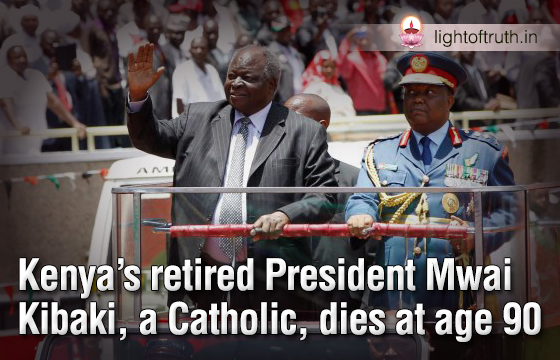
Kenya’s retired President Mwai Kibaki, a Catholic, dies at age 90
Emilio Stanley Mwai Kibaki, who served as president of Kenya from 2002 to 2012, died April 22. He was 90. President Uhuru Kenyatta declared a national mourning period for Kibaki, a Catholic. Details of his funeral were not announced immediately.
“As we mourn this immeasurable loss, we recall with eternal gratitude President Kibaki’s patriotic journey in the service of his country, which can be traced way back in Kenya’s fight for liberation,” said Kenyatta, describing Kibaki as a gentleman of Kenyan politics, a brilliant debater whose eloquence, wit and charm won the day.

Superiors plenary to focus on synodal experience in religious life
The International Union of Superiors General (UISG) is scheduled to meet in Rome May 2-6 for its 22nd Plenary Assembly which will bring together some 700 religious of 71 different nationalities.
As many as 521 superiors general are expected to attend in person to discuss the theme: “Embracing Vulnerability in the Synodal Journey”.
Ten key speakers will lead reflections on the focus theme of synodality from five perspectives: vulnerability, synodal process, religious life and synodality, peripheries, and calls to transformation.
The event will be presented at 12,00 pm on April 29 at the Press Office of the Holy See by Sister Jolanta Kafka, UISG president, Sister Patricia Murray, executive secretary, Sister Franca Zonta, superior general of the Marianist Sisters, and Sister Roxanne Schares, superior general of the School Sisters of Notre Dame.
A space for listening and research
“There are many ways to make synodality visible: our assembly, with its contents and methods, is an experience of synodality of female religious life and we truly hope to experience a privileged space of listening and research accompanied by the Holy Spirit,” Sister Jolanta explains. “We will discuss how we are contributing to the synodal process of the Church, how we can encourage deep listening in a synodal style, and how to enter into a dynamic of common discernment as a Church by recognizing vulnerability as a typically human feature”.
The UISG was founded in 1965 as a global forum for superiors general of institutions of Catholic women religious. Its members include some 1,900 superiors, whose general houses are distributed in 97 countries around the globe: 25 European countries; 16 Asian countries, 30 American countries, 22 countries in Africa, and 4 countries in Oceania.