
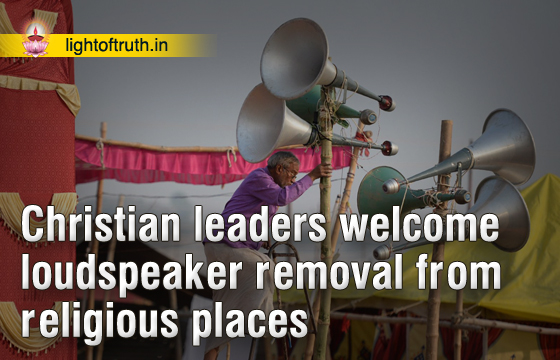
Some Catholic leaders in Uttar Pradesh have welcomed a government drive to remove loud speakers from religious places in the northern Indian state. “If the government is doing it in a non-partisan way and without religious prejudices, it is to be appreciated,” says Father Anand Mathew, who quoted some reports to point out that majority of the loudspeakers removed in the past decades were from the Hindu temple tops.
The Uttar Pradesh government on April 25 began a statewide drive to remove unauthorized loudspeakers from religious places and set the volume of others within permissible limits.
Additional Director General of Police (Law and Order) Prashant Kumar told re-porters that by May 1 morning they have removed a total of 53,942 loudspeakers and set the volume of 60,295 loudspeakers within permissible limits.
Kumar clarified that they are removing the loudspeakers from all religious places without any discrimination.
Meanwhile a senior home department official confirmed that the drive will continue in the coming days.
Those loudspeakers which have been placed without taking due permission from the district administration or the ones which are placed in excess of the permitted numbers are categorized as unauthorized, Kumar explained.
He said the administration also considered the High Court order regarding loudspeakers. After a 2017 government order on the matter, the High Court had asked it if loudspeakers at religious and public places were installed after taking permission in writing from authorities referring to the Noise Pollution (Regulation and Control) Rules, 2000.
All posts by Light of Truth
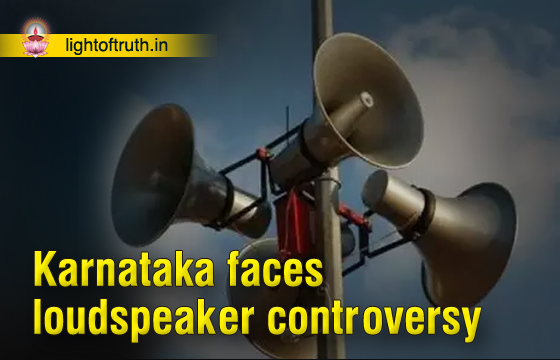
Karnataka faces loudspeaker controversy
People in Karnataka began from May 9 to get up at 5 am to pray, sing or curse.
Muslims in the southern Indian state start their day with Azaan announced through loud-speakers fit atop mosques. Hindus, on the hand, use the public address system to counter the Muslim call to prayer with “Suprabhata” and “Hanuman Chalisa” (hymns in praise of Lord Hanuman).
Pramod Muthalik, founder of the Sri Ram Sena (army of Lord Ram), on May 9 opened the Hindu prayer at 5 am in temples of Mysore temples. More than 1,000 Hindu temples in the state also did the same, he claimed.
A controversy over Muslim using loudspeakers to announce Azaan was reported from states such as Uttar Pradesh and Maharashtra. They have enacted laws to control the use of loud-speakers by any religious group. The Uttar Pradesh government of the Hindu nationalist Bharatiya Janata Party (BJP), has removed 54,000 unauthorized loudspeakers from religious places.
The Karnataka government, led also by the BJP, is yet to en-act a law on loudspeakers. How-ever, it has succeeded in controlling Muslim girl students wearing veil in schools. Muslim traders are reportedly barred from Hindu festival while people are urged to avoid food prepared according to Muslim customs or Malls owned by Muslims.
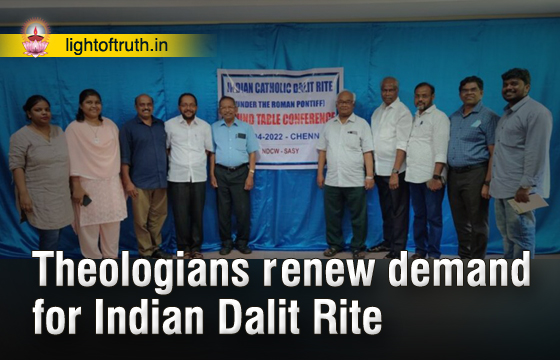
Theologians renew demand for Indian Dalit Rite
The demand for a Dalit Rite in the Catholic Church in India was reiterated at a conference of theologians, biblical scholars and canon law experts from the community. Caste is a stark reality and caste-based discrimination is rampant in the Catholic Church’s hierarchy, parishes and institutions, bemoans Reverend Vincent Manoharan, a theologian, while introducing the April 28-29 conference at St. Thomas International Centre, Chennai.
Dalits, he pointed out, are totally neglected in the Church despite the Dalit Empowerment Policy of the Catholic Bishops’ Conference of India that demanding to set it right.
The bishops issued the policy on December 13, 2016, that acknowledged that “caste discrimination is a grave social sin” and committed to ensuring that the practice of untouchability will not be tolerated within the Church. Reverend Manoharan also added that the Dalit representation is abominable in the Catholic Church and their voices are not heard adequately.
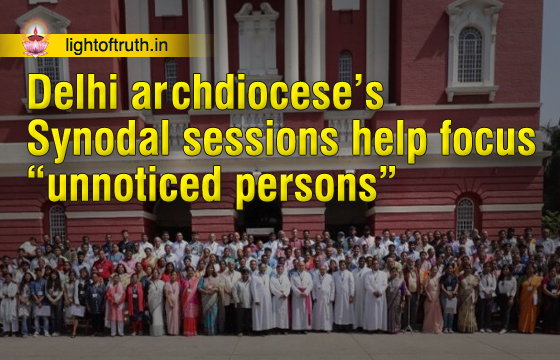
Delhi archdiocese’s Synodal sessions help focus “unnoticed persons”
Thousands of Catholics have attended the Delhi archdiocesan consultation meetings to prepare for the Rome Synod that began more than six months ago.
While Jesuit Father Stanislaus Alla, a theology professor, finds the process “truly historic,” Abp Anil J Couto of Delhi, who initiated it, says the Church in the archdiocese will not be the same after the exercise ends.
Father Alla, who teaches in Delhi’s Vidyajyoti College of Theology, has read through hundreds of pages of reports from various groups in the archdiocese and drafted the “Diocesan Syn-thesis” with his colleague, Presentation Sister Shalini Mulackal.
The latest archdiocesan Pre-Synodal meeting at the cathedral campus in New Delhi was attend-ed by 8-month-old Ayston Jez and 85-year-old Emeritus Abp Vincent Concessao of Delhi among more than 200 participants.
Archbishop Couto opened the April 29-May 1 with a prayer and inaugural address. Auxiliary Bishop Deepak Tauro of Delhi presented an overview of the proceedings. The meeting ended with a Mass on May 2.
8-month-old Ayston Jez with Leena Sunny, a Core Committee member, and Archbishop Anil Couto of DelhiThe archdiocese launched the Synodal process October 17, 2021, with a Mass led by Archbishop Couto.
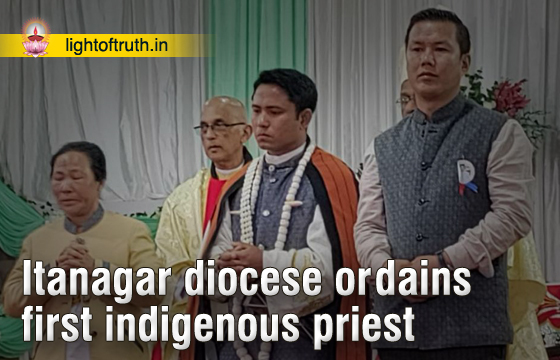
Itanagar diocese ordains first indigenous priest
Itanagar diocese in the north-eastern Indian state of Arunachal Pradesh May 7 ordained its first priest of indigenous origin
Bishop John Thomas of Itanagar ordained Father Roshan Bamin Peter, a member of the Apatani tribe, at Mary Immaculate Church, Hapoli, Ziro, his home parish in Lower Subansiri district.
“It is a proud moment for all of us in the diocese especially to the people of Apatani tribe,” Nani Yase Teresa, the president of Apatani Catholic Women Asso-ciation of Itanagar diocese. “It will inspire many young people of all tribes to become priests and nuns,” she added.
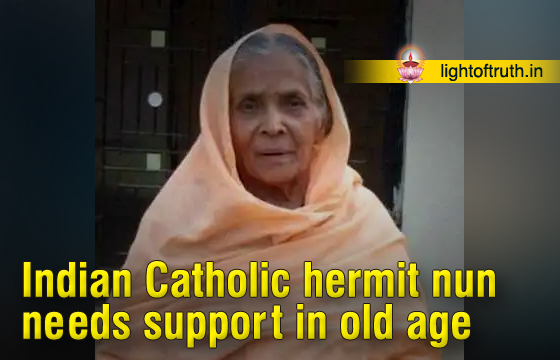
Indian Catholic hermit nun needs support in old age
An aging Catholic nun, who adopted Hindu ascetic life during the movement for inculturation of the Indian Church some five decades ago, now lives under the care of a parish priest in western India.
The 88-year-old Sister Prasanna Devi lived alone for around 40 years in a forest around the sacred hill of Girnar in Junagadh district of Gujarat known for its Jain and Hindu temples dating back to centuries.
The surrounding forests happen to be the only natural habitat of the Asiatic lions and are home to leopards, jackals, striped hyena and the Indian fox besides several species of mammals, birds and reptiles.
Sister Prasanna Devi lived in the midst of this wildlife inside a hut-like hermitage from 1974 until September 2014 when she had a fall that caused her to move out of the forest to the annex of St. Ann’s Catholic Church, located six kilometers away and falling under Rajkot Diocese.
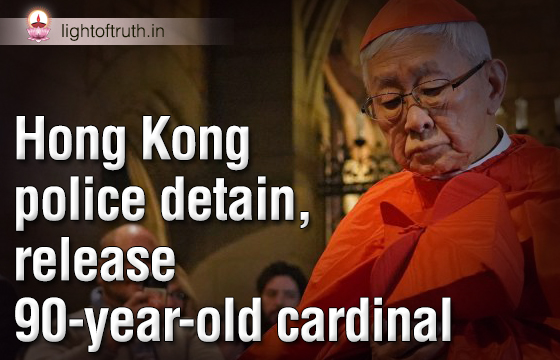
Hong Kong police detain, release 90-year-old cardinal
Hong Kong’s national security police released Cardinal Joseph Zen Zekiun, retired archbishop of Hong Kong, May 11 after detaining him for allegedly colluding with foreign forces.
The cardinal, 90, has been a very public supporter of pro-democracy and independence protests that have roiled the city for much of the past decade and came to a head in 2019 with unprecedented street marches and six months of spasmodic street battles with authorities. He was detained along with along with former opposition lawmaker Margaret Ng Ngoiyee and singer Denise Ho Wansze.
The independent Hong Kong Free Press tweeted a photo of a masked Cardinal Zen and said: “Cardinal Joseph Zen was released on bail from Chai Wan Police Station at around 11 p.m. on Wednesday. He did not speak. He then entered a private car parked outside the police station. The 90-year-old was accompanied by five people when he left the police station.”
The cardinal, Ng and Ho were among five trustees of the 612 Humanitarian Relief Fund, which was set up to offer financial assistance to those involved in anti-government protests in 2019 and which came under scrutiny of authorities over the past year.
A fourth trustee, former adjunct associate professor Hui Po Keung, was arrested by national security police May 10 as he was about to catch a flight to Germany, a source said. The South China Morning Post reported May 11 that Hui had been put on the list of people who would be stopped by law enforcers if they tried to leave the city via the airport or other control points.

Marcos Jr’s popularity shows lasting appeal of strongman leaders in the Philippines
Nearly 70 million Filipinos headed to polling centres on May 9)to elect the next president of the Philippines, hoping their pick will turn around a country battered by the COVID-19 pandemic over the last two years.
The fight for the presidency was centred between Ferdinand “Bongbong” Marcos Jr, the son and namesake of the late Filipino dictator, and Vice President Maria Leonor ”Leni” Robredo, a human rights lawyer and economist. On May 11 Marcos Jr claimed victory, after partial unofficial counts covering 98 percent of the votes showed he had obtained 31 million votes, double that of Robredo. Sara Duterte-Carpio, President Rodrigo Duterte’s daughter and Marcos Jr’s vice presidential running mate, has also been reported to have won over three times more voters than that of her closest opponent.
In the past, the Marcos family added to the general hardship of Filipinos by plundering billions of dollars from state coffers Dis-illusioned by unfulfilled promises from the Duterte administration to lower costs of living, end labour contractualisation and clean up corruption, they believe Marcos Jr could deliver change. Marcos’ campaign, focused on unifying the country and bringing it back to the global stage must have resonated.
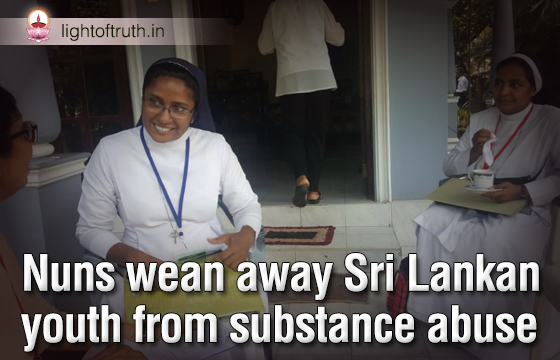
Nuns wean away Sri Lankan youth from substance abuse
Cletus (name changed) is just 24 but now undergoes treatment for heroin addiction at a rehabilitation centre in northern Sri Lanka.
The region, once the centre of the armed conflict between the Sri Lankan army and Tamil Tigers, now faces a new crisis – Substance Use Disorder, says Sister Theophane Cross, head of the Holy Family congregation’s Jaffna province.
The congregation in 2020 started its mission among sub-stance abuse victims when it celebrated its 200th anniversary of foundation.
The civil war ended in 2009, but the island nation is on another war – against drugs — “which is much more challenging and enslaving,” Sister Cross told.
The nuns, who are yet to open a de-addiction centre, refer their patients to the ‘Change Rehabilitation Centre’ managed by the Oblates of Mary Immaculate priests in Jaffna.
Sister Cross says she is deeply pained that most abuse victims are depressed young people with no jobs. “A lot of them are addicted to drugs and alcohol,” she bemoans.
Cletus was brought to the Oblate father’s centre in September 2021 by his wife, sister and mother on the advice of some Holy Family nuns who had visited them.

Pope tells Russian patriarch: ‘Don’t be Putin’s altar boy’
Warning that the Russian Orthodox patriarch should not “turn himself into Putin’s altar boy,” Pope Francis also said he would like to go to Moscow to meet Vladimir Putin in an attempt to end the conflict in Ukraine.
The Pope reiterated that he would not be going to Kyiv “for now,” but “I first must go to Moscow, I must first meet Putin,” he said in an interview with the Italian newspaper Corriere della Sera, published May 3. Vatican News also published most of the interview.
Pope Francis said he sent a message through Cardinal Pietro Parolin, Vatican secretary of state, “20 days after the war” started, to be delivered to Putin telling him, “I was ready to go to Moscow.”
“We still have not had a response, and we are still being persistent, even though I am afraid Putin may not be able to and may not want to have this meeting right now,” the Pope said. “I am doing what I can. If Putin were to open the door. …”
“But so much brutality, how do you not try to stop it? We saw the same thing with Rwanda,” he said, referring to the genocide against members of the Tutsi minority ethnic group in 1994, when at least 500,000 people were killed in about 100 days.