
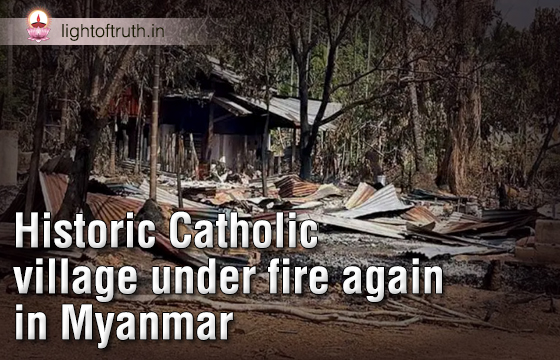
The Myanmar military has continued to target a historic Catholic village in the country’s Bamar heartland while pressing ahead with attacks on religious buildings in predominantly Christian regions. At least 320 out of the estimated 350 households were burned down during a military raid on Chaung Yoe village in the Sagaing region on May 20, according to local sources.
Thousands of Catholic villagers were forced to flee their homes to nearby safe areas as junta troops set fire to one house after another. Houses in three nearby Buddhist villages were also set ablaze during the military raid on the same day.
Sources said Mary Help of Christians Church, convent and the priest’s house were not damaged. The latest attack came just four days before the annual celebration of Mary Help of Christians on May 24.
“We have no homes and no property. Where will we stay in the village when we return if the situation is deemed safe?”
“It’s so sad. I was in tears when I saw smoke coming out from my village as my house was also burned down,” said a Catholic woman who sought safety among her relatives in a nearby town.
All posts by Light of Truth
Chinese bishop remains in detention one year on
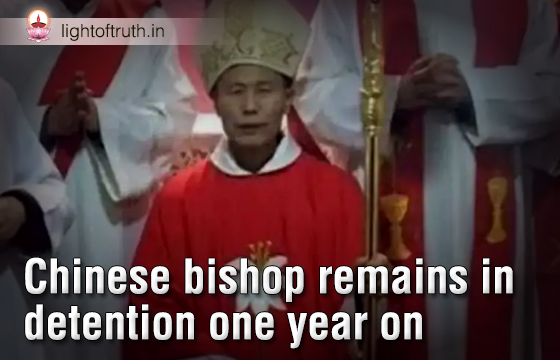
A Vatican-approved Chinese bishop remains in detention more than one year after his arrest for allegedly violating the communist country’s repressive regulations on religious affairs.
Bishop Joseph Zhang Weizhu of Xinxiang in Henan province was arrested on May 21 last year.
His arrest came a day after police arrested 10 priests and an unknown number of seminarians from a Catholic seminary in the diocese that was set up in an abandoned factory building.
About a year ago, authorities in Xinxiang shut down Catholic schools and kindergartens in line with a government ban on education by religious groups.
All those arrested were accused of violating China’s regulations on religious affairs and subjected to “political lessons” in detention, media re-ports said
The priests and seminarians were released after brief detention but remain under surveillance, while the seminary is still closed.
Since his secret ordination with a Vatican mandate in 1991, Bishop Zhang was under constant pressure and barred from carrying out his duties as Bishop.
Pakistan: ‘I spent 8 years on death row falsely accused of blasphemy’
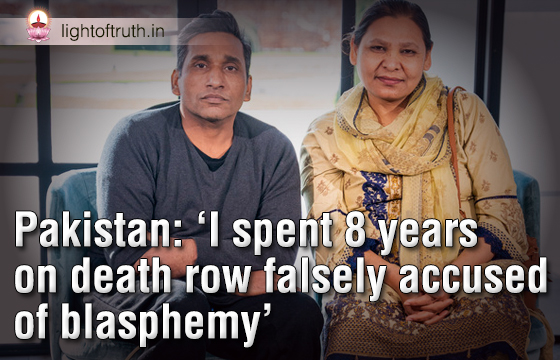
In July 2013, Shagufta and Shafqat Emmanuel, a Catholic couple in Mian Channu, a small town 155 miles south of Lahore, Pakistan, were arrested on false charges of blasphemy. After eight years on death row, separated from each other and from their four children, they were finally released on 3 June 2021 by the Lahore High Court. Free at last, Shagufta shares her story with ACN, in her own words.
“I was born into a family with a strong Christian faith. I regularly attended Mass and received Communion, and I was always very eager to go to the catechism and recite the rosary. My father and my mother taught me and my six brothers and sisters to be strong in our faith, and to be ready for all kinds of sacrifices or persecutions.
“Most families in our village were Muslim, but there was also a good number of Christians. We had very cordial relations with Muslims. I remember playing with Muslim girls and we visited each other’s homes and exchanged greetings and sweets during Christmas and Eid al-Fitr. My brothers also had very good Muslim friends. I do not remember any fight or dispute in the name of religion.
“A few years after marrying Shafqat Emmanuel we moved to Gojra, and my husband got a job there. Tragically he was paralysed by a stray bullet, while trying to break up a fight, about 12 years ago. Life was hard after that, but we were fortunate to get jobs at St John’s High School, in Gojra. After school hours, my husband used to repair cell phones, to make some extra money for family expenses.
“Then, one day in July 2013, we were terrified to see several police vans pull up, with dozens of officers. They raided our house and arrested my husband and I on charges of blasphemy in the form of an offensive message about Mohammed, sent via our mobile SIM card. The phone was registered in my name and was used by my husband as well. The offending message was written in English, a language neither my husband nor I speak or read. We were kept in police custody for one night; the next day we were transferred to jail.
“In jail, we were tortured. The officers told my husband that if he did not confess, they would rape me in front of him, and so he confessed, even though we were both innocent.
“We were in jail for eight months before a judge found us guilty and sentenced us to death. Our lawyer was not allowed to complete his closing arguments, and neither of us was heard.”
Hoping for divine intervention to save the Philippines
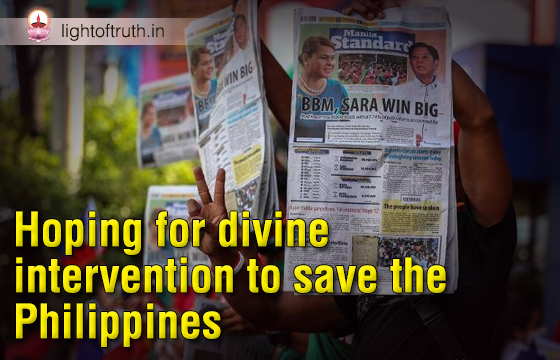
It has been five decades since the late Philippine dictator Ferdinand Marcos imposed martial law on Sept. 21, 1972. In this 50th year since the iron fist of repression was imposed, his son, Ferdinand “Bongbong” Marcos Jr., will soon be the country’s head of state. Sara Duterte, daughter of outgoing president Rodrigo Duterte, will serve as vice president.
Those who voted for them are rejoicing over the impending return of the so-called golden age, a mythical period of national prosperity, peace and order boastfully dubbed the “Bagong Lipunan” or “New Society.”
When I asked some of them why they were voting for Marcos and Duterte, they could not give clear answers. We can only hope against hope that they can answer this question honestly without being haunted by a not-so-erroneous conscience.
The apathetic others call on their fellow Filipinos to move on. Whatever the meaning of this call, they do not clearly comprehend it, sorry to say.
They can only heave a sigh of regret for their failure to combat the glaring impunity seen in the absence of punishment of human rights violators who roam free and enjoy positions of power.
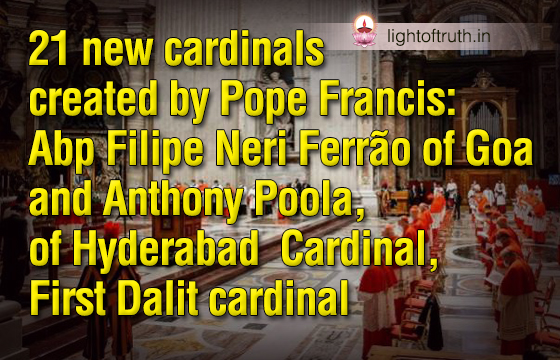
21 new cardinals created by Pope Francis: Abp Filipe Neri Ferrão of Goa and Anthony Poola, of Hyderabad Cardinals, First Dalit cardinal
There will be 16 cardinals under the age of 80 elevated at the next consistory, to be held Aug. 27. This will be the eighth consistory of Pope Francis’ pontificate, and the first of his to be held in August.
The last time a cardinal was made in August, a torrid month in Rome when all things slow down in the Vatican Curia, was on Aug. 24, 1807 when Pius VII created Francesco Guidobono Cavalchini a cardinal “in pectore”, announcing his name only in April 1808.
With these new cardinals, Pope Francis will have created 122. There are three members of the Curia: The cardinals are:
— Cardinal Jean-Marc Noël Aveline, 63, Archbishop of Marseille, who will become the first French diocesan bishop to get the honor during Pope Francis’ pontificate;
— Peter Ebere Okpaleke, 59, Bishop of Ekwulobia in the central region of Nigeria, who was created bishop in 2012 by Benedict XVI;
— Leonardo Ullrich, 77, Archbishop of Manaus, in Brazil’s Amazon region, a Franciscan who played a leading role during the Amazon Synod and the current Vice President of the recently created Amazonian Bishops’ Conference;
— Filipe Neri António Sebastião do Rosário Ferrão, 69, Archbishop of Goa, appointed bishop by St. John Paul II in 1993 and currently the President of Latin-rite bishops of India;
— Robert McElroy, 68, Bishop of San Diego (United States), whose diocese is suffragan to the Archdiocese of Los Angeles, led by the President of the USCCB, Archbishop José Gomez;
— Virgilio do Carmo Da Silva, 68, a Salesian, Archbishop of Dili (East Timor);
— Oscar Cantoni, 71, Bishop of Como (Italy), appointed in January 2005 by St. John Paul II, who is suffragan to Milan;
— Anthony Poola, 60, Archbishop of Hyderabad (India), a bishop since 2008 and the first dalit to become a cardinal;
— Paulo Cezar Costa, 54, Archbishop of Brasilia (Brazil), the fourth archbishop of the Brazilian capital to become a cardinal;
— Richard Kuuia Baawobr, 62, Bishop of Wa (Ghana), former Superior General of the White Fathers, and bishop since 2016;
— William Goh Seng Chye, 62, Arch-bishop of Singapore since 2013; — Adalberto Martinez Flores, 70, Archbishop of Asunción (Paraguay) and the first Paraguayan cardinal;
— Giorgio Marengo, 47, Italian Missionary of the Consolata and Apostolic Prefect of Ulan Bator in Mongolia, who will be the youngest cardinal in recent history, along with Karol Wojtyla, who also was created a cardinal at 47, during the consistory of June 26, 1967.
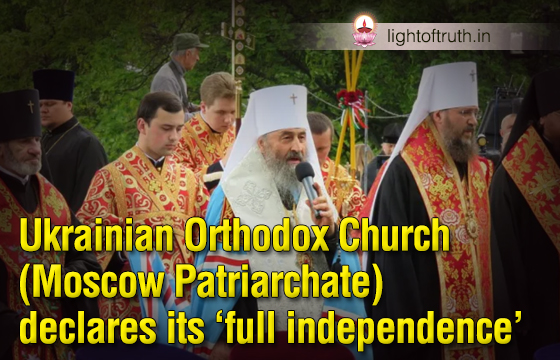
Ukrainian Orthodox Church (Moscow Patriarchate) declares its ‘full independence’
A council of the Ukrainian Orthodox Church (Moscow Patriarchate) on May 27 resolved on its “full self-sufficiency and independence,” distancing the Church from Russian Orthodoxy. The decision comes amid the third month of the Russian invasion of Ukraine, which has been prominently supported by Patriarch Kirill of Moscow.
“The Council adopted relevant amendments and additions to the Statutes on the administration of the Ukrainian Orthodox Church, indicating the full self-sufficiency and independence of the Ukrainian Orthodox Church,” the Church resolved May 27 in Kyiv.
The council also condemned the Russo-Ukrainian War, gave terms for dialogue with the Orthodox Church of Ukraine, and broached the possibility of making chrism, which as been considered a sign of autocephaly in the Russian tradition.
“The council condemns the war as a violation of God’s commandment Thou shalt not kill,” it said, and it expressed its “disagreement with the position of Patriarch Kirill of Moscow and All Russia regarding the war in Ukraine.”
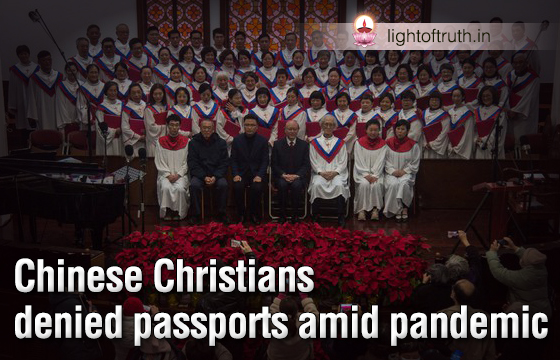
Chinese Christians denied passports amid pandemic
Christians in eastern China who wish to travel abroad for various reasons including emigration and studies are facing hard times as authorities have denied them passports, citing travel restrictions due to the Covid-19 pandemic.
Christians from several families in Zhejiang and Jiangsu provinces said immigration officials questioned the purpose of their passport applications and later rejected the applications after they discovered their religious adherence, Radio Free Asia (RFA) reported on May 26.
In Zhejiang’s Wenzhou city, which has a significant concentration of Protestant Christians, authorities have reportedly rejected the passport applications of many students seeking over-seas education, an education consultant said.
The scenario is similar in Jiangsu province as well.
“A bunch of students from Wenzhou with a church back-ground had been planning to go and study at overseas universities, but the government has refused to give them passports,” said Zhu, a Christian from Xu-zhou city in Jiangsu who would be identified only by his surname.
Pope Francis highlights danger of staid liturgies that ‘deny Vatican Council II’
Pope Francis is pushed in a wheelchair by his aide, Sandro Mariotti, as he leaves an audience with students and professors of Rome’s Pontifical Institute of Liturgy at St. Anselm, May 7 at the Vatican. The Pope said that the celebration of the liturgy and the study of it should lead to greater unity in the church, not division and squabbles.
There is an old saying: “During Holy Week, there is nothing more useless than a Jesuit.” The magnificent liturgies of that holiest of times requires a profound liturgical sense. Members of the Society of Jesus have never been known for their liturgical flair and Pope Francis is no exception. When he presides, it is in a very unembellished, straightforward manner.
Consequently, his remarks to the members of the Pontifical Liturgical Institute last weekend (May 7) were a bit surprising. No one should be surprised that a man of such spiritual solidity entertains deep spiritual sentiments about the liturgy, but to hear him share them was a rare insight into what makes the Holy Father tick.
Much of the attention has focused on his remarks about liturgical formalism. “I would like to underline the danger, the temptation of liturgical formalism: going after forms, formalities rather than reality, as we see today in those movements that try to go backwards and deny Vatican Council II itself,” the Pope said. “In this way, the celebration is recitation, it is some-thing without life, without joy.” (Emphasis in original.)
The key phrase there is “deny Vatican Council II.” We have all attended post-conciliar liturgies that lack joy. But it is when the liturgy becomes a weapon in the culture wars, when doubts are raised about Vatican II and its legitimacy, when liturgy becomes an ideological expression rather than an ecclesial one, that is where the Holy Spirit is shut out and the in-breaking of the divine mystery is nullified.
Francis did not mince words here: “When liturgical life becomes something of a banner of division, there is the odor of the devil, the deceiver, in there.”
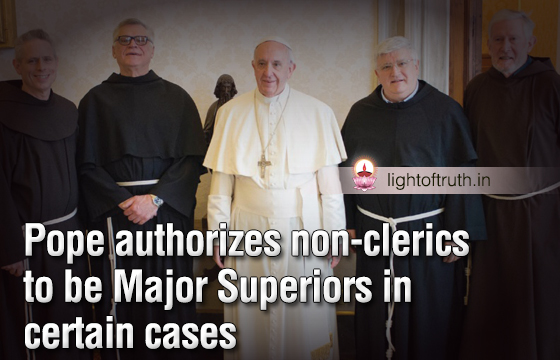
Pope authorizes non-clerics to be Major Superiors in certain cases
Pope Francis has authorised the Congregation for Institutes of Consecrated and Societies of Apostolic Life to grant dispensations that would allow non-clerics to hold the office of Major Superior in some cases.
The Holy Father did so in a rescript promulgated on May 25, concerning the possibility of a dispensation from Canon 588 §2 of the Code of Canon Law (CIC), which stipulates that that clerical institutes be governed by clerics.
Major superiors, along with their vicars, are those who govern an entire or a part of a clerical institute, and are call-ed to “devote themselves diligently to their office and together with the members entrusted to them are to strive to build a community of brothers or sisters in Christ,” according to the CIC.
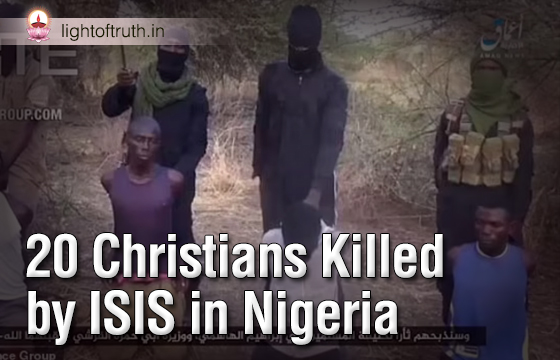
20 Christians Killed by ISIS in Nigeria
ISIS extremists executed 20 Nigerian Christians in a brutal knife attack to “avenge the killing of the group’s leaders in the Middle East.” The Islamic State posted footage of their executions in a vile warning to Nigerians, that they are there, are expanding their territory, and have the intent of imposing a draconian and barbaric rule. The militants carried out the merciless executions in Borno state where rival Islamist groups Boko Haram and Islamic State in West Africa (ISWAP) have been abducting, looting and killing on a huge scale.
Footage of the latest massacre shows one of the executioners saying in the Hausa language that the killings are a response to ISIS deaths in the Middle East earlier this year. It came a week after Islamic rebels killed at least seven people in an attack in northeast Borno.
Over 35,000 people have been killed and many more displaced in West Africa as a result of the extremist groups. The groups are clashing with each other, as well as the local and national governments that oppose them.
The ISIS insurgents attacked Kautukari village in the Chibok area at the same time that UN Secretary-General Antonio Guterres was in the state to meet with survivors of jihadist violence.
The Chibok area is 70 miles away from Maiduguri, the state capital, where Guterres met with former militants being reintegrated back into the society and thousands of people displaced by the insurgency.
Boko Haram and ISWAP were originally aligned but the groups splintered in 2016 and are now considered rivals. “They came in large numbers with superior firepower (and) took over the community,” said Hassan Chibok, a community leader.
Troops from a nearby military base were deployed to repel the attack but “the damage had been done,” Chibok said, adding that “casualties are up to 10.”
Another resident, Yana Galang, said at least seven people were killed in the latest violence before the Nigerian military intervened.