
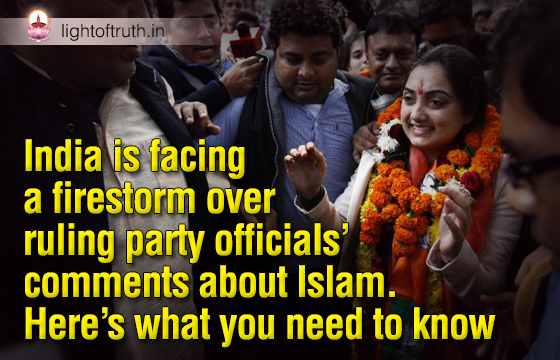
India is trying to contain the diplomatic fallout as outrage grows in the Muslim world following derogatory comments made by ruling party officials about the Prophet Mohammed.
The United Arab Emirates, Malaysia, Oman, and Iraq are among at least 15 Muslim-majority nations to have condemned the remarks, which were described as “Islamophobic,” with several countries summoning India’s ambassadors.
The incident sparked protests in neighbouring Pakistan and prompted calls from around the region to boycott Indian goods.
India’s Hindu nationalist ruling Bharatiya Janata Party (BJP) disciplined the two officials involved, but the firestorm involving India’s major Arab trade partners is yet to die down.
Here’s what you need to know.
At the centre of the controversy is Nupur Sharma, now suspended national spokesperson for the BJP — the party of Indian Prime Minister Narendra Modi.
On May 26, Sharma made comments during a televised debate on an Indian news channel about the Prophet Mohammed that were widely deemed offensive and Islamophobic.
All posts by Light of Truth
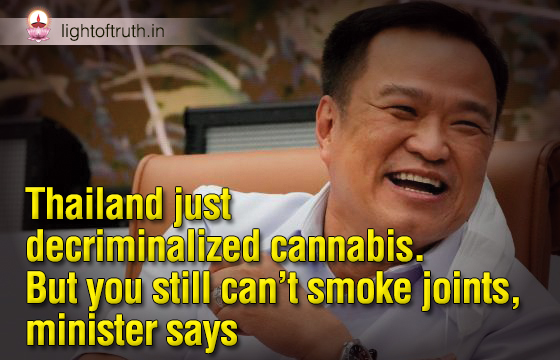
Thailand just decriminalized cannabis. But you still can’t smoke joints, minister says
On June 9 Thailand became the first country in Asia to decriminalize cannabis — but tough penalties will still apply to those who use the drug to get high, according to the minister who spearheaded the change.
Speaking to CNN in an interview ahead of the move, Thai Health Minister Anutin Charnvirakul said he expected legal cannabis production to boost the economy but cautioned that recreational use of the drug remains illegal. “It’s a no,” said Anutin, who is also a deputy prime minister. “We still have regulations under the law that control the consumption, smoking or use of cannabis products in non-productive ways.”
Under decriminalization, it is no longer a crime to grow and trade marijuana and hemp products, or use parts of the plant to treat illnesses. Cafes and restaurants can also serve cannabis-infused food and drinks — but only if the products contain less than 0.2% tetrahydrocannabinol (THC), the plant’s main psychoactive compound.
Harsh penalties remain in place under the Public Health Act, including up to three months in jail and an $800 fine for smoking cannabis in public.
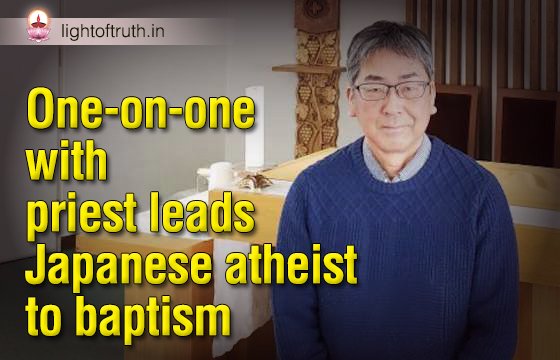
One-on-one with priest leads Japanese atheist to baptism
Kazuhiro Sasahara met the priest suggested by his Catholic wife, a member of Kitami Church on Japan’s island of Hokkaido
One-on-one with priest leads Japanese atheist to baptism
Kazuhiro Sasahara was born into a family of the Buddhist Jodo Shinshu sect but considered him-self an atheist. Because his wife, whom he met as a student, was baptized as an infant, their wedding was held in a Catholic church and their three children were baptized as infants.
“I went to church once a year at Christmas and I didn’t say anything about the faith of my wife or children, leaving that to my wife. Besides going to church on Sundays, my wife doesn’t say much about her faith. However, compared to the beginning of our marriage, statues of Mary and crosses have multiplied all over the house,” said the 63-year-old Japanese man.
After his retirement from years as a principal of elementary and junior high schools, Sasahara engaged in after-school children’s classroom activities with the board of education until April of last year.
At that time, “I thought it might be better to have the same faith as my wife.” He did not believe in God’s existence, but as his remaining years “shortened” he wanted to go into the future “with the same attitude as my wife with whom I’ve shared life for so many years.”
His wife, a member of Kitami Church on Japan’s northern island of Hokkaido, suggested that he meet the parish priest, Father Masahiro Uesugi of Sapporo Diocese. Since July 2020, they have met once a month.
“At the time, I didn’t have any strong desire for baptism or to attend any study sessions,” said Sasahara. “I just wanted to talk with the priest. I talked about books I had read, movies I had seen, TV dramas, and the state of the world today, and the priest talked about his interests.”
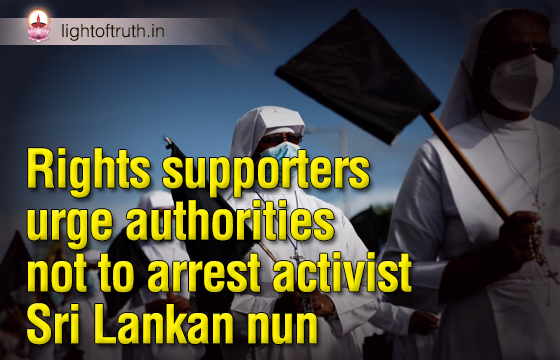
Rights supporters urge authorities not to arrest activist Sri Lankan nun
Activists called on Sri Lankan authorities not to arrest an activist nun who has supported anti-government pro-testers.
Sister Mary Sonali of the Congregation of the Apostolic Carmel was summoned by police June 7 to record a statement about an arson attack.
Shehan Malaka Gamage, a social activist and national convener of the Coalition of Catholic Lay Organizations, said June 8 that Sister Sonali was accused of aiding violence and inciting people to set fire to houses.
“We stand against the continuing state repression and the large number of arrests. Police have arrested many social activists to satisfy the needs of politicians and by now they have begun to touch the clergy as well. That is a very serious matter,” Gamage said.
“Several Buddhist monks were recently imprisoned on absurd charges but eventually the court released them. Even Father Cyril Gamini was prepared to be arrested in the same manner, but the police failed,” he said.
Father Gamini is former director of the National Catholic Center for Social Communications and has been an outspoken critic of how government agencies handled the investigation of the Easter 2019 attacks — including two on Catholic churches — that killed 279 people in three cities.
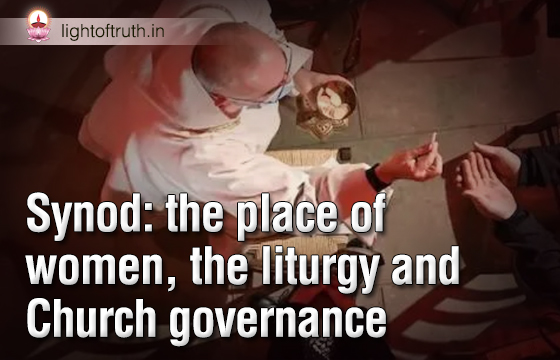
Synod: the place of women, the liturgy and Church governance
France has published its first synthesis of what Catholics who participated in the synodal process believe should be top priorities for their Church
“It is not only a question of women exercising much more responsibility in leadership, which must be done. Their place is also expected at the heart of sacramental life,” the document notes.
The exercise was tedious, given the magnitude of the expectations, dreams and regrets that more than 150,000 Catholics in France expressed over the last few months while participating in the synodal process.But Bishop Alexandre Joly of Troyes and his national team that is accompanying the Synod on Synodality were able to take the diocesan syntheses and turn them into a 10-page report, which was published on Thursday.The text is divided into three main chapters – the importance of “finding inspiration in the Word of God”, the urgency of “proposing meaningful and credible signs in society” and the need for “places of fraternal dialogue”. It is meant to help the bishops reflect further on the issues when they meet in an extraordinary plenary assembly June 14-15 in Lyon in the presence of lay invitees.The latter will have no decision-making power, but “for the first time” they will be able to participate “in all the working sessions of the assembly”, according to the French Bishops’ Conference (CEF).
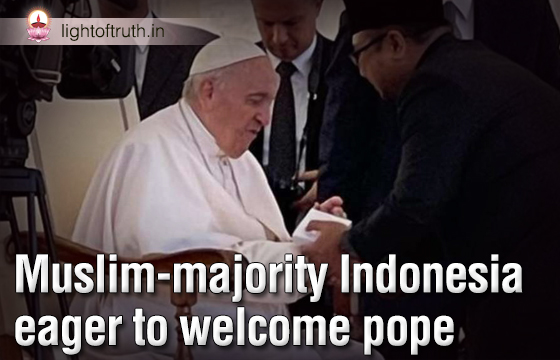
Muslim-majority Indonesia eager to welcome pope
Indonesia has officially invited Pope Francis to visit the world’s largest Muslim-majority nation. Country’s Religious Affairs Minister Yaqut Cholil Qoumas met Pope Francis at the Vatican on Wednesday and deli-vered the invitation letter on be-half of President Joko Widodo.
Archbishop Yohanes Harun Yuwono, chairman of the Indonesian bishops’ Commission for Ecumenical and Interreligious Affairs, said Catholics are elated about the invitation as they are eager to see the Pope.
Christians make up 24 million of Indonesia’s estimated population of more than 270 million. Catholics account for about 7 million. The country has six organized religions— Buddhism, Catholicism, Confucianism, Hinduism, Islam and Protestantism — and around 200 traditional beliefs.
Pope Paul VI visited Indonesia in 1970 and Pope John Paul II in 1989. Pope Francis was supposed to visit Indonesia, Timor-Leste and Papua New Guinea in 2020 but cancelled the trip due to the Covid19 pandemic.
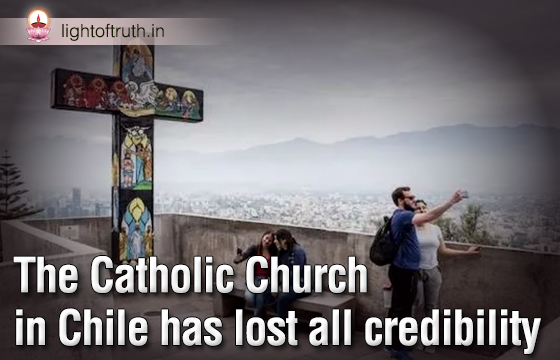
The Catholic Church in Chile has lost all credibility
When running an errand in the centre of Santiago, the capital of Chile, Gina always stops at the Catholic cathedral. She 67-year-old stays there for about 20 minutes, thanking the Lord for her health and entrusting her son who lives far away. She also prays every night at home. But she has not been to Mass for the past ten years.”After all that has happened, all the sexual abuse, we no longer trust. How can we go to Mass and confess before a priest?” she exclaims.” In Chile, all the indicators of trust in the Church are down, except for popular piety,” says Eduardo Valenzuela, a sociologist of religion at the Pontifical University of Chile.” What characterizes this piety is that it does not require the mediation of a priest,” he admits.
It is not a crisis of Christian faith, but a crisis of faith in the Catholic Church. A crisis with no end in sight Pope Francis’ visit to Chile in January 2018, and the weeks following it, caused an earthquake in the Chilean Church that really brought the sexual abuse crisis to light.
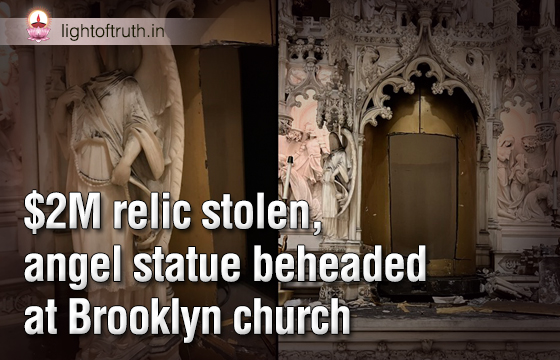
$2M relic stolen, angel statue beheaded at Brooklyn church
Police say someone busted into the altar at a New York City church, stole a $2 million gold relic and removed the head from a statue of an angel at some point late last week.
The incident happened between 6:30 p.m. Thursday and 4 p.m. on May 26th at St. Augustine’s Catholic Church, known as the “Notre Dame” of Brooklyn’s Park Slope neighbourhood.
The church was closed for construction at the time. Camera recordings from the church’s security system were also stolen, the church’s pastor said. The Diocese of Brooklyn called it “a brazen crime of disrespect and hate.”
The diocese said the thief or thieves cut through a metal protective casing and made off with a tabernacle dating to the church’s opening in the 1890s.
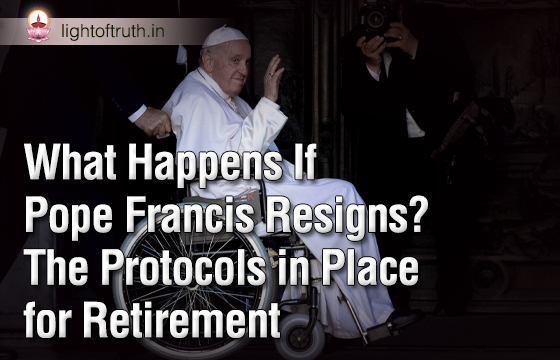
What Happens If Pope Francis Resigns? The Protocols in Place for Retirement
Speculation about Pope Francis’ future continues to grow as the Vatican announced June 10 he would not be going on a scheduled trip to the Democratic Republic of Congo and South Sudan this July.
“At the request of his doctors, and in order not to jeopardize the results of the therapy that he is undergoing for his knee, the Holy Father has been forced to postpone, with regret, his Apostolic Journey to the Democratic Republic of Congo and to South Sudan, planned for 2 to 7 July, to a later date to be determined,” said Matteo Bruni, the director of the Holy See Press Office, in a statement.
The knee problem has caused the pope, 85, to use a wheelchair at recent events. And, in July 2021, he underwent intestinal surgery, which kept him in the hospital for 10 days.
While rumours of the Pope being ill and ready to resign are common in Italian media, the speculations were renewed by the announcement that the Pope will travel to L’Aquila in central Italy in late August—similarly to previous (rare) popes who have retired.
But is that the protocol for a pontiff’s resignation News-week has found no protocols set in stone for such an occurrence as it is very rare. The only certai-nty if the Pope is to resign is that cardinals will gather together to name a successor. The College of Cardinals is made up of the Catholic Church’s most senior officials. They are appointed by the Pope and ordained by bishops.
The latest Pope to resign was Benedict XVI, who left the Holy See on February 28, 2013-the first pontiff to resign in around 600 years. He stated that his resignation came over concerns over his health. The Pope has not officially said that he will resign. As stated above, the rumours have been re-ignited due to the fact that Francis is set to visit the Italian city of L’Aquila in August for a feast.
The “Feast of Forgiveness” was inaugurated by Pope Celestine V, who abdicated in 1294.
Robert Mickens, editor of the English edition of La Croix, a Catholic daily newspaper, has stated: “it’s very odd to have a consistory in August, there’s no reason that he needs to call this [event] three months in advance and then go to L’Aquila in the middle of it.” Benedict XVI had also visited L’Aquila in 2009. He would retire four years later.

Brazil procession celebrates the Holy Spirit
Over the course of nine days, a religious procession known as the Folia of the Di-vine Holy Spirit brings messages of faith and song to farms and villages across the countryside of Brazil’s Goias state. Like a medieval caravan, the group framed by small red and white flags is comprised of more than 300 people, many of them on horseback.
The image of a dove decorates the pole of a banner during the culmination of the religious tradition, “Folia do Divino Espirito Santo” or Feast of the Divine, in the rural area of Pirenopolis, state of Goias, Brazil, Saturday, May 28, 2022 A mounted rider plays a Berrante, an ox horn musical instrument, during a parade culminating the religious tradition, “Folia do Divino Espirito Santo” or Feast of the Divine, in the rural area of Pirenopolis, state of Goias, Brazil, Saturday, May 28, 2022 Revelers take part in the grand dance of the night of the religious tradition, “Folia do Divino Espirito Santo” or Feast of the Divine, in the rural area of Pirenopolis, state of Goias, Brazil, Saturday, May 28, 2022.