
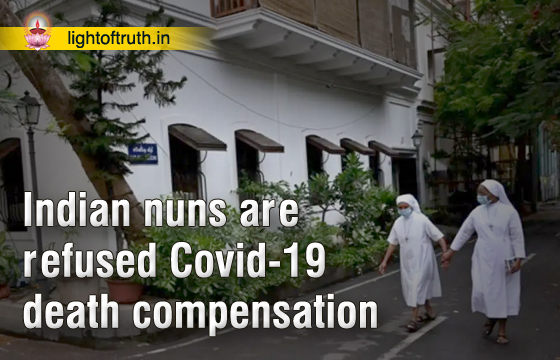
Church officials in the southern Indian state of Kerala are upset with the provincial government for refusing to pay financial compensation to Catholic nuns who died of Covid-19.
Authorities declined to pay the Covid-19 death compensation of Rs 50,000 (US$625) each to four nuns belonging to the indigenous order of Sisters of the Destitute (SD).
“I moved the claims for compensation,” Sister Kiran Mandoth, SD, told on July 22. “The officials at the village and district made me run from pillar to post to gather nearly a dozen documents including death certifi-cates. I was made to wait for over a year only to be told that nuns were not eligible for compensation.”
Sister Mandoth said the officials cited no reason for the denial of compensation. “It is not about the money. But are nuns not citizens of India,” she asked.
Father Jacob Palakkappilly, the spokesman of the Kerala Catholic Bishops Council (KCBC), said the provincial government has no right to block humanitarian services to anyone including Catholic nuns, priests or seers, regardless of their religion.
“This is injustice and discrimination against the nuns who are citizens of India,” he said.
The provincial governments were ordered to pay exgratia compensation to families of persons who died of Covid-19 by the Supreme Court of India in October 2021.
All posts by Light of Truth
Indian Catholics seek withdrawal of ‘misleading’ lesson on Hagia Sophia
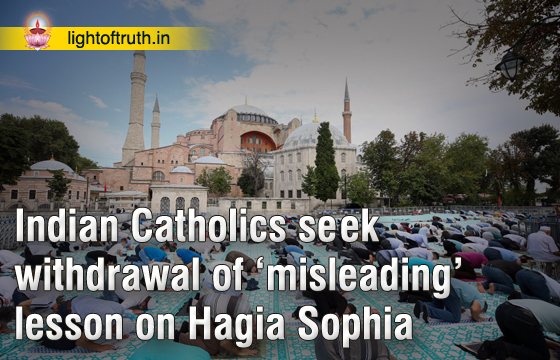
Catholics have questioned the distorted version of the history of Istanbul’s ancient Cathedral Hagia Sophia being taught in schools in communist-ruled Kerala state in southern India.
Fr Jacob G Palakkappilly, spokesman of the Kerala Catholic Bishops Council (KCBC), said “it is quite disturbing to note that students in Class Seven were being taught a false history of one of the world’s greatest Byzantine monuments originally built as a church.”
The Hagia Sophia was built in the 6th century and is also known as the Church of the Holy or Divine Wisdom, and in subsequent centuries became a mosque, a museum, and a mosque again two years ago.
The textbook for Class Seven in Kerala has a lesson under the title, “Europe in the path of trans-formation,” which described the ancient cathedral as a “historical monument” but hid the fact that it was originally a Christian church that was turned into a mosque, the priest told on July 20. “When you teach history, you need to explain who, what, when, where, and how”
Government officials said it was an old lesson that needed to be updated. But Christian leaders said it amounted to wiping out a crucial part of history involving the contributions of Christians in building the historical cathedral.
“Why did the government safely bury its Christian connection,” asked Father Palackkapilly.

Church TV channel organizes Gospel Singer Reality show
Indore, July 26, 2022: One of the popular religious channels of northern India is organizing a Gospel Singing Reality show to recognize choir members of the region.
“It was my dream to give a bigger platform for the choir members of North India. Some of them are at the service of the Church for some 25 years. Their role in the liturgy is as important as the priest minister,” says Fr Anand Chirayath, the founder director of Atmadarshan (inner vision), which is organizing the show.
Online and offline auditions were held April 23 to May 5 where 250 Christian musicians from ten states and 30 dioceses in northern India attended. Among them, 50 singers were selected for the first round that was held July 13-14 at Atmadarshan Studio in Indore, the commercial capital of Madhya Pradesh. After evaluation by the panelists and online voting, 30 will be selected for the second round scheduled for Aug 13-14.
The semi-final and final will also be held at Atmadarshan. Around 20 people will be selected for the semi-final and 10 from them for the final.
The oldest participant of the show is 67-year-old Ravindra Gupta from Bhopal, capital of Madhya Pradesh. He has been into the parish choir for more than 40 years.
Father Chirayath says the reality will give the choir members to be known beyond their parish churches and dioceses.
Fr Chirayath says he and Fr Selvin Ignatius, assistant director of Atmadarshan, traveled almost 6,000 km and conducted auditions in 15 cities of eight north Indian states in 12 days.
The first round also felicitated some renowned Catholic, non-Catholic and non-Christian musicians who have enriched the North Indian Christianity.
Holy Spirit Sister Pushpanjali, who has written and composed more than 180 songs for the Catholic liturgy, was the guest of honor in the show.
Church protests India’s apathy toward coastal erosion
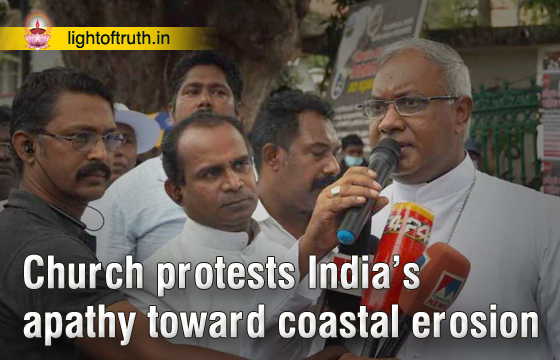
Two Catholic bishops led some 100 priests and thousands of lay people as they launched an indefinite protest against government apathy toward the rehabilitation of families affected by coastline erosion in the Archdiocese of Trivandrum in the southern Indian Kerala state.
The life of common people, especially the fisher people, had become miserable due to the continued onslaught of natural calamities and disasters, said Archbishop Thomas J Netto of Thiruvananthapuram while leading the protest in front of the state secretariat on June 20.
Archbishop Netto lamented that the communist-led state government ignored their pleas for rehabilitation of the affected people and a permanent solution to coastline erosion.
The protest initiated by the Latin-rite archdiocese witnessed a huge turnout of laypeople including those from the fishing community living along the state’s coastline.
“We have at least 500 families who lost everything and have taken refuge with relatives and friends, besides the local schools and warehouses,” Auxiliary Bishop Christudas Rajappan told.
A 2018 study by India’s National Centre for Earth Science Studies showed that 60 percent of Kerala’s coastline was under erosion due to urbanization, tourism, development of new ports and “unscientific shoreline protection methods” that have caused the beaches to become unstable.
Myanmar executions should serve as wake-up call
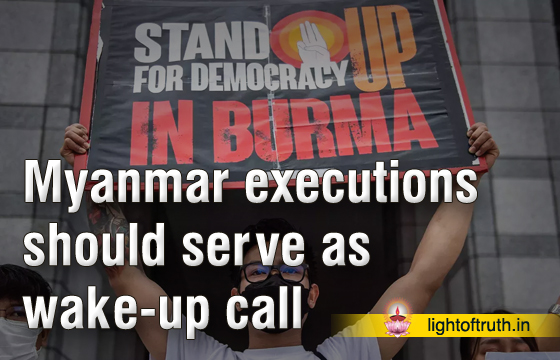
The execution of four political prisoners by Myanmar’s military junta made headlines in international news media on July 25 and sparked outrage and shock among world leaders.
The executions, which made a comeback after more than three decades in the conflict-torn nation, are an attempt to instil fear among the people who are offering strong resistance to the military rule since the coup in February 2021.
The United Nations was joined by world leaders including the United States, Europe and Japan, besides global rights groups to vigorously condemn the barbaric act of executing political opponents. The junta accused the four over the weekend, after accusing them of committing terror acts.
The four include former MP Phyo Zeya Thaw and activist Kyaw Min Yu, better known as Ko Jimmy. Both were linked to democracy leader Aung San Suu Kyi’s National League for Democracy (NLD) party. The other two—Hla Myo Aung and Aung Thura Zaw—were accused of murdering a woman, which many believe was a trumped-up charge.
“The regime’s sham trials and these executions are blatant attempts to extinguish democracy; these actions will never suppress the spirit of the brave people of Burma,” US Secretary of State Anthony Blinken said.
Thomas Andrews, the UN special ra-pporteur on human rights in Myanmar, said: “These depraved acts must be a turning point for the international community.”
The junta continues to unleash terror and commit atrocities on its people as the world fails to take real action. World leaders have paid much attention to the Ukraine war while Myanmar has been completely forgotten.
Only when mass killings such as the Christmas eve massacre in Kayah state occur does the nation grab international media attention and the UN and world leaders rush to release statements that repeatedly express ‘deep concern’ over Myanmar’s crisis.

Save Myanmar from absolute hell
Myanmar has known many, many dark chapters in its history, especially over the past 18 months since the latest coup d’etat. But the execution of four pro-democracy activists — the first judicial executions in more than three decades — plunges the country into even greater darkness.
The news broke less than a week after the country marked its Martyrs Day — the anniversary of the assassination of founding father General Aung San and several members of his cabinet in 1947. Today, his daughter, democracy leader Aung San Suu Kyi, languishes in prison again, and Myanmar has four new martyrs to mourn.
I had the privilege of meeting two of the four: Kyaw Min Yu (aka Ko Jimmy) and Phyo Zeya Thaw. I did not know them intimately, but I met them a few times.
In the course of my human rights work throughout Asia over the past 25 years or more, I have known many friends and acquaintances who have been in jail or run the risk of imprisonment; quite a few have endured shocking torture; some who face death threats; two who have survived assassination attempts; and another two who have been assassinated.
“It shows the world the scale of the depravity, inhumanity, brutality, cruelty and criminality of the illegal military dictator-ship”
But this is the first time any-one I have met has been sentenced to death in cold blood by a dictatorship and the sentence has been carried out.
When the death sentence was imposed on these four earlier this year and upheld against their appeal last month, I was shocked.

Vietnamese clergy fall victim to soccer fever
Father Joseph Pham Huu Quang attends soccer practice sessions on July 18 Monday and Friday afternoons at Tay Loc stadium in Thua Thien Hue province.
Father Quang, who has to ride a motorbike to the state-run stadium 30 kilometres from his Son Qua parish, is at the ground regular as clockwork, wearing football boots and a blue strip, talking with other priests before their 90-minute practice sessions.
“We do some warm-up, stretching and leg exercises for a while and then learn the skills necessary to run and control, pass, shoot and head balls,” he said, adding that these are essential to promote physical health, reduce injuries and play well.
The 38-year-old priest, who plays in midfield, said in the early days of practice he fell and sprained his knee dodging a pass that was about to touch his left hand. He was a bit discouraged because of the pain, and it took him a few days to recover.
“I have since gained practical experience to confidently over-come light injuries,” said the priest, who had not played soccer since he left Xuan Bich Major Seminary in Hue in 2016.

Southeast Asian MPs slam Myanmar executions
Parliamentarians from Southeast Asian nations have strongly condemned the execution of four political prisoners by Myanmar’s military junta as an “act of judicial barbarism.”
Myanmar’s state media announced that the death sentences of four prisoners were carried out on an unspecified date at Insein Prison in Yangon. They were the first such executions in the country since 1988 and spark-ed global outrage.

Sundarbans ban leaves Bangladesh communities reeling
The Bangladesh government’s ban on access to the Sundarbans forest has left those who earn their living from the world’s largest stretch of mangroves in hardship amid a lack of promised compensation. The Forest Department has banned the issuing of passes and permits to enter the Sundarbans for June- August. The move covers fishing, crab and honey harvesting and entry of all tourists to all rivers and canals in this extensive mangrove forest. According to the recommendations of the Integrated Resources Management Plan for the protection of fish resources in the Sundarbans from 2019, the Forest Department has stopped fishing in all rivers and canals in this forest from June 1 to Aug 31.

Indonesian Catholic mother sustains faith, struggles for rights
For 87-year-old Thresiamma, nothing works without the blessing of Jesus. As Maria Yuliana Farida carried the freshly harvested cocoa fruit in a basket into the backyard of her home, she murmured: “If one of these is damaged, we will have less to eat next week.”
The cocoa fruit harvested in the June-July season in Indonesia’s Catholic-majority Flores Island is part of her family’s weekly income. “I believe that God, who we call in our language, Mori Kraeng, will always provide what we need. But of course, we also need to work hard,” 44-year-old Farida says with a smile.
She and her husband, Fransiskus Din, 47, work hard five days a week from morning till evening to feed their three children and bring them up in the faith.
While Saturdays is market day, the Catholic family spends Sundays as a day of rest and prayer dividing it between the parish church and home, Farida said.
Every Saturday morning, Farida and Din, walk one kilometer along the only pathway that connects their Wae Sano village to the outside world.
Carrying the farm produce on their heads, the couple walks the narrow, potholed path to arrive at a road that leads to the traditional market in Werang, a sub-district town, 10 kilometres to the east from their village.
Farida’s non-descript and isolated village, surrounded by hills and forests, is part of Indonesia’s Christian-dominated East Nusa Tenggara province. Sundays “are like a small feast day,” as they take a break from the dawn-to-dusk farm work and start the day with Sunday Mass in the village, Farida said. On Sunday mornings, Farida and her family walk to St Michael Parish Church, barely 100 meters from their house, dressed in their Sunday best. “Going to meet God means that I wear a nice dress,” Farida said.