All posts by Light of Truth

5.4 billion people at risk of losing freedom of religion, says new report

Roughly 5.4 billion people around the world could face persecution and discrimination for their beliefs, according to a new report from Aid to the Church in Need (ACN). The report, “Religious Freedom in the World,” which was presented on 21 October in the UK Houses of Parliament, also draws attention to how anti-Christian incidents are on the rise not just in the Global South but also across Europe and North America. 

As a result of the scale of the problem, the charity has called for fresh action by the UK Government and by the United Nations to uphold Article 18 of the Universal Declaration on Human Rights, which asserts the right to freedom of thought, conscience and religion.  The report highlights grave violations of religious freedom in 62 countries: with 24 classified as “persecution” (the worst category) and 36 as “discrimination” (the second most serious category).

Chairing the meeting for the launch, Brendan O’Hara MP said: “We cannot allow the issue of freedom of religion or belief to be ghettoised, or hived off, or [to become] something which is deemed too complicated or uniquely challenging. “Freedom of religion or belief is a fundamental, inalienable human right, and it has to be treated and seen as such.”

The report focuses on how religious persecution increasingly fuels forced migration and displacement. “In Nigeria, attacks by radicalised Fulani militants have ravaged churches, villages and clergy, triggering mass displacement,” O’Hara said. “Religious persecution is a major and often overlooked driver of today’s global displacement crisis.”

Speaking at the event, Bishop John Bakeni of the Diocese of Maiduguri, in north-eastern Nigeria, gave a powerful testimony of his personal experience of religious violence in Nigeria: “Since 2009, the Boko Haram Islamist militant group in allegiance with Daesh extremists in Iraq and Syria – now [called] ISWAP – has inflicted mass terror on civilians, killing over 40,000 Nigerians, kidnapping thousands and displacing over 2 million people from their ancestral homes,” the bishop said. “Whilst the conflict is not solely about religion, it is equally simplistic not to see the religious dimension as a significantly exacerbating factor, especially as churches, priests and other potent symbols of Christianity are attacked, seemingly with impunity.”

John Pontifex, head of press and public affairs at ACN, spoke of his own experience: “I was in the North Central middle belt of Nigeria only in the spring and I was privileged enough to see and meet so many individuals and families and communities and Church leaders who are wrestling, grappling with this terrible situation of persecution. “I saw the impact of the threat [that] religious extremism has had on individuals and families, who have been driven from their homes, from their farmlands and from their home communities.”

The report also states that there’s been a significant rise in attacks against Christian sites and believers in the West, with France having recorded approximately 1,000 anti-Christian incidents in 2023, while Greece reported over 600 cases of church vandalism.  The report argues that authoritarianism is the greatest threat to religious freedom, with regimes systematically enforcing “legal and bureaucratic mechanisms to suppress religious life”.

Speaking to the Catholic Herald, Sir Edward Leigh MP, the so-called Father of the House in the Commons, as its most senior member, praised ACN’s work and called for parliamentary action. 

“I support Aid to the Church in Need and everything they do and their marvellous work on behalf of persecuted Christians worldwide – this is something that we should promote in Parliament to ensure that government fully enforces Article 18 of the Declaration of Human Rights,” Leigh said.  “[This] will be a powerful weapon to protect persecuted minorities around the world.”
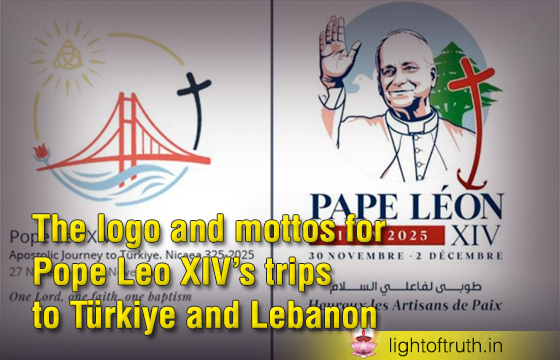
The logo and mottos for Pope Leo XIV’s trips to Türkiye and Lebanon

The Holy See Press Office released on Monday, October 27, the logos and mottos for Pope Leo XIV’s Apostolic Journeys to Türkiye and Lebanon, from November 27 to December 2. The Holy See Press Office has released the logos and mottos for Pope Leo XIV’s Apostolic Journeys to Türkiye and Lebanon, which will take place from November 27-30; and November 30 to December 2, respectively.

The Pope will first travel to Türkiye for the 1700thanniversary of the Council of Nicaea. He will visit the capital, Ankara; Istanbul; and the city of İznik (on the site of ancient Nicaea).

The logo of the Apostolic Journey to Türkiye in fact reflects this important commemoration as it consists of a circle enclosing the Dardanelles Bridge that represents the meeting of Asia and Europe, and symbolizes Christ as the bridge between God and humanity.

Under the bridge, waves are featured to evoke baptismal waters as well as Lake İznik, the Holy See Press Office explained. To the right of the logo there is the Cross of the 2025 Jubilee, while at the top left three intertwined rings represent the Holy Trinity.

This logo reflects the motto of the Journey which is “One Lord, one faith, one baptism”, taken from St. Paul’s letter to the Ephesians (verse 4:5).

“The circle symbolises the oneness of God; the bridge, the one faith that unites peoples; and the waves, the baptism that gives new life to the children of God,” the Holy See Press Office said. “This invites us to build fraternity and dialogue between East and West.”

After Türkiye, Pope Leo XIV will go to Lebanon, where he will visit the capital Beirut, as well as the cities of Annaya, Harissa, Bkerké, and Jal Ed Dib.

The logo for this trip features the Pope with his right hand raised in blessing, flanked by a dove, symbolizing peace, and a cedar tree, which represents Lebanon’s rich history of faith and interreligious harmony. On the right of the image there is a Cross in the form of an anchor, from the 2025 Jubilee logo, signifying firm hope founded on faith in Christ.  

“The colours of deep blue, soft pink, green and light blue express serenity, unified by white to reflect Lebanon’s yearning for peace,” the Holy See Press Office statement says.

The motto “Blessed are the Peacemakers”, taken from the Gospel of Matthew, “contains the Visit’s core message, namely to comfort the Lebanese people and encourage dialogue, reconciliation and harmony among all communities.”

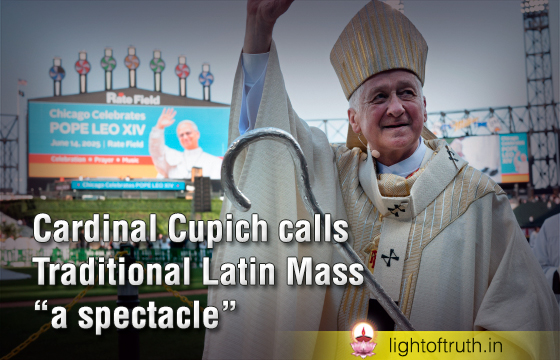
Cardinal Cupich calls Traditional Latin Mass “a spectacle”

Cardinal Blase Cupich has described the Traditional Latin Mass as “more of a spectacle rather than the active participation of all the baptised,” arguing that post-Vatican II liturgical reforms stripped away courtly accretions to restore the Eucharist’s focus on solidarity with the poor.

In a reflection on —the Second Vatican Council’s 1963 Constitution on the Sacred Liturgy—Cupich cited scholarly findings that imperial and royal influences had gradually transformed worship into a display of worldly power. The reforms, he wrote, purified these elements “to enable the liturgy to sustain the Church’s renewed sense of herself.”

The cardinal framed authenticity in Eucharistic celebration not by ritual form but by concern for the marginalized. “The criterion by which the authenticity of our Eucharistic celebrations is judged,” he stated, is service to those in need; the Mass must be “the locus of solidarity with the poor in a fractured world.”

Cupich linked the reforms to Vatican II’s vision of the Church as “the Church of all and in particular the Church of the poor,” a phrase Pope John XXIII elevated from the Council’s margins. He quoted Bologna Archbishop Giacomo Lercaro’s 1962 declaration: “This is the hour of the poor, of the millions of the poor throughout the world.” The renewal,  argued, restored “simplicity and sobriety” to worship, freeing it from aesthetics that had “transformed the liturgy’s meaning” into spectacle.

His comments enter a decades-long debate over the 1969 Novus Ordo Missae, which replaced the Tridentine rite codified by Pope Pius V in 1570. Sacrosanctum Concilium had mandated “full, conscious and active participation” by the faithful; Pope Paul VI implemented the revised Missal to achieve that end.Use of the older form expanded under Pope Benedict XVI’s 2007 Summorum Pontificum but was curtailed by Pope Francis’s 2021 Traditionis Custodes. Cupich’s statement coincided with American Cardinal Burke’s traditional Latin Mass celebration on 25 October in St. Peter’s Basilica, drawing clergy and laity from multiple continents.

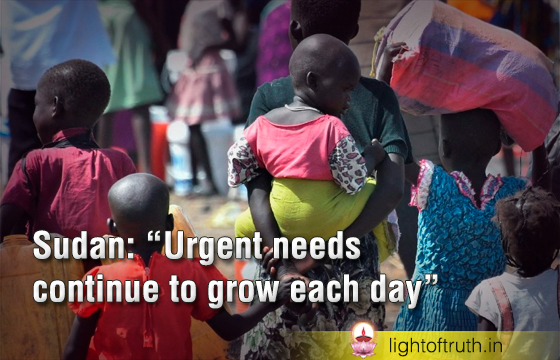
Sudan: “Urgent needs continue to grow each day”

Since April 2023, Sudan has been engulfed in a devastating conflict, which has displaced millions of people. A recent declaration by UNICEF Deputy Executive Director Ted Chaiban reaffirms that “Sudan is currently the world’s largest humanitarian crisis and the conflict is escalating.” Those suffering the most: children.

After visiting Darfur and Khartoum, Chaiban describes how the ongoing violence is tearing communities apart. He spoke with women and children forced to flee their homes in Al Fasher due to an ongoing siege. They recount being forced through armed checkpoints, robbed of belongings, and harassed and assaulted. Many families have gone for days without food.

Chaiban reports severe acute malnutrition is on the rise in Darfur and Kordofan as 1.4 million children live in areas affects by or at risk of famine. “Without urgent treatment, thousands will die,” he underscores.

In North Darfur alone, some 150,000 children are expected to face severe acute malnutrition this year—“the deadliest form of hunger.” In Tawila, the number of cases soared from hundreds to over 2,000 per month since April as Tawila has become the primary gathering place for people fleeing Al Fasher.

Moreover, Chaiban highlights how parents lament that their children have not been in a classroom in years. “Four out of five children in Sudan—around 14 million—are out of school, a whole generation growing up without education”, he reports.

Disease is rampant in the country as cholera, diphtheria, malaria, and dengue claim the lives of many young people and children, while the health system fails.

Children are denied safety. Chaiban explains that in six months, at least 350 grave violations have been reported and verified in North Darfur, including killings and mutilations. For sixteen months, Al Fasher has been under siege, keeping some 130,000 children trapped without food, water, or healthcare. “There is no safe way in or out”, he underlines.

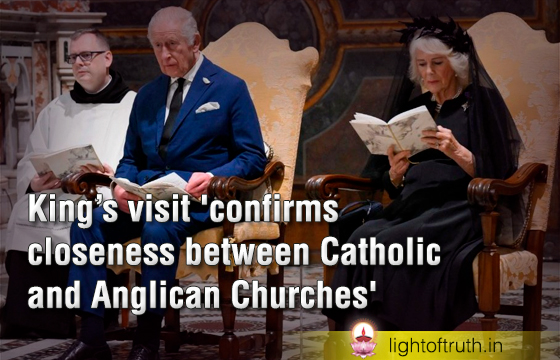
King’s visit ‘confirms closeness between Catholic and Anglican Churches’

On October 23, Pope Leo XIV participated in various events with King Charles III and Queen Camilla, including an ecumenical prayer in the Sistine Chapel, marking a historic moment in Anglican-Catholic relations. The day included a private meeting between the two leaders in the Apostolic Palace and an ecumenical service in the Basilica of Saint Paul Outside the Walls, where King Charles was conferred the title of Royal Confrater of Saint Paul.

Father Martin Browne, an Irish Benedictine monk and official of the Dicastery for Promoting Christian Unity, whose work focuses on the Church’s relationship with the Anglican Communion, spoke to Vatican News’ Xavier Sartre about some of the main elements of this historic day, especially the ecumenical aspects and the unifying theme of the care for creation.

“One of the most significant things is that an English King has not prayed in the same place as a Pope since before the Reformation, since long before the separation of the Church of England from the Church of Rome,” said Father Browne. Despite many English sovereigns having visited the Vatican, the last time they prayed with a Pope was 500 years ago. This historical event thus marks a “further development in the warmth of the relationship” between the two Churches, Father Browne continued.

The afternoon service in the Basilica of St. Paul Outside the Walls also represents the inauguration of “a new kind of relationship between the Basilica and the English crown”. With the King becoming a Royal Confrater, he was “welcomed formally to the Basilica and seated in a very special chair that has been created for the occasion,” which bears his coat of arms and the verse in Latin from the Gospel of John, Ut unum sint (“That they may be one”).

“Traditionally, before the Reformation, the English sovereigns were known as the protectors of St. Paul’s Outside the Walls. The Benedictine Abbey to this day still has a symbol of the British Order of the Garter, which is the highest order in the United Kingdom, as part of its coat of arms,” Father Browne said.

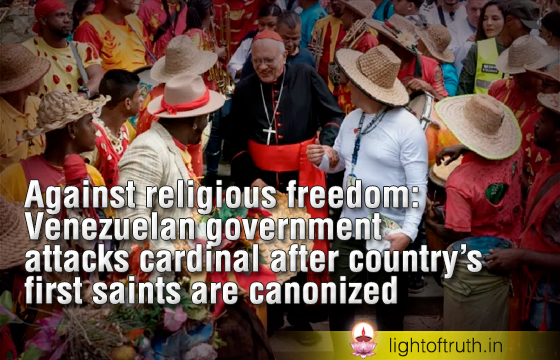
Against religious freedom: Venezuelan government attacks cardinal after country’s first saints are canonized

In the days following the canonization of Venezuela’s first saints, a celebration that should have united the nation around faith and pride has instead revealed a deepening fracture between Church and State. What began as a moment of joy for Catholics has turned into a tense episode of confrontation, intimidation, and open hostility.

On October 25, Cardinal Baltazar Porras, Archbishop Emeritus of Caracas and one of the most prominent voices in the Venezuelan Church, reported that government interference and military obstruction prevented him from reaching Isnotú, the birthplace of Saint José Gregorio Hernández. The cardinal had been scheduled to celebrate a Mass of thanksgiving there, part of the national celebrations marking the canonizations of Saint José Gregorio and Saint Carmen Rendiles.

According to Porras, his state airline flight was abruptly canceled the night before—though he later confirmed that it departed and landed as scheduled, without him on board. Determined to continue, he chartered a private flight, but midway was instructed to make an unscheduled landing in Barquisimeto. “We were told that the Valera airport was closed due to strong winds,” he said, “but later learned that other flights were arriving normally.” What followed, the cardinal recounted, resembled a scene of intimidation more than a safety precaution. “We were surrounded by armed soldiers,” he said. “It was clear we weren’t free to move.” His attempts to continue by land were also blocked. “It’s troubling that one cannot travel freely within one’s own country,” he remarked, calling the episode “a violation of basic civil rights.” The prelate linked the incident to recent accusations made by President Nicolás Maduro, who publicly accused him of “conspiring” to obstruct the canonization of Saint José Gregorio Hernández. Days earlier, in a speech delivered in Rome, Porras had called for the release of Venezuela’s political prisoners—more than 800 people, according to the human rights organization Foro Penal.

Pope Leo XIV: ‘Peace is holy, not war’

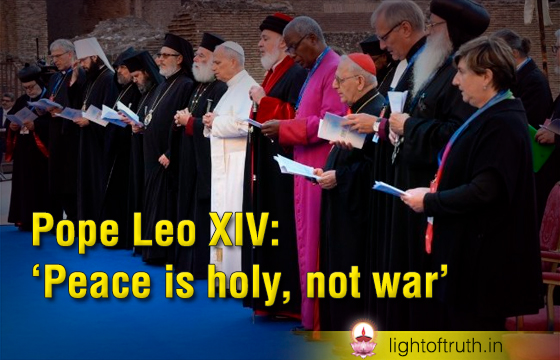
At the closing of the International Meeting for Peace: Religions and Cultures in Dialogue, organised by the Sant’Egidio Community, Pope Leo XIV joined leaders of the world’s religions at Rome’s Colosseum on 28 October for a Meeting for Prayer for Peace.

In his address, delivered in the presence of Christian, Jewish, Muslim, Buddhist, Hindu, and other religious representatives, the Pope renewed the Church’s call for reconciliation, dialogue, and fraternity among all peoples.

“We have prayed for peace according to our diverse religious traditions,” Pope Leo said, “and we are now gathered together to proclaim a message of reconciliation. Conflicts are present in all parts of life, but war is no help in dealing with them or finding solutions. Peace is a constant journey of reconciliation.”

Echoing the urgent need for unity in a world torn by war and displacement, the Pope decried “the abuse of power, displays of force, and indifference to the rule of law,” and called for “a true and sound era of reconciliation.” “Enough of war,” he said forcefully, “with all the pain it causes through death, destruction and exile! Gathered here today, we express not only our firm desire for peace, but also our conviction that prayer is a powerful force for reconciliation.”

Pope Leo warned against the misuse of religion, saying that “those who practice religion without prayer run the risk of misusing it, even to the point of killing.” True prayer, he said, “is an opening of the heart,” a movement that “changes the course of history” and transforms places of worship into “tents of encounter, sanctuaries of reconciliation and oases of peace.”

‘Polarisations’ have no place in the Church, Leo tells Synod Jubilee

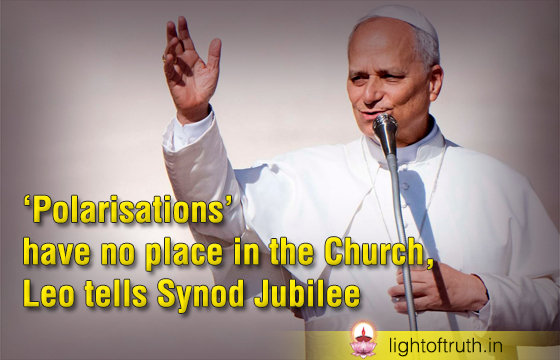
Nobody in the Church “should impose his or her own ideas” on others, Pope Leo said on 26 October, asking that tensions between tradition and novelty not become “ideological contrapositions and harmful polarisations”. “The supreme rule in the Church is love. No one is called to dominate, all are called to serve,” Leo said. “No one should impose his or her own ideas – we must all listen to one another,” he continued. “No one is excluded – we are all called to participate. No one possesses the whole truth – we must all humbly seek it and seek it together.”

The Pope celebrated Mass on the thirtieth Sunday in Ordinary Time for the closing of the Jubilee of Synodal Teams and Participatory Bodies, part of the 2025 Jubilee of Hope. In a call for communion, Pope Leo addressed all the participants in the synodality meeting and asked for their help to expand “the ecclesial space” and make it “collegial and welcoming.” “Being a synodal Church means recognising that truth is not possessed but sought together, allowing ourselves to be guided by a restless heart in love with Love,” he emphasised.

The Pope called on Christians to live “with confidence and a new spirit amid the tensions that run through the life of the Church: between unity and diversity, tradition and novelty, authority and participation. We must allow the Spirit to transform them, so that they do not become ideological contrapositions and harmful polarisations.”

It is not a question of resolving these tensions “by reducing one to the other, but of allowing them to be purified by the Spirit, so that they may be harmonised and oriented toward a common discernment”, he said. He insisted that “prior to any difference, we are called in the Church to walk together in the pursuit of God, clothing ourselves with the sentiments of Christ.”

Jailing of Bangladeshi indigenous rights activist sparks uproar

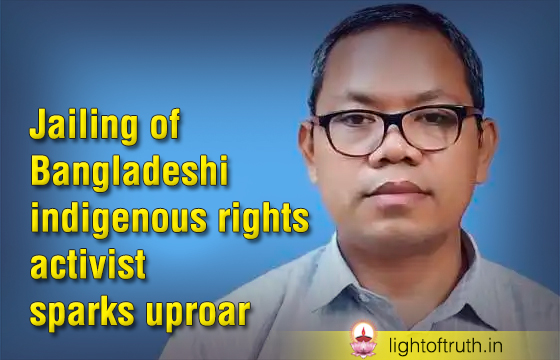
A Bangladeshi court jailed an ethnic tribal leader for eight years for an alleged charge of extortion, about a year after he was released from nearly five years in secret detention.

A court in Rangamati district of Chattogram Hill Tracts (CHT) region in southeast Bangladesh sentenced Michael Chakma and two others to eight years rigorous imprisonment on Oct. 8. The case was filed in 2007 during the tenure of the military-backed caretaker government.

Chakma, 46, an ethnic Chakma and Buddhist, is a leader of the CHT-based political organization, the United People’s Democratic Front (UPDF), which seeks autonomy for the hilly, forested, and restive region.

He disappeared while visiting the national capital, Dhaka, in 2019. Chakma told the media that the state forces kept him in secret locations until he was dropped off at the door of his home on Aug. 7, 2024, two days after former Prime Minister Sheikh Hasina fled to India following a massive student-led public uprising.

He is among about 700 victims of enforced disappearance during the 15-year authoritarian regime of Hasina’s Awami League government.

The interim government led by Nobel Peace Prize winner Professor Muhammad Yunus, which replaced the ousted regime, formed the Commission of Inquiry on Enforced Disappearances to probe into hundreds of people who were either killed or secretly detained. Chakma was convicted in absentia in 2023 for alleged illegal possession of arms, which he termed “yet another false case.”

Pakistan slammed for delay in forming Minorities Commission

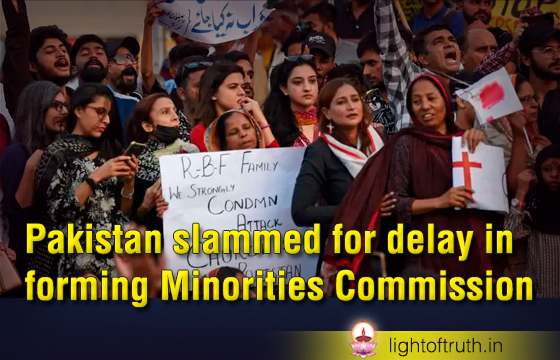
Leaders from Christian and Hindu communities have criticized Pakistani authorities for their failure to form a commission to protect the rights of religious minorities despite nearly five months after the parliament passed a related law. Pakistan’s parliament passed the National Commission for Minorities’ Rights Bill 2025 on May 12. The law was hailed as a landmark move to safeguard the rights of minorities in a country criticized for violations of religious freedom.

The criticism came as media reports suggest the bill has been in limbo after being returned by President Asif Ali Zardari to the Ministry of Human Rights for review. In a report released on Oct. 10, the Catholic bishops’ National Commission for Justice and Peace (NCJP) expressed disappointment over the limbo.

The report titled “Thousands of Slips Stand Guard” cited administrative hurdles and political apathy as major causes for the delay in forming the proposed 30-member minorities commission. The NCJP urged the government to ensure the commission enjoys independence.

It further urged the government to re-table the bill, ensure amendments comply with the Paris Principles, the standards for the credibility and effectiveness of National Human Rights Institutions adopted by the UN General Assembly in 1993.