
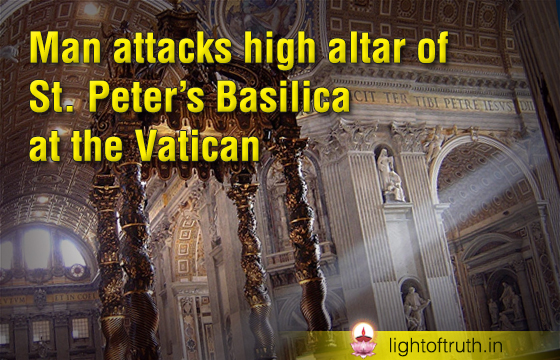
A man desecrated the main altar of St. Peter’s Basilica in the Vatican on February 07 by climbing on top of it and throwing six candelabras that were on the altar to the ground, according to the Italian news agen-cy ANSA. After throwing the candelabras, the man began to remove the altar cloth, as can be seen in a video posted on social media. The subject was then quickly detained by security agents.
According to ANSA, the suspect, of Romanian origin, was detained by the Vatican Police, after which he was identified and charged by agents of the Vatican Inspecto-rate. “This is an episode of a person with a serious mental disability, who has been detained by the Vatican Police and then placed at the disposal of the Italian authorities,” the director of the Holy See Press Office, Matteo Bruni, told ANSA.
According to the Spanish newspaper ABC, the man was arrested because the basilica’s alarm was activated when he stood on the altar. In 2023 a similar incident was recorded when a man climbed the high altar and undressed, after which he was also arrested. The Code of Canon Law, the law that regulates the Catholic Church, establishes in canon 1210 that “in a sacred place” such as St. Peter’s Basilica, “only those things which serve the exercise or promotion of worship, piety, or religion are permitted in a sacred place; anything not consonant with the holiness of the place is forbidden.”
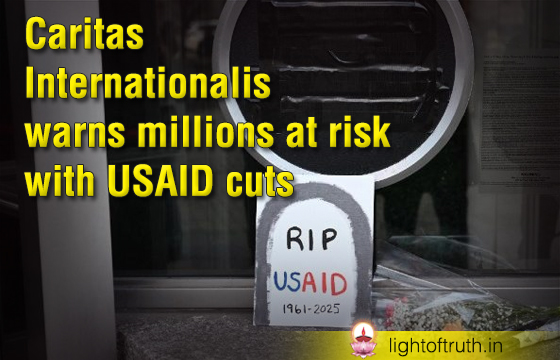
Caritas Internationalis warns millions at risk with USAID cuts
Caritas Internationalis’ Secretary General, Alistair Dutton, has warned against the decision to close USAID-funded programmes and offices around the world, saying the sudden shutdown “will kill millions of people and condemn hundreds of millions more to lives of dehumanising poverty.” With an annual budget of over 40 billion dollars, USAID has funded humanitarian and development aid in some 120 countries, especially the world’s poorest.
In a statement issued on Monday 10 February, Alistair Dutton said the decision marks a grave threat “to people’s God-given human dignity” and “will cause immense suffering.” He also noted the result “presents massive challenges for all of us in the global humanitarian community, who will have to completely reassess whom we can continue to serve and how.” He further warns “the resulting harm to people, particularly the poorest, will be catastrophic, threatening the lives and dignity of millions.”
Contacted by telephone while in Burkina Faso, Alistair Dutton deplored the very real consequences of this suspension of aid that is causing “complete uncertainty for the humanitarian system worldwide.” He explained how “ships are arriving in ports with cargo, but we can’t pay to unload them, store their contents or transport them to the people who need them.”
In West Africa, for example, over six million people will not receive their medi-cines. The same applies to the 750,000 people facing starvation in Sudan or refugees in camps in Syria, where essential supplies of water are provided, without which “critical health problems immediately arise, which can kill millions of people…the people who need help are going to suffer enormously, if they don’t simply die.”
USAID has been an “essential partner” of Catholic relief efforts for over 60 years. Faced with this financial but also human deficit in meeting the massive humanitarian needs worldwide, Caritas Internationalis has appealed for a reconsideration of the cuts and for governments, international agencies, and stakeholders to work together to concretely reaffirm the “commitment to compassion and peace by supporting the most vulnerable people around the world.” Immediate efforts are underway to reduce the impact of the freeze and ensure continued support for as many vulnerable people as possible since, as Alistair Dutton says, ”the lives and dignity of millions hang in the balance.”
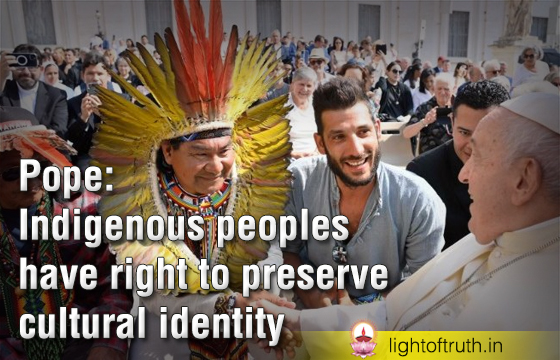
Pope: Indigenous peoples have right to preserve cultural identity
“Land, water, and food are not mere commodities but the very foundation of life and the bond of [indigenous] peoples with nature.” Pope Francis offered that remin-der in a message sent to the 7th Indigenous Peoples’ Forum orga-nized by the UN’s International Fund for Agricultural Develop-ment (IFAD). The forum takes place in Rome on February 10-11 under the theme: “Indigenous Peoples’ right to self-determina-tion: a pathway for food security and sovereignty.”
In his message, the Pope said indigenous peoples have the right to preserve their identity but noted that this right is severely threatened by the increasing sei-zures of farmland by multinational corporations and states. These seizures cause much harm to indigenous peoples and put at risk communities’ right to a dignified life, he lamented.
“The defense of the right to preserve one’s culture and identity requires the recognition of the value of their contribution to so-ciety, as well as the safeguarding of their existence and the natural resources essential for their livelihood,” he said.
Pope Francis added that de-fense of indigenous peoples’ rights is a matter of justice, as well as a way to guarantee a sustainable future for all humanity. “Driven by our sense of belonging to the human family,” he said, “we can ensure that future generations enjoy a world in harmony with the beauty and goodness that guided God’s hands in creation.” The Pope praised the heritage of indigenous peoples, saying their ancestral traditions reveal a “horizon of hope in our present time, marked by intense and complex challenges and numerous tensions.”
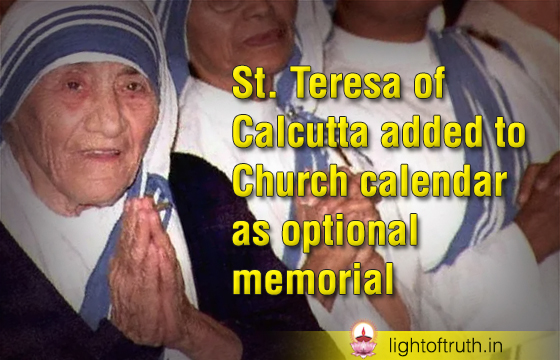
St. Teresa of Calcutta added to Church calendar as optional memorial
Pope Francis added the Sept. 5 feast of St. Teresa of Calcutta to the Catholic Church’s liturgical calendar as an optional memorial. The decree issued Feb. 11 by the Vatican noted the influence of St. Teresa’s spirituality around the world and said her name “continues to shine out as a source of hope for many men and women who seek consolation amid tribulations of body and spirit.”
The General Roman Calendar is the liturgical calendar of the Catholic Church, which denotes the dates of holy days and the feast days of saints commemorated annually. The Sept. 5 memorial of St. Teresa of Calcutta will now appear in the Church’s calendars and liturgical texts with specific prayers and readings to be used at Mass and the Liturgy of the Hours. Memorials rank third in the classification of feast days on the Catholic Church’s liturgical calendar. The memorial of St. Teresa of Calcutta will be an optional memorial, which means it is voluntary whether to observe it.
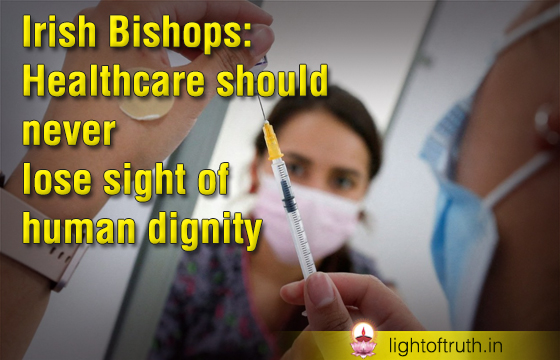
Irish Bishops: Healthcare should never lose sight of human dignity
As the Church marks the 33rd World Day of the Sick, on Feb-ruary 11, the Chair of the Irish Bishops’ Conference Council for Healthcare has reiterated that human dignity must remain at the core of healthcare practices. “Upholding the dignity and rights of each person is essential in healthcare,” remarked Bishop Michael Router, in a statement in which he expresses concern over the gradual erosion of this principle in Ireland.
Welcoming Pope Francis’ recent message for the observance of the Day, the Auxiliary Bishop of Armagh highlights the Jubilee theme of hope as a sustaining force in times of suffering. Pope Francis – he explains – calls for a renewed perspective on illness: not as an isolated struggle “but as an opportunity to encounter God, to receive His gifts, and to share His love with others.” The presence of caregivers, medical professionals, family members, or friends, says Bishop Router, is a tangible expression of that love showing that “suffering is not an isolated journey but one that unites us in faith, love, and solidarity.”
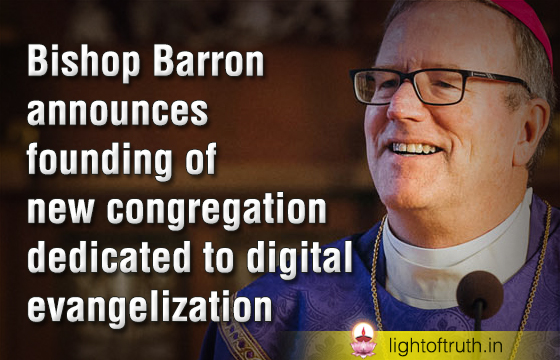
Bishop Barron announces founding of new congregation dedicated to digital evangelization
In an era where the digital world has become the new public square, Bishop Robert Barron is taking a bold step to ensure the Catholic Church not only has a voice in the conversation but leads it. On January 15, Word on Fire, Barron’s influential media apostolate, announced an ambitious new initiative: the founding of a religious order dedicated entirely to evangelizing through digital platforms.
This development is not just another expansion of Word on Fire–it represents a new model of priestly life, one that places digital mission work at its core. The move signals a recognition that the internet is not simply a tool for spreading the Gospel but a mission field in itself, one that demands a dedicated response from the Church.
Barron’s journey as a digital priest began modestly in the late 1990s with a series of Sunday Gospel reflections aired on a Chicago radio station at an inconvenient early morning hour. Realizing the limitations of radio, a friend suggested he post his homilies online. What began as a simple website soon evolved into Word on Fire, an international multimedia ministry that has reached millions.
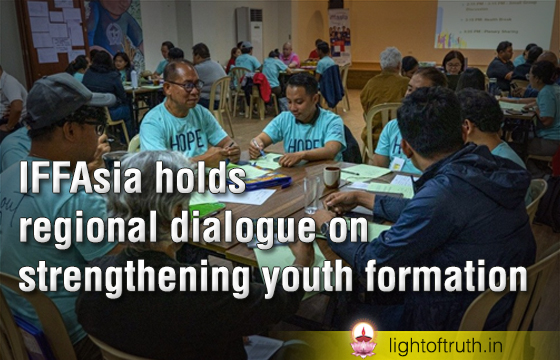
IFFAsia holds regional dialogue on strengthening youth formation
The Institute of Formation Fondacio Asia (IFFAsia) has gathered stakeholders for a dialogue aimed at nurturing partnerships and collaboration “to shape a stronger future” for youth formation in the region. “Today we come together, not as individuals, but as a community deeply committed to the formation of young people in Asia, walking alongside them as they navigate life, faith, and purpose,” said IFFAsia Director Florence Alexius during the opening program.
Some 57 representatives from various Church institutions and civil society groups across 10 Asian countries are participating in the dialogue, which runs from February 9 to 11 in Tagaytay City, Philippines. Ms. Alexius said the dialogue hopes to explore ways “to be a Synodal Church to the young people in their ordinary part of life” and how institutions and organizations “be helpful in enabling and engaging the present generation for the local Church and communities in Asia.”
“This was our guiding objective when designing this program. We truly hope that everyone here sees themselves as collaborators in this journey,” she added. The dialogue process is guided by the principles of Syno-dality–the Christian way of ‘walking toge-ther’–which emphasizes listening, discern-ment, and participation.
IFFAsia is a discipleship and mission school for young adults and laypeople in Asia. Founded by laity from Malaysia and the Philippines within the Catholic lay association Fondacio, it addresses the need for formation programs equipping young laypersons for social and pastoral work.
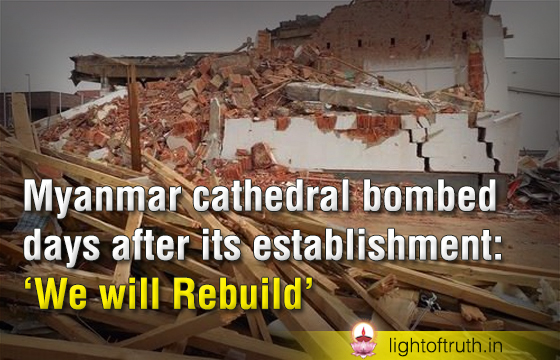
Myanmar cathedral bombed days after its establishment: ‘We will rebuild’
A newly-designated Catholic cathedral in Myanmar was bomb-ed by the military regime last week amid an ongoing conflict in the region. The Sacred Heart of Jesus Church in Mindat was severely damaged by airstrikes by the Myanmar military regime in Chin, Myanmar’s only Christian-majority state.
Though the damage took place on Feb. 6, news of the bombing has only recently come to light. The church’s roof and stained-glass windows were destroyed, rendering the church unusable, according to Fides, the informa-tion service of the Pontifical Mission Societies. No injuries were reported and the area had recently been evacuated.
Less than two weeks before the bombing, on Jan. 25, Pope Francis designated the church a cathedral for the newly-formed Diocese of Mindat. In the days leading up to the attack, local Catholics were planning upcoming liturgical celebrations, including the consecration of the newly-appointed bishop, Father Augus-tine Thang Zawm Hung, Fides reported.
The newly-formed Diocese of Mindat has a total population of almost 360,000, with more than 14,000 Catholics and 23 parishes, according to the Holy See. A local priest, identified as Father Paulinus, told Fides that the faithful are determined to rebuild. “We are very sad that our church has been hit by the bombs. It is a wound in our heart. But we will not let ourselves be defeated. We will rebuild it,” the local priest said. “We are certain that the Lord will ‘bombard’ us with his grace and blessing: This will bring peace and prosperity to our people.”
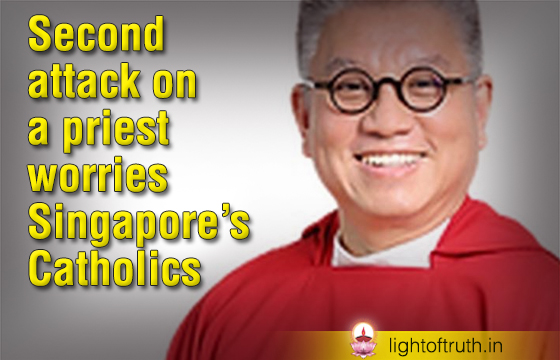
Second attack on a priest worries Singapore’s Catholics
Yet another attack against a priest in Singapore. The second episode in a few months after the one last November, which is beginning to ring more than a few alarm bells in an area where there are strict controls and, at least until now, no serious episodes of violence against Catholics have been recorded. This time it was Fr Cary Chan of the Archdiocese of Singapore who was attacked by a man inside the Church of the Holy Spirit on Upper Thomson Road on 10th February 2025. The assailant, a 22-year-old young man from the city-state of Chinese origin and with special needs, punched the priest in the head, causing minor injuries to his face.
Interviewed by the local media, Fr Chan gave his testimony about the attack: ‘He gave me a hard blow to the head. I feel a bit shaken; I did not expect such a strong blow from him’. Taken by surprise, the priest had no way to defend himself. According to Fr Chan, the attacker is a regular churchgoer and is partially blind, which is why he may not have recognised the priest. Meanwhile, the police say in a note that they have arrested a 22-year-old man involved in the attack on the Upper Thomson Road church. The police emphasise that the young man will be sent to the Institute of Mental Health for further and more thorough assessment.
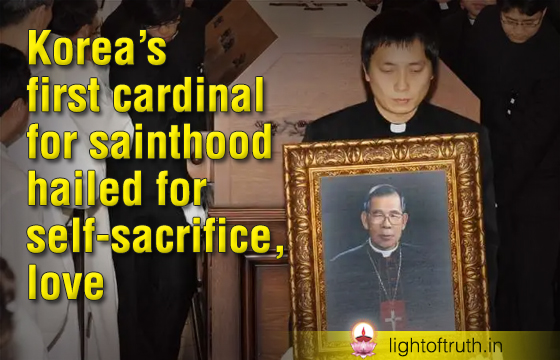
Korea’s first cardinal for sainthood hailed for self-sacrifice, love
Late South Korean Cardinal Stephan Kim Sou-hwan, a candidate for sainthood, has been praised as a model of self-sacrifice and love, and for his lasting influence on Christians and people of other faiths during a special symposium on his life and contributions. “As we convene for this symposium, we are called to reflect upon the life and virtues of Cardinal Kim, striving to emulate his extra-ordinary example,” said Auxiliary Bishop Job Yobi Koo of Seoul Archdiocese on Feb. 7. Yobi made his remarks at “The Symposium on the Beatification Process of Servant of God Cardinal Stephen Kim Sou-hwan: A Celebration of Life, Virtue, and Legacy” held in the capital Seoul. He reflected on Kim’s life devoted to the service of others and his philosophy which was “one of selfless dedication,” Seoul archdiocese said in a statement. Yobi also serves as chair of the committee spearheading Cardinal Kim’s (1922-2009) beatification. He is currently venerated as a “Servant of God.” The Seoul archdiocesan Committee for Promotion of Beatification and Canonization and the Research Foundation for Korean Church History organized the symposium which was attended by laity and priests from various locations.