
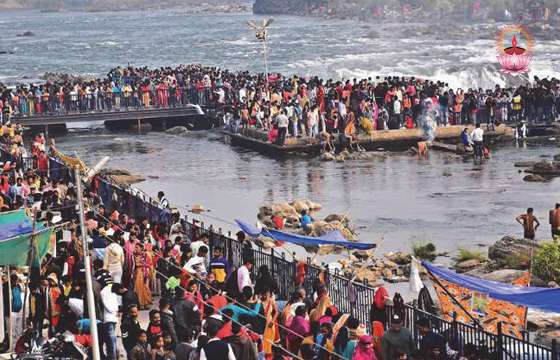
Madhya Pradesh State in central India has replaced its more than 50-year-old anti-conversion law with a new and more stringent one that can criminalize even conversion for marriage.
The law notified on Jan. 9 says any attempt to convert a person from one religion to another through misrepresentation, allurement, use of threat or force, undue influence, coercion or by marriage is a punishable offense.
Violators can be jailed for up to 10 years under the new law called the Madhya Pradesh Freedom of Religion Ordinance 2020. Those abetting or conspi-ring such conversions can also be punished.
The new law replaces the Madhya Pradesh Freedom of Religion act of 1968. However, it allows the reconversion of a person to one’s parental religion without violating the law’s provision.
Leaders of the state government-run by the pro-Hindu Bharatiya Janata Party (BJP) hold that Hinduism is the parental religion of religious minorities in the country such as Christians and Muslims.
In effect, the law allows Hindu groups to convert Christians and Muslims to Hinduism. But those Hindus who convert to Islam or Christianity for marriage can be punished along with their spouses, who can be accused of abetting and conspiring the con-version.
“This law is one-sided and against fundamental rights guaranteed in the Indian constitution,” said Father Maria Stephan, public relations officer of the Catholic Church in Madhya Pradesh.
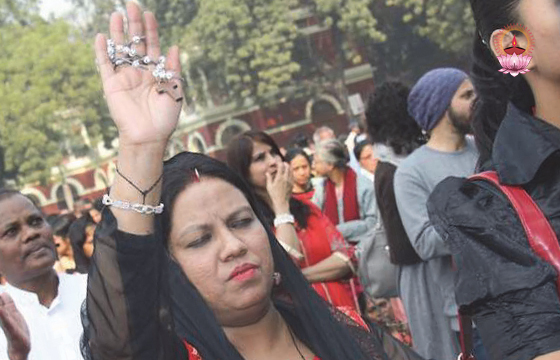
Police on alert after conversion claim in Indian state
Police in an Indian state have directed officers to keep a watch on prayer gatherings after five Christians were arrested on a charge of religious con-version. Vishwa Hindu Parishad (VHP), a hard-line Hindu group, handed the five Christians to police in Shahjahanpur district of Uttar Pradesh State, which is run by the pro-Hindu Bharatiya Janata Party (BJP).
“It is just an allegation from the fanatic groups and if they are sure about it, let them prove it. People are free to express their views in a democratic country,” Father Harold D’ Cunha, vicar general of Bareilly Diocese, told.
“As far as the Catholic Church is concerned, it does not promote or propagate religious conversion in the diocese as well as in the country.
“Occasionally, these groups blame us for conversions, but until now there is no record of any religious conversion where the Church is involved.”
He said the Church is engaged in many charitable works that can be construed as allurement to conversions, “but it is not true.”
S. Anand, superintendent of Shahjahanpur police, told the Press Trust of India that after the alleged religious conversion activities, officers have been asked to keep a watch on religious gatherings.
“We have directed concerned police officials to take strict action if anyone is found guilty of religious conversion activities,” he said.
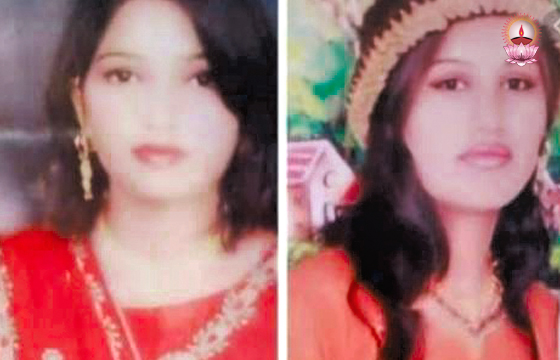
Murder of two young Christians, killed for not wanting to give up their faith according to the pastor of their Protestant community
“The merciless murder of Abida and Sajida is a tragedy that shows how the lives of religious minorities in Pakistan are held by a thread or is worthless. Rape, kidnappings, forced conversions and even murders of young Christian girls are worrying phenomena. The government must not deny this and has the duty to stop the violence against Christians.” This is what Nasir Saeed, Director of the NGO CLAAS (Centre for Legal Aid Assistance & Settlement) said in a note sent to Agenzia Fides, commenting on the case in recent days which has provoked outrage and the protest of the community of the faithful in Pakistan.
Two young Christian sisters, Abida, 26, and Sajida, 28, residing in the Christian neighbourhood of Makhan, near Lahore, were murdered last December after stubbor-nly refusing to convert to Islam. Police arrested two Muslims, Mumtaz Khan and Muhammad Naeem, suspected of killing the women. As Fides learned, Mushtaq Masih, Sajida’s husband, reported that the two sisters worked in a medicine factory and that they disappeared on Nov. 26, 2020. The family filed a formal complaint following their disappearance, reporting to the police his fears of kidnapping, as the two sisters had indicated that they had been often sexually harassed and had received from two work colleagues, Muhammad Naeem and Mumtaz Khan, the request, always rejected, to convert to Islam. Pakistani Prime Minister Imran Khan has pledged to ensure minorities are safe and happy in Pakistan. When we see cases of false accusations of blasphemy, kidnappings, forced conversions and murder of Christian girls, it must be emphasized that, in practice, this is not true and that the condition of Christians in society is getting worse” (PA). Nearly 1,000 girls from religious minorities who are forced to convert to Islam in Pakistan each year, largely to pave the way for marriages that are under the legal age and non-consensual.

China’s Threat to the Bible
The Bible is America’s best-selling book, annually outpacing the top 20 best sellers combined. Yet a single Chinese company has a near monopoly on Bible printing, meaning that any rupture in the supply chain—say, from U.S. or Chinese government poli-cies—would lead to a Bible shortage in America. This poses a serious threat both to American Christians’ fundamental religious liberty rights and to national security.
More than 20 million Protestant and Catholic Bibles are printed annually by America’s largest Bible publishing compa-nies. But few are aware that most of these Bibles are printed in China, by Amity Printing Company. (Bible publishers that don’t print in China include InterVarsity Press [IVP], St Ignatius Press, St Benedict Press, Cambridge University Press, R.L. Allan & Son, and Schuyler Bibles). Thanks to American publishing decisions, American Christians rely on a state that represses Christianity for their Bibles. While China intensifies religious persecution at home and is considered by U.S. Intelligence to be “the greatest threat to America today,” this Bible supply chain is increasingly precarious. Yet the Bible publishers have no plans to use alternative printing presses.
The supply chain was tested in 2019, when the Trump administration proposed broad trade tariffs to better balance U.S.-China trade relations. As the plan included tariffs against Bibles, America’s Bible publishers found themselves alongside Beijing vociferously lobbying Washington against the measure. Harper Collins Christian Publishing (HCCP), now the world’s largest Bible publisher (having acquired Zondervan and Thomas Nelson), uses Amity to print most of its Bibles, as does Tyndale House, America’s largest privately-owned Christian publisher. HCCP CEO Mark Schoen-wald denounced the proposed tariff before the U.S. Trade Commission last year. He called it a “Bible tax,” and argued that it would force his company to reduce sales and discontinue some Bible editions. The Trump administration quickly exempted Bibles from the China tariffs.
Christian ministry publishers lobbied as well, arguing that the tariffs would curb First Amendment rights. Stan Jantz, president of the Evangelical Christian Publishers Association, declared that the tariffs would do “significant damage to Bible accessibility.” He stated before the Trade Commission that “some believe such a tariff would place a practical limitation on religious freedom.”
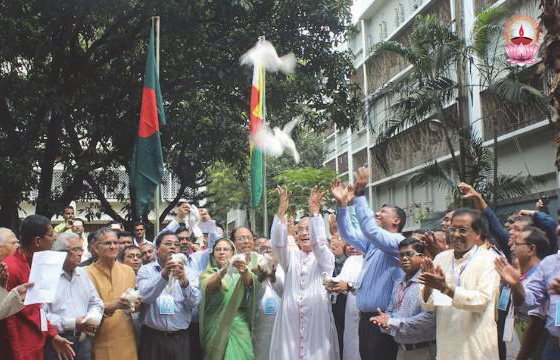
Bangladeshi minorities seek scripture readings in state programs
Bangladeshi religious minority groups have urged the government to introduce the reading of scriptures of all four major religions at the beginning of parliamentary sessions and state ceremonies.
Bangladesh Hindu Buddhist Christian Unity Council (BHB-CUC), the country’s largest minority group, made the call during a virtual conference this week.
Parliamentary sessions and state programs in Muslim-majority Bangladesh now begin with a recitation from the Quran.
BHBCUC leaders say intro-ducing readings from the holy books of the four major religions would be a significant symbolic gesture to behold pluralism in Bangladesh on the eve of the country’s golden jubilee of independence from Pakistan this year.
Advocate Rana Dasgupta, a Supreme Court lawyer and BHBCUC secretary, said that such a move is important as it recognizes the equal dignity and rights of minorities.
“Our constitution has given equal rights for all religions but only a recitation from Quran is done in the parliament and in various state functions. We hope that by introducing the reading of all scriptures we can fill a void that the spirit of the constitution has enshrined,” Das told UCA News on Jan. 8.
Das said the group will hold a press conference and submit a memorandum to the parliament speaker to press the government over their demand. Holy Cross Father Liton H. Gomes, secretary of the Catholic bishops’ Justice and Peace Commission, support-ed the move.
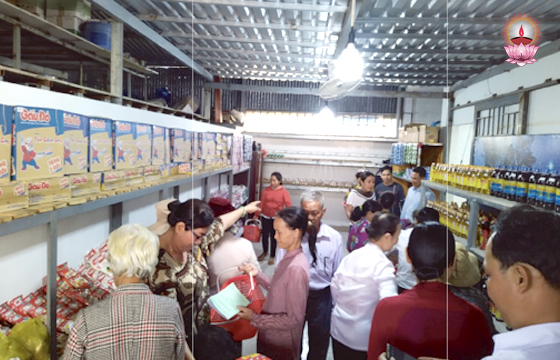
The Diocese of Can Tho opens two ‘free supermarkets’ for the poor
The Diocese of Can Tho opened two supermarkets at the start of the month where the poor affected by the coronavirus pan-demic can get basic necessities for free. One is in Sông Ñc pari-sh, the other in Cái Tac parish.
Vietnam is one of the coun-tries that seems to have better managed the COVID-19 crisis. So far it has reported just over 1,500 cases, with 1,360 hospitalisations and 35 deaths. Despite this, many Vietnamese are facing hardships.
Volunteers run the two supermarkets, also known as “solidarity shops,” the most popular form of charity in Vietnam. The Diocese helps families in difficulty, orphans and people with disabilities.
The beneficiaries have a booklet where the products they receive each month are registered, mostly salt, sugar, rice, fish soup and cooking oil. In Cái Tac more than a hundred families get supplies from one supermarket; each booklet gives the right to get 100,000 dong (US$ 4.3) worth in goods per month.
Bishop Stêphanô Tri Bíu Thiên of Can Tho said that many Catholics face serious economic conditions, and this required some action. “After talking with local priests, we decided to help those who need it most,” the prelate explained, based on Pope Francis’s teachings about the “culture of care as a path to peace.”
–AsiaNews
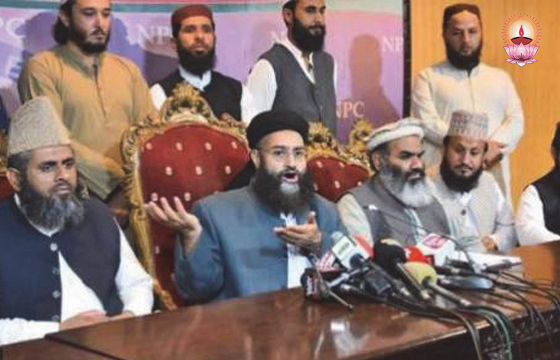
Christians welcome the new government initiative to protect religious minorities
“We appreciate the government’s renewed commitment to the protection of religious minorities in Pakistan, especially for the protection of those falsely accused and for the protection of innocent underage girls trapped in forced conversions and marriages. The initiative of the Government Office for Interreligious Harmony will certainly strengthen peace and harmony between people of different religions and help ensure that members of religious minorities do not to live in fear.”
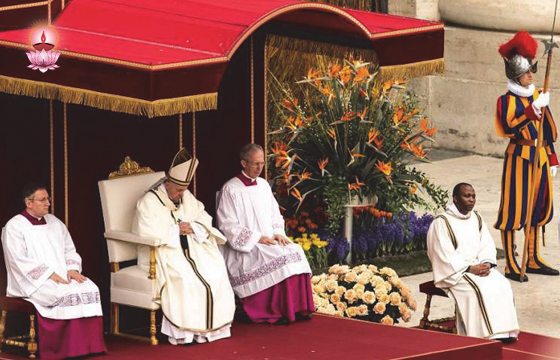
Pope Francis opens ministries of lector and acolyte to women
On Jan. 11, Pope Francis published an apostolic letter issued motu proprio (which means “on his own impulse” in Latin), modifying canon law regarding women’s access to the ministries of lector and acolyte. He also released a letter to Vatican doctrinal chief Cardinal Luis Ladaria explaining his reasoning for the decision.
In the document, Spiritus Domini, the Pope changed Church Law so that women can be formally instituted to the lay ministries of lector and acolyte.
The Pope modified the wording Canon 230§1 of the Code of Canon Law, which previously limited the ministries to lay men.
He changed the phrase “lay men” to “lay persons,” so that the canon now reads: “Lay persons of suitable age and with the gifts determined by decree of the Episcopal Conference may be permanently assigned, by means of the established liturgical rite, to the ministries of lectors and acolytes; however, the conferment of such a role does not entitle them to support or remuneration from the Church.” Yes, in many parts of the world women serve and read at Mass. But until now they were not officially established in the role with the liturgical rites associated with the ministry of an acolyte or lector. They per-formed the role “by temporary designation,” under Canon 230§2 of the Code of Canon Law.
The ministries were traditionally reserved to men because they were associated with what were known as the “minor orders” of priesthood: stages on the way to priestly ordination.
But in 1972, Pope Paul VI intended to abolish the minor orders in the motu proprio Ministeria quaedam. From then on, he said, lector and acolyte should be regarded as ministries, rather than minor orders. When they are conferred, he wrote, it should not be called “ordination,” but rather “institu-tion.” A lector is a person who reads Scripture to the congregation at Mass (other than the Gospel, which is only proclaimed by deacons and priests).
After abolishing the minor orders, Pope Paul VI wrote that an acolyte was a ministry in the Church with the “duty to take care of the service of the altar, to help the deacon and the priest in liturgical actions, especially in the celebration of the Holy Mass.”
In Pope Francis’s letter to Cardinal Ladaria, he said that the Congregation for Divine Worship and the Discipline of the Sacraments would be responsible for guiding the changes, amending parts of the Roman Missal and the rite of institution of lectors and acolytes where necessary.
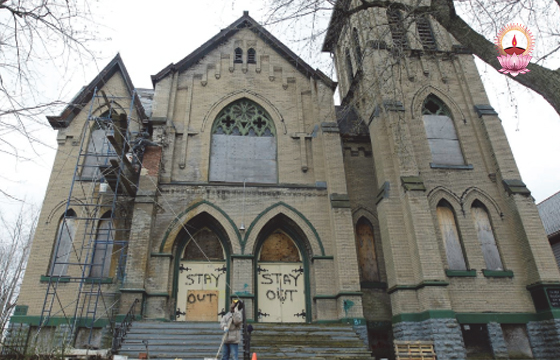
A new solution for America’s empty churches: A change of faith
Over the past few decades, vacant and under-utilized churches have become a familiar sight in American cities.
In some cases, a congregation or a religious governing body – say, a Catholic diocese – will sell the church to developers, who then turn them into apartments, offices, art galleries, museums, breweries or performance spaces. But what about churches in neighborhoods that aren’t doing well, areas that are less attractive to developers looking to turn a profit?
In Buffalo, New York, two empty Roman Catholic churches have been converted – not into apartments or offices, but into other places of worship. One became an Islamic mosque, the other a Buddhist temple.
As an architect and historic preservation planner, I was drawn to this phenomenon. With the help of Enjoli Hall, who was then a graduate student at University at Buffalo, I interviewed those involved in converting the former churches.
With immigrant and refugee populations growing in post-industrial cities across the U.S., the con-version of vacant Christian churches into new places of worship can preserve historic archi-tecture and strengthen burgeoning communities.
In Buffalo, a split between east and west.
Buffalo has long been an immigrant gate-way. From 1850 to 1900, the city’s population in-creased by over 700%. In 1892, over one-third of Buffalo’s residents were foreign born. Poles, Ger-mans and Italians settled in the city, leading to a wave of church construction. In the 1930s, African Americans started migrating from southern US to the east side of the city.
But by 2010, the city’s population had dwindled to just over 260,000 people – less than half of what it was in 1950.
Nonetheless, Buffalo has recently been in the news for its efforts to overcome decades of population decline and disinvestment. In 2016, Yahoo News anchor Katie Couric, fascinated by Buffalo’s transformation, featured the city in her six-video series, “Cities Rising: Rebuilding America,” while The New York Times detailed the changes taking place in some of the city’s neighbourhoods. This public attention, however, has mainly focused on the West Side neighbour-hoods, which have experienced the bulk of investment and population growth. Neighbourhoods in Buffalo’s East Side continue to face tremendous challenges of poverty, crumbling infrastructure and abandoned houses.
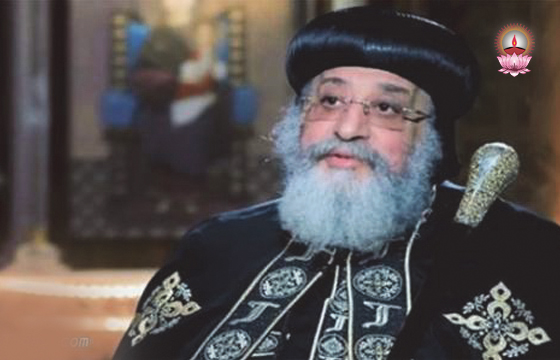
Refusal of the word persecution to qualify the situation in Egypt on the part of the Coptic Orthodox Patriarch
“When I meet the leaders of the world, they always ask me questions about the persecution that is affecting us in Egypt, and I answer that there is no persecution, clearly rejecting this expression to qualify our condition in our country.” This is how Coptic Orthodox Patriarch Tawadros II described his reaction to foreign representatives – including political leaders and Heads of State – who, when they meet him, evoke in their conversation formulas and schemes with which the Coptic Christians of Egypt in the “mainstream” media representation, and in general the Christian communities in the countries of North Africa and the Middle East, are systematically labelled as “persecuted minorities.”
This representation – explained Pope Tawadros in an interview broadcast by the satellite television channel Nile TV on the occasion of the Coptic Christmas – provides “a distorted image of the situation in Egypt,” where Copts are called to face difficulties and problems also linked to sectarian violence and discrimination, which however do not constitute a condition of systematic religious persecution.
“If there is a problem between the different communities in a village,” the Patriarch explained, referring to recent cases of sectarian conflicts that have exploded in certain regions of Upper Egypt, “it is necessary to take into account that in Egypt there are 5000 villages. It happens that in some of them people act recklessly, but for this they are arrested and judged. I categorically reject the definition of “persecution” that some leaders put before me when they talk about Copts.”
During the interview, the Patriarch also dwelt on the new law on the construction of new churches, which since September 2016 has removed the limitations and conditions that previously made it also impossible to build new Christian places of worship in Egypt. Within the framework of this new legislative provision, promoted by President Adel Fattah al Sisi – commented the Patriarch – we can also perceive “the shrewdness of the political leader” who, through laws and choices, aims to preserve stability and social peace.