
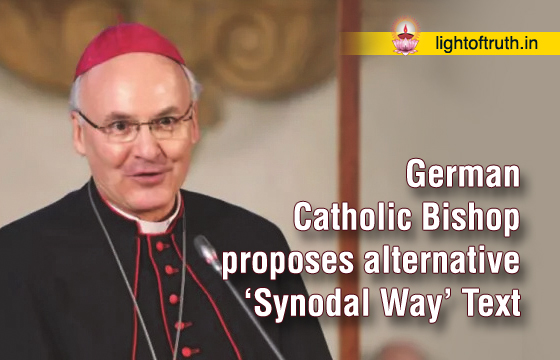
Bp Rudolf Voderholzer of Regensburg, southern Ger-many, presented the text on a website launched on Sept. 3, reported CNA Deutsch, CNA’s German-language news partner. In an introduction to the website, the bishop wrote: “We are joining in the Synodal Way, but we are increasingly convinced that [this process] will not reach its goal if it continues along the path it has taken so far.”
“We are convinced that only a Synodal Way that is undertaken alongside and by the whole Church can be sound and achieve its goal. The whole Church is not only the worldwide Church, but also the early Church and the Church of the saints who have already arrived at their destination.” “Its foundation is the God-man Jesus Christ, who is truly present in the Eucharist and from it builds up the Church.” The Synodal Way is a multi-year process bringing together bishops and lay people to discuss four main topics: the way power is exercised in the Church; sexual morality; the priesthood; and the role of women.
The German bishops’ con-ference initially said that the process would end with a series of “binding” votes — raising concerns at the Vatican that the resolutions might challenge the Church’s teaching and discipline.
Bishops and theologians have expressed alarm at the process, which is expected to end in February 2022, but bishops’ conference chairman Bishop Georg Bätzing has defended it vigorously.
The new website appears as participants prepare to attend a plenary session of the Synodal Way in Frankfurt, southwestern Germany, on Sept. 30-Oct. 2. The event will be the second meeting of the Synodal Assembly, the supreme decision-making body of the Synodal Way.
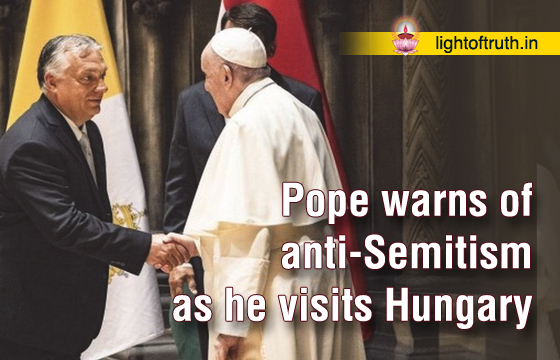
Pope warns of anti-Semitism as he visits Hungary
Pope Francis has warned the threat of anti-Semitism is “still lurking” in Europe, during a brief trip to Hungary.
He was speaking after meeting Hungary’s populist and anti-immigrant PM Viktor Orban, with whom he has stark differences on the issue of refugees. Mr Orban has also been accused of an anti-Semitic stance, but he has said this is “simply ridiculous”.
In a Facebook post, the PM said he had “asked Pope Francis not to let Christian Hungary perish.”
Pope Francis’ meeting with Mr Orban lasted about 40 minutes in the Museum of Fine Arts in Budapest.
In his address to Christian and Jewish leaders afterwards, Francis warned of “the threat of anti-Semitism still lurking in Europe and elsewhere”.
He said: “This is a fuse that must not be allowed to burn. And the best way to defuse it is to work together, positively, and to promote fraternity.”
Hungary has a large Jewish community – some 100,000 strong.
Mr Orban was criticised for his 2017 election campaign that included posters of Jewish financier George Soros, with the words “Let’s not allow Soros to have the last laugh!” He rejected calls from the Jewish community to take them down.
On a visit to London, the PM denied any anti-Semitism, saying that Mr Soros was simply a rival who favoured migrant movement.
Mr Orban and the Pope certainly have divergent views on refugees and migration.
Some of the PM’s supporters in Hungary, along with pro-Orban media, have in the past mocked the Pope as “anti-Christian” for his comments on helping refugees.
At a Mass later on Sunday, Pope Francis alluded to the issue, saying: “The cross, planted in the ground, not only invites us to be well-rooted, it also raises and extends its arms towards everyone.”
“The cross urges us to keep our roots firm, but without defensiveness… My wish is that you be like that: grounded and open, rooted and considerate,” the Pope said.
Francis was celebrating Mass to mark the end of the Eucharistic Congress, which has attracted tens of thousands of Christians from around the world over the past week.
One worshipper, Eva Mandoki, 82, told Agence France-Presse: “We are not here for any politics, but to see and hear the Pope, the head of the Church. We can hardly wait to see him.”
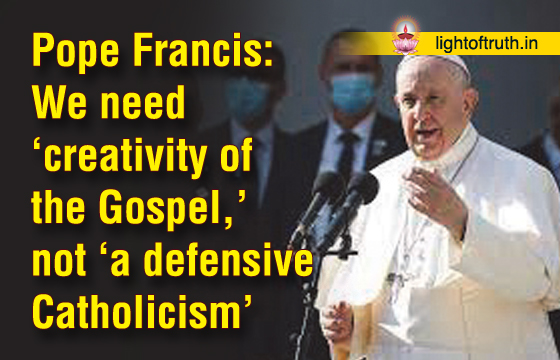
Pope Francis: We need ‘creativity of the Gospel,’ not ‘a defensive Catholicism’
Pope Francis told Slovakia’s Catholics on September 13 that the Church should respond to secularization with the “creativity of the Gospel,” not “a defensive Catholicism.”
Speaking to clergy and lay people in St. Martin’s Cathedral in the capital, Bratislava, on Sept. 13, the Pope encouraged Catholics to draw inspiration from Sts. Cyril and Methodius, who translated the Bible into the Slavonic language.
“Isn’t this what Slovakia also needs today? I wonder. Isn’t this perhaps the most urgent task facing the Church before the peoples of Europe: finding new ‘alphabets’ to proclaim the faith?” he asked.
“We are heirs to a rich Christian tradition, yet for many people today, that tradition is a relic from the past; it no longer speaks to them or affects the way they live their lives.”
“Faced with the loss of the sense of God and of the joy of faith, it is useless to complain, to hide behind a defensive Catho-licism, to judge and blame the bad world. No, we need the creativity of the Gospel.”
The 84-year-old Pope, who is making his first international trip since undergoing surgery in July, looked at ease as he deli-vered his live-streamed address in the capital’s largest church, located beneath the imposing Bratislava Castle.
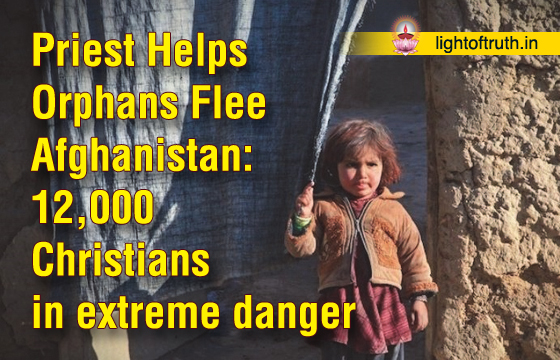
Priest Helps Orphans Flee Afghanistan: 12,000 Christians in extreme danger
Barnabite priest Fr. Giovanni Scalese, ecclesiastical superior of the Catholic mission Sui Iuris in Afghanistan, told la Repu-bblica in late August how he helped 14 disabled children and 5 nuns escape from the embattled city of Kabul.
Father Scalese spoke to the newspaper the day after landing in Rome on Aug. 25, saying, ”I would have never returned to Italy without these children. We couldn’t leave them there.”
The 14 children had been cared for by a group of nuns from the Missionaries of Charity, a religious congregation founded by Mother Teresa of Calcutta. These nuns have been keeping orphans off the streets of Kabul for the last 20 years. The 14 children were between the ages of 6 and 20, with some confined to wheelchairs.
Scalese updated his followers on social media upon reaching Rome. “We thank the Lord for the success of the operation,” wrote the priest in a Facebook post. A missionary in Afghani-stan for seven years, Scalese told SIR, the media arm for Italian bishops, that he was concerned after the Taliban takeover but felt safe in the Italian embassy.
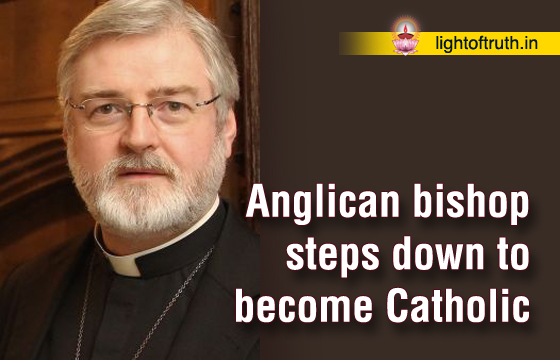
Anglican bishop steps down to become Catholic
A prominent Church of England bishop has announced that he is stepping down in five days to become a Catholic. The Bishop of Ebbsfleet Jonathan Goodall, a suffragan in the Canterbury diocese, is resigning after what he described today as “one of the most testing periods of my life.”
His decision after eight years as Bishop of Ebbsfleet – one of the Anglican church’s provincial episcopal visitors, dubbed “fly-ing bishops”, whose role was pastoral care of certain groups of traditionalist parishes – was announced in a statement by Lambeth Palace this morning. The Archbishop of Canterbury Justin Welby said he had accepted his resignation “with regret.”
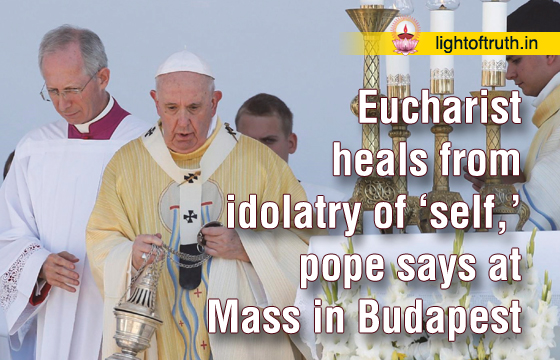
Eucharist heals from idolatry of ‘self,’ pope says at Mass in Budapest
Spending time in adoration of the Blessed Sacrament can heal Christians from a self-absorbed religiosity that is ostentatious and triumphalist, Pope Francis said.
Presiding over the closing Mass of the International Eu-charistic Congress September 12, the Pope urged people to make time for Eucharistic adoration.
“Let us allow Jesus, the living bread, to heal us of our self-absorption, open our hearts to self-giving, liberate us from our rigidity and self-concern, free us from the paralyzing slavery of defending our image, and inspire us to follow him wherever he would lead us,” he said.
After departing from Rome’s Fiumicino in the early morning, the pope told journalists aboard the flight that the papal trip had “a bit of a farewell feeling” due to it being the last time that Bishop-designate Guido Marini would serve as papal master of ceremonies. The Pope named the bishop-designate to lead the Diocese of Tortona, Italy.
Pope Francis also noted that it was the final papal flight aboard Alitalia, which will shutter operations in October after serving 75 years as Italy’s national airline.
Landing in Budapest, the pope was welcomed by Hun-garian Deputy Prime Minister Zsolt Semjén. He then made his way to the Museum of Fine Arts near the site of the closing Mass of the International Eucharistic Congress.
The Vatican said Pope Francis met privately with Hungarian President János Áder, Prime Minister Viktor Orbán and Semjén for roughly 40 minutes “in a cordial atmosphere.”
“Among the various topics discussed were the role of the church in the country, the commitment to the protection of the environment, the protection and promotion of the family,” the Vatican said.
In a statement on his Facebook page, Orbán, who views migration as a threat to Europe’s Christian identity, said, “I asked Pope Francis not to let Christian Hungary perish.”
Pope Francis, arriving in his pope mobile, was greeted warmly by thousands who lined the street leading toward the Mass site in Heroes’ Square.
In the homily, Pope Francis reflected on the Sunday Gospel reading, in which Jesus asks his disciples, “Who do you say that I am?”
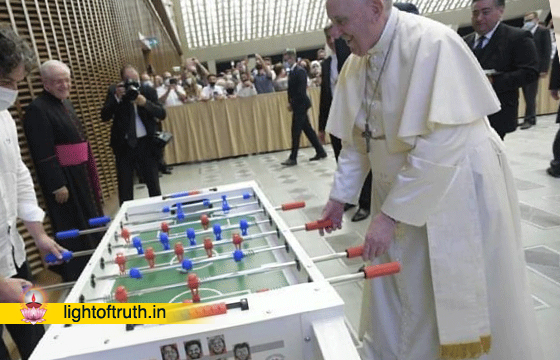
Soccer-loving Pope Francis gets a new toy: A foosball table
Pope Francis has received dozens of soccer jerseys and game balls during his eight-year pontificate but he got a new football-themed toy on Wednesday: his very own foosball table. Francis played a round on the table that was presented to him at the end of his general audience by representatives of a Tuscany-based table football association, Sport Toscana Calcio Balilla in Altopascio. The mayor of Altopascio, Sara D’Ambrosio, wrote on Facebook that the table was designed to be inclusive and work well for people with physical disabilities to encourage their participation in sport.
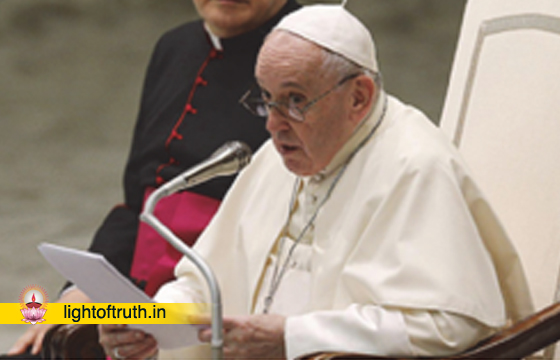
Hypocrisy in the church is ‘detestable,’ pope says at audience
Hypocrites are afraid of the truth, fearful of who they really are and incapable of truly loving, Pope Francis said during his weekly general audience.
What hypocrites do “is like putting make-up on your soul, like putting makeup on your behaviour” and hiding the truth, the pope said Aug. 25 to those gathered in the Paul VI audience hall at the Vatican.
All this pretending, he said, “suffocates the courage to openly say what is true and thus the obligation to say the truth at all times, everywhere and in spite of anything can easily be evaded,” he said.
The pope continued his series of talks on St. Paul’s Letter to the Galatians and focused on the dangers of the law by looking at the apostle Peter’s “inconsistency” at Antioch.
Gentile Christians were free from the Jewish law, but there was pressure from people from Jerusalem that caused Sts. Peter and Barnabas to draw back from what the Gospel said.
That is why, in his letter, St Paul condemns St Peter “to his face because he clearly was wrong” by trying to appease critics who still observed Mosaic law and to justify his hypocritical behavior.
“Peter had been eating with the Christians of pagan origin without any difficulty; however, when some circumcised Christians from Jerusalem arrived in the city, he then no longer did so, because he did not want to incur their criticism,” Pope Francis said.
“Watch out. The mistake was paying more attention to the criticism, to make a good impression than the reality of the relationships,” the pope said.
This was serious in St Paul’s eyes, because other disciples imitated St. Peter, and, even though he did not mean to, “Peter was, in fact, creating an unjust division within the community” by not being transparent or clear about what he was doing, Pope Francis said.
In his letter, St. Paul “wanted to remind the Christians of that community that they were absolutely not to listen to those who were preaching that it was necessary to be circumcised, and therefore be ‘under the law’ with all of its prescriptions,” Pope Francis said.

After Maronite patriarch pressured, U.S. advocates express support
Advocates, political leaders and a Maronite Catholic bishop gathered on Zoom for a virtual seminar to express support for Lebanon’s Maronite patriarch, who came under pressure after calling for the Lebanese army to take control of the southern part of Lebanon, where Hezbollah is engaging in skirmishes with Israel.
Card Bechara Rai, Maronite patriarch, also said Aug. 8 that the Lebanese Armed Forces should enforce a 2006 U.N. Security Council resolution that requires the disarmament of all armed groups in Lebanon. He said Lebanon does not wish to be involved in military actions that elicit destructive Israeli responses. Afterward, an image of the patriarch with a noose super-imposed on his neck circulated on social media.
Rai has “no political agenda,” Maronite Bishop A. Elias Zaidan of Our Lady of Lebanon of Los Angeles told those on the Aug. 12 Zoom call, sponsored by In Defense of Christians, a Washington-based nonprofit advocating for the protection and preservation of Christians and Christianity in the Middle East.
The cardinal’s remarks con-sistently are on behalf of the people of Lebanon, who are saying, “We want to eat. We want to survive,” Zaidan said.

Poor Clare sister from Maryland is elected abbess, succeeds Mother Angelica
BAL When Theresa Buck was still in high school at Mount de Sales Academy in the Baltimore suburb of Catonsville, she took a standardized assessment test meant to give some indication of the kind of career that would best suit her talents, personality and interests. Topping the list of potential careers, according to the assessment? Ministry as a woman religious.
An exercise completed more than two decades ago turned out to be more than prescient. Not only did the former parishioner of St Agnes Parish in Catonsville enter the Poor Clares of Perpetual Adoration at the Our Lady of the Angels Monastery in rural Ala-bama, she recently was entrusted with leadership of the inter-nationally known monastery.
Today with the religious name of Mother Mary Paschal of the Lamb of God, she was elected abbess July 29, taking on the same post that was once held by Mother Angelica, founder of both the monastery and the glo-bal Catholic communications net-work known as EWTN.
The Poor Clares of Perpetual Adoration are a contemplative community of cloistered nuns whose charism is centered on adoration of the Blessed Sacrament. Established in France in 1854, the religious community has monasteries that act autonomously.