
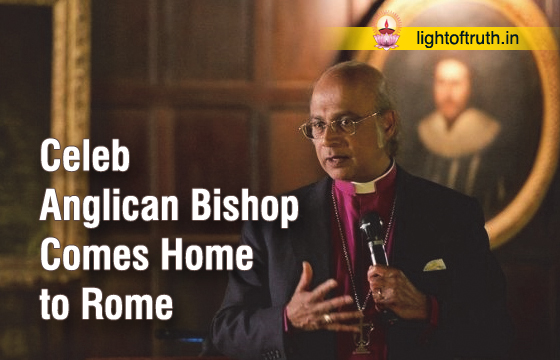
Dr Michael Nazir-Ali, former Bishop of Rochester, England – once the see of English martyr St John Fisher – and a champion of persecuted Christians in Islamic countries, has joined the Personal Ordinariate of Our Lady of Walsingham.
“I write to let you know of my reception into the ordinariate established for Anglicans who wish to be in full commun-ion with the See of Peter,” Lord Nazir-Ali announced.
“I am doing so because I believe that the traditional Anglican desire to adhere to the fullness of apostolic, patristic and conciliar teaching can now best be maintained in this way,” he explained.
An Ordinariate priest told Church Militant that “Lord Nazir-Ali is the most high-profile convert from the Church of England to Rome for the last 100 years, probably since the con-version of the intellectual giant Msgr Ronald Knox.”
Such a high-profile conver-sion is a setback to ecumenism.
“Michael is one of the most prodigious intellects of our time, a heroic apologist for the faith, a bulwark against radical Islam, a laser-sharp cultural commenta-tor, a persuasive preacher, a pa-ssionate evangelist of the highest calibre, and a brilliant linguist and poet,” the priest said.
Cardinal Vincent Nichols, Archbishop of Westminster, will ordain the former Anglican pre-late to the Catholic priesthood October 30 at the Ordinariate pro-cathedral of Our Lady of the Assumption & St Gregory at Golden Square in London.
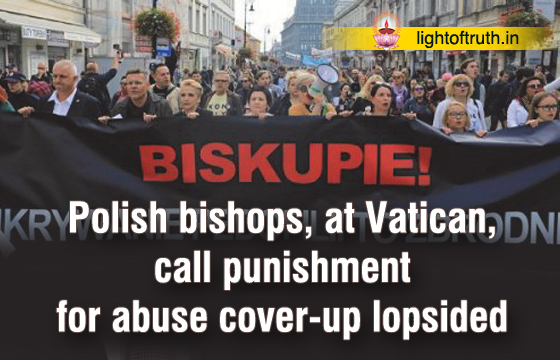
Polish bishops, at Vatican, call punishment for abuse cover-up lopsided
The president of the Polish Bishops’ conference said that in meetings with a Vatican official, several church leaders criticized the Vatican’s handling of sex abuse cases, particularly “dispro-portionate punishments” inflicted on bishops accused of cover-ups in comparison with convicted abusers.
Archbishop Stanislaw Gade-cki, conference president, told Poland’s Catholic Information Agency, KAI, that Polish bishops met with Cardinal Marc Ouellet, prefect of the Congregation for Bishops, at the Vatican October 12. He said the bishops were trying to be faithful to Pope Francis’ May 2019 motu proprio, “Vos Estis Lux Mundi,” revising and clarifying norms and pro-cedures for holding bishops and religious superiors accountable for protecting abusers.
“Our task is to work with the Holy Father in clearing up our church’s current situation, which has undermined trust among certain people,” Gadecki told KAI after the meeting with Ouellet. The meeting was part of the bishops’ “ad limina” visit to meet with Vatican officials every five years.
“But critical remarks have been made about the Holy See’s treatment of bishops who’ve had punishments imposed for short-comings, transgressions or acts of forgetfulness in dealing with clergy accused of paedophilia. Some (Polish bishops) highlight-ed the disproportionate, lasting penalties imposed on bishops after initial investigations, when paedophile criminals can leave prison after five years and begin a new life with a clean sheet.”
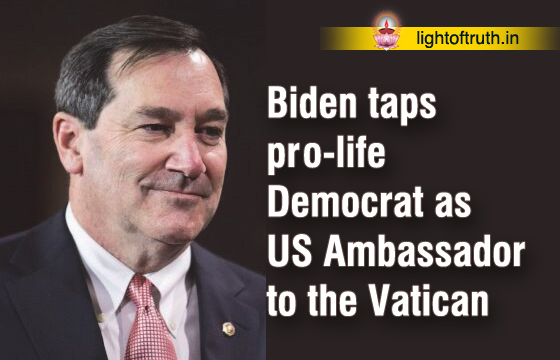
Biden taps pro-life Democrat as US Ambassador to the Vatican
After months of anticipa-tion, the White House announ-ced on October 8 afternoon that President Joe Biden will nominate former U.S. Senator Joseph Donnelly as the U.S. ambassador to the Holy See.
Like President Joe Biden, Donnelly is a devout Irish Catholic.
Donnelly, a Democrat, was senator from Indiana from 2013-2019 and was a member of the U.S. House of Repre-sentatives from 2007 to 2013, representing Indiana’s 2nd Congressional District.
“I am truly honoured to be nominated to this role by President Biden, a man of faith and a friend,” Donnelly said in a statement to Insider. “If confirmed, I look forward to working with the Holy See on a wide variety of issues, in-cluding human rights, religious freedom, immigration, climate change, peace, and poverty.”
Donnelly, a pro-life Democrat, didn’t mention issues of life, mainly abortion. Biden, the second Catholic president in U.S. history has been under fire from many Catholics since the election for his pro-abortion stance. This includes from a portion of the U.S. Conference of Catholic Bishops that have advocated he, and other pro-abortion politicians including Speaker of the House Nancy Pelosi be barred from receiving communion.
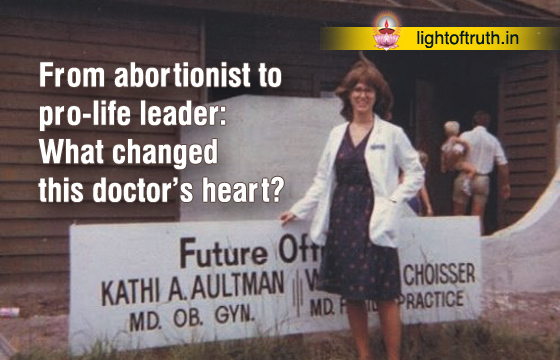
From abortionist to pro-life leader: What changed this doctor’s heart?
Kathi Aultman was six weeks postpartum when she returned to work at an abortion clinic in Gainesville, Florida. She performed abortions on the weekends to earn money while in medical school.
“I felt really strongly that abortion was a woman’s right,” Aultman told in an interview on September 17 interview. “I mean, I bought the whole thing: hook, line, and sinker.” “I even did abortions when I was pregnant — very pregnant. But I didn’t see any contradiction. My baby was wanted, theirs wasn’t. If they wanted to abort their baby, that was their right.”
But Aultman remembers something was different about that first abortion she performed after delivering and caring for her own baby. For the first time in her life, Aultman made the connection that the unborn child she was aborting was, in fact, a child. Not dissimilar to her own child.
Aultman completed the abortion, and she continued to perform abortions in the weeks that followed. But she said her experience that first day back from maternity leave marked the beginning of her journey toward be-coming a pro-life advocate.
Today, Aultman has testified on pro-life issues before state and congre-ssional bodies and state courts, and has assisted various state attorneys and the Justice Department in considering cases related to abortion. She was a speaker at the 2019 March for Life in Washington.
Most recently, Aultman was one of 240 of pro-life women to sign an amicus brief in support of Dobbs v. Jackson Women’s Health Organization, a case out of Mississippi that has the potential of overturning federal protection for abortion in the United States.
“I was fascinated,” she said. “I thought they were so interesting. I love[d] sending foetal parts down to pathology so I could look at the slides and see what the embryonic tissue looked like. I did not see them as people.”
Suddenly, Aultman saw herself as a mass murderer. It happened to be within a few years of the arrest and execution of infamous serial killer Ted Bundy, and Aultman remembers thinking that she had probably killed a lot more people than Bundy had.
“That was the point when I understood that abortion was wrong, and I became pro-life.”

Rally launched to promote communal harmony in Kerala
Leaders of various religious communities and social organizations have started a journey in the southern Indian state of Kerala to promote communal harmony and national integration.
The journey named ‘Sarva Dharma Sadbhavana Yatra’ (Journey to foster goodwill among all religions, is an initiative of the Dharmabharathi mo-vement and promoted by a 16-member team. The journey was flagged off October 8 from Ananda Ashram, a Hindu centre, in Kasargod, Kerala’s northernmost town. It will end October 14 at Thiruvananthapuram, the state capital in the south.
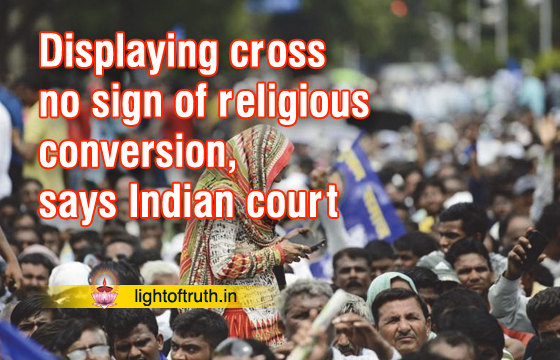
Displaying cross no sign of religious conversion, says Indian court
A top court in the southern Indian state of Tamil Nadu has ruled that a Dalit Hindu woman marrying a Christian or displaying religious symbols such as the cross cannot be cited as reasons to revoke her scheduled caste (SC) community certification. The Madurai bench of Madras High Court held that hanging the cross on a wall or going to church does not necessarily mean one has altogether abandoned the original faith to which one was born and cannot be the basis for cancelling an SC certificate.
The bench was hearing the case of Dr. P. Muneeswari, who belongs to the Hindu Pallan community. Her SC certificate was cancelled by district officials in Ramana-thapuram in 2013 on grounds that she was married to a Christian man and their child-ren were also being brought up in the Christian faith. The officials had reached the decision after finding a cross hanging on the wall of her clinic and concluded that she had converted to Christianity and hence was not liable to continue as a member of her Hindu SC community.
Members of the Hindu Dalit or former untouchable communities in India are often discriminated against under the centuries-old caste system. In legal and constitutional terms, they are now listed as scheduled castes enabling them to access the government’s affirmative action policies and programs.
Dalits who converted to Christianity and Islam are excluded from India’s affirmative action plan that includes reservations in educational institutions and government jobs among other social welfare schemes.
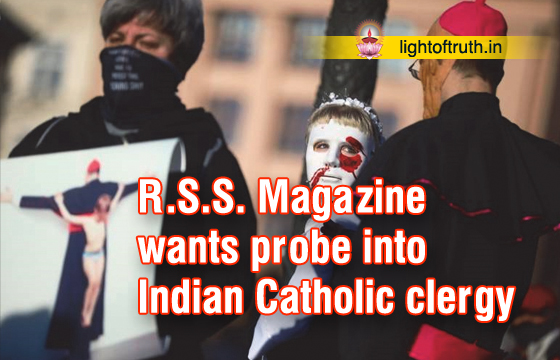
R.S.S. Magazine wants probe into Indian Catholic clergy
Panchjanya, a weekly ma-gazine linked to the Rashtriya Swayamsevak Sangh (RSS), has sought an inquiry into the Indian Catholic Church and its clergy while citing the recent expose of child sexual abuse within the French Church.
In its latest issue, which will hit the stands on Oct. 17, the magazine has reportedly published a cover story on the sexual exploitation of children and nuns by priests across the world.
Panchjanya, published in Hindi to uphold Hindu patri-otism in keeping with the objectives of the nationalist RSS, has claimed that incidents of sexual exploitation of children and nuns are on the rise in India too.
Referring to the reported incidents of rape of a woman in a missionary college in Che-nnai and a nun from Kerala, the magazine has said the people of the country wanted a probe against the Church and its priests.
Detailing the inquiry that unearthed the scale of abuse within the French Church, the magazine termed the earlier apology by Pope Francis in 2019 for such incidents a “formality under pressure.”
It went on to question and blame the style of functioning of the Church for the declining number of religious nuns acro-ss the globe. A similar trend was witnessed in the southern Indian state of Kerala and so the Church was targeting girls from poor families in under-developed states such as Chha-ttisgarh, Jharkhand, Himachal Pradesh and Odisha, the maga-zine alleged.
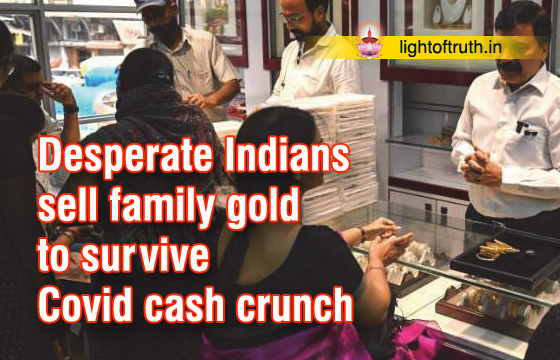
Desperate Indians sell family gold to survive Covid cash crunch
In Mumbai’s jewellery bazaar, Kavita Jogani gingerly places her wedding bangles on the shopkeeper’s scales, one of the thousands of Indians parting with their most cherished asset – gold.
It was not an easy decision – Jogani was desperate after her garment business took a severe hit in the past year and a half with multiple corona-virus lockdowns, making it difficult to pay shop bills and the salaries of her 15 emplo-yees.
The headline growth numbers suggest Asia’s third-largest economy is rebounding from the economic crisis un-leashed by Covid-19, but there is no end yet to the financial pain for many Indians.
“I don’t have any other option than selling the gold,” said Jogani as she waited nervously for the shop owner to make her an offer.
“I bought these bangles before my wedding 23 years ago,” the 45-year-old told.
Business closures and job losses pushed more than 230 million Indians into poverty in the past year, according to a study by Azim Premji University, leaving many struggling to pay rent, school fees and hospital bills.
Their difficulties have been compounded in recent weeks by soaring prices for electricity, fuel and other items.
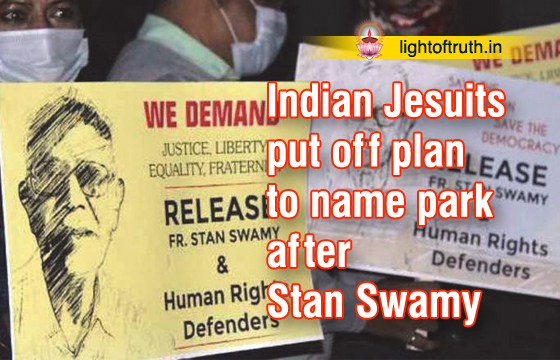
Indian Jesuits put off plan to name park after Stan Swamy
The opposition from Hindu nationalists’ organiza-tions has compelled a Jesuit-run institution in the southern Indian state of Karnataka to postpone the naming of a park inside its campus after late Jesuit priest and tribal rights activist Father Stan Swamy.
The 140-year-old St. Aloy-sius College in Mangaluru had decided to hold the naming ceremony on Oct. 7 but post-poned it citing President Ra-manath Kovind’s two-day offi-cial visit to the city.
Vishwa Hindu Parishad, its youth wing Bajrang Dal and Akhil Bharatiya Vidyarthi Pa-rishad, the students’ wing of the ruling BJP, had threatened to stage a protest if the college went ahead with the plan. The park is located on the college’s Beeri campus on the outskirts of the coastal city but VHP said it would be an insult to name it after someone accused of terror activities.
“It is unfair to oppose the naming of the park in the name of Father Stan and to brand him as a Maoist because it is not yet proven in court,” Father Denzil Fernandes told.
Hindu groups harass nuns, Christians in Uttar Pradesh
Some 50 Christ devotees attending Sunday service were attacked by Hindu radicals in the Mau district of the northern Indian state of Uttar Pradesh. The activists of Bajrang Dal (party of the stout and strong) and Hindu Yuva Vahini, a youth group, paraded the Christians to the nearby police station where they were detained until late night on October 10.
Seven of them, including three women and a pastor, were sent to jail for attempting forced religious conversion and other allegations.
Meanwhile two Ursuline Franciscan nuns, who had come to the city bus stand, were forcibly taken to the police station and kept there from 12:30 pm to 6 p.m. They were released under pressure from high ranking police officials from Lucknow, the state capital.
Sister Gracy Monteiro, working in Mirpur Catholic mission, told Matters India that she had gone to the bus stand to help her companion Sister Roshni Minj to board a bus to Varanasi.
Sister Minj was going home to visit her ailing father in the eastern Indian state of Jharkhand. As Minj went to ask about the bus, some Hindu radicals attacked the driver and forced the nuns to walk to the police station, where the Sunday worshipers were already detained..
Sister Monteiro said she was under terrible shock for almost an hour as she and Sister Minj were accused of being part of the Sunday worshippers who were allegedly attempting to forcibly converting the people.
Vijendra Rajbhar, the leader of the Christ devotees, told the police and the journalists that the Catholic nuns were not part of the prayer meeting. The Hindu radicals insisted that the nuns are part of the conversion gang.