
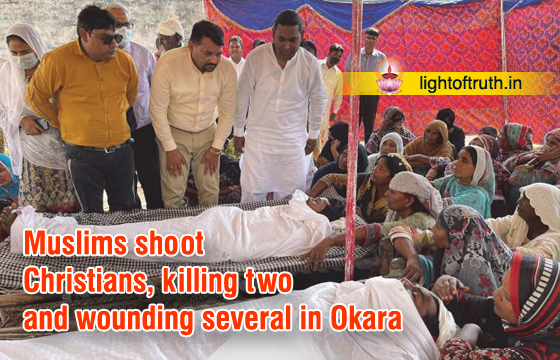
More than 20 Muslims have attacked a Christian commu-nity in Punjab. The violence followed a row between two families over the irrigation of some fields in the Okara area.
When a group of young Christians went back to water their fields, Muslims opened fire with guns and rifles.
Two young Christians, Yaqub Mukhtar and Haroon Mukhtar, died on the spot, whi-le half a dozen other Christians had to be hospitalised in critical conditions. A First Information Report (FIR) was drawn up against a group of Muslims, said Indrias Mukhtar, a witness to the incident.
Those named in the FIR include Muhammad Abbas, Babar, Mustafa, Shafqat, Gulzar, Qadir Gulzar, Nasar-Ullah, Noor, Abbas Ahmad, Hassan Ahmad, Azhar Taj.
In all, police registered a case against 18 people, but only two have been arrested so far.
Asif Munawar, a human rights activist and member of the Jhang District Committee, visited the site of the shooting and attended the funerals. He offered his condolences to the families of the dead.
In this case the violence was unleashed by a disagree-ment between three young Christians who were cleaning the entrance of their church and a Muslim passing by.
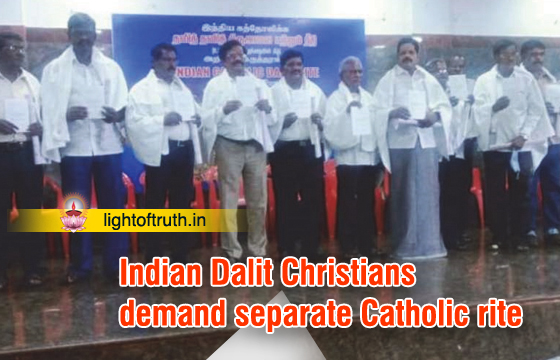
Indian Dalit Christians demand separate Catholic rite
Dalit Christian organiza-tions in the southern Indian state of Tamil Nadu have demanded a separate rite for Dalit Catholics as a solution to caste-based discrimination in the Indian Church. Dalit Chri-stians have long wanted an end to caste-based discrimination in the Church and have in the past urged Pope Francis to create a Catholic rite like the Kerala-based Syro-Malabar and Syro-Malankara churches.
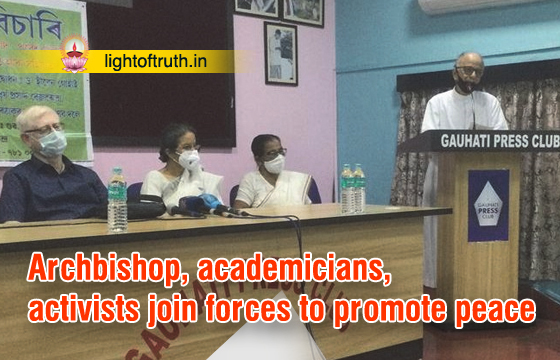
Archbishop, academicians, activists join forces to promote peace
A group of academicians and social activists came together under the leadership of Archbishop emeritus of Guwahati to promote peace at a time when the whole of Brahmaputra Valley is “in search of peace.”
The occasion was the re-lease of an Assamese langua-ge book entitled Hanti Bisari (In Search of Peace) written by Archbishop Thomas Mena-mparampil. The original work in English language was tran-slated into Assamese by a civil society leader, Paresh Mala-kar.
The book-release on Octo-ber 22 turned out to be a social-discussion session in which the need for mutual understanding between communities was emphasized. A reputed intelle-ctual of Assam, Hiren Gohain released the book at Guwahati Press Club.
Archbishop Thomas says, “Professor Satyakam Bortha-kur of the University of Dibrugarh had helped in the compi-lation of texts from original Assamese authors. So, the book turns out the product many hands, coming out precisely at a time when the whole of Brahmaputra Valley is ‘in search of peace’.”

From Mumbai to Jerusalem, the synodal path begins in Asia
The Churches of Asia, in communion with Catholic communities around the world, yesterday marked the start of the two-year synodal path announced by Pope Francis centred on the theme “For a Synodal Church: Communion, Participation and Mission”.
The first phase, which entails listening to the whole people of God, will see individual dioceses take the lead.
To this end, Card Oswald Gracias, president of the Catholic Bishops’ Conference of India (CBCI), led a solemn Mass in the Cathedral of the Holy Name of Jesus in Mumbai.
Due to COVID-19 restrictions, only 122 people representing various groups attended the service, while thousands more people followed the service via online streaming.
In a show of the willingness to listen to everyone, women were given a prominent place in the liturgical readings. A migrant woman from Jharkhand proclaimed the first reading in Hindi (the national language), while a second woman performed the second reading in Marathi (the local language). Prayers were also recited in Tamil and Konkani.
In his homily, Card Gracias said, “the Synodal process [is] meant to reform the church, by discerning what ails the Church, which means even listening to those who have left the Church and those who are thinking of leaving the Church, [for] they have a story to tell, which might make us reflect.”
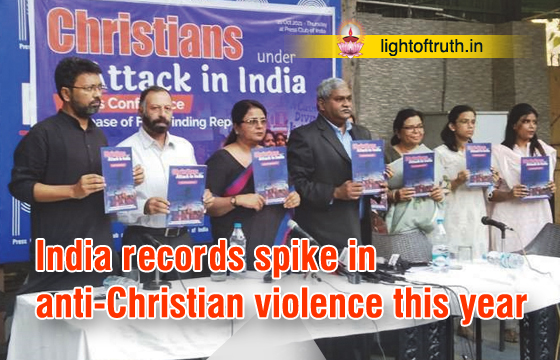
India records spike in anti-Christian violence this year
India has witnessed a significant rise in violence against Christians this year with 305 incidents recorded across 21 states during the past nine months. Surprisingly, official cognizance of the targeted violence was lax with only 30 complaints registered by police so far.
September had the highest number of incidents with 69, followed by 50 in August, 37 in January, 33 in July, 27 each in March, April and June, 20 in February and 15 in May. These figures were published in a fact-finding report by the Association for the Protection of Civil Rights (APCR) and United Against Hate and United Christian Forum (UCF) and released at a press conference in New Delhi on Oct. 21
Christian Prio Sadhana Lanse and her daughters Pearl and Eva from Roorkee presented horrific details of the attack they suffered.
Eva recalled how an armed mob of around 200 shouting slogans like “Jai Shri Ram” (Hail Lord Ram) and “Vande Mataram” (I bow to thee, motherland) barged in, vandalized a prayer house and manhandled the Christian faithful on Oct. 3.
“We feel unsafe there and fear for our lives,” she said, adding that police made no arrests despite naming the main attackers in their complaints with evidence of the violence and destruction they caused.
Uttar Pradesh in northern India ruled by the pro-Hindu Bharatiya Janata Party (BJP) topped the list with 66 incidents of attacks this year, followed by Congress-ruled Chhattisgarh (47), tribal people’s Jharkhand Mukti Morcha-ruled Jharkhand (30) and BJP-ruled Madhya Pradesh (26).
Karnataka in the south, also ruled by the BJP, witnessed a spurt in violence against Christians with 32 incidents.
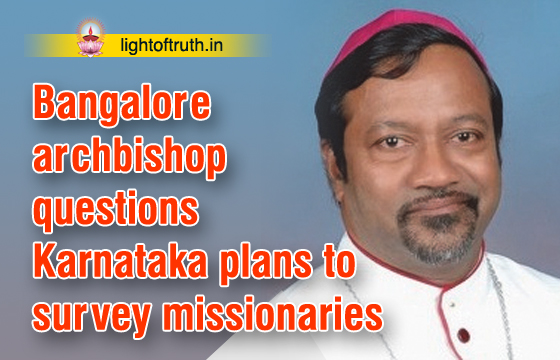
Bangalore archbishop questions Karnataka plans to survey missionaries
Archbishop Peter Machado of Bangalore has condemned the continuous harassment on the Christian Missionaries in the state and questioned the wisdom behind conducting a survey on their presence and activities in Karnataka.
The Backward Classes and Minorities Welfare Department in Karnataka has ordered the officers to conduct a survey of both official and non-official Christian missionaries in the southern Indian state, following a discussion on Christian conversions in the state on October 13.
“Why is the government interested in making survey of the religious personnel and places of worship only of Christian community?” asked the Bishop in a statement issued October 15.
Instead, “let the government take the count of education institutions and health centers run by the Christian missionaries, which will give a fare idea of the service that is rendered by the Christian community to the nation building and how many people are converted in these places and institutions,” he challenged.
“We consider this exercise as futile and unnecessary. There is no good that will come out of it,” stated the archbishop. In fact, in the background of the conversion boggy and anti-religious feelings that are being whipped up, it is dangerous to make such surveys, he added.
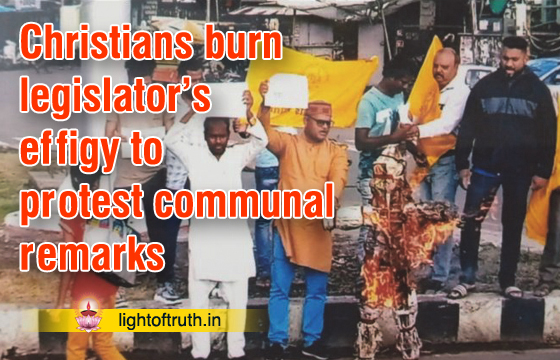
Christians burn legislator’s effigy to protest communal remarks
Some young Christians have burnt the effigy of a Hindu law maker in the central Indian state of Madhya Pradesh to protest against his unsavoury statement against Christians and Muslims.
Rameshwar Sharma, a legislator belonging to the ruling pro-Hindu Bharatiya Janata Party, urged Hindus at a religious gathering “to stay away from Father (referring to Christians) and Chadar (referring to Muslims) and Peer Baba (a Sufi Muslim saint).”
The law maker cautioned Hindus that the company of company of Christians and Muslims “will destroy you.”
The legislator’s communal remarks provoked some Christians, who on October 18 burnt his effigy at Lilly Talkies Square in the state capital of Bhopal.
“This time we burnt Sharma’s effigy at a public place to caution him,” Jerry Paul, the national president of the Sarva Isai Mahasabha (grand council of all Christians), told Matters India, October 22.
“If the legislator repeats the same, we will not hesitate to burn his effigy in front of his house and lodge police case against him for creating communal discord among people on religious lines,” Paul warned.
Sharma believed to have made the remarks at a Dussehra celebration on October 15 in Bhopal. It came to light through a video clipping on social media two-days later.
The legislator further urged Hindus to stop using “good morning” (apparently referring to European culture and Christianity) and instead use “Jai Shree Ram” (hail Lord Ram) to greet people.
Meanwhile Archbishop Leo Cornelio of Bhopal condemned the legislator’s divisive remarks. “An MLA representing the people of a state should have a sense of what to speak and what not to speak in public forum,” the prelate said.

Indian pastor injured after mob barges into church
A pastor of a Protestant church was held by the police after a mob of pro-Hindu activists barged into a church in the Indian state of Karnataka and began singing bhajans or Hindu devotionals as a protest against alleged forced religious conversions.
A video clip of the incident reported from Hubbali town on Oct. 17 showed activists of the Vishwa Hindu Parishad (World Hindu Council) and its youth wing, the Bajrang Dal, forcibly entering Bairidevarkoppa Church and singing devotionals.
Pastor Somu Avaradhi and some of his associates reportedly sustained minor injuries in a scuffle but Arvind Bellad, a local member of the legislative assembly belonging to the ruling Bharatiya Janata Party (BJP), blocked a highway along with his supporters demanding their arrest.
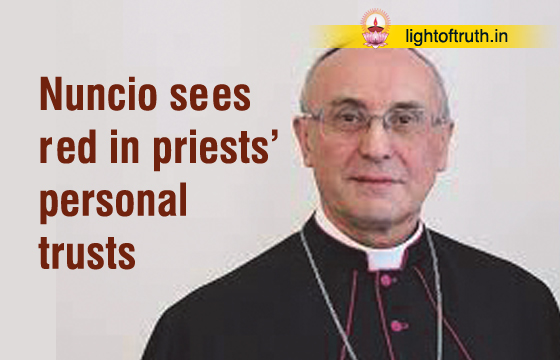
Nuncio sees red in priests’ personal trusts
Apostolic Nuncio to India Archbishop Leopoldo Girelli has pulled up Tamil Nadu bishops for “a tendency” among priests to set up and manage independent trusts violating the canon law. The nuncio says the existence of such trusts in Tamil Nadu came to his attention during his recent visit to the diocese of Kottar in the southernmost tip of India.
“Even if the aim of such trusts may appear to be praiseworthy, all too often those trusts become financial and political power bases for the priests involved,” says the nuncio’s October 8 letter addressed to the Catholic bishops of Tamil Nadu.
The letter, shared widely in social media platforms, quotes various sections of the canon law to urge bishops of dioceses with such trusts to regulate them guided by the bishops’ conference.
“Priests and religious should not be directly associated with any independent or standalone trusts or societies or For/Not-for-profit companies, unless their involvement has specifically been approved by” the local bishop, the nuncio asserts.
The Vatican representative wants bishops to follow the canon law to punish the offenders according “to the gravity of their offence.”
He has recommended the Tamil Nadu bishops’ conference to formulate “clear guidelines on the subject,” if they are non-existent.
He wants every bishop to ascertain the details of the personal trusts held by any of his priests and instruct holders of existing personal trusts to close them immediately. He also wants the bishops to ensure that no new trust is opened by his priests.
The nuncio wants the diocesan trust or the diocesan social services trust to bring under its control personal trusts of priests that “are of genuine benefit to the life and mission of the diocese.”
The Vatican official urges the bishops to resolve that no trust is set up under “the sole control of a single member of the clergy.”
The nuncio concludes the letter saying his recommendations are for the well-being of the Church in Tamil Nadu. In response to the nuncio’s letter, Bishop Thomas Aquinas of Coimbatore, one of the 18 dioceses in Tamil Nadu, wrote to his priests on October 16 that he is aware of “a couple of priests” who have trusts.
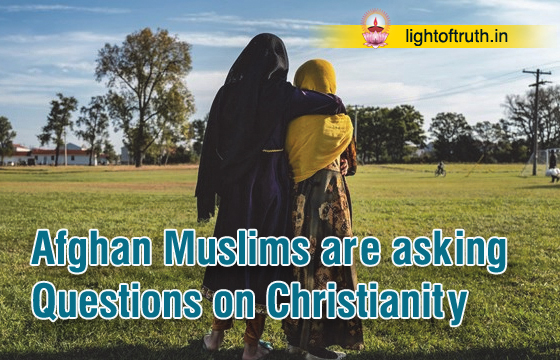
Afghan Muslims Are Asking Questions on Christianity
Mike Christian and his wife lead a small congregation called the Afghan-American Church of the Bay Area. But their main ministry is not gathering with a dozen or so Afghan believers during the week. It is engaging with the tens of thousands of Afghan seekers from around the world who reach out through messaging apps, social media, and online outlets.
Mike, who was born in Afghanistan and worked alongside the US military there, adopted the name “Mike Christian” after his conversion. It was a signal to fellow Afghans that they could speak with him if they were curious about Christianity. His popular Facebook page shares Bible verses and Christian messages in Dari alongside an invitation to get in touch.
The recent Taliban takeover has created a unique opportunity for some Afghan Muslims to rethink their faith, just as a massive influx of Afghan evacuees are fleeing to the United States for resettlement. It ’s the younger generation, and especially the women, Mike says, who are most dis-enchanted with Islam, and most open to learning about the God of Christianity.
“We receive tons of text messages, emails, WhatsApp, and phone calls from Afghanistan,” Mike told in an interview. “They ’re saying, ‘We don ’t like Islam. We don ’t want that kind of religion. We want to become a Christian. Please help us. Show us how we become a follower of Jesus.’”
“I just keep praying,” he says, “‘Lord, you have the power to change Afghan people—to join your church, to seek you and believe in you, to pray and repent.’’”
The couple fields hundreds of questions a day from curious Afghans, describing the good news to them and connecting new believers to nearby house churches. But they are also part of the global network of believers with Afghan connections, helping create resources for churches to better serve their Afghan neighbors—both here and abroad.
“I’m engaged with 30,000 Afghans now,” said Mike. “I don ’t remember the Lord tell-ing me to stop. The Lord ’s mission is never stopped, so let ’s keep going.”
When Mike was working with the military during the War in Afghanistan, he found himself in a dark place and struggling after a deadly mission. He had a series of dreams about Jesus, who called him by name to share the gospel with his people. After joining the underground house church movement, Mike endured intense persecution, multiple imprisonments, and brutal torture for his evangelism efforts before he was able to escape Afghanistan and make his way to the United States.