
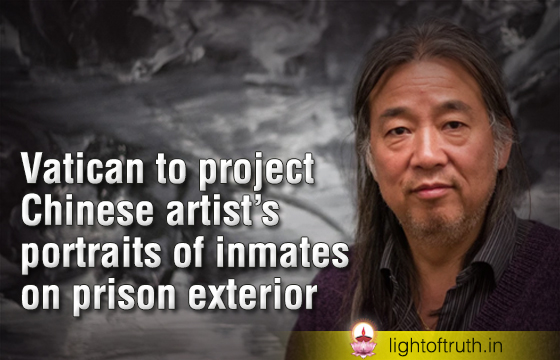
A Chinese artist’s paintings of inmates living inside one of Rome’s most well-known prisons will be projected on the prison building’s exterior and displayed in a new exhibit space near the Vatican as part of 2025 Jubilee initiatives.
The 64-year-old Yan Pei-Ming is a contemporary artist who has been living in France since 1981. He is known for his “epic-sized” portraits of figures such as Chairman Mao, St. Pope John Paul II, Bruce Lee, and Barack Obama. Pei-Ming’s latest portrait series, 27 prisoners living inside Regina Coeli Prison, will be displayed on the side of the prison building. The works, created at the request of the Vatican’s education and culture dicastery, will be the inaugural exhibit of a new art space on Via della Conciliazione, the main street leading to St. Peter’s Basilica.
The Vatican will highlight the work of contemporary artists during the 2025 Jubilee Year and beyond with the new exhibit space, called “Conciliazione 5,” to be inaugurated Feb. 15, during the Jubilee of Artists and the World of Culture. The Vatican has planned a slew of events for the Feb. 15-18 Jubilee of Artists, including the opening of the contemporary art space, Sunday Mass with Pope Francis, and the first-ever visit by a pope to the film studios of Cinecittà. The Vatican expects more than 10,000 people from across the wider art and cultural environments – hailing from over 100 countries and five continents – to participate in events over the four days.
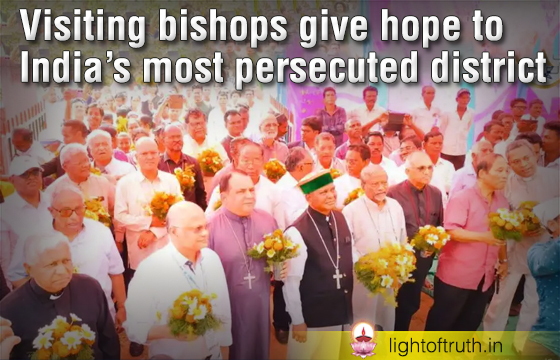
Visiting bishops give hope to India’s most persecuted district
An Indian archbishop who led a group of bishops on a Feb. 5 visit to eastern Odisha’s Kandhamal district — the epicenter of anti-Christian violence nearly 20 years ago — has said the land will become a pilgrimage centre for Catholics. “I am sure, one day, this land of martyrs in Kandhamal will become a pilgrimage site for Catholics,” Archbishop Peter Machado of Bangalore and newly elected vice president of the Conference of Catholic Bishops of India (CCBI) told UCA News on Feb. 6. He said the 23 bishops accompanying him interacted with many survivors of the 2008 violence that tore through churches and Christian villages in the district. “The survivors are safe now after being rehabilitated by a Catholic Church initiative with the support of the government, but their lives are not without fear,” Machado noted. More than 100 people were killed and hundreds wounded during the attacks that began on Aug. 24, 2008, and lasted more than four months, rendering more than 56,000 people homeless. The violence followed the Aug. 23 murder of Swami Lakshmananda Saraswati, a Hindu nationalist leader in Odisha. Local left-wing Maoist rebels claimed responsibility, but local Hindu groups blamed the murder on Christians instead. The four months of violence left a trail of destruction as over 300 churches and 6,000 homes were razed. Many Christians were forced to flee into nearby forests, where some succumbed to hunger and even snakebites. “Although there is no visible violence [now] against Christians in this region, people can sense hatred and suspicion from dominant Hindu groups,” Father Manoj Kumar Nayak, a survivor of the violence from Tiangia village, told on Feb. 7. Now the parish priest of Our Lady of Miraculous Medal Church in Mondasoru village, which has 300 Catholic families, Nayak said the victim families have been rehabilitated in small houses. But “one cannot miss the lingering fear of the Hindu nationalists,” he added. Nayak said Catholics were reassured by the visit of the Apostolic Nuncio Archbishop Leopoldo Girelli on Jan. 31 to Kandhamal district to show solidarity with them. He said the 23 bishops, led by Archbishop Machado, visited Our Lady of Charity Church in Raikia and Nandagiri, where 82 families have rebuilt their lives after being forcibly removed from their original village of Beticola.
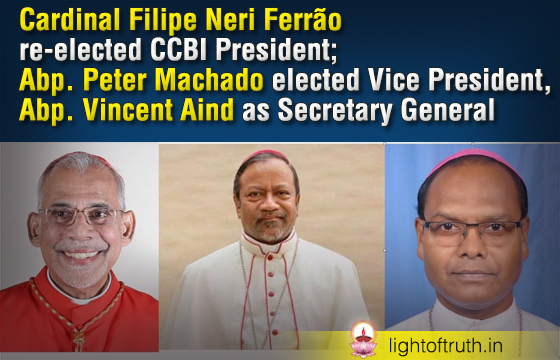
Cardinal Filipe Neri Ferrão re-elected CCBI President; Abp. Peter Machado elected Vice President, Abp. Vincent Aind as Secretary General
Cardinal Filipe Neri Ferrão has been re-elected as the Presi-dent of the Conference of Catholic Bishops of India (CCBI), while Archbishop Peter Machado of Bangalore has been elected as the Vice President and Archbishop Vincent Aind of Ranchi as Secretary General. The elections took place during the 36th Plenary Assembly of the CCBI at XIM University, Bhubaneswar. Cardi-nal Filipe Neri Ferrão (72) was first elected the President at the 31st Plenary Assembly held in Chennai in 2019. He was re-elected for a second term in 2023 at the 34th Plenary Assembly in Bangalore. In addition to his leadership in India, he also serves as the President of the Federation of Asian Bishops’ Conferences (FABC), an office he assumed in January 2025. He is also the member of the Dicastery for Evangelisation and the Secretariat for the Synod of Bishops.
Archbishop Peter Machado (70) currently serves as the Presi-dent of the Karnataka Regional Bishops’ Council and the Chairman of the CCBI Commission for Laity.
Archbishop Vincent Aind (70) was appointed Bishop of Bagdogra on April 7, 2015 and ordained on June 14, 2015. Archbishop Aind is also the Chairman of the CCBI Commission for Theology and Doctrine. On December 30, 2023, he was appointed Archbishop of Ranchi.

Indian Catholics lend helping hand to Kumbh Mela pilgrims
A Catholic-run hospital and a college in the northern Indian state of Uttar Pradesh have offered free meals to Hindu devotees as mi-llions gather to attend the Kumbh Mela, dubbed the world’s largest religious gathering. Father Vipin D’Souza, director of Nazareth Hospital, said they are glad to lend hands to the pilgrims. The hospital, in collaboration with the Allahabad Diocesan Commission for Interreligious Dialogue, spon-sored free meals outside the hospital premises on Jan. 29 and Feb. 3 as thousands of devotees passed by a road leading to the Kumbh Mela venue, about five kilometres away. “We decided to organize the free meals for the devotees as they have been walk-ing more than 10-15 kilometres to reach the place,” D’Souza told. “Recognizing the needs of the weary pilgrims, we planned to give them tea, snacks, and other food items. We gave free medi-cine to some and treated four Hindu monks in our hospital for free,” he said. He added that between 25,000 to 30,000 pilgrims received various services from the hospital. Kumbh Mela (festival of the Sacred Pitcher) is a major, centuries-old Hindu pilgrimage that involves bathing or taking a dip in a sacred river, such as the Ganges. It occurs once every 12 years. The 45-day-long festival began on Jan. 13 on the confluence of the Ganges-Yamuna-Sarasvati rivers at Prayagraj (formerly Allahabad), the largest city in Uttar Pradesh state. Hindus believe the ritual dip liberates them from sins and offers spiritual atonement.
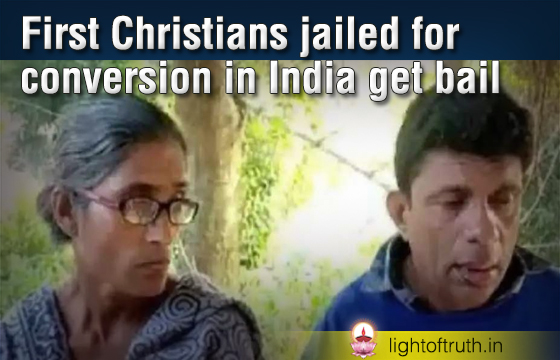
First Christians jailed for conversion in India get bail
A Christian couple convicted of trying to convert people to Christianity in the first such case in India has been granted bail, after they challenged the conviction in the high court of Uttar Pradesh state. The Lucknow bench of the Allahabad High Court, the northern state’s top court, has granted bail to Pastor Jose Pappachan and his wife, Sheeja Pappachan, said Pastor Joy Mathew, who has been assisting the couple. “The court is yet to release detailed orders, but it is confirmed that they have been granted bail today,” Mathew told. Pappachan and his wife had moved separate applications requesting bail and to set aside the conviction of a special court in Ambedkar Nagar district, which deals with crimes against socially poor castes. In the Indian judicial system, convictions can be challenged in appellate courts, and allowing bail for convicts ordinarily means temporary suspension of sentence. The couple were sentenced on Jan. 22 to five years in jail. They were convicted of violating the state’s law that restricts conversion – the Uttar Pradesh Prohibition of Unlawful Conversion of Religion Act 2021.

Indian bishops oppose movie disparaging faith, conversion
Bishops of Christian Churches across India have jointly condemned a film, saying it deroga-torily portrays their religion and faith in the language of an eastern Indian state having a history of anti-Christian violence. The movie Sanatani–Karma hi Dharma, made in the Odia language of Odisha state, was released in cine-mas on Feb. 7, despite calls from Christians and other secular groups to stop it. The movie “misrepresents religious conversion as a criminal activity, undermining the freedom of religion,” said the National United Christian Forum. The forum of Catholic, Protestant, Orthodox, and Evangelical bishops also accused the movie of distorting “key aspects of Christian doctrine.” The bishops said the movie, set in the background of tribal villages, can potentially “fuel divisions among tribal communities.” The movie reportedly revolves around Christian conversion and witchcraft in the tribal villages in the state. The name uses the Sanskrit word Sanatani, which refers to those who follow the Hindu religion. It asserts that for such people, Karma hi Dharma, meaning duty is religion. The eastern state has a history of anti-Christian violence. The worst was in 2008 when Hindu groups attacked and burned down hundreds of Christian homes and churches in the tribal-dominated Kandhamal district, killing some 100 people, mostly Christians. Hindu groups, who work to establish a nation of Hindu hegemony, oppose Christian missionary activities and conversion, particularly in the villages where they say missionaries target the socially poor tribal and former lower caste people. The tribal-dominated Kandhamal has a Christian concentration, forming 20 percent of the district’s 750,000 people, with the majority of tribal people following the Hindu religion or their animist traditions.
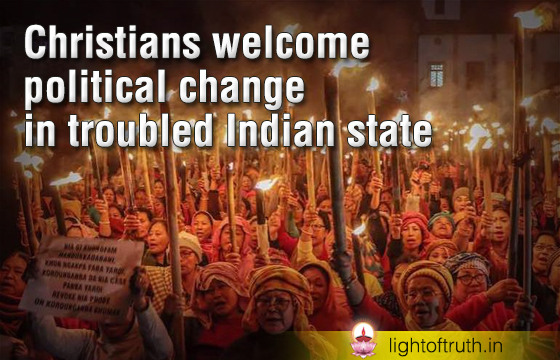
Christians welcome political change in troubled Indian state
Christian leaders in strife-torn Manipur state in northeastern India have welcomed the resignation of its chief minister, close to two years after the state witnessed unprecedented violence that claimed over 250 lives, mostly Christians.
Chief Minister Biren Singh submitted his resignation letter to Governor Ajay Kumar Bhalla who is the constitutional head of state, on Feb. 9 in the state capital amid continuing unrest between Kuki tribal Christians and Hindu-majority Meitei people. The resignation is “definitely a welcome move for the betterment of the violence-ravaged state,” said a Christian leader who did not want to be named, fearing retribution. “Now there is a scope for restoration of peace and reviving the shattered lives of the people of Manipur,” the Church leader told.
The tiny, hilly state with 3.2 million people has been in turmoil since May 3, 2023, after unprecedented violence broke out between the Meitei and indigenous Kuki people, who are a minority in the state but mostly Christians. The violence erupted after the Meitei people attacked Indigenous Christians, who were rallying to protest the Singh government’s decision to extend tribal status to the Meiteis. Kuki people say the extension of the status will help Hindu Meitei people eat up tribal benefits meant for weaker sections. Meitiei people are considered comparatively wealthy and politically influential, they say.
The violence persisted, and at least 11,000 houses and 360 Churches were burned down, and scores of Church institutions, including schools, presbyteries, and other offices, were destroyed. Kuki leaders accused Singh, a Meitei, of orchestrating and supporting the violence and demanded his resignation. But Singh refused, asserting that his government, led by the Bharatiya Janata Party (BJP), made all possible efforts to restore peace.
“The presence of Singh as the leader of the government was a major stumbling block for peace in the state as the indigenous Kuki-Zo people never trusted him,” another Church leader said. Singh, a state leader of BJP, “was outright a partisan leader who only represented the interests of his [Meitei] community.
Therefore, the state could not move forward with any peace talk until now,” the Church leader said. He expressed hope that the federal government under Modi “will now take appropriate steps to restore peace in the state.”
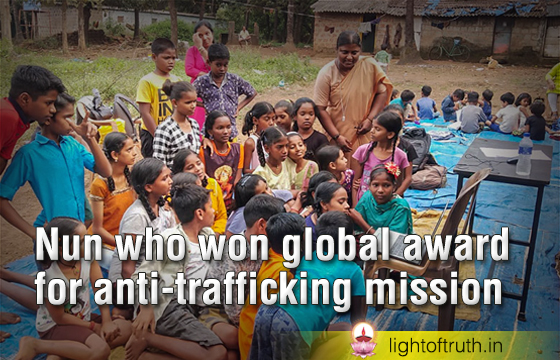
Nun who won global award for anti-trafficking mission
Canossian Sister Grasy Luisa Rodrigues received the Common Good Award at the Sisters’ Anti-Trafficking Awards May 23, 2024, in Rome for saving trafficking victims for the past 13 years.
She also educates youth about the Indian Juvenile Justice Act, cyber safety and online exploitation, child labour, health and hygiene, and children’s rights and protection.
The 45-year-old nun organizes human trafficking awareness campaigns in hotels, colleges, villages, schools and slums with the support of law enforcement agencies. She helps rehabilitate the rescued and works with networks such as the International Justice Mission and Justice and Care.
In 2022, Rodrigues became a founding member of Mukti Kiran (Ray of Liberation), an organization that works with Goa police to prevent human trafficking.
Rodrigues, who lives in Goa’s Arambol village, shared with Global Sisters Report how she entered social work and contributed to society.
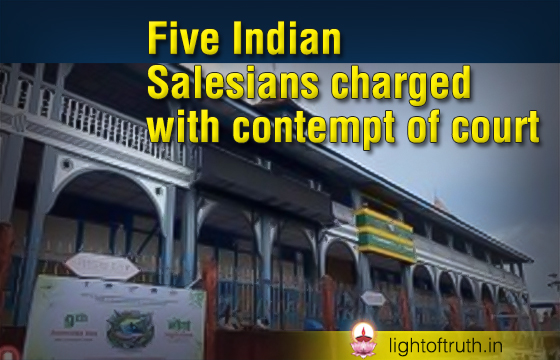
Five Indian Salesians charged with contempt of court
The top court in India’s northeastern Meghalaya state has issued contempt of court notices against five Salesian priests for demolishing a build-ing, ignoring a petition that sought the court’s intervention to protect it. Meghalaya High Court on Jan. 28 issued notices to the priests – Saji Stephen, Arcadius Puwein, Edmund Gomes, Dianetius Fernandez and Cyril Tirkey – asking them to explain “why they should not be punished for criminal contempt” of the court.
The bench Chief Justice I P Mukerji and Justice W Dieng-doh issued the notice and scheduled Feb. 24 for the next hearing. The priests are ma-nagement officials of the Salesian-run Don Bosco Tech-nical School in Shillong, the state capital. The fiasco centres on demolishing the building of St. Anthony’s Lower Primary School, which is on the Don Bosco Technical School cam-pus. Last December, a public interest litigation (PIL) challe-nged the plans to demolish the school building and sought court intervention to help protect it as a heritage building. The school’s director, Saji Stephen, told that they demolished the building after obtaining permission from the state government. He said the school, with some 1,200 students, continues functioning in other buildings on the same campus. During the previous hearing on Dec. 9, the court “neither imposed any order to maintain the status quo, nor any stay on dismantling the dilapidated building.
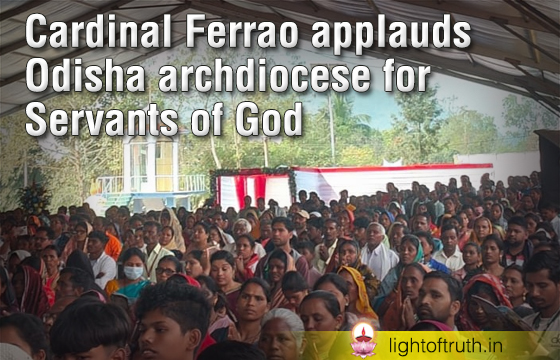
Cardinal Ferrao applauds Odisha archdiocese for Servants of God
Cardinal Felipe Neri Ferrao, president of the Conference of Catholic Bishops of India (CCBI), has congratulated the Archdiocese of Cuttack-Bhubaneswar for producing 35 martyrs of faith. The cardinal’s message was read by Archbishop Peter Machado of Bangalore, newly elected CCBI vice president, at a function to mark the golden jubilee of the only archdiocese in the eastern Indian state of Odisha. The February 6 function at Our Lady of Holy Rosary Parish, Daringbadi, in Kandhamal district was attended by 23 bishops, 145 priests, 150 nuns and 20,000 Catholics. “We the bishops of India are delighted to congratulate you on the beatification and canonization of 35 Servants of God. You have unwavering faith in Christ,” said the cardinal’s message. “We cannot forget the sacrifice of the people of your diocese for faith in the anti-Christian violence of 2007-2008. We appreciate you [Divine Word Archbishop] John Barwa [of Cuttack-Bhubaneswar] and your people. Kandhamal has become the land of martyrs now, added the message offering solidarity, affection and closeness to the faithful of the archdiocese.