
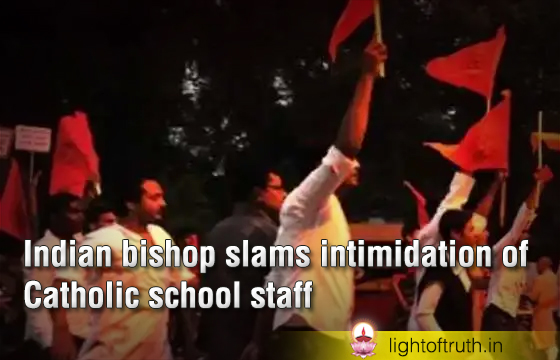
A Catholic bishop has condemned the harassment of staff from a Church-run school, including a priest and two nuns, while they were on a picnic, by alleged Hindu activists in the central Indian state of Madhya Pradesh. “The men stopped us on spotting the nuns and some of our staff wearing rosaries around their necks, and started interrogating us,” said Father Sonu Vansuniya, the principal of New Catholic Mission Sch-ool under the Catholic diocese of Jhabua. The men claimed to be members of the Hindu organization, Bajrang Dal, or the army of the Hindu god Hanuman, and he recalled that they “suspected we were carry-ing out conversion activities.” “They stopped us from getting into our bus after leaving the park we were visiting, and instead told us to accompany them to the nearest police station,” Vansuniya told on May 2. When refused, they began questioning members of the staff, mostly from indige-nous tribal or Dalit (formerly untouchable) backgrounds, if “they were being lured or forced to accept Christianity,” he said. Meanwhile, some police officers arrived at the scene and repeated the same questions that the Hindu acti-vists were posing. “Failing to find anything wrong or obje-ctionable, the police allowed us to leave after around two hours of harassment in full public view,” Vansuniya said. Bishop Thomas Mathew Kutti-mackal of the Indore diocese condemned the incident that occurred in his jurisdiction.
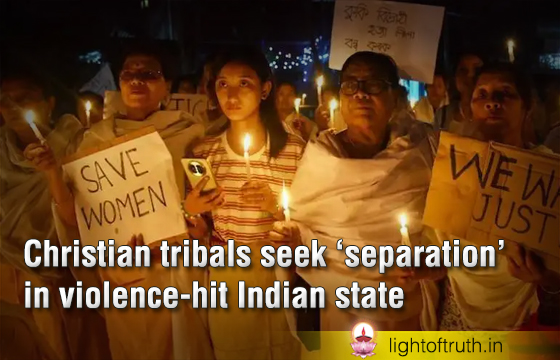
Christian tribals seek ‘separation’ in violence-hit Indian state
A Christian-majority tribal group in India’s Manipur state has reiterated its demand for a separate administrative area as it marked the second anniver-sary of the outbreak of ethnic violence between them and the Hindu-majority Meitei people. Kuki-Zo communities observed May 3 as “Separation Day,” marking the start of the unpre-cedented ethnic violence in 2023 that has claimed at least 260 lives and displaced some 60,000 people, mostly Christi-ans. Thousands gathered for a memorial service at the Wall of Remembrance in Kuki-Zo dominated Churachandpur district, where they read the Bible and sang hymns for those lost in the violence. Ginza Vualzong, spokesperson for the Indigenous Tribal Leaders’ Forum (ITLF), said that the community demands a federally ruled separate territory because “that’s the only option for ensu-ring welfare and justice for the indigenous communities.” He said Kuki-Zo and Meitei people “can no longer coexist” in one state and under the same administration, as people have lost trust in administrative sys-tems involving Meitei people. Violence erupted when Meitei people attacked a Kuki-Zo march protesting a government initiative to classify the Meitei as tribal. This classification would grant the Meitei, an economically and politically influential group, access to benefits from the state’s affir-mative action program designed for weaker sections of society.
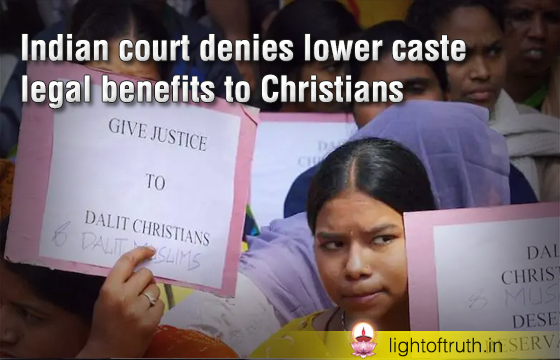
Indian court denies lower caste legal benefits to Christians
An Indian court has de-nied Christians of Dalit origin legal protections meant for lower caste people, saying a person who converted to Chri-stianity cannot claim to be a member of a lower caste group. The Andhra Pradesh High Court, the highest court in the southern Indian state, issued the ruling in an appeal challenging criminal proceedings against a group of non-Christians, based on a complaint by a Protestant pastor. The pastor, who comes from the Dalit community, officially referred to as Scheduled Caste people, filed the complaint in January 2021 against a group of people who allegedly abused him, violating clauses of the Scheduled Castes and the Scheduled Tribes (Prevention of Atrocities) Act.
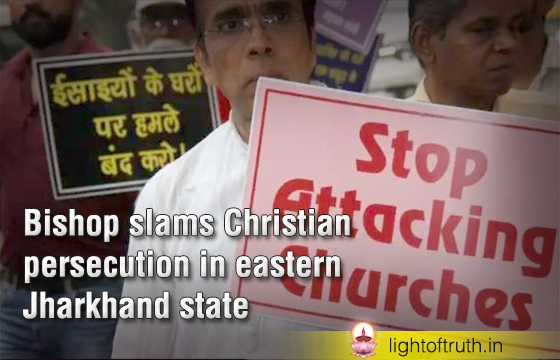
Bishop slams Christian persecution in eastern Jharkhand state
Church leaders in the eastern Indian state of Jharkhand have deplored the continuing persecution of tribal Christians in the state by “anti-social groups” with the backing of some political parties. “These anti-social groups are certainly backed by bigger forces, including political parties; else how can they take the law into their hands?” said Bishop Theodore Mascarenhas of Daltonganj. The prelate said a sustained campaign is underway against the work done by the Christian missionaries for the welfare of the tribal people in Jharkhand. “Religious conversion is alleged very often nowadays with no basis or proof by some anti-social elements who do not want peace to prevail in the state,” Mascarenhas told on May 2. He referred to the latest incident of six Christian families in his diocese who were forced to abandon their homes and flee, fearing for their lives. These Christian families from Hata village in Latehar district were threatened by a pro-Hindu group for refusing to donate money for Sarhul, a spring festival celebrated in early April by various tribal groups in Jharkhand. The six families left the village on April 28, reported the local ETV Bharat news channel. The report quoted Nageswar Oraon, one of the Christians who is now living with his family in a neighbouring village, saying that “since we had no money, we expressed inability to pay for the festival.” “We were threatened and attacked by some villagers because we are Christians,” he added.
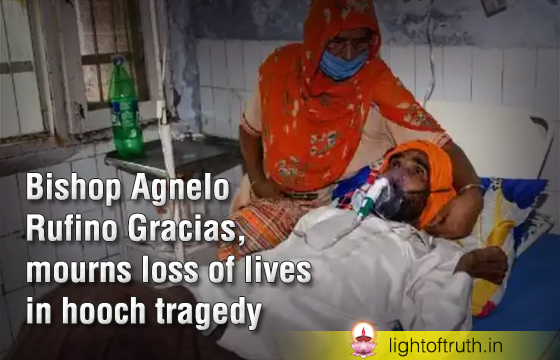
Bishop Agnelo Rufino Gracias, mourns loss of lives in hooch tragedy
Church leaders in northern India’s Punjab state have blamed a lack of urgency by authorities in dealing with bootleg liquor for the deaths of at least 17 people this week. Government officials told the media on May 13 that three people were still in critical condition after drinking spurious liquor in the Majitha area of Amritsar district. The tragedy “could have been avoided easily had authorities been alert. It is a man-made tragedy,” Bishop Agnelo Rufino Gracias, the Apostolic Administrator of Jalandhar diocese, told on May 13. Gracias, whose diocese covers the entire Punjab, expressed his “heartfelt condolences” to the bereaved families who lost their loved ones. “What is disheartening is that we have not learned from the past experience” of 2020, when 121 people died after consuming spurious liquor in the state, the prelate said. “It’s very unfortunate that some money-minded people are risking the lives of ordinary citizens by supplying substandard things.” Gracias stressed that the government must combat the life-threatening and illegal liquor business by arresting the people involved in it. A Church leader who wished to remain anonymous, said that the church was unaware of any Christian families affected by the tragedy.
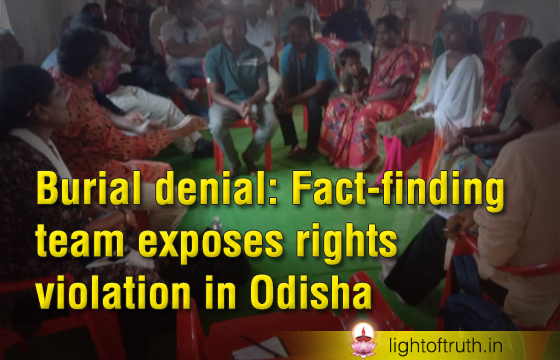
Burial denial: Fact-finding team exposes rights violation in Odisha
A joint fact-finding team has uncovered widespread human rights violations against Dalit and Adivasi Christians in the Nabarangpur district of Odisha state in eastern India. The team, comprising the members of the Odisha Lawyers Forum and activists, visited the region April 26 and 27 and documented multiple cases of families being barred from burying their dead according to their Christian faith. In several instances, the victims were allegedly coerced into either renouncing their religion or “converting” the deceased to Hinduism in order to gain access to burial spaces, the team reported. Many of the violations have occurred within the Assembly constituency of the state minister for Scheduled Castes, Scheduled Tribes, and Minorities, it pointed out.
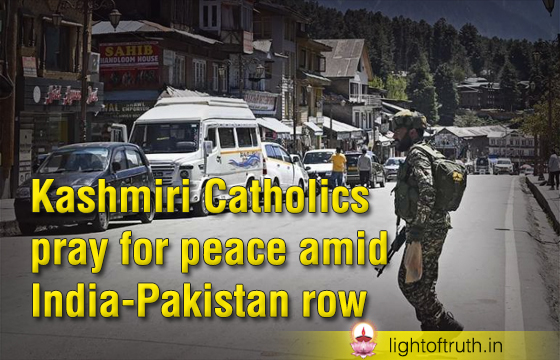
Kashmiri Catholics pray for peace amid India-Pakistan row
“The Catholics of Kash-mir are praying incessantly for peace. They pray in churches and homes. And they are marching the streets alongside other people of goodwill, carrying lit torches to shine the light of God and the flame of reconciliation and peace,” said Bishop Ivan Pereira of Jammu-Srinagar, Fides news agency reported on April 29. The diocese has about 9,000 Catholics in the Indian administered Kashmir. The disputed region is administered partly by India and Pakistan. Tensions and diplomatic rows sparked between arch rivals India and Pakistan after armed terrorists killed 26 Indian tourists on the Indian side of Kashmir on April 22. Both countries have withdrawn their diplomats, revoked visas, banned the use of their airspace, and asked armed forces to remain fully prepared. Media reports of exchanges of fire between Indian and Pakistani soldiers have been reported. “We are experiencing a moment of tension and fear that is affecting the entire popu-lation,” Pereira told Fides. “We know there are cease-fire violations in the border area. And according to widespread reports, the Indian police have destroyed several houses belonging to militants and terrorists. This is not an easy time for us here, and many are reliving the night-mare of conflict,” he said.
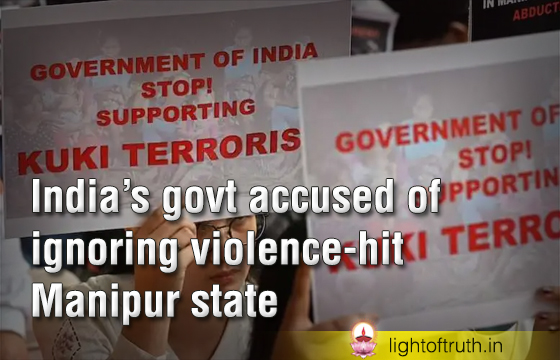
India’s govt accused of ignoring violence-hit Manipur state
Leaders of a group involved in ethnic-violence in India’s strife-torn Manipur state have criticized the federal government of Prime Minister Narendra Modi for its inability to find a solution to the unrest, two years after it broke out. Ahead of the second anniversary of the outbreak of violence on May 3, the Hindu Meitei groups jointly said that New Delhi seems to lack interest in finding an amicable solution to the violence between them and the Kuki-Zo, a Christian majority tribal group. “The Indian government seems to differ in dealing with its citizens in different parts of the country,” said Athouba Khuraijam, convener of the Coordinating Committee on Manipur Integrity (COCOMI), an influential body of Meitei civil society organizations. The Modi government in October last year imposed federal rule after the state government failed to end violence that has claimed 260 lives and displaced more than 60,000 people, mostly Kuki-Zo Christians. “Our fundamental rights and constitutional rights have been violated and suspended for two years,” Khuraijam told the media on April 29 in Imphal state. He said that federal rule has become “ineffective and symbolic.” People expected federal rule to bring law and order, “but instead, we have seen continued chaos.” The violence began on May 3, 2023, when Meitei people attacked a Kuki-Zo march protesting a Meitei demand for indigenous status. Indigenous status would allow the Meiteis, a politically and socially powerful group, to access benefits from the government’s affirmative action plans, including reserva-tions in government jobs and education, among other things, for the disadvantaged.
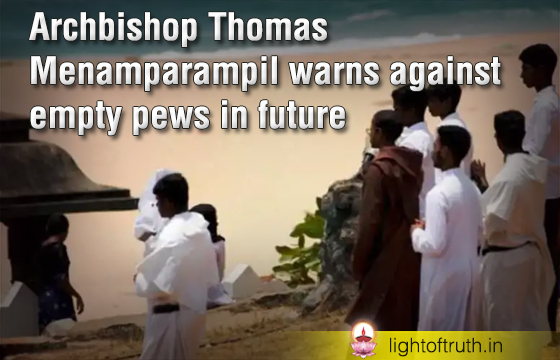
Archbishop Thomas Menamparampil warns against empty pews in future
Archbishop Thomas Menam-parambil has urged Indian Church authorities to be more attentive to the diverse voices within and the needs of the new generation, while cautioning against a gradual decline in faith among Catholics in the country. Archbishop Tho-mas Menamparampil of Guwa-hati, in the northeastern state of Assam, warned Church authorities on May 10 about an impending fate similar to that of the Euro-pean Church, where priestless parishes, empty altars, and pews are sad realities. “Unless timely efforts are made to settle internal conflicts and indifference among the faithful,” the Church in India may face a similar fate in the future, Menamparampil said. The prelate was addressing some 4,800 priests, brothers, and nuns working as missionaries across the globe from the Diocese of Palai in the southern Indian state of Kerala on May 10, at the St Augustine’s Church compound in Pravithanam.

India is known to Pope Leo, Augustinians say
Pope Leo XIV is familiar with India, having visited the country twice and spent nearly a fortnight as prior general of the Order of St. Augustine, according to an Augustinian priest in India. Augustinian Cardinal Robert Francis Prevost, who was elected pope and took the name Pope Leo XIV, visited several places in the southern Indian states of Kerala and Tamil Nadu in 2004 and 2006, says Father John Bosco, who teaches at St. Augustine’s Study House in Aluva, central Kerala. In 2004, the Augustinian prior general’s programs included the ordination of six deacons, including the then Deacon Bosco. “I feel so great and blessed,” Bosco told on May 12, adding: “I never imagined the future pope was attending my priestly ordination.” “He is so down to earth and has great concern for the poor and those living in the periphery,” the priest said. “He likes to listen more rather than speak,” Bosco said. “As prior general of the order, he kept visiting houses of the order in as many countries as possible and made it a point to interact with as many people as possible, including the general public,” the Kerala-based priest recalled. During the 2004 visit, he spent time with people in Kerala. However, during his 2006 visit, he toured a school run by the order in Pollachi, a town in Coim-batore district in the southern Indian state of Tamil Nadu.