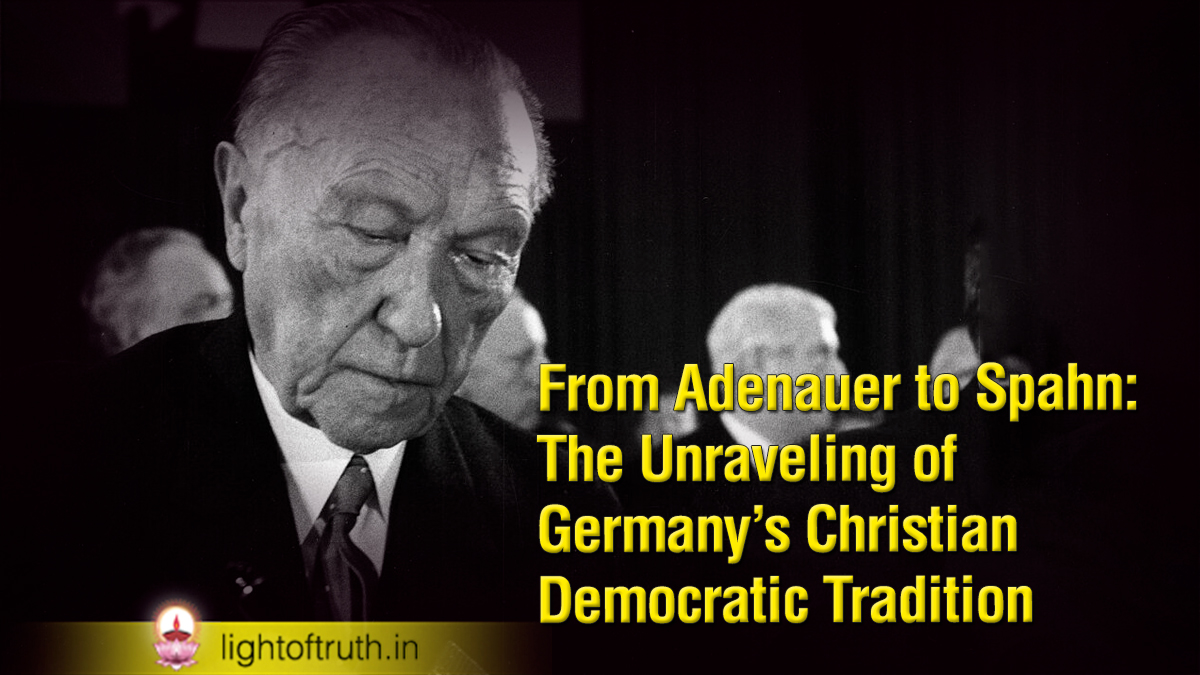
The recent controversy surrounding German politician Jens Spahn, until recently the parliamentary leader of the center-right Christian Democratic Union (CDU) in the Bundestag and long regarded as a potential future chancellor, was revealing. Spahn resigned after it emerged that he and his same-sex partner had commissioned an American surrogate mother, despite belonging to a party that has long opposed the encroachment of the market into one of the most fundamental of human relationships: that between a mother and her unborn child. Most commentators treated the affair as a straightforward case of political hypocrisy, while other more opportunistic actors hoped to seize upon it as an opportunity to argue for the liberalization of Germany’s laws governing assisted reproduction. Yet the deeper significance of the episode lies elsewhere.
The Spahn affair is symptomatic of a Christian Democratic tradition that is now Christian largely in name alone. The party founded by Konrad Adenauer sought to rebuild Germany on the moral and spiritual foundations of Christian civilization after the catastrophic rupture that was National Socialism. Over time, however, the CDU has gradually surrendered that inheritance. It has exchanged a confident vision of redemption and renewal for the cautious respectability of a bourgeois party whose primary ambition is the acquisition and preservation of political power. At worst, it risks becoming defined not by resistance but by accommodation – a Vichy-like surrender to the very forces that Pope Benedict XVI, a proud son of Bavaria, warned against as the “dictatorship of relativism.”
In many respects, Adenauer anticipated the synthesis later articulated by Pope John Paul II in his 1991 encyclical Centesimus Annus, which defended the legitimacy of private property and free economic initiative while insisting upon a genuine commitment to social justice. Adenauer sought to ground Germany’s economic reconstruction in the principles of Catholic social teaching. He rejected both socialist collectivism and a purely materialistic conception of capitalism, recognizing that both become reductive when detached from the proper telos of the human person. In other words, while recognizing that man requires his daily bread, bread alone cannot satisfy the deeper spiritual longings that animate human existence. Thus, the CDU’s enduring appeal rests on a fundamentally anthropological claim: that human dignity is rooted in man’s creation in the image of God and that the moral order is not made by politics but precedes it.
If Jens Spahn represents the future of a Christian Democracy untethered from its Christian anthropology, Markus Söder’s Kreuzpflicht reveals the fate of its patrimonial inheritance. The cross endures, but increasingly as an emblem of identity shrouded in vague notions of ‘cultural Christianity’ rather than as the sign of a moral order to which both ruler and citizen are accountable. At best, the cross becomes a political instrument wielded to reclaim cultural ground from the insurgent AfD, a party that now threatens to eclipse the CDU as the principal force on the right side of Germany’s political spectrum. Yet this instrumentalization of Christian heritage-preserving its symbols while severing them from their theological foundations-is not only unprincipled but strategically shortsighted. One can only imagine that Konrad Adenauer, devout Catholic and astute statesman in equal measure, would find little comfort in the trajectory of his party. (Adapted from Joe Wozniak’s article)