Regional Training of Trainers for Lay Leadership held in Jammu

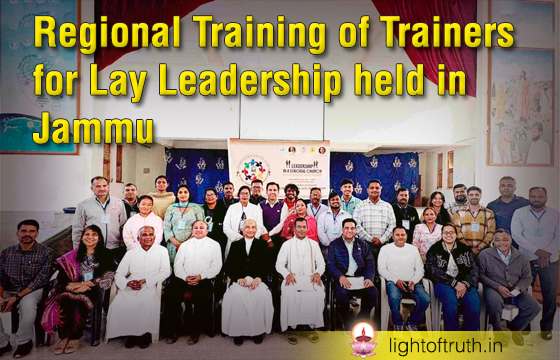
The Commission for Laity organised a two-day Regional Training of Trainers (ToT) for lay leaders of the Northern Region at Maithri Bhavan, the Diocesan Pastoral Centre (DPC), Jammu, under the Diocese of Jammu–Srinagar. The training, held from 7 to 8 November, revolved around the theme “Leadership in a Synodal Church.”

A total of 40 lay leaders from four dioceses—Archdiocese of Delhi, Jammu–Srinagar, Shimla–Chandigarh, and Jalandhar—participated in the programme. The event was graced by Dr. Sahaya Thatheus Thomas, Chairman of the Laity Commission, Northern Region, and Dr. Ivan Pereira, Bishop of Jammu–Srinagar. Both prelates, along with other regional leaders, lit the ceremonial lamp to inaugurate the training.

In their addresses, both bishops underscored the vital role of lay leaders in fostering a truly Synodal Church. The sessions were led by Fr. Anthony Fernandes, National Executive Secretary for Laity, and Ms. Seanna Rodrigues, a professional trainer. Their inputs centred on pastoral and people-oriented leadership, exploring topics such as Mindfulness and Self-Values for Synodal Leadership, Servant Leadership, Creative Collaboration in Ministry, and Jesus’ Model of Leadership. The training encouraged active participation through group discussions and diocesan-level planning.

Adding a touch of camaraderie, cultural activities and team-building games enlivened the two-day programme, fostering fellowship and collaboration among the participants. The training concluded with diocesan teams presenting concrete action plans aligned with the National Pastoral Plan 2033, focusing on strengthening pastoral leadership at parish, deanery, and diocesan levels. The Regional ToT proved to be an enriching and empowering experience, equipping lay leaders to serve more effectively in the spirit of synodality.
Bishop appeals for prayers for jailed priest

Bishop Niranjan Sualsingh of Sambalpur in Odisha has urged his faithful to join in prayer for a diocesan priest arrested following a motorcycle accident. The Bishop’s November 11 circular asked Catholics and people of goodwill “to keep Father Paul Adapoor in their prayers, that he may be strengthened by faith and delivered from his present trials.”

Expressing deep concern, the Bishop wrote, “It is with great sadness that I inform you about an unfortunate incident involving Fr. Paul Adapoor, the Parish Priest of Meghpal Parish.” On November 9 at around 2:00 p.m., Fr. Paul was returning from Sambalpur to Meghpal when his vehicle was involved in an accident near Hiro village, under the jurisdiction of Jujumura Police Station. A motorcyclist, allegedly under the influence of alcohol, collided with Fr. Paul’s vehicle and died at the scene.

Following the accident, a crowd gathered at the scene. In the ensuing tension, Fr. Paul was physically assaulted by some members of the mob. The police intervened promptly, rescued him, and took him to Jujumura Police Station for his safety and to complete the necessary legal formalities. A case has been registered under Sections BNS 281 and 106/1, but regrettably, Section 105 has also been falsely added. Due to this additional charge, Fr. Paul was denied bail and was sent to Sambalpur Jail on November 10.

“We are in close contact with the concerned authorities and are taking all necessary legal steps, including applying for bail at the District Court. We remain confident that truth and justice will prevail and that Fr. Paul will be released soon,” the Bishop assured.

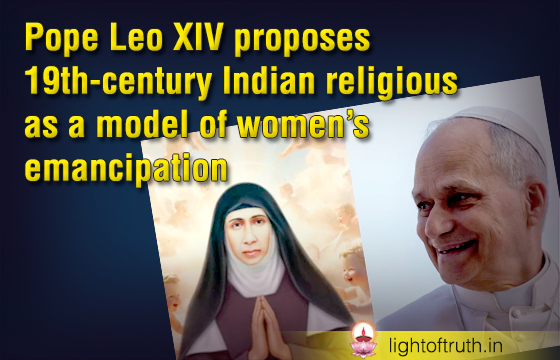
Pope Leo XIV proposes 19th-century Indian religious as a model of women’s emancipation

Pope Leo XIV spoke of the beatification this week of Mother Eliswa Vakayil, a 19th-century Indian religious and founder of the Third Order of the Teresian Discalced Carmelites, highlighting her “courageous commitment to the emancipation of the poorest girls.” “The witness of Mother Eliswa Vakayil,” the pope affirmed during his greetings in Italian at the end of his general audience on Nov. 12, “is a source of inspiration for all who work in the Church and in society for the dignity of women.”

The beatification ceremony on Nov. 8 was held in the square in front of the Basilica-Shrine of Our Lady of Ransom in Vallarpadam, Kochi, in the Indian state of Kerala, and was presided over by Cardinal Sebastian Francis, Archbishop of Penang, Malaysia.

Before thousands of faithful and men and women religious from across the country, the cardinal emphasized that the new blessed represents “a beacon of hope” for all “consecrated women, for all mothers, and for all those who suffer in silence and yet choose to love,” according to Vatican News.

During the homily at the beatification, the cardinal emphasized the “inclusive vision” of Mother Eliswa Vakayil, with which she “was ahead of her time and is a true expression of synodality in action: walking together in communion.” The new blessed, he added, “shows the way” to the Church on its synodal journey “listening, discerning, and walking together.” 

The foundation of her “unwavering faith,” he affirmed, “lies in her spirituality, vision, and mission, all rooted in her identity as a faithful disciple of Jesus Christ through baptism, the very heart of synodality.” With the official recognition of her holiness, the Church proposes Mother Eliswa Vakayil  as a model of evangelical life embodied in service to the poor, in the promotion of women, and in the building of fraternal communities.

Church leaders express sorrow over deaths in Delhi car blast

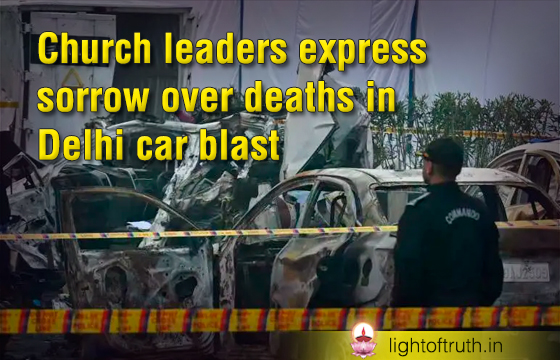
Church leaders in India have expressed deep sorrow over the reported loss of 13 lives in a powerful explosion near Delhi’s historic Red Fort on the evening of Nov. 10. The explosion took place around 6:52 p.m. inside a car near a traffic signal in a crowded area, injuring around 24 people and damaging other vehicles, said Federal Home Minister Amit Shah

Authorities are investigating the cause of the explosion, which is suspected to have been triggered either by a CNG (compressed natural gas) cylinder or a low-intensity improvised explosive device (IED). Officials have yet to formally confirm the cause of the blast or name suspects, but they appear to be treating the explosion as a potential act of terrorism, not just a criminal or accidental blast, according to media reports.

The entire area around the 17th-century Mughal fortress, visited by thousands of tourists every day, and where Indian prime ministers give their Independence Day speeches each year, has been sealed off. India’s national capital and other major cities have been placed on high security alert.

“The Catholic Church in New Delhi joins others to condole the lives lost in the blast and pray for the speedy recovery of the people who are injured,” said Father Savarimuthu Sankar, spokesperson of Delhi archdiocese. He hoped that the federal government would take all the necessary steps to uncover the truth behind the blast and maintain peace. “The Church has always stood for peace and promotes brotherhood among all faiths, and hopes innocent lives are not lost in mindless violence,” Sankar said.

A C Michael, the convenor of the ecumenical United Christian Forum, said civil society needs to work closely with the government of the day to ensure social harmony in the country in difficult times. “It is the responsibility of the incumbent government to maintain harmony in the country,” said the Catholic lay leader, who is a former member of the Delhi Minorities Commission. Michael said that politicians should avoid making statements that “create unnecessary divisive feelings among the citizenry.”

Indian tribal Christian women launch hunger strike over police inaction

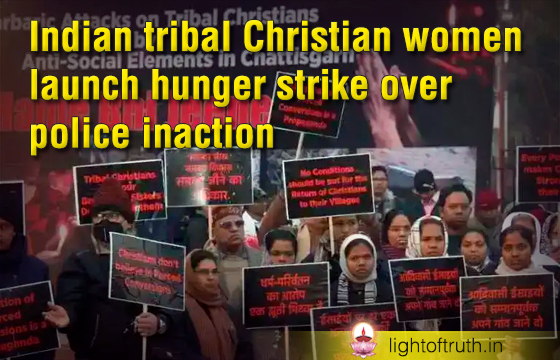
Three Christian tribal women, who were intimidated and assaulted by Hindu activists at a railway station in central India’s Chhattisgarh state four months ago — an incident that also led to the arrest of two Catholic nuns — have begun a relay hunger strike demanding justice.

The women, joined by their families and supporters, launched an “indefinite relay fast” on Nov. 10 outside the Narayanpur district headquarters. “The women were forced to take this extreme step as police failed to register a case against their attackers–Hindu activists,” said Phulsingh Kachlam, district secretary of the Communist Party of India (CPI), which is backing their protest.

The Chhattisgarh State Women’s Commission, a statutory body, had on Oct. 8 directed the state’s Director General of Police to file a case based on the women’s complaints. The official was given two weeks to comply and report back. But the order remains unimplemented. “Nothing has been done,” one of the women said, speaking on condition of anonymity. “We will continue our fast until we get justice.” Their demand is straightforward, she said — to register a police case documenting the incident.

The July 25 assault took place at Durg railway station, where the women and two nuns from the Assisi Sisters of Mary Immaculate — Sisters Vandana Francis and Preeti Mary — were stopped by Hindu activists, including some women.

Christian leaders say Hindu groups target Christians in their attempt to turn India into a Hindu-only nation. Last year, the United Christian Forum, a New Delhi-based ecumenical rights group, documented 165 anti-Christian incidents in the state — the second-highest number in India. Christians make up less than 2 percent of Chhattisgarh’s roughly 30 million people.