Bishops of the Global South urge UN to uphold 1.5°C Climate Goal

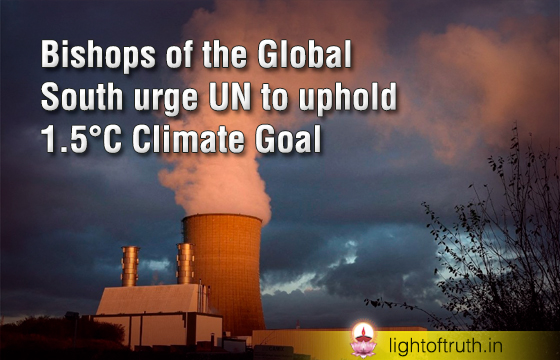
Bishops representing the Catholic Churches of Africa, Asia, Latin America and the Caribbean have issued a strong appeal to world leaders gathering in New York for the UN General Assembly and the High-Level Event on Climate Action. In a letter addressed to UN Secretary-General António Guterres, to the President of the 80th General Assembly, Annalena Baerbock, and to Simon Stiell, Executive Secretary of the United Nations Frameowrk Convention on Climate Change (UNFCCC), the bishops express “good will and great concern” for the future of the planet, and urge leaders not to fall short of the 1.5°C limit agreed in Paris. “We the Bishops of the Global South are honoured to bring to your attention the Message… on the occasion of COP30 – A Call for Climate Justice and the Common Home: Ecological Conversion, Transformation and Resistance to False Solutions” the letter states. The statement, they add, has already been presented to Pope Leo XIV and to local Churches, as a sign of “shared responsibility and commitment to our common home.”

Recalling the words of Pope Francis in Laudato Si’ and Pope Leo XIV’s call for an integral ecology rooted in justice, the bishops stress that the urgency of the crisis leaves no space for delay or half-measures. “The Church will not remain silent,” they write. “We will continue to raise our voice alongside science, civil society, and the most vulnerable, with truth, courage and consistency, until justice is done.” The bishops underline that global warming, which reached 1.55°C in 2024, is not merely “a technical problem: it is an existential issue of justice, dignity and care for our common home.”

Rejecting false solutions

The letter denounces what it calls “false solutions” such as green capitalism, technocracy, the commodification of nature and extractivism, which, the bishops warn, “perpetuate exploitation and injustice.” Instead, they call for policies that prioritise equity, justice and protection. “Rich nations must pay their ecological debt with fair climate finance without further indebting the Global South,” the bishops demand, insisting on the need for a just transition that does not leave the most vulnerable behind.


Addressing world leaders as they prepare for COP30 in Brazil, the bishops express confidence in the power of dialogue: “We remain confident that genuine dialogue, grounded in truth and justice, can guide the international community towards the profound transformations required,” the letter reads. “The urgency of this moment leaves no room for delay, compromise, or half-measures.” The statement is signed by Cardinal Jaime Spengler of Brazil, President of CELAM; Cardinal Filipe Neri Ferrao of India, President of FABC; and Cardinal Fridolin Ambongo Besungu of the Democratic Republic of Congo, President of SECAM.
Mexico-U.S. bishops: Migrants face inhumane, dangerous conditions

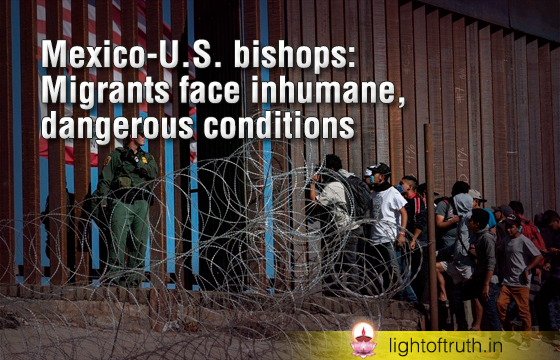
Mexican migrants attempting to cross the U.S. border are facing increasingly dangerous and inhumane conditions. Following a recent meeting in Piedra Negras, Coahuila, the bishops from along the Mexico-U.S. border once again denounced the dire circumstances affecting thousands of people. They issued a strong appeal—not only to governments but also to civil society—calling for accountability of the violations against human dignity faced by those fleeing war, violence, and extreme poverty.

The bishops described the migratory route through Mexico as “the most dangerous in the world.” According to the International Organization for Migration, migrants escaping devastating conditions in their home countries face exponentially greater risks as they travel through Mexican territory.

Since January, the U.S. has blocked key legal avenues for seeking asylum, including applications via the CBP One app and humanitarian permits. On top of that, there have also been forced transfers, families separated, and deportations to third countries. The level of insecurity along the route is deeply concerning as kidnappings, extortion, forced labour, and sexual violence have become everyday dangers.

The dismantling of migrant shelters, driven by U.S. policy, has further deepened migrants’ vulnerability and invisibility—particularly in peripheral areas where they live in fear of being detained or forcibly removed and where they lack access to basic services.

In their final statement, the bishops called for immediate and coordinated action to “open safe and legal humanitarian corridors for the most vulnerable migrants and refugees.” They reaffirmed their belief that while every nation has the right to protect its borders, it also has the responsibility to safeguard human life and ensure migration is safe, orderly, and humane—this includes respecting the right to asylum.

“The Church reaffirms the urgent need for the rule of law that protects families, especially migrant and refugee families, who are now facing even greater hardships.”

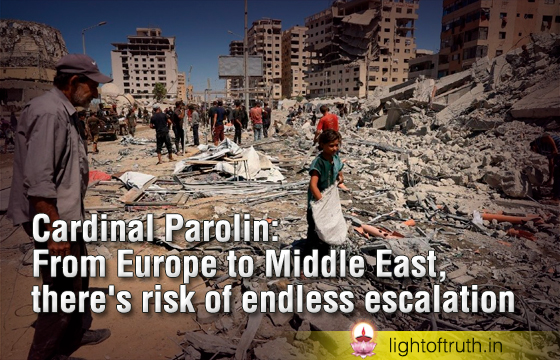
Cardinal Parolin: From Europe to Middle East, there’s risk of endless escalation

We are on the brink of the abyss because there is a risk of an endless escalation that is frightening. The Vatican Secretary of State, Cardinal Pietro Parolin, did not hide his concern about “the risk of a wider war” when responding to journalists’ questions about the Russian drone attack that violated Polish airspace. Speaking at the Vatican’s Casina Pio IV, on the sidelines of the international seminar on “Creation, Nature, Environment, for a World of Peace,” Cardinal Parolin said he shared the analysis expressed by the President of the Republic of Italy, Sergio Mattarella, who spoke of a level of tension similar to that which preceded the First World War. In this context, Cardinal Parolin observed, “If there really isn’t a moment of reconsideration regarding the path being taken, there is a risk of an endless escalation and thus also of the outbreak of a wider war.”

Cardinal Parolin also expressed concern about the war in the Middle East and the tragedy unfolding in Gaza. The Israeli escalation in the Strip – he said – “unfortunately does not stop, despite the many appeals that have been made, including by the Catholic Church and by the Latin Patriarch, Cardinal Pizzaballa.”

On the other hand, the Cardinal highlighted the “truly admirable resilience” of the parish priest of the Holy Family Church in Gaza, Father Gabriel Romanelli, and of the people sheltered in the church in Gaza City, “They remain alongside people with disabilities and therefore do not want to give in to violence.”

The Cardinal expressed that the Holy See continues its diplomatic efforts tirelessly. “We are doing everything possible,” Cardinal Parolin said. “Our diplomacy is trying to make contact with all the involved parties; we talk, we insist—these are the tools we have to try to stop this escalation.”

Protecting Minors Commission President presents safeguarding report to Pope

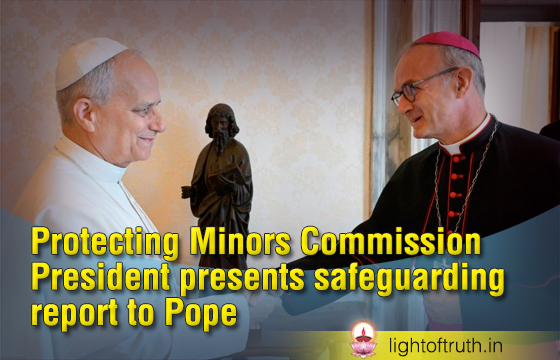
Pope Leo XIV received the President of the Pontifical Commission for the Protection of Minors XIV, Archbishop Thibault Verny, Archbishop of Chambéry, in the Vatican on September 12. The encounter marks the first official meeting between the President of the Commission and the Holy Father, following Archbishop Verny’s appointment on July 15.

The Commission’s Secretary, Bishop Luis Manuel Alí Herrera, accompanied the Commission President. The audience was requested by Archbishop Verny in order to personally express his gratitude to the Holy Father for the trust placed in him through the appointment, and to present the Second Annual Report on Policies and Procedures for Protection in the Church.

This report, established at the initiative of Pope Francis in 2022, aims to assess the safeguarding capacities of local Churches, offering practical recommendations based on the concrete experiences of various ecclesial regions.

During the meeting, the Commission President underscored, the Commission’s commitment to continuing the mission entrusted to it by Pope Francis through Praedicate Evangelium, in the development of safeguarding policies, the drafting of the annual report, and support for local Churches through the Memorare Initiative.

“With humility and hope,” Archbishop Verny reaffirmed, “the Commission continues the mission entrusted to us, advancing the Holy Father’s vision of rooting throughout the Church a culture of prevention that tolerates no form of abuse: neither of power or authority, nor of conscience or spirituality, nor of sexual abuse.” 

Pope Leo XIV: Inappropriate behaviour of the clergy ‘cannot be kept in a drawer’

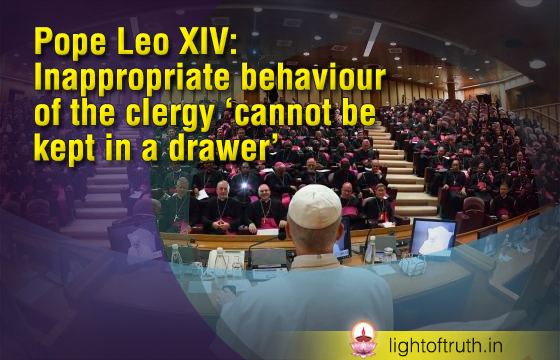
In a meeting with bishops appointed in the last year, Pope Leo XIV exhorted them to address issues related to inappropriate behaviour on the part of the clergy: “They can’t be put away in a drawer.” At the end of his Sept. 11 morning address to the prelates participating in the formation course organized by the Holy See, the Holy Father engaged them in a fraternal dialogue, giving them the opportunity to convey their concerns and worries. The pontiff offered an overview of the challenges and issues bishops face at the beginning of a new ministry, such as fear, a sense of unworthiness, and the different expectations each had for their lives before being called.

As the Vatican noted in a statement released Sept. 12, the Holy Father also offered the bishops some valuable advice: “Remain close to the Lord, set aside time for prayer, and continue to live out unconditional trust in the Holy Spirit, the origin of one’s vocation.” He also exhorted them to be persevering disciples “who do not allow themselves to be frightened by the first difficulty; pastors close to the people and to priests, merciful and firm, even when it is a matter of making a judgment; capable of listening and dialogue, not just preaching sermons.”

Before answering questions, Pope Leo XIV encouraged the bishops to promptly address issues related to inappropriate behaviour on the part of the clergy: “They cannot be put away in a drawer; they must be addressed with a sense of mercy and true justice toward the victims and the accused.” The pontiff thanked the new bishops for accepting the ministry: “I pray for you; the Church appreciates your ‘yes’; you are not alone; together we bear the burden and together we proclaim the Gospel of Jesus Christ.”