
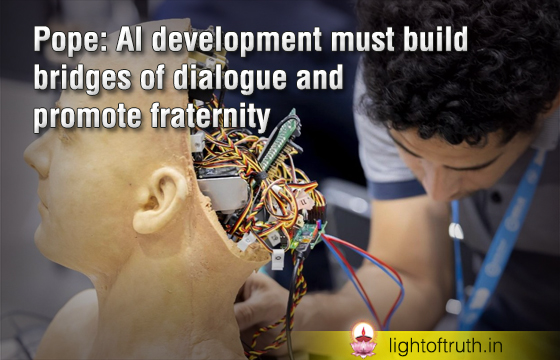
Pope Leo XIV encouraged nations to establish frameworks and regulations on AI so that it can be developed and used according to the common good, in a message sent on July 10 to the participants of the AI for Good Summit, taking place in Geneva, Switzerland, from July 8 to 11.
“I would like to take this opportunity to encourage you to seek ethical clarity and to establish a coordinated local and global governance of AI, based on the shared recognition of the inherent dignity and fundamental freedoms of the human person”, the message, signed by the Secretary of State, Cardinal Pietro Parolin, said.
The summit is organized by the United Nations’ International Telecommunication Union (ITU) and is co-hosted by the Swiss government. The event sees the participation of governments, tech leaders, academics and others who are interested and work with AI.
In this “era of profound innovation” where many are reflecting on “what it means to be human”, the world “is at crossroads, facing the immense potential generated by the digital revolution driven by Artificial Intelligence”, the Pope highlighted in his message.
“As AI becomes capable of adapting autonomously to many situations by making purely technical algorithmic choices, it is crucial to consider its anthropological and ethical implications, the values at stake and the duties and regulatory frameworks required to uphold those values”, the Pope underlined in his message.
He emphasized that the “responsibility for the ethical use of AI systems begins with those who develop, manage and oversee them” but users also need to share this mission. AI “requires proper ethical management and regulatory frameworks centered on the human person, and which goes beyond the mere criteria of utility or efficiency,” the Pope insisted.
Citing St. Augustine’s concept of the “tranquility of order”, Pope Leo highlighted that this should be the common goal and thus AI should foster “more human order of social relations” and “peaceful and just societies in the service of integral human development and the good of the human family”.
Daily Archives: July 12, 2025
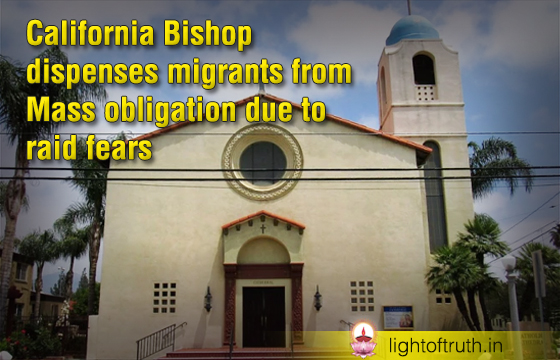
California Bishop dispenses migrants from Mass obligation due to raid fears
The Bishop of San Bernardino, California, Bishop Alberto Rojas, issued a decree on July 8, 2025, dispensing immigrant faithful from the obligation to attend Sunday Mass until further notice, in light of the “genuine fear” of potential immigration enforcement actions. “There is a real fear gripping many in our parish communities that if they venture out into any kind of public setting, they will be arrested by immigration officers. Sadly, that includes attending Mass,” Bishop Rojas said in a media statement accompanying the decree released on July 10. “I want our immigrant communities to know that their Church stands with them and walks with them through this trying time.”
On June 20, diocesan officials stated ICE agents entered two Catholic parish properties in Montclair and Highland, and detained multiple people in the parking lot of St. Adelaide Church in Highland, California. The director of communications for the Diocese of San Bernardino, John Andrews, said at the time that one male parishioner was taken into custody, adding the others detained were neither parishioners nor worked for the parishes.
These events have “only intensified” the fear of many migrant faithful, the Bishop explained in his recent message. He had already written a letter on June 23 in which he asked “political leaders and decision-makers to “reconsider and cease” immediately these tactics, in favour of an approach that “respects human rights and human dignity.”
The Bishop of San Bernardino, the sixth-largest Catholic diocese in the United States, emphasized that his decree seeks to alleviate the “burden” people may feel due to not being able to fulfil the Catholic obligation of Sunday Mass, considering “all the worry and anxiety” these individuals are experiencing. Bishop Rojas also underlined in the decree that pastors and other Church members “are to provide compassionate support to those affected” and ensure “that they feel welcomed and safe in communities.”
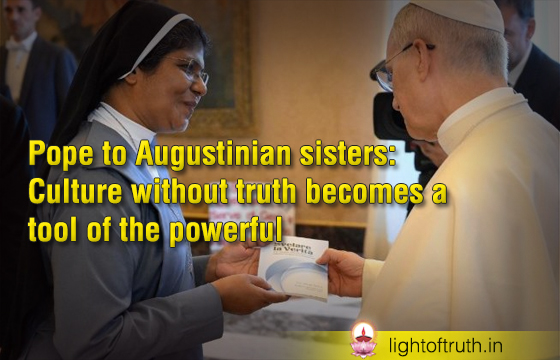
Pope to Augustinian sisters: Culture without truth becomes a tool of the powerful
“A culture without truth becomes a tool of the powerful”. Pope Leo XIV gave this consideration during a meeting with the Augustinian Sisters Servants of Jesus and Mary in the Apostolic Palace on July 5. He explained that “instead of freeing consciences, it confuses and distracts them according to the interests of the market, trends or worldly success”.
“You will be persevering in the following of Christ, who is ‘the way, the truth and the life’ and therefore the criterion of all our cultural initiatives”, the Pope emphasized.
The Augustinian Sisters Servants of Jesus and Mary were founded in 1827 by the Venerable Maria Teresa Spinelli, an Italian Augustinian sister who dedicated her life to teaching and helping young people. Today, the members of this religious order are present in nine countries spanning from the Philippines to Brazil. They follow in their foundress’ footsteps with educational projects, by assisting marginalized young people and women, and offering medical assistance.
Other than allowing Christ to be the guiding element for their mission, the Pope also offered the sisters two other suggestions in order for them to imitate their foundress in their work. You will “be patient in tribulations, because it is precisely in our trials that the Lord confirms his faithfulness; you will be brave in your mission, so that the educational work to which you dedicate yourselves may form wise minds and hearts capable of listening and to feel passion for humanity”, he explained. The Pope in fact urged the sisters to read St. Augustine’s text ‘De Magistro’, where he highlights “that outward teaching must always lead to an encounter with the inner Teacher, who is Jesus”.
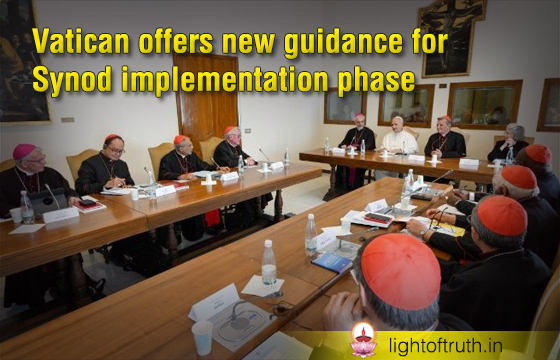
Vatican offers new guidance for Synod implementation phase
The General Secretariat of the Synod released “Pathways for the Implementation of the Synod”, which provides “an interpretive key for understanding the implementation phase of the Synod on Synodality.” Released on July 07, Pathways for the Implementation Phase of the Synod offers “local Churches throughout the world the world a shared framework that will make it easier to walk together” and promotes “the dialogue that will lead the whole Church to the Ecclesial Assembly,” set for October 2028 that will mark the culmination of the synodal process begun by Pope Francis in 2020.
Opening Pathways, Cardinal Mario Grech, the Secretary General of the Synod, notes that “the synodal form of the Church is at the service of its mission… it is the urgency of this mission that drives us to implement the Synod, a task for which all the baptized share responsibility.” He says that the General Secretariat of the Synod, which prepared the new document, is at the service of the local Churches, ready “to listen to them, support their efforts, and, above all, contribute to animating the dialogue and exchange of gifts between the Churches.”
Pathways opens with an explanation of the implementation phase and its objectives, and goes on to describe the participants of the implementation phase, along with their tasks and responsibilities; to suggest how to engage with the Synod’s Final Document, the main point of reference for this phase of the Synod journey; and to offer advice on methods and tools that “can help shape our path during the implementation phase.”
“We convey” these pathways, says Cardinal Grech, “to the entire People of God, who are the subjects of the synodal journey, and in particular to the Bishops and Eparchs, to the members of the synodal teams, and to all those who are involved in various ways in the implementation phase.” The aim, he adds, “is of making them feel our support and continuing the dialogue that has characterized the entire synodal journey.”