
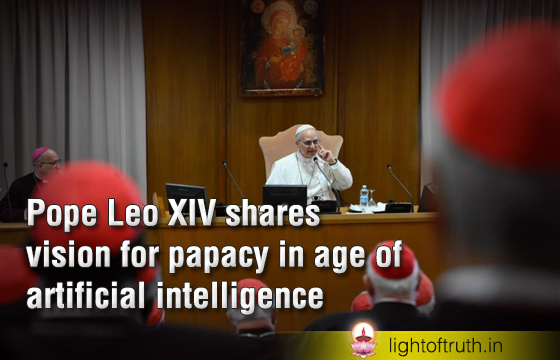
Pope Leo XIV met with the College of Cardinals on May 10 for his first official address since his election, outlining key priorities for his pontificate in the age of artificial intelligence while emphasizing continuity with his predecessors and commitment to the Church’s social teaching.
The U.S.-born pontiff, speaking in Italian, explained his choice of papal name, noting that Pope Leo XIII “addressed the social question in the context of the first great industrial revolution” with his encyclical Rerum Novarum. “In our own day, the Church offers to everyone the treasury of her social teaching in response to another industrial revolution and to developments in the field of artificial intelligence that pose new challenges for the defence of human dignity, justice, and labour,” Pope Leo said.
The 69-year-old pope began the meeting with a prayer, expressing his gratitude to the cardinals while acknowledging his own limitations in assuming the papacy. “You, dear cardinals, are the closest collaborators of the pope. This has proved a great comfort to me in accepting a yoke clearly far beyond my own limited powers, as it would be for any of us,” he said. The pope specifically thanked Cardinal Giovanni Battista Re, dean of the College of Cardinals, and Cardinal Kevin Joseph Farrell, camerlengo of the Holy Roman Church, for their service during the sede vacante period.
In his address, Pope Leo emphasized his commitment to continuing the Church’s path following the Second Vatican Council, specifically highlighting Pope Francis’ apostolic exhortation Evangelii Gaudium as providing “masterful and concrete” direction.
The pope identified several fundamental principles to guide his pontificate, “the return to the primacy of Christ in proclamation; the missionary conversion of the entire Christian community; growth in collegiality and synodality; attention to the sensus fidei, especially in its most authentic and inclusive forms, such as popular piety; loving care for the least and the rejected; courageous and trusting dialogue with the contemporary world.”
After his prepared remarks, the Holy Father engaged in a dialogue session with the cardinals, discussing “advice, suggestions, proposals, concrete things” raised during the pre-conclave meetings. Pope Leo concluded by quoting St. Paul VI’s hope expressed at the beginning of his pontificate in 1963, praying that the Church would “pass over the whole world like a great flame of faith and love kindled in all men and women of goodwill.”
Daily Archives: May 14, 2025
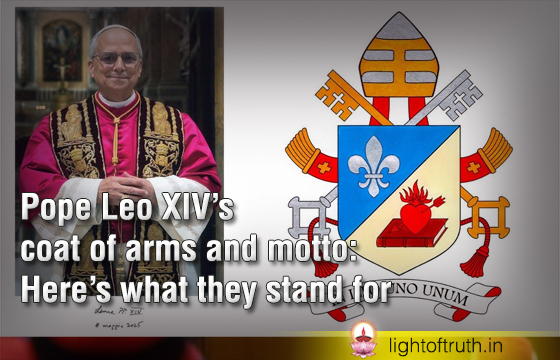
Pope Leo XIV’s coat of arms and motto: Here’s what they stand for
The official coat of arms and motto of Pope Leo XIV were made public on May 10. Rooted in Augustinian spirituality, the symbols the pontiff chose represent a sign of continuity with his episcopal past, confirming elements already adopted during his consecration.
The papal coat of arms is presented with a shield divided diagonally: in the upper section, on a blue background, stands a white lily, a symbol of purity and spiritual dedication. In the lower section, on a light background, is depicted a heart pierced by an arrow, resting on a closed book. The latter element recalls the Order of St. Augustine and, in particular, evokes the intense conversion experience lived by the saint from Hippo.
The symbol is inspired by the Latin expression “Vulnerasti cor meum verbo tuo” – “You pierced my heart with your Word” – uttered by St. Augustine to describe the transforming effect of the scriptures on his life.
Leo’s motto, visible under the shield, is “In Illo uno unum.” The phrase, taken from a sermon by St. Augustine on the Exposition of Psalm 127, means “Although we Christians are many, in the one Christ we are one.” This choice highlights the pontiff’s fidelity to the Augustinian heri-tage, but calls for spiritual unity of the church under one shepherd.
In his first speech as pope, Leo expressed his desire to lead God’s people by following the example of St. Augustine, whose thought and spirituality profoundly influenced his religious journey.

Pope Leo XIV to media: Thank you ‘for your service to the truth’
In his first address to international media on May 12, Pope Leo XIV thanked journalists for their service to the truth and for communicating peace in difficult times.
“We are living in times that are both difficult to navigate and to recount. They present a challenge for all of us, but it is one that we should not run away from,” Leo said in the Pope Paul VI Audience Hall on May 12. “On the contrary, they demand that each one of us, in our different roles and services, never give in to mediocrity.” The pontiff, elected May 8, also emphasized the important role of communications for promoting peace. ”In the Sermon on the Mount, Jesus proclaimed: ‘Blessed are the peacemakers’ (Mt 5:9). This is a beatitude that challenges all of us, but it is particularly relevant to you, calling each one of you to strive for a different kind of communication, one that does not seek consensus at all costs, does not use aggressive words, does not follow the culture of competition, and never separates the search for truth from the love with which we must humbly seek it,” Leo said.
“Peace,” he continued, “begins with each one of us: in the way we look at others, listen to others, and speak about others. In this sense, the way we communicate is of fundamental importance: We must say ‘no’ to the war of words and images, we must reject the paradigm of war.”
According to the pope, one of the most important challenges for media today is promoting communication that moves away from the confusion of the “Tower of Babel” and the “loveless languages that are often ideological or partisan.”
“Your service, with the words you use and the style you adopt, is crucial,” he underlined. “As you know, communication is not only the transmission of information, but it is also the creation of a culture, of human and digital environments that become spaces for dialogue and discussion. In looking at how technology is developing, this mission becomes ever more necessary.”
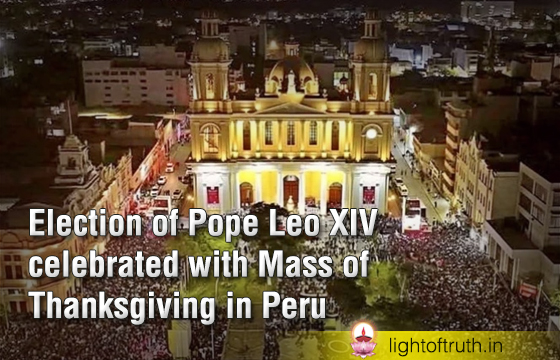
Election of Pope Leo XIV celebrated with Mass of Thanksgiving in Peru
In a jubilant atmosphere, more than 10,000 faithful gathered in front of the Basilica and Cathedral of Santa María de Chiclayo in Peru to celebrate a thanksgiving Mass for the election of Pope Leo XIV, who was bishop of the diocese for more than eight years.
The celebration vibrated with joy following the election of Cardinal Robert Francis Prevost Martínez — both a U.S. and Peruvian citizen — as successor to Peter on May 8. Dozens of local priests joined Chiclayo Bishop Edinson Farfán at the celebration. The plaza in front of the cathedral was outfitted with an outdoor platform and altar for the occasion, surrounded by musical bands and giant banners with the image of the pontiff and phrases from his first papal greeting from St. Peter’s Square.
In his homily, Farfán spoke of the profound love the new pontiff has for Peru — a country he first visited in 1985 — and, in a special way, for the Diocese of Chiclayo, which he pastored from 2014 to 2023. The bishop of Chiclayo noted the deep spiritual connection then-Bishop Prevost had with the expressions of faith of the Peruvian people: from his devotion to the Señor Cautivo of Ayabaca and the Señor de los Milagros to his love for the Peruvian saints: Rose of Lima, Martin de Porres, Francis Solano, John Macias, and Toribio de Mogrovejo.
“His beloved Diocese of Chiclayo, as he called it in his first address, was for him a school of faith, of closeness, of humanity,” he affirmed, adding that this city in northern Peru “is a simple town that he loved deeply and that he continues to carry in his heart.” Farfán also announced that the diocese will extend an “invitation for him to visit us” and said that “without a doubt, Chiclayo will be in his heart.” The prelate further emphasized the pastoral profile of Pope Leo XIV, describing him as “a shepherd with the smell of sheep,” deeply human, sensitive to the suffering of the most vulnerable, and close to the needs of the people.
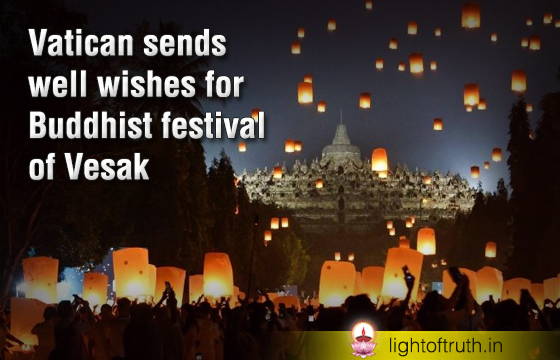
Vatican sends well wishes for Buddhist festival of Vesak
May 12, 2025 marks Vesak or Buddha Day, a major Bu-ddhist festival commemorating the birth, enlightenment, and death of Buddha. To comme-morate the festival, the Dica-stery for Interreligious Dialogue sent a message to all Buddhists around the world entitled, “Buddhists and Christians in Liberating Dialogue for Our Time.”
Signed by the Prefect of the Dicastery, Cardinal George Jacob Koovakad, and the Dicastery’s Secretary, Monsignor Indunil Janakaratne Kodi-thuwakku Kankanamalage, the message highlights the common ground between Catholicism and Buddhism.
The message begins by extending heartfelt greetings and wishes to everyone celebrating Vesak Day, before noting that “Our greetings this year are further enriched by the spirit of the Jubilee.” Re-flecting on the Second Vatican Council Declaration, Nostra Aetate, the Dicastery reaffirms that “‘the Catholic Church rejects nothing of what is true and holy’ in other religions.” This Declaration – which cele-brates 60 years in 2025 – encourages an ongoing commitment to dialogue.
The Dicastery’s message points out that Buddhism’s path to liberation “finds deep resonance in our shared pursuit of truth and fullness of life.” It explains that in the current situation in the world, “marked by division, conflict, and suffering, we recognize the urgent need for a liberating dialogue.” But it warns against keeping dialogue at a merely verbal level. The Vatican instead encourages Catholics and Buddhists to take words and make them into “concrete actions for peace, justice and dignity.”
In light of the injustice, conflict, and uncertainty rampant in the world today, the messages emphasizes that “we remain convinced of the profound capacity of religions to offer meaningful responses to ‘the unsolved riddles of human existence.’” It highlights how dialogue between the two religions can enable them to share their wisdom and address the current global challenges.
The message reiterates the idea found in Nostra Aetate – still relevant today – of working towards “unity and love among all peoples and nations” and “appreciating our differences.” To close, the Dicastery for Interreligious Dialogue expresses its hope that “through dialogue, our respective traditions may offer worthy responses to the challenges of our time.”
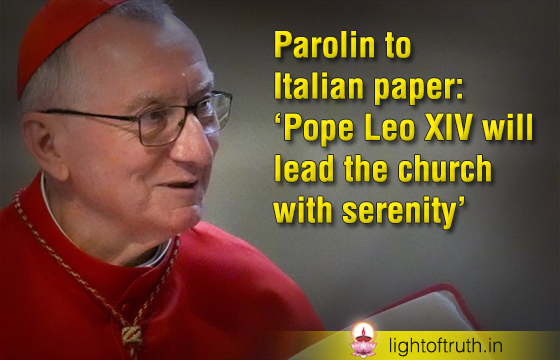
Parolin to Italian paper: ‘Pope Leo XIV will lead the church with serenity’
Italian Cardinal Pietro Parolin, who had been a top contender to be pope, wrote a letter to his hometown newspaper praising the new pontiff, Pope Leo XII. ”I believe that Pope Leo XIV, in addition to the grace of the Lord, will find in his great experience as a religious and a pastor the resources to effectively carry out the ministry that the Lord has entrusted to him,” he wrote in a letter to the Il Giornale di Vicenza.
Parolin expressed deep gratitude for the warm welcome given to the new pontiff, recalling his emotion at the response inside the conclave after then Cardinal Robert Prevost accepted his election. ”I believe I am not revealing any secret,” Parolin wrote, “if I say that a very long and warm applause followed that ‘acceptance’ that made him the 267th Pope of the Catholic Church.”
Parolin, who served as secretary of state for nearly 12 years under Pope Francis, said Pope Leo XIV was capable of facing with balance the challenges the church faces. ”What struck me most of all about him was the serenity that shone from his face in such intense and, in a certain sense, ‘dramatic’ moments, because they totally change a man’s life,” Parolin said. The cardinal said he collaborated with Prevost during his tenure as head of the Dicastery for Bishops.
Parolin also said he was confident in the new pope’s abilities, highlighting his gifts of listening, balance and deep knowledge of ecclesial situations. Parolin said Leo’s connection with the spirituality of St. Augustine is a strength for the new papal ministry. The letter concluded with an invitation to prayer and trust, stressing that the election of Leo was the fruit of a path guided by the Holy Spirit. “We are close to him with our affection, our obedience and our prayer,” he said.
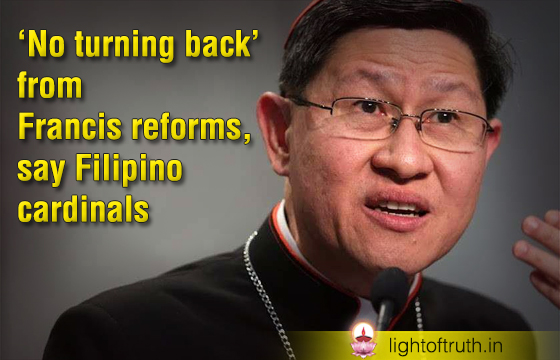
‘No turning back’ from Francis reforms, say Filipino cardinals
Filipino cardinals said Pope Leo XIV will continue the legacy of Pope Francis, and that there would be “no turning back” from the late Pope’s focus programmes for the poor. “The programmes may evolve, and they may take different expressions. But there’s no turning back from that,” said Cardinal Luis Antonio Tagle, pro-prefect of the Dicastery for Evangelisation, in a post-conclave press conference on 9 May.
Cardinal Tagle said Leo, formerly Cardinal Robert Prevost, was himself “exposed to situations of poverty, climate change, indigenous peoples, and refugees” when he was a missionary and later a bishop in Peru. “I cannot imagine how, as Pope, he would lose that compassion. It might even deepen further,” said the 67-year-old Tagle.
The Bishop of Kalookan Cardinal Pablo Virgilio David, 66, said a majority of the cardinals “would like to see a continuity of the spirit of the papacy of Pope Francis without being a clone, without being a photocopy”. David said he saw in Leo the characteristics of Francis, whom he described as “a pope of mercy and compassion” who sought to build a listening, welcoming Church. “I’m full of hope in my heart that this is going to be a really good papacy,” said David, who sat beside Tagle in the same press conference.
While the Filipino cardinals showed optimism about Leo, they also voiced disappointment about the disinformation that spread during the conclave. One rumour that circulated in Italian reportage suggested Tagle was a frequent gambler in Macau and was part of a billionaire network.
“I haven’t even been to Macau,” Tagle said, laughing before turning serious. “Of course, as a person, I am hurt when there are such comments,” he said. “That’s how I learned: don’t be afraid that God will be your judge. Because in the end, only he is the judge whom you can depend on.”
The cardinal said he follows the Bible instruction to pray for those who persecute them, and not to repay evil with evil. When asked if he plans to complain to Italian authorities, Tagle said he had made complaints in the past, but nothing happened.
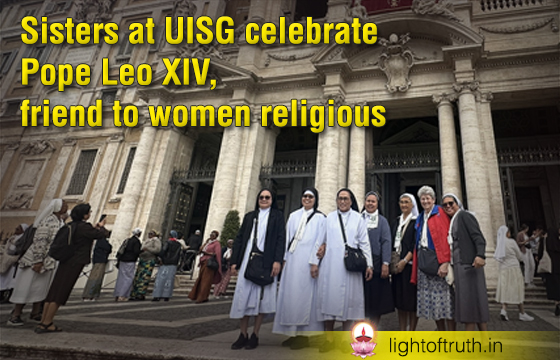
Sisters at UISG celebrate Pope Leo XIV, friend to women religious
At the very moment the white smoke appeared from the Sistine Chapel, some 900 sister leaders from around the world had just received communion. They had spent the last few days together at Ergife Palace Hotel, the site of the five-day general assembly for the International Union of Superiors General, or UISG. Throughout their plenary, the sisters had prayed for the cardinals in the papal conclave.
And on the evening of May 8, one sister decided to check her phone after the Eucharist. Soon, joyous commotion rippled through the hotel ballroom at the news of a new pope – communal elation erupted with dancing and singing, even before the assembled learned that Cardinal Robert Prevost had become pope. ”There was a rumble on the side – obviously someone had seen the white smoke,” recalled Sr. Josephine Kane, superior general of the Sisters of Our Lady of the Missions New Zealand. “Then suddenly the whole group erupted into singing ‘Alleluia,’ the musicians were beating the drums and singing, and it was just fantastic.”
For most of the sisters, the serendipitous timing of this long-planned UISG assembly, held May 5-9, coinciding with a papal election was impossible to shake – that it was no accident but rather a sign of the Holy Spirit at work.
Many bolted for St. Peter’s Square at the news of white smoke, making their way into the crowds just in time to witness the pope’s first blessing. Others chose to stay at the Ergife, savouring the moment as a group and watching it unfold on television.
But whether they encountered Pope Leo XIV from afar on the square or via the big screen, all saw a fellow religious who understands community; a missionary who shares the values of Pope Francis; a friend to Catholic sisters; and the leader many said is the one the church needs now.
“He understands religious life, and he knows women religious,” said Sr. Pat Murray, executive secretary of UISG, highlighting that he comes from the Augustinian tradition, one shared with many sisters.
Leo’s brief time as a cardinal – Francis appointed him in 2023 – already demonstrates a promising record when it comes to relationships with women in the church. Murray, an Irish Loreto sister, noted that the then-Cardinal Prevost chose three women – one of whom is a Catholic sister – to be part of the commission that appoints new bishops.
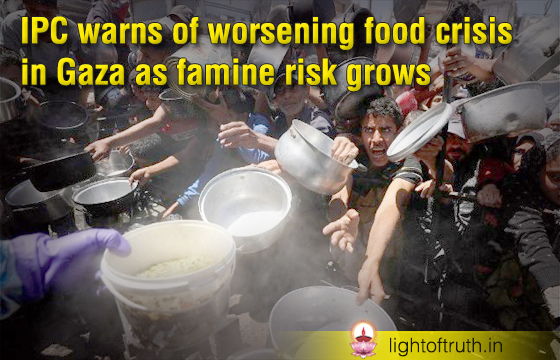
IPC warns of worsening food crisis in Gaza as famine risk grows
Philippe Lazzarini, the Commissioner-General of UNRWA, the UN agency that supports Palestinian refugees, told the BBC that he was running out of words “to describe the misery and the tragedy affecting the people in Gaza. This week, the Integrated Food Security Phase Classification (IPC) estimates that one in five people—about 500,000—are at risk of starvation. Food prices have surged, with a 25-kilogram sack of wheat flour now costing between $235 and $520, a 3,000 percent increase since February. The IPC cautioned that continued military operations and the blockade of humanitarian aid could severely limit access to survival essentials.
UN Secretary-General António Guterres expressed alarm over the findings, highlighting the extreme hunger affecting children. The World Food Programme (WFP) and UNICEF report worsening malnutrition since aid deliveries were halted on March 2.
WFP chief Cindy McCain said families are starving while food remains stuck at the border, warning that if action is delayed until famine is officially declared, it will be too late for many. Aid organizations in Gaza report a sharp drop in hot meal distribution, with only 260,000 meals provided today—down 70 percent from 840,000 just five days earlier.
The UN says more than 60 of the 180 kitchens it supports had closed after using up their last remaining supplies. Humanitarians also report that adults are prioritizing feeding their children over themselves when they do find something to eat.
Furthermore, the UN says an Israeli proposal to deliver aid supplies through hubs controlled by the military would be a breach of core humanitarian principles of neutrality, impartiality and independence.
U.S. bishops’ updated document on pornography addresses loneliness epidemic, deepfakes
The U.S. Conference of Catholic Bishops (USCCB) has released a new 10th anniversary preface to a major document on the Church’s response to pornography, offering fresh recommendations for parents, clergy, educators, and civil leaders on combatting porn’s influence in an age of increased social isolation and the rise of artificial intelligence.
“Create in Me a Pure Heart: A Pastoral Response to Pornography” calls for a renewed commitment to chastity and offers a message of hope and healing through Christ and the Church’s ministry, positioning the Church as a “field hospital” for those wounded by pornography.
The 50-page document includes a new introduction penned by the bishops’ Committee on Laity, Marriage, Family Life, and Youth, providing an update to a document the bishops first released in 2015 — years before the social upheaval wrought by the COVID-19 pandemic and lockdowns, the founding of new “user generated” porn platforms such as OnlyFans, and the rise of sophisticated AI-generated ”deepfakes” that proliferate fake pornographic imagery, often utilizing celebrities’ images without their consent.
Pornography, the bishops write, “gravely contradicts” the virtue of chastity to which all people — no matter their state in life — are called, offering a “deceptive substitute for real relationship” and posing a “serious threat to love in the life of the individual and the community.”
Jesus himself condemns the pornographic attitude in clear terms: “Everyone who looks at a woman with lust has already committed adultery with her in his heart” (Mt 5:28), they note.
The bishops say the “loneliness epidemic,” which for years has exacerbated society’s appetite for porn, has only grown more acute since the COVID-19 lockdowns. “Social isolation was already a danger in an individualistic society like ours, but it has worsened due to the continued spread of social media and the lasting effects of the COVID-19 pandemic. Studies have confirmed that isolation and increased exposure to mobile devices have severely damaged the mental health of consumers, especially young people,” the document reads.
“This isolation threatens one of the deepest desires of the human heart. The desire for genuine relationship is intrinsic to human nature and its goodness is revealed by God: ‘It is not good for the man to be alone’ (Gn 2:18).”