
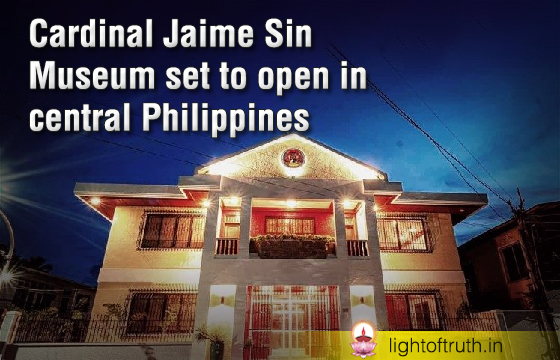
The Cardinal Jaime Sin Museum will open on September 1, 2024, as announced by the local government of New Washington and the Diocese of Kalibo in the central Philippines.
This museum, the first ecclesiastical museum in Western Visayas, will showcase the life and legacy of Cardinal Sin, who played a key role during the 1986 Edsa People Power Revolution. “Already, we are thankful to the Serviam Foundation and the Kalibo Diocese for making the house of Cardinal Sin a museum,” said Mayor Jessica Panambo of New Washington.
The local chief executive said the government plans to open the museum to the public, especially the youth “so that they would learn all the good things about the good Cardinal.”
The National Museum in Visayas has been training the museum staff since June to prepare for the opening. Exhibits will include personal belongings of Cardinal Sin, preserved by the Serviam Foundation.
Fr. Rufino Sescon, Jr., former personal secretary to Cardinal Sin and current rector of the Minor Basilica and National Shrine of Jesus Nazareno in Quiapo, has donated items and memorabilia to the museum.
The opening events will include a cultural event on August 30 at the New Washington Community Center, followed by an unveiling and blessing on August 31, coinciding with what would have been Cardinal Sin’s 96th birthday. Fr. Justy More, chair of the Historical Research and Cultural Council and project coordinator, said the idea for the museum was proposed at the Catholic Bishops’ Conference of the Philippines meeting in Kalibo to mark the 50th-anniversary jubilee of the Kalibo Diocese in 2026.
The Kalibo Diocese has been preparing for this event since July 2023, following an agreement with the Serviam Foundation to secure and display the late Cardinal’s memorabilia.
Cardinal Sin, the 30th Catholic Archbishop of Manila and the third Filipino cardinal, was a prominent figure during the 1986 Edsa People Power Revolution. Hailing from Chinese-Filipino descent, he left a significant legacy in both the Church and national history.
He was born in New Washington on August 31, 1928. He died of kidney complications due to diabetes on June 21, 2005.
Daily Archives: August 29, 2024

China officially recognizes formerly ‘underground’ bishop, Vatican says
The Vatican announced on August 27 its “satisfaction” that China has officially recognized Bishop Melchior Shi Hongzhen as bishop of Tianjin. “This provision is a positive fruit of the dialogue established over the years between the Holy See and the Chinese government,” reads a Holy See statement released Aug. 27. According to Reuters, 95-year-old Shi had once been placed under house arrest after refusing to join the church officially backed by the Chinese government.
Shi was ordained a priest in the Catholic Church on July 4, 1954, and consecrated coadjutor bishop of Tianjin on June 15, 1982. He was ordained bishop of the Diocese of Tianjin on June 8, 2019. According to the Holy See statement, 56,000 Catholic faithful – distributed across 21 parishes served by 62 priests – belong to the Diocese of Tianjin. Under Pope Francis, the Holy See has expanded dialogue with China and engaged in talks regarding provisional agreements on the appointment of bishops in the Asian nation.
The controversial Sino-Vatican Agreement, first signed in 2018, which has never been made public, is said to stipulate that the Catholic Church is allowed to have bishops in communion with Rome who are at the same time recognized by Chinese authorities in the country. It was renewed in 2020 and 2022.
In 2021, the Holy See sent a delegation led by a member of the then-Congregation for the Evangelization of Peoples (now known as the Dicastery for Evangelization), Archbishop Claudio Maria Celli, to meet with Chinese authorities and negotiate the two-year renewal of the Sino-Vatican Agreement before it expires.
Negotiations between the Vatican and China resumed Aug. 28–Sept. 2, 2022, when a Holy See delegation was sent to meet with local authorities in Tianjin.
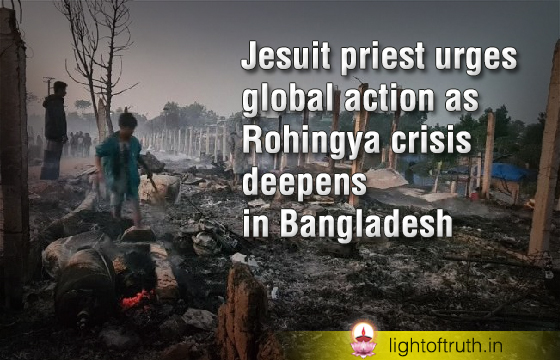
Jesuit priest urges global action as Rohingya crisis deepens in Bangladesh
Seven years after over 700,000 Rohingya fled Myanmar to escape violence, escalating tensions and dwindling aid in overcrowded camps threaten their survival. In an AsiaNews report, Father Jerry Gomes, a Jesuit priest and head of Jesuit Refugee Service (JRS) programs in Bangladesh,warned that Bangladesh cannot continue to bear the burden alone, urging the international community to take action.
“The violence in the camps continues, with incidents of theft, vandalism, murder, and kidnappings,” said Fr. Gomes, who has worked in Cox’s Bazar for seven years. As Myanmar’s civil war rages, more Rohingya refugees continue to flee, further straining Bangladesh’s resources. He stressed that repatriation is not viable without peace in Myan-mar. “A peaceful and favourable atmosphere must be created so that all ethnic communities can live in harmony,” he said.
Since 2020, JRS has partnered with Caritas Bangladesh to provide education, psychological support, and vocational training to over 6,000 Rohingya children and adolescents.
However, a 70 percent funding gap hampers efforts. Out of 400,000 school-age children, only 300,000 attend learning centres. Rising violence in the camps further jeopardizes progress.
Fr. Gomes echoed Pope Francis’ 2017 call for global compassion and justice for the Rohingya, emphasizing the need for the international community to step up.
“The international community should address the issue of repatriation since Bangladesh cannot hold them for long,” he said, urging global action to secure peace in Myanmar and support the refugees.
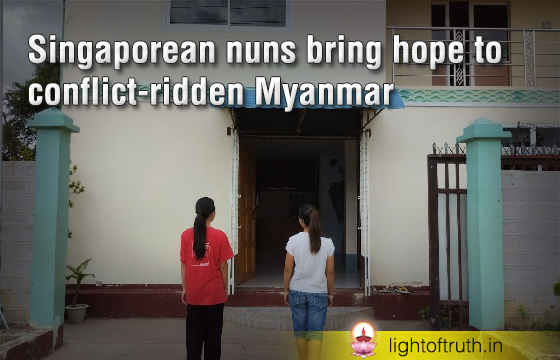
Singaporean nuns bring hope to conflict-ridden Myanmar
In 2021, a military junta seized power in Myanmar, plunging the country into a state of civil conflict, substantially worsening what was already a difficult humanitarian situation. For several decades, the Canossian Daughters of Charity, a religious congregation with a strong presence in Singapore, have been at work in the country, aiming to build a brighter future for Myanmar’s youth.
Canossian Sisters from Singapore first began making trips to Myanmar in 1996 – a journey of around 2,000 kilometres. They went, says Sr. Wang, in response to a request for help from the late Burmese Archbishop Matthias U Shwe, then Bishop of Taunggyi.
The Archbishop had invited them to educate the country’s young, and to help with the formation of groups of young evangelizers. Volunteers travelled regularly from Singapore to Myanmar on mission outreach trips for more than a decade, organising everything from leadership camps and English lessons to Bible courses.
Then, in 2008, the Canossians set up their first centre in the country, which became home to a small group of Sisters and lay partners. That community began a programme aimed at the integral formation of educators, with the motto: “Serve With Love.”
In 2012, they opened Canossa Home, which housed residential facilities for the formation of educators, as well as a boarding house for children from poor families living in villages with no schools.
These educators are trained to give quality care to children and teenagers staying in boarding houses run by the local Church – who otherwise would have no access to professional training – by educating them to one day become teachers themselves.
Since the centre was opened in 2008, the Sisters have trained about 350 young women, most of whom have now returned to serve in communities throughout Myanmar.
In 2017, meanwhile, the Sisters opened a preschool for children in the area.
Since the COVID-19 restrictions in 2020 and the military coup in 2021, volunteers from Singapore have not been able to travel to Myanmar. The Sisters and volunteers in Singapore keep in touch by sending parcels with food and other necessities. The communities in Myanmar, meanwhile, are kept running by six local Canossian Sisters and trained local lay staff, mentored by an experienced Sister from Singapore.
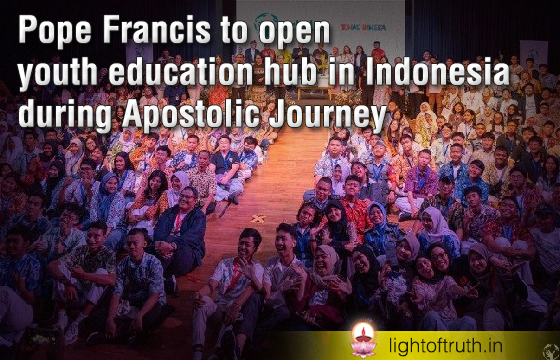
Pope Francis to open youth education hub in Indonesia during Apostolic Journey
Pope Francis will inaugurate the first regional headquarters of Scholas Occurrentes in Southeast Asia during his visit to Indonesia from Sept. 3 to 6.
The global educational project, which started in 2001 under his leadership as Archbishop of Buenos Aires, focuses on engaging youth in education, art, and sports.
On September 4, Pope Francis will visit the “Grha Pemuda” Youth House in Jakarta, where he will meet 200 Indonesian students from various islands, schools, and religions, according to a report by AsiaNews.
The visit will highlight the values of unity in diversity and the culture of encounter, key principles of Scholas Occurrentes.
Scholas Occurrentes will also launch the Scholas Citizenship program in Southeast Asia. This initiative is in partnership with Indonesia’s Ministry of Education, Culture, Research, and Technology and the Global 5P Movement.
The program will train university students and young teachers in the Scholas methodology, which they will implement in their communities.
Scholas Occurrentes said that the approach seeks to address the needs of Indonesian society, where the youth population is growing rapidly.
Scholas Occurrentes started as a project in Buenos Aires to bring together students from public and private schools, regardless of religious background, to work for the common good.