
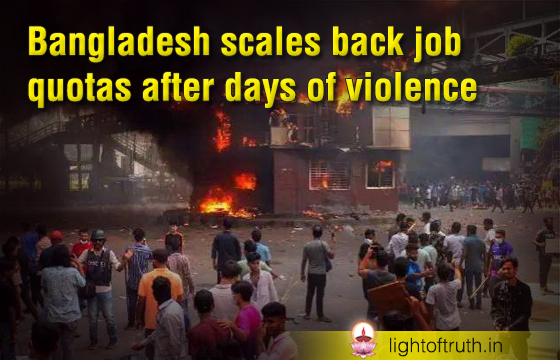
Bangladesh Supreme Court reversed its earlier decision to reintroduce quota system in civil service jobs, following weeklong deadly violence that left nearly 200 killed, thousands injured, and state properties worth millions of dollars vandalized and gutted. The full bench of the Appellate Division said the government should reserve only a seven percent quota for public service jobs against the 56 percent quota policy previously. The next day, the ruling Awami League government issued a gazette to implement the court order.
The peaceful movement led by university students in the capital Dhaka and other major cities turned violent after police along with pro-government students attacked protesters last week. The attacks intensified the protests which later spread across the country. The government imposed a nationwide curfew, deployed the military, and cut off the internet for five days to restore law and order. Student activists welcomed the court verdict and urged the government to fulfill their demands including justice for the violence and killings.
Daily Archives: July 31, 2024

Church leaders praise Pakistan amendment raising legal age for marriage of Christians
Pakistan’s National Assembly unanimously approved the raising of the minimum legal age for marriage to 18, amending a 19th-century law allowing the marriage of Christian children.
The Christian Marriage Act of 2024 amended an 1872 British rule allowing marriage at 13 for girls and 16 for boys, raising the age to 18 for both genders. The law was approved amid incidents of child marriage, kidnapping, and forced conversion in Pakistan, where about 19 million Pakistani women are victims of child ma-rriage, according to 2018 data.
The act was first introduced to the Senate last year by Sen. Kamran Michael as an update to the 1872 law and was approved on July 9 of this year after Na-veed Aamir Jeeva, a Christian from Punjab province, introduced it to Pakistan’s sovereign legisla-tive body, the National Assem-bly.
The act applies to Christians in the Islamabad Capital Terri-tory, a territory in the north-western area of the Punjab region surrounding Islamabad, the capital of Pakistan. Local Catholic lead-ers including the president of the Catholic Bishops’ Conference of Pakistan, Bishop Samson Shukar-din, and the National Commission for Justice and Peace have since hailed the act for protecting girls from forced conversions and child marriages, which is very common in Pakistan.
The new amendment may help prevent the practice of abducting young girls from the minority population of Christians and the forcing of them to convert to Islam and marry an older man. Fewer than 2% of Pakistanis are Chri-stian and Hindu, respectively. Sunni Islam is the majority reli-gion, at about 83% of the popu-lation, while Shia Islam is about 12% of the population.

Canonization process for first Korean Cardinal begins
The Vatican has approved the sainthood process for first Korean Cardinal Stephen Kim Sou-hwan, known for his love for the poor, efforts for lay participation in the Church, and support for demo-cracy.
The Vatican has allowed the launch of the sainthood process for Cardinal Stephen Kim Sou-hwan, the first Korean cardinal known for his initiatives in interfaith dia-logue, lay participation and pro-democracy stance.
In a statement, the Archdio-cese of Seoul said it has received the “no objection” letter from the Vatican’s Congregation for the Causes of Saints to start the process. Archbishop Peter Chung Soon-taick of Seoul received the letter on June 18, allowing the archdiocese to venerate Cardinal Kim as a “Servant of God.”
Kim was born in 1922 and ordained a priest in 1951. He was ordained as the bishop of Masan diocese in 1966 and the archbishop of Seoul in 1968. In 1969, Pope Paul VI made him a cardinal.
He is credited for working to implement the spirit of the Second Vatican Council. He is hailed for strengthening the Korean Church amid various trials and tribula-tions, including political turmoil under a series of military regi-mes.
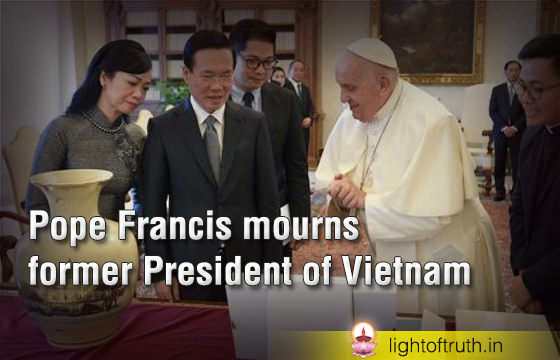
Pope Francis mourns former President of Vietnam
Pope Francis has expressed his condolences for the death of Nguyen Phú Trong, and the Ge-neral Secretary of the Communist Party of Vietnam and the country’s former President.
In a telegram sent on his behalf by the Holy See’s Secretary of State, Card. Pietro Parolin, to the country’s current President, Gene-ral Tô Lâm, the Holy Father ex-pressed his closeness to all who mourn the long-serving leader of the Asian country, who died at age 80 last week, after battling an illness.
“Having learned of the death of His Excellency Nguyen Phú Trong, General Secretary of the Communist Party and former President of the Socialist Re-public of Vietnam,” the telegram began, “His Holiness Pope Fran-cis sends condolences to all who mourn his loss, especially his fa-mily, together with the assurance of his prayers for their consolation and peace.”
In the text, the Holy Father expressed “particular apprecia-tion” for the late President’s role “in fostering and promoting the positive development of the relations between Vietnam and the Holy See.”
Pope Francis concluded his message by affirming his spiritual closeness to President Tô Lâm and to all his fellow citizens at this time of sorrow for the nation.
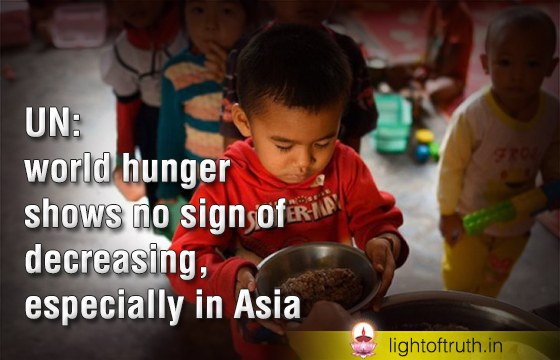
UN: world hunger shows no sign of decreasing, especially in Asia
Some 733 million people suffered from hunger last year, that is one person in 11,152 million more than in the pre-pandemic period (2019). This is the third consecutive year that the number is not decreasing, remaining “stu-bbornly unchanged,” this according to a report on The State of Food Security and Nutrition in the World (SOFI) released by the Food and Agriculture Organisation of the United Na-tions (FAO) and four other agencies. The document, presented in Rio de Janeiro, Brazil – the country that holds the rotating presidency of the G20 this year – underscores the fact that the fight against hunger has suffered a 15-year setback.
Undernourishment levels are comparable to those of 2008-09 and the Sustainable De-velopment Goal of Zero Hunger appears un-achievable by 2030, despite some improve-ments in specific areas, like breastfeeding or stunted children. Instead, if current trends continue, 582 million people will be chronically undernourished by the end of the decade, 130 million more than in the pre-COVID-19 period. At the regional level, there are wide variations. In Asia, the percentage of people afflicted by food insecurity and malnutrition has stabilised at 8.1%. But hunger is still a huge problem for the region, home to more than half of the world’s hungry people, or 385 million people.
South Asia has the highest percentage, with 13.9% undernourished (almost 281 million), while in East Asia the figure is less than 2.5% and it is just over 6% in Southeast Asia. Food insecurity (defined as the situation in which an individual is without food for one or more consecutive days) also continues at record levels in South Asia, but the worst data come from Africa, where 58% of the population is in this condition. In South Asia, 2023 saw a drop to 41.1% (compared to 24.8% in the region), equal to 833.4 million people.
Only Central Asia has seen improvements over 2021, with 2.4 million fewer people suffering from severe or moderate food in-security, even though 16.6% of the population is still affected.
Compared to the past, hunger today affects men and women almost equally, the United Nations points out, thanks mainly to improve-ments in the conditions of women around the world. Asia, on the other hand, has the highest number in absolute terms, with over 1.65 billion people who cannot afford a healthy diet.

Arunachal chief minister acknowledges Christian contribution to society
Chief Minister of right wing Hindu Bha-ratiya Janata Party ruling northeastern state of Arunachal Pradesh had words of apprecia-tion and praise for a group of Catholic Church leaders visiting him on July 17. In his official Facebook post Chief Minister Pema Khandu said, “blessed to receive a call-on from Bishop Benny Edathittayel of Itanagar, Bishop George Palliparambil of Miao and the members of the Arunachal Pradesh Catholic Association, led by President Shri Taw Tebin Ji.”
“Their tireless efforts in promoting peace, education, and social welfare in our state are truly commendable,” he wrote. Serving a second term as Chief Minister Khandu did not hesitate to place on record the contribution of the Church stating, “I deeply appreciate the Catholic community’s dedication to raising awareness on critical issues like corruption, drug abuse, and the money culture in elections, contributing to a more informed and respon-sible society.” In concluding the post the Chief Minister of Arunachal Pradesh state which introduced the anti-Christian legislation – Freedom of Religion Act in 1978 – did not hesitate to say, “Thank you for your selfless service and commitment to the betterment of Arunachal Pradesh.” Pema Khandu born on August 21, 1979 is the son of former Chief Minister of Arunachal Pradesh late Shri Dorjee Khandu. Several states in India, including Arunachal Pradesh, Uttar Pradesh, Madhya Pradesh, Himachal Pradesh, Gujarat, and Odisha, have implemented anti-conversion laws. Anti-conversion laws are legislative measures aimed at preventing or prohibiting religious conversions. These laws can be used to discourage individuals from leaving a particular faith or to restrict religious groups from actively seeking new members from other religious backgrounds. The specific provisions and enforcement of anti-conversion laws differ across jurisdictions, and they may involve both criminal and civil penalties. Christian leaders content that the implementation of these laws have the potential to favour domi-nant religions or suppress minority faiths
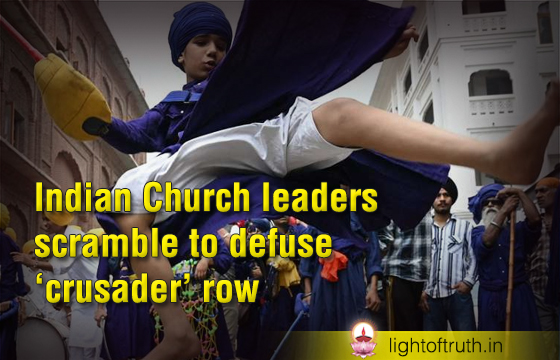
Indian Church leaders scramble to defuse ‘crusader’ row
Church leaders have met the top leader of Sikhism after Sikhs objected to being called “crusaders” by unidentified pastors in a northern Indian Punjab state. The pastors alle-gedly called Sikh community members “crusaders” following a spate of attacks on the state’s Christians, who were accused of forced conversions. Christians account for 10 percent of Punjab’s population.
“Some unknown pastors have allegedly used the word ‘crusaders’ for them [Sikhs]. It is painful and unfortunate,” Bishop Agnelo Rufino Gracias, apostolic administrator of Jullundur diocese in Punjab state, told. The prelate added that they have had a “good rapport with the Sikhs” for years and hardly “faced any issues.” A delegation from Jullundur (Jalandhar) diocese in northern Punjab met Jathedar Giani Raghbir Singh of the Akal Takht (the seat of power of the Sikh religion) on July 15. The Sikhs form the majority of Punjab’s 28 million population the Jathedar is the head of the Sikh religion. The meeting took place in Amritsar, where the Jathedar is based. The delegation, led by Father John Grewal, the diocese’s director of interreligious dialogue, handed Singh a letter titled “Masih Maha Sabha” (Christian General Assembly) and promised cooperation to address the contentious issue of religious conversion.
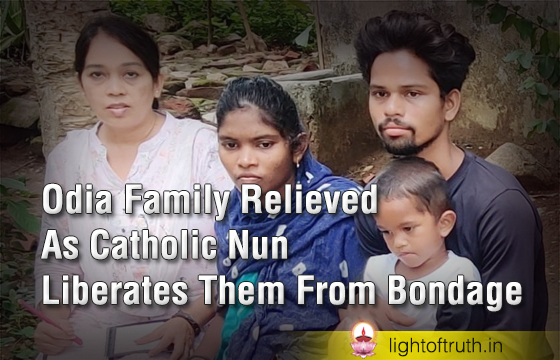
Odia Family Relieved As Catholic Nun Liberates Them From Bondage
A family in Odisha now thanks a Catholic nun for rescuing them from bonded labour in the southern Indian state. “I can finally breathe freely. I thank Sister Sujata pro-fusely,” says Deepthi Singh, who was held in bondage along with her husband in a brick kiln in Karnataka state’s Mallur district. The 22-year-old pregnant woman told Matters India July 17 that they had spent “countless nights crying out for help, feeling bitter about my circumstances and even blaming my parents.” Sister Sujata Jena’s initiative has helped Deepti, her husband, father, mother and stepmother to return to Gandhinagar, their village in Odisha’s Gajapati district, on July 11 after toiling in the Karnataka brick kiln for a total of nine years. Sister Jena, a lawyer and a mem-ber of the Congregation of the Sacred Hearts of Jesus and Mary, said she heard about the family on July 3 during her visit to villa-ges in Gajapati district to conduct awareness programs for migrant workers. One of the participants of an awareness program was Deepti’s mother Subasini Singh, who told the nun how her family – husband, daughter, son in law and another member – was held in bondage in Karnataka. On her return to Bhubaneswar, Odisha capital, five days later, Sister Jeana appealed to the Labour Commissioner of Karnataka to get the family released from the illegal bondage. “The family’s rescue highlights the demeaning conditions of migrant labourers in India,” Sister Jena, who has worked among migrants for more than five years, told.
Indian Church leaders back Amnesty’s Manipur relief camp call
Church leaders have concu-rred with a global rights group report that relief camps in Mani-pur in India’s northeast are “in dire need of support” after secta-rian strife uprooted more than 50,000 and killed over 220 people, most of them Christians.
”There is no doubt, Amnesty International has come out with the reality existing in Manipur” in northern India, said A.C. Michael, based in the national capital New Delhi. “Both the federal and state governments failed to restore peace even after a year,” he told on July 19. In a report released on July 16, Am-nesty accused Indian Prime Minister Narendra Modi’s pro-Hindu Bharatiya Janata Party (BJP) government in Manipur, bordering civil war-hit Myanmar, of ignoring the plight of people living in relief campus in the state. They are “in dire need of support” even after the promise of a financial aid package by Modi in April this year, the London-based rights group said in the report. Amnesty said its findings revealed “a picture of a state missing-in-action” despite the claims of “ti-mely intervention” and promise of financial aid. The camps lack adequate relief and rehabilitation measures, including adequate shelter, sanitation, food, water, medical care, and access to edu-cation opportunities “in violation of the UN Guiding Principles on Internal Displacement,” the re-port said. The Catholic Church has a diocese in the troubled state, based in the state capital Imphal, and headed by Abp Linus Neli.

Christian leaders ask India to repeal anti-conversion laws
A delegation of Christian leaders has urged India’s federal government to ask 11 states to repeal the sweeping anti-conversion laws, which they say target Christians.
“The anti-conversion law has been weaponized to target religious minorities,” an eight-member delegation from the United Christian Forum (UCF) told federal minority affairs minister Kiren Rijiju. The delegation met the minister in his office on July 20 and asked him to “issue an advisory to the state governments to repeal the anti-conversion law.” Stringent laws that criminalize conver-sion have been enacted in 11 states, most of them ruled by the Hindu right-wing Bharatiya Janata Party (BJP). The Christian forum monitors anti-Christian violence in the country and its delegation presented a memorandum to the minister highlighting the rising persecution against Christians. “The minister agreed to look into our grievances,” said A C Michael, a delegation member. Michael told on July 22 that they would discuss the issue further with the federal government and the provincial states concerned. The memoran-dum has the details of persecution, including murder, false cases, social boycotts, and denial of burial grounds. There were 727 incidents of violence against Christians in 2023, the memorandum said, and termed them “as a disturbing trend.” In the current year till June-end, “a staggering 361 incidents of targeted attacks” against Christians were reported, it said. The central Indian state of Chhattisgarh tops the list with 96 incidents, followed by northern Uttar Pradesh, which has 92 cases. Both the states are ruled by the BJP and have the anti-conversion law in force, which bans religious conversion by using force or allurement. “The primary reason for these attacks “was the false allegations of fraudu-lent [religious] conversions,” the memorandum noted. The memorandum said that “police collude with the right-wing groups” to target Christians, who make up a mere 2.3 percent of India’s 1.4 billion people. The delegation also told the minister that Christians were mercilessly beaten to death for their faith even when the Indian constitution guarantees religious freedom.