
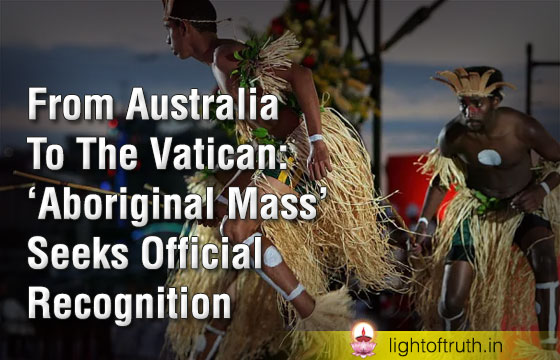
On May 7, Australia’s Catho-lic bishops officially approved a liturgy used in a remote Western Australian diocese that incor-porates elements of Abori-ginal language and culture. The liturgy has been celebrated for over 50 years in the Diocese of Broome, where some 13,000 Catholics live in nine parishes across an area about the size of Texas, with a total population of just over 50,000. The Mass of the Land of the Holy Spirit – in Latin, “Missa Terra Spiritus Sancti” – now awaits the Vatican’s official recognition after the Australian Catholic Bishops’ Conference passed the motion at its plenary meeting in Sydney on May 7.
Bishop Administrator Michael Morrissey of Broome said the decision was a milestone. “After a lengthy period of engagement, it’s a significant acknowledgment by the Australian bishops.” Two Indigenous elders, Maureen Yanawana and Madeleine Jadai, presented the Mass to the bishops and shared its impact on their community. “Singing at the top of our voices brings us peace,” Yanawana shared during the presentation at the bishops’ meeting in Sydney’s Mary Mac-Killop Place, highlighting the spiritual enrichment it brings.
Daily Archives: May 14, 2024
Conference In Rome Addresses Dangers Of AI And Child Pornography
“What dangers does arti-ficial intelligence (AI) present for the safety of children in digital environments?” was the topic addressed by a conference organized by the S.O.S Il Tele-fono Azzurro Foundation and the Italian Embassy at the Holy See as part of the National Day against Pedophilia and Child Pornography, which is observed in Italy every May 5.
According to its website, Il Telefono Azzuro (“The Blue Telephone”) “offers a hotline service, managed by 114 Children’s Emergency, through which it is possible to report illicit or potentially harmful content for children and adolescents.”
Disturbing statistics were reported at the event: In 2023 there were more than 275,000 child pornography websites on the internet with approximately 11,000 photos generated by AI in just one month.
However, these figures could be even higher, Vatican News noted, given that this new phenomenon “is difficult to quantify concretely.”
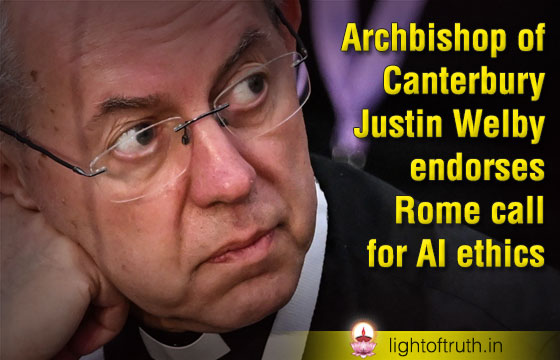
Archbishop of Canterbury Justin Welby endorses Rome call for AI ethics
The Archbishop of Canter-bury, Justin Welby, has joined other illustrious leaders, ethicists, and university professors in signing the ”Rome Call” for the ethical development of artificial intelligence. Archbishop Welby, leader of the Anglican Communion, endorsed the initiative on 30 April at a ceremony in Rome at the headquarters of the Pontifical Academy for Life, according to a note from the Academy and its Renaissance Foundation. The Call for AI Ethics is a document that “aims to foster a shared sense of responsibility for human dignity amid rapid technological advancements.”
“I am delighted to support the Rome AI Call, which emphasises the dignity of every human being amid technological change,” Archbishop Welby said when signing the document on behalf of the Church of England. “While we can’t predict the future, we do know that there will continue to be rapid developments in science and technology and we need to be prepared,” he noted. While recognizing the enormous potential AI can offer “in improving human capability,” he emphasised that we must also strive “to protect, preserve and cherish the dignity of the human person.” The enormous advances made in AI, therefore, “cannot be the sole property of its developers, or any single part of the human race,” but benefit all in serving the common good, safe-guarding climate, and aiming at sustainable development.
“So much of how we under-stand Artificial Intelligence,” Archbishop Welby concluded, “comes down to how we under-stand the nature of being human” and our working together “to ensure that the dignity of every human being, created by God, not for profit or productivity, is central to all we do.”
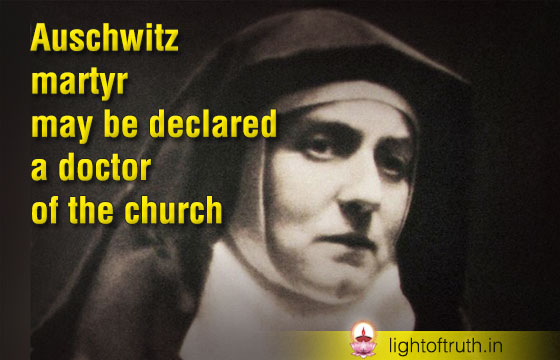
Auschwitz martyr may be declared a doctor of the church
Pope Francis received an official request from the superior general of the Discalced Carmelites, Fr Miguel Márquez Calle, on April 18 in a private audience at the Vatican to recognise the theological legacy of the saint who was martyred in Auschwitz. If accepted, Stein, also known by her religious name St Teresa Benedicta of the Cross, could become the fifth woman to be declared a doctor of the Church, a title that recognises a substantial contribution to the Church’s theology and moral life.
With the petition, the Vatican Dicastery for the Causes of Saints can officially begin the required process to grant Stein the title. The Carmelites first launched an inter-national commission to gather the necessary documentation required by the Vatican in 2022, a year that marked both the 100th anniversary of Stein’s baptism and the 80th anniversary of her martyrdom. A title that was proposed for her at the time was “doctor veritatis” because of her relentless intellectual pursuit of truth, which after her conversion she recognised in the person of Jesus Christ.
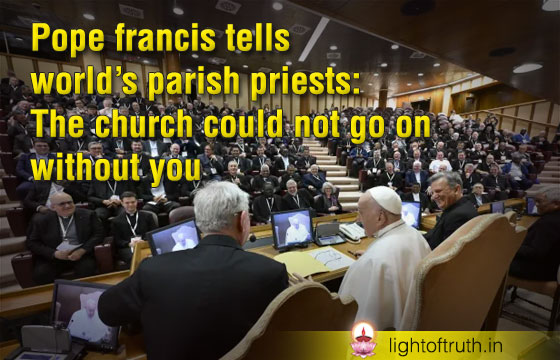
Pope francis tells world’s parish priests: The church could not go on without you
Pope Francis published a letter addressed to all parish priests in the world with his advice for building a missionary Church in which all the baptized share in the mission of proclaiming the Gospel.
“Parish communities increasingly need to become places from which the baptized set out as missionary disciples and to which they return, full of joy, in order to share the wonders worked by the Lord through their witness,” Pope Francis wrote in the letter published on May 2.
The pope presented the letter to 300 priests participating in the Synod on Synodality’s “World Meeting of Parish Priests” during an audience at the Vatican, saying that their meeting is “an opportunity to remember in my prayers all of the parish priests in the world to whom I address these words with great affection.” “Before all else, I would like to express my gratitude and appreciation for the generous work that you do each day, sowing seeds of the Gospel in every kind of soil,” Pope Francis wrote. “It is so obvious as to sound almost banal, but that does not make it less true: the Church could not go on without your dedication and your pastoral service,” he added.
In the letter, Pope Francis offered three suggestions to parish priests for building “a synodal and missionary Church.” The first is for priests to live out their “specific ministerial charism in ever greater service to the varied gifts that the Spirit sows in the people of God.” He said that by nurturing the many and varied charismatic gifts of the laity, priests will “feel less alone in the demanding task of evangelization” and “will experience the joy of being true fathers, who do not dominate others but rather bring out in them, men and women alike, great and precious possibilities.”

Christians And Buddhists Must Walk Together ‘For The Sake Of Peace’
In a message entitled “Christians and Buddhists: Working together for Peace through Recon-ciliation and Resilience” released on 6 May, Cardinal Ayuso, the Prefect of the Dicastery for Interreligious Dialogue, reflected on how the teachings of both traditions highlight the need for collaborative efforts in healing the wounds of humanity and the earth.
Quoting Pope St. Paul VI’s timeless plea, “Never again war, never again war,” the Cardinal said it serves as an urgent reminder of how “the continuing escalation of conflicts worldwide calls for renewed attention to the critical issue of peace and deeper reflection on our role in overcoming the obstacles standing in the way of its growth.”
Noting that pursuing peace demands “vigorous efforts” on the part of all, Cardinal Ayuso pointed to the need “to strengthen our commitment to work for recon-ciliation and resilience.” The Cardinal remarked on how the quest for lasting peace requires acknowledging that true recon-ciliation cannot occur without addressing the underlying causes of conflicts and he emphasized the importance of equity and justice in political, economic, and cultural spheres.

Czech Theologian Says Catholicism Must Rid Itself Of ‘Heresy Of Triumphalism’
Catholicism must rid itself of the “heresy of triumphalism” if it is to become more synodal and better able to evangelise in a secular age, according to noted Czech theologian and philosopher Msgr Tomas Halik.
“We see ourselves as a soci-etes perfecta,” or a perfect soci-ety, that is too self-sufficient, said Msgr Halik, who was recently chosen by the Vatican’s Synod office to help lead an April 29-May 2 gathering for some 200 parish priests from all over the world. The gathering was orga-nised in response to concerns that Pope Francis’ Synod on Synodality included only a few parish priests among the more than 400 delegates that participated in the first session of the assembly in October 2023. Msgr Halik praised Francis’ synodal efforts and his commit-ment to root out a culture of cleri-calism, where priests see them-selves as more powerful than the laity.
But, he said, he would also point to “ecclesial triumphalism,” which he said is a prideful, wide-spread attitude defined by a Catho-licism that is closed off from the world around it. In an address to the parish priests in attendance at the Synodal gathering, Msgr Halik lamented that “some Chri-stians, alarmed by the rapid changes of the world, want to make the Church an island of unchanging certainties.” “There are still places where the parish priest sees himself as the pope of his parish. But the Church confers the gift of infallibility on only one of its members, and then only under strictly limited conditions,” he continued. “And if even a Pope relies on several consultative councils to help him make his decisions, how much more should a parish priest listen to those he has been sent to serve?” Msgr Halik said he was encouraged by the open and frank discussions that took place during the gathering.

Nigerian Nun Organizes Yak Iyamma Team To Fight Human Trafficking
Trafficking in persons has been a cruel reality in Nigeria since the 1980s, one that is un-fortunately still present. In response to an appeal made by the Bishops of Nigeria and Major Superiors to join in the fight against human trafficking, Sister Anthonia M. Essien, HHCJ, and her team have launched awareness raising programs in rural villages in Akwa Ibom State.
Sr. Anthonia M. Essien is a member of the Congregation of the Handmaids of the Holy Child Jesus in Nigeria. She is a Professor of Sociology of Religion and the current Deputy Vice-Chancellor at the University of Uyo, Nigeria. Despite her busy schedule as a university Professor, Sr Anthonia responded to the plight of trafficked victims by whole-heartedly joining in the fight against human trafficking, through awareness and skills acquisition programs. “I was moved by the stories of the victims. I could not sleep. I had to do something for them,” said Sr. Anthonia.
Since 2021, Sr. Anthonia has carried out several pastoral activities in rural villages in Akwa Ibom State, raising awareness among the people on the ills of trafficking in persons. She works actively in collaboration with local law enforcement agencies to facilitate the arrest of traffickers, and ensuring that they face the law. Her efforts recently resulted in the rescue of several children and teenagers who had been sold to traffickers within the country. “I was shocked to learn that some of the children had been sold by an adult known to them,” Sr. Anthonia said. “My first response, when the father of two of the children told me they were missing, was to get the police and the State anti-trafficking department involved. Their prompt response led to the rescue of the children.” Sr. Anthonia came up with the idea of a Community Action Group – local donors and stakeholders – to involve the local community in the Yak Iyamma project for the prevention of human trafficking.
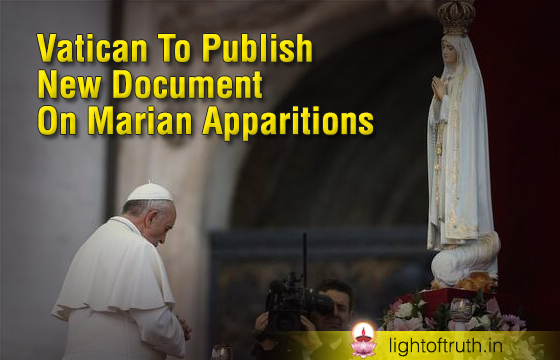
Vatican To Publish New Document On Marian Apparitions
The Holy See Press Office announced that Cardinal Víctor Manuel Fernández, the prefect of the Dicastery for the Doctrine of the Faith (DDF), will unveil new norms for discernment regarding “apparitions and other super-natural phenomena” on Friday, May 17.
In an interview with the National Catholic Register Cardinal Fernandez said that the document will provide “clear guidelines and norms” for discernment. The new norms will be the first time that the Vatican’s doctrinal office has issued a general document on apparitions in four decades. Pope Paul VI approved norms on “the discernment of presumed apparitions or revelations” in 1978.
The Catholic Church calls for “great prudence” in examining the facts related to presumed apparitions of revelations. According to the 1978 norms, it is the Church’s responsibility to first judge the facts before permitting public devotion in the case of an alleged apparition.
“Throughout the ages, there have been so-called private revelations, some of which have been recognized by the authority of the Church. They do not belong, however, to the deposit of faith,” paragraph 67 of the Catechism of the Catholic Church states. “It is not their role to improve or complete Christ’s definitive revelation, but to help live more fully by it in a certain period of history. Guided by the magisterium of the Church, the sensus fidelium knows how to discern and welcome in these revelations whatever constitutes an authentic call of Christ or his saints to the Church.”
Under Pope John Paul II, the Vatican Congregation for Divine Worship and the Discipline of the Sacraments issued a lengthy document on popular piety in 2001 that reiterated the Church’s teaching that private revelations do not belong to the deposit of faith.