
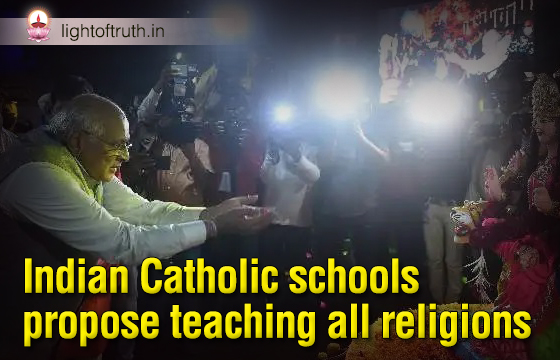
Catholic schools in the western Indian state of Gujarat have sought to include all major religious scriptures along with the Hindu scripture Bhagavad Gita in their academic curriculum.
The provincial government in Gujarat had last week announced the teaching of the Bhagavad Gita in classes 6-12 across the state for the new academic session.
“We are not against teaching the Bhagavad Gita but want the government to introduce the sacred texts of other major religions to uphold the secular and democratic credentials of the nation,” said Father Teles Fernandes, secretary of Gujarat Education Board of Catholic Institutions.
Father Fernandes told on March 22 that the Catholic institutions have approached Gujarat Chief Minister Bhupendra Patel to apprise him of their concerns.
The pro-Hindu Bharatiya Janata Party (BJP) government in the state said it wanted to promote a sense of pride and connection with India’s rich traditions through the teaching of the Bhagavad Gita.
The Catholic institutions in a memorandum sent to the chief minister on March 18 said the introduction of Hindu scriptures in the school curriculum was “not an issue in itself” but given the diversity and religious plurality of India “it would be imperative that impressionistic minds of the young students are also given the taste of other holy scriptures of major world religions.”
The memorandum mentioned the Quran, Bible, Guru Granth Sahib, Avesta, Tripitaka and Agamas among others. “All these holy books speak of the language of love, brother-hood/sisterhood, kindness, charity, tolerance, forgiveness, etc. We are all children of the same God. This will instill harmony, broadmindedness, acceptance, sensitivity and oneness in our society,” it added.
The Catholic institutions further lauded the government for its decision to introduce the English language as a compulsory subject from Class 1 onwards, calling it “a move in the right direction as India is fast becoming a global player and the English language is an international accepted mode for trade and communication.”
Daily Archives: March 31, 2022
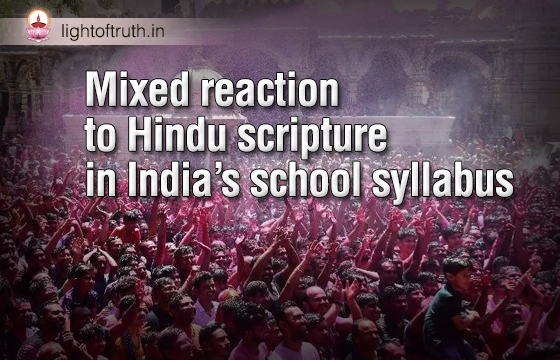
Mixed reaction to Hindu scripture in India’s school syllabus
A Catholic priest and human rights activist from the western Indian state of Gujarat has welcomed the inclusion of a Hindu scripture, Bhagavad Gita, in the school syllabus but warned against growing majoritarianism.
“The study of any and every religious or holy book needs to be welcomed all at all times. However, introducing only the study of Bhagavad Gita smacks of majoritarianism, which is violative of the secular fabric of the country,” Jesuit Father Cedric Prakash told.
The provincial government in Gujarat announced on March 17 that the Hindu scripture will be taught to students from classes 6-12 to cultivate a sense of pride and connection with their traditions.
The government in southern India’s Karnataka state has also hinted at introducing Bhagavad Gita to its school syllabus. Both states are ruled by the pro-Hindu Bharatiya Janata Party (BJP).
Father Prakash said the decision “though not totally unexpected” was “yet another step toward the establishment of a Hindu Rashtra (Hindu nation).”
The Catholic priest said the government must reconsider and instead introduce a well-planned course involving the study of all major world religions and their holy books including the Bible, Quran, Guru Granth Sahib, Avesta, Tripitaka, Agamas and others along with the sacred Hindu scriptures.
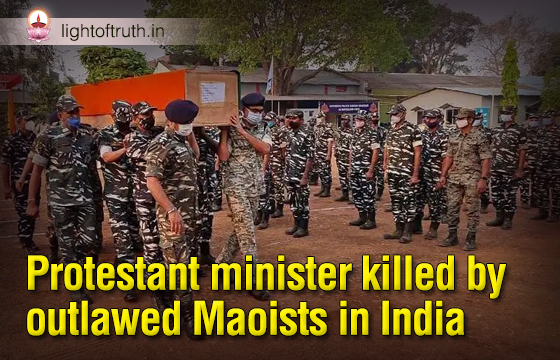
Protestant minister killed by outlawed Maoists in India
Christians are concerned for the security of the family of a Protestant minister who was brutally stabbed to death by outlawed Maoist rebels in the central Indian state of Chhattisgarh.
The bloodsoaked body of Pastor Yalam Shankar, who was in his fifties, was found in the Maoist-infested South Bastar forests in Bijapur district on March 17.
Local news outlets quoted a statement from the Maoists claiming responsibility for the killing and alleging the deceased pastor was a police informer working against the interests of the outlawed rebels since 2018 in the area falling under the jurisdiction of Madded police station.
The armed outlaws reportedly forced their way into Pastor Shankar’s house and dragged him out before stabbing him to death. They justified their action by saying the pastor was warned many times in the past but to no avail.
Police denied the Maoists’ claim that the pastor was their informer but the incident shocked the Christian community in Chhattisgarh.
“We are shocked to know about the murder of the pastor,” said Guruvinder Singh Chadda, president of Akhil Bharati Isai Samudaya Adhikar Sangathan, an organization working for the welfare of Christians in Chhattisgarh.

Indian journalists demand halt to hatred against Muslims
Leading media figures have urged India’s top constitutional bodies “to step in and uphold their mandate” amid rising threats to religious minorities, especially Muslims.
They issued a statement condemning the alarming rise in “open calls from various quarters for attacks on India’s religious minorities, especially Muslims” and said that “silence is not an option.”
Senior journalist and writer Mrinal Pande, N. Ram, former editor-in-chief of English daily The Hindu, R. Rajagopal, editor of The Telegraph, and Vinod Jose, executive editor of Caravan magazine, were among the 28 media persons who signed the March 23 statement.
“Sometimes the occasion is an election, at other times it is a political gathering, a so-called Dharam Sansad [religious parliament], or a controversy over clothing, or even the screening of a movie,” they stated, adding that “these calls for violence — which have been widely reported in the media — have been met with a cold and calculated silence from the country’s top leaders.”
Referring to the latest controversy in Karnataka state over the hijab or veil worn by Muslim girls, the journalists highlighted the systematic hate being propagated against Muslims under the pretext of Covid-19, including calls by legislators for their socioeconomic boycott.
“Disturbingly, the term ‘corona jihad’ was fabricated and amplified by sections of the media establishment,” they said.
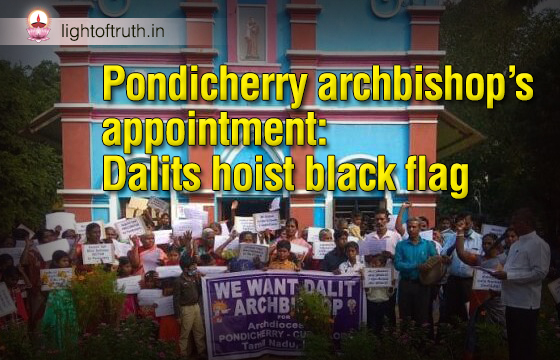
Pondicherry archbishop’s appointment: Dalits hoist black flag
Dalit Catholics in Tamil Nadu have pro-tested the appointment of a non-Dalit as an archbishop in the southern Indian state.
The Dalit Christian Liberation Movement, which leads the protest, on March 20 hoisted a black flag in the Church of Our Lady of Fatima in Vrithachalam parish of Pondicherry-Cuddalore archdiocese.
A day earlier, the Vatican announced the transfer of Bishop Francis Kalist of Meerut to Pondicherry-Cuddalore in Tamil Nadu as its archbishop, ignoring Dalit Catholic groups’ demand for a prelate from their community.
Although the Archbishop-elect is Tamil, he is a non-Dalit who has been serving a northern Indian diocese for decades. The Dalit groups also posted a hashtag on Twitter, “FRANCIS KALIST GO BACK.”
What has upset the Dalits is that Bishop Kalist has ignored their plea to him to not accept the new post.
A rumor spread in Tamil Nadu weeks earlier indicated Bishop Kalist coming to Pondicherry. S Anandaraj, the movement’s communication secretary, on March 1 wrote to Bishop Kalist warning him that the Dalit Christians would not allow him to take charge if he agreed to the Vatican proposal. “We shall continue to fight,” he wrote.
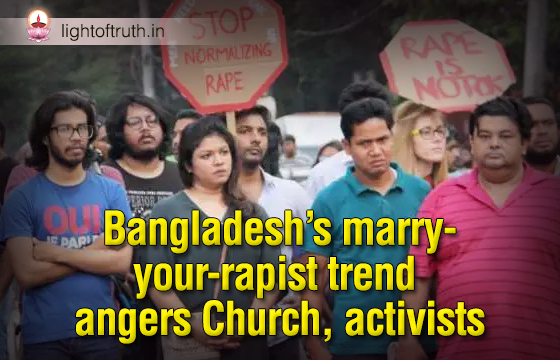
Bangladesh’s marry-your-rapist trend angers Church, activists
A rising trend of rape victims settling for marriage with their rapists has triggered an angry response from female activists in Bangladesh who termed it unethical and unacceptable in a civilized society.
“Instead of punishment, a rapist is being allowed to marry a rape victim. This is absolutely unethical and it undermines women’s rights. If the perpetrators get away this way, then more rape will happen in our society,” said Rita Roselin Costa, convener of the women’s desk at the Catholic Bishops’ Laity Commission.
In Bangladesh, women and minor girls are socially ostracized when they become victims of rape, she said, adding that even if they go for trial, they lose patience for justice due to the lengthy and complex legal system. “And then the criminals take the opportunity, marry the victims and get relieved from the punishment,” she said.
Costa, a social activist and mother of three, was speaking after a court granted bail to a police officer after he married the woman he raped in June 2020. The inspector was jailed and convicted of rape.
On March 23, Judge Mehedi Hasan Talukdar of the Women and Children Repression Prevention Tribunal in Panchagarh district in northern Bangladesh granted bail to police sub-inspector Abdul Jalil after he married his rape victim on the court’s premises.
Jalil, 45, was arrested and imprisoned after the woman filed a case against him on March 25, 2021, alleging she was raped during an investigation into a land dispute she was involved in.
Local media reported the marriage took place on the premises of the district lawyers’ association office within the court in the presence of Jalil’s first wife, who gave consent for the marriage.
The court granted bail after Jalil applied for bail on the condition that he would marry the victim, his lawyer Mehedi Hasan told.
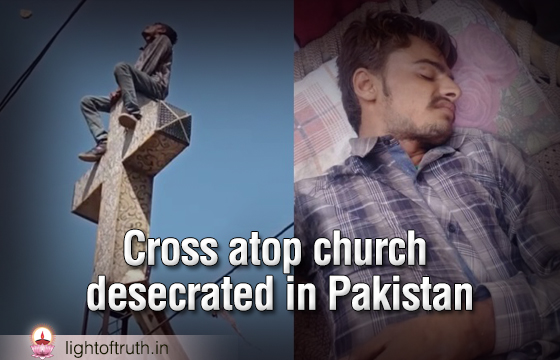
Cross atop church desecrated in Pakistan
A Pakistani Muslim youth who climbed a church roof and sat on the cross chanting “Allahu Akbar” (Allah is great) was arrested and charged with blasphemy by police in Punjab province.
Videos circulating on social media showed Muhammad Bilal mounting the cement cross standing 12 meters from the ground on the rooftop of One in Christ Church in the Hafiz Chowk area of Lahore.
“He climbed the church roof at 10 am from the adjacent lattice factory and first tried to break the cross. Later he sat on the cross and kept chanting ‘Allahu Akbar’ for half an hour,” said M.M. Akash, a local evangelist who called the police helpline.
Bilal was detained by police in Kasur district, 49 kilometres from Lahore, after a first information report (FIR) under section 295-A of the blasphemy law was registered by Akash on March 16.
“As people gathered in the street, Bilal came down. He was arrested but later released by the police after an initial investigation. The same evening we gathered at the police station to register the FIR and gave witnesses [statements] about the blasphemy in front of the super-intendent of police. Bilal was rearrested late at night,” Akash said.
Church authorities have urged the community to remain peaceful. About 400 Christian families are members of the church built in 1985.

Archbishop seeks transparent and free election in Timor-Leste
Timor-Leste, the predominantly Catholic country in Southeast Asia, goes to the polls on March 19 to elect a new president. The influential Catholic Church wants to ensure a “transparent and free” election.
Salesian Archbishop Virgilio do Carmo da Silva of Dili, in an exclusive interview, shared issues affecting the Church in the tiny country of 1.3 million people, 98 percent of them Catholics. Protestants and Muslims share the other 2 percent equally.
The Portuguese brought the Catholic faith to the nation that occupies the eastern half of Timor island in the 16th century. Indonesia occupied it in 1975 after the Portuguese Timor-Leste became a free and democratic nation after decades of struggle for independence after an UN-sponsored referendum at the beginning of the current millennium. But two decades after political freedom, the nation continues to face crippling poverty, corruption, and political uncertainty.
Pope Francis is expected to visit the country soon amid political uncertainty that continues to threaten democratic freedoms and values. The 54-year-old archbishop says the Church — which serves Timor-Leste under three dioceses of Díli, Baucau, and Maliana — keeps reminding politicians of the need to have a free and democratic nation.
Archbishop Da Silva said: “Since it is the celebration of all, we have to avoid all attitudes that will contribute to violence and foster a friendship that will nurture freedom and respect each other during the campaigns.”

Crucifix leads an Indonesian Muslim to Catholic faith
Vicky Adam Ubaid Akram had a dream that helped him choose the Catholic faith.
In the dream, he walked in an alley that had many houses of worship including mosques, temples and churches on both sides. But his eyes remained fixated on a Catholic church with a cross on top.
He then fell down and woke up from his sleep. “In that falling position, I looked up again and my eyes were still on the crucifix,” he recalled.
Protestant churches normally do not display a crucifix — a cross with an image of Christ’s body on it — but prefer only a simple cross.
Vicky soon began to read more about Catholicism. “The more I knew, the more interested I became,” he said. Jesus’ teaching about the law of love as “the first and foremost law” was deeply touching, he said. “I really like that part, which for me is the key to being a good human being,” he recalled.
Gradually, Vicky began to visit the Catholic church in Ma-lang. The 24-year-old had grown up in a devout Muslim family in Malang in Indonesia’s East Java, a predominantly Muslim province.
Just like his father, Vicky strictly followed Islamic rituals such as praying five times a day. But three years ago he first felt “a spiritual dryness” and lost interest in his family’s religion.
“In 2018 while I was studying in college, I began to feel that I could not find peace when carrying out Islamic religious rituals such as praying,” he said.
He even began to feel that Islam was ineffective in “communicating with God and finding him peace” and began to search for other religions.
That was when Vicky turned toward Christianity, his mother’s former religion. A Protestant Christian, she had converted to Islam to marry his father and ever since followed Islamic precepts strictly.
Islamic customs and traditions were strong in Vicky’s family, just like most families in the province, where 94 percent of its 39 million people are Muslims.
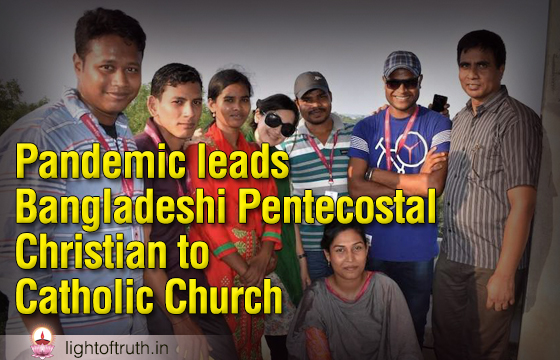
Pandemic leads Bangladeshi Pentecostal Christian to Catholic Church
Kaushik Hembrom lost his job as a computer operator with an insurance company in Bogura city of northern Bangladesh due to the Covid-19 pandemic.
The 35-year-old Pentecostal Christian was forced to return to his native village Dighalchan in neighboring Dinajpur district where he spent more than a year confined to his house without any spiritual assistance.
He would watch his Catholic neighbors attend their parish church and receive pastoral care from priests throughout the protracted lockdown. But he and his family members had no church or prayer meeting to attend in the locality.
Hembrom approached the parish priest of St. Francis of Assisi Church in Dhanjuri under Dinajpur Diocese and expressed his desire to join the Catholic Church.