

Yoon Suk-yeol, a conservative former top prosecutor, was declared winner in South Korea’s presidential polls on March 10, defeating a liberal rival in one of the most closely fought polls in the country’s history.
With more than 98 percent of the ballots counted, Yoon managed to secure 48.6% of votes against his rival Lee Jae-myung’s 47.8%. Both candidates spent months mocking and demonizing each other in a bitter political campaign.
Yoon will take office in May as leader of the world’s 10th-largest economy to serve a single five-year term.
In his first public action, after he became the presidential candidate for the People Power Party last October, he visited Yoido Full Gospel Church in Seoul on a Sunday, sang hymns and prayed with the congregation. Media reports said the move was to attract Christian votes and silence critics who said he followed shamanism.
He was baptized with the name Ambroise in the Catholic Church but he does not practice his faith life in any parish community, according to Church sources.
Christianity has emerged as the largest religion in South Korea and is followed by some 28% of its 51 million people, according to the 2015 national census. A larger group, some 56%, follows no religion at all. Some 15% follow Buddhism, making it the second-largest religion in the country.
In the run-up to the election, Yoon promised to deal sternly with provocations by North Korea and to boost trilateral security ties with Washington and Tokyo.
Daily Archives: March 15, 2022

Myanmar conflict turns 16 parishes into ghost towns
Some 16 parishes in Loikaw Diocese in Myanmar’s Kayah state have been totally abandoned with the escalation of the conflict between military and rebel forces.
The green and mountainous eastern region bordering Thai-land was relatively peaceful for decades but has seen intense fighting since May 2021.
Parish priests, nuns and parishioners from these parishes have fled to safe areas, according to church officials.
Nearly two-thirds of the 90,000 Catholics in Kayah state have been forced to flee their homes, they added.
The junta has unleashed airstrikes and artillery shelling, forcing thousands of people including women, children, the elderly and the infirm to flee their homes to seek refuge in nearby jungles or churches in neighboring villages and towns.
At least seven Catholic churches have been hit by artillery shelling and airstrikes by Myan-mar’s military in Loikaw Diocese, with 16 out of 38 parishes severely affected by the intensifying fighting.
More than 650 houses and other civilian properties including churches, monasteries and schools have been burned or destroyed in Kayah since May 2021, according to reports cited by the UN.
Meanwhile, some parishes in Pekhon Diocese that covers Shan state and border areas of Kayah state have also been affected by the conflict.
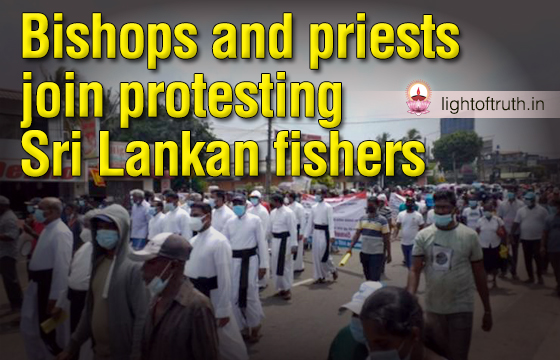
Bishops and priests join protesting Sri Lankan fishers
Bishops and priests joined fisher people in Sri Lanka on March 3 to demand protection of their livelihoods from destructive development projects that were harming the coast and the sea. Sebastian Fernando, a leader of local fishers, said: “The sea bed has been eroding for years. The people are constantly complaining but the authorities have not paid attention to their demand for a permanent solution.”
He said the sand being pump-ed to fill the east and west jetties of Colombo port was having a huge impact on fishing in the country. Seaweed and ornamental fish are greatly affected.
“The disaster-struck X-press Pearl ship also caused great damage to our marine environment but fishermen did not receive fair compensation,” said Fernando, referring to the environmental disaster unleashed by a cargo ship carrying chemicals that caught fire off the coast of Sri Lanka in May 2021.
Several containers have washed ashore from the X-press Pearl and nitrogen oxides have been released into the air and sea in large quantities, exposing the island nation to acid rain in the future, say experts.
Environmentalists have warn-ed that the chemicals inside the containers could enter the sea-water and pose a threat to the marine life system in the short and long term. The Catholic Church in Sri Lanka has repeatedly urged the government to compensate fishing families for their loss of livelihood and restore the environment.

China tightens grip on Hong Kong’s education system
School education, the last bastion of the pro-democracy movement in Hong Kong, is falling asunder like the beads of a broken necklace.
The blood-red flag with five yellow stars flutters in the air on campuses in Hong Kong as it did in mainland China following the Tiananmen Square protest in 1989.
Students in Hong Kong are getting familiarized with patriotism with Chinese characteristics because there are still black sheep in universities and schools whose capitalist hearts have to be won over before they initiate the long march to socialism.
University and high school students made up the majority of protesters in 2019 and teenagers represented almost a fifth of the 10,000 arrests made as part of the crackdown, according to data by Bloomberg.

A karate trainer’s journey of faith in Hong Kong
Eddie Lo grew up in a religionless Chinese family and never considered practicing a religion despite his schooling under Catholic priests and brothers. But the Covid-19 pandemic and Hong Kong’s democracy struggle helped him change.
The 55-year-old professional karate trainer says “the seed of faith” he received at Hong Kong’s St Antony’s Primary School, run by the Salesians, has matured after four decades.
He is now a catechumen preparing to be baptized Ignatius Lo on Easter Saturday in St. Patrick’s Parish in Lok Fu under Hong Kong Diocese.
Lo is among some 1,550 adults under-going catechumen classes in 52 parishes and territories of the diocese, readying themselves to be baptized this Easter season.
Each year several thousand adults join Hong Kong Diocese. During Easter 2019, before the pandemic hit, some 2,800 adults were baptized. The number of adult baptisms has dwindled since then.
Lo grew up in a traditional family “with Dad and Mum following Confucius thinking but without any religion,” he recalled. He followed no religion until a year ago.
The isolation of the pandemic restrictions and the chaos of Hong Kong’s pro-democracy campaign guided him to the Catholic Church, he says.
As a martial arts trainer, his focus was on physical energy and techniques to control mind and body. But social disruption since 2019 as well as the pandemic made him “think and feel differently, especially with my students.”
Lo recalls that he was “harsh and tough” with his students to help them win competitions and gain recognition.
“But after what happened in Hong Kong, I began to appreciate young people with independent thinking and changed the way I teach them,” he says.
Young university students have been spearheading the pro-democracy movement with thousands taking to the streets protesting what they called their shrinking freedoms. It continued until the Chinese government suppressed protests with a sweeping new security law in June 2020.
As Covid-19 lockdowns and isolation continued, Lo wanted a change. He began to think about the meaning and purpose of life and even tried new things like making bread and practicing iaido, a Japanese martial art. “At the same time, I wanted someone to guide me for the future. I began to think that I needed more mental support and someone to rely on,” he says.

Indian pastor accused of converting tribal people
A Hindu organization has been joined by a Sikh group in demanding the arrest of a pastor for organizing faith-healing sessions to lure tribal people into Christianity in the eastern Indian state of Jharkhand.
The Vishwa Hindu Parishad (VHP) or World Hindu Council accused Pastor Ravi Singh and his wife of conducting a Changai Sabha (healing ministry) from their home in Nanak Nagar in Jamshedpur city’s Golmuri area.
The VHP and a Sikh organization, Jhar-khand Gurdwara Management Committee, staged a protest against Pastor Singh on Feb. 27 and accused Chief Minister Hemant Soren of failing to take action against him
Media reports said state police briefly detained Pastor Singh that day but released him in the evening.
Ratan Tirkey, a member of the Jharkhand government’s tribal advisory council, denied the allegations of religious conversions against the pastor.
“As per information from our sources, Pastor Singh embraced Christianity some time back and is involved in spreading awareness among the youth about the importance of education and their rights,” he told.
“Pastor Singh is being misunderstood by Hindu activists as a missionary indulging in religious conversion activities. We have no information about his converting anybody.”
He said Hindu activists often accuse Christian missionaries of conversion activities without any basis or proof. “The VHP and other fanatic groups need to read the constitution of India to know about religious freedom granted to the citizens of this country,” the Catholic lay leader said.
Tirkey said Christians would not be a small minority group in Jharkhand if conversions were rampant as alleged by the Hindu organizations.

Dalit woman is youngest mayor of India’s Chennai city
Priya Rajan, a Dalit woman, has become the youngest mayor of Chennai, the fourth-largest city in India with a population of around 10 million. Rajan, 28, a postgraduate in commerce, was sworn in on March 4 as the 49th mayor of the city.
She is said to be a member of the Evangelical Church of India (ECI), which has congregations in at least 10 states.
Welcoming the appointment, Father Vincent Chinnadurai, the former spokesperson of the Tamil Nadu Bishops’ Council, said it was a remarkable moment for Dalit women.
“We appreciate the state government for this bold move. I am sure more women will feel inspired by Priya Rajan,” he added.
Chennai, the state capital of the southern state of Tamil Nadu, is a hub for education, health, information technology and automobile industries.
Considered the second-oldest city council in the world after London, the Greater Chennai Corporation was formed in 1668 by the erstwhile East India Co-mpany, which founded it in 1640 as a trading post.
The state’s ruling DMK (Dravida Munnetra Kazhagam or Dravidian Progressive Front) under the leadership of Chief Minister Muthuvel Karunanidhi Stalin, 68, won a landslide victory in the polls held on Feb. 19 after a gap of 11 years.

Indian probe against Mother Teresa nuns falls apart
The much-publicized case of religious conversion against Missionaries of Charity (MC) nuns in India’s western state of Gujarat has come a cropper with the prosecution admitting there was no serious basis to proceed against them. The prosecution gave a written undertaking to a court in Vadorara city that it would not pursue the case any further, although the first information report written by police to set the investigation in motion has yet to be quashed.
The prosecution’s undertaking meant an end to the adverse publicity and unnecessary harassment of the nuns from the Kolkata-based organization founded by Mother Teresa which ran a shelter home for the destitute in Vadodara.
In a related development, the court also dropped the hearing of an anticipatory bail application filed by two MC nuns, who did not want to be identified, ending their nearly three-month ordeal to avoid likely arrest for a crime they never committed.
“Indeed it is happy news and vindication of our stand from the very beginning,” said Father Cedric Prakash, a Jesuit priest and rights activist based in Gujarat.
He confirmed that the local court decided to drop the legal proceedings on March 3 after the government prosecutor admitted in writing that there was no serious basis to proceed against the nuns.
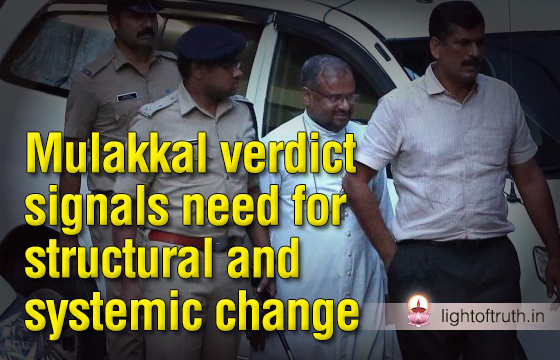
Mulakkal verdict signals need for structural and systemic change
The verdict acquitting Bishop Franco Mulakkal in the much-awaited case of the sexual abuse of a religious sister has been disappointing to many of us, and has made us suspicious.
“I write this for many reasons; first, because I have journeyed with this case from a distance; and because I feel the need for speaking up in defense of our sisters, and sounding a wake-up call for us as women religious.” Wrote Dorothy Fernandes
What has pained me more than anything else is that some women religious that I know have rejoiced about the verdict of acquittal of a Bishop who was accused of nothing less than rape — and worst of all, he happens to be the patron of that local congregation. We all know now that at Kottayam the Additional District and Sessions Court Judge G. Gopakumar acquitted Franco.
Some women religious raise very naive questions: Why was she silent for all these years? Why was there such a delay in reporting the crime? I am afraid those who say that lack empathy and can’t imagine the trauma she has been going through. As women religious, some think: “He is a Bishop — he obviously cannot do it!” Wait a minute, he is also a human being, a man invested in power.
For too long we women in the church have accepted dominance and hierarchy and never questioned this because of the socialization processes we have gone through. Right from our childhood and into our teens we have been taught to accept everything without questioning. Because “they” know and you don’t; this is internalized and every institution in our society has reinforced this belief.
I know that a very small number of sisters in India have moved out of institutions and are living among or working with those on the periphery. I have been living by myself for more than two decades in Patna, and many priests who know me say “not everyone can be like you.” As if finding my space was so easy! I have often been perceived as “aggressive,” and my responses are “assertive.” So – it seems our institutional church does not want assertive women.”
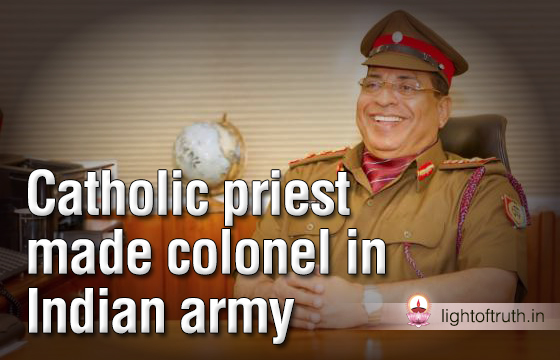
Catholic priest made colonel in Indian army
A Carmelite of Mary Immaculate priest was on February 26 conferred the honorary title of Colonel Commandant by the federal Ministry of Defense.
Father Abraham Mani Vettiankal, who serve as the vice chancellor of the Christ University in Bengaluru is the first Indian Catholic priest to get the honour for his outstanding contributions to the promotion of National Cadet Corps and National Service Scheme in the Christ University in the past decade.
The official piping was performed by Lt General Gurbirpal Singh, the director general of NCC at a ceremony conducted at the Parachute Regiment Training Center, Bengaluru, the capital of the southern India state of Karnataka.
Awarding this honor, Singh said the recognition was conferred to Father Abraham in recognition of being the first university in the country to introduce NCC as a credit course and for promoting its students to join the Indian Defense Service.
“The Christ University has promoted NCC as a priority program resulting its members joining the armed and paramilitary forces in significant numbers as well as for providing infrastructure and facilities for NCC training at the University Campus,” said the director general.