
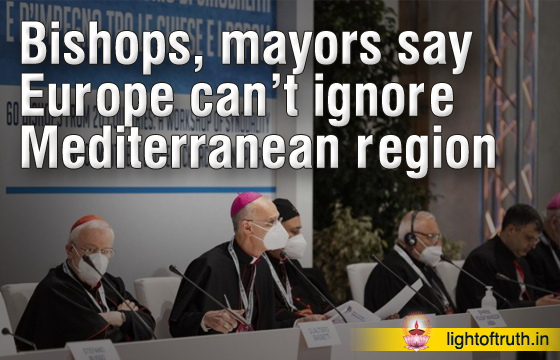
Due to acute knee pain, Pope Francis will be skipping this Sunday’s foray into the Italian city of Florence, where he was scheduled to close a summit that brought together bishops and mayors of the Mediterranean to discuss migration.
The announcement, made by the Vatican’s press office, came minutes before a previously scheduled press conference in Florence with a handful of those taking part in the February 23-27 symposium titled “Mediterranean, border of peace.”
“I could hear a two-folded pain from him: For his knee, but also for having to miss this encounter,” said Cardinal Gualiero Basetti, president of the Italian bishops’ conference that is organizing the summit.
Cardinal Giuseppe Betori, archbishop of Florence, urged those who have tickets to still take part in the celebration: “This will be a sign of our affection for the Holy Father. It was with him that we wanted to pray and we will pray with him, albeit with a contact of the heart and not with the gaze that sees him physically close to us. But he is no less close to us, with his person and his concern for the Mediterranean, especially in this moment of great crisis.”
Spanish Cardinal Cristobal Lopez, Archbishop of Rabat, Morocco, said that people often find it easy “to speak about our rights, yet it is difficult for us to speak about our duties. We speak about having a right to an education, but we do not fulfil the duty to provide that education.”
The church he leads is incredibly small: There are estimated 50,000 Catholics in Morocco; most of whom are foreigners coming from Europe and Sub-Saharan Africa. “We are a church made of foreigners, but we do not want to be a foreign church.” Having said this, he identified five duties that arose so far during the summit and are applicable both in the community he leads and in the rest of the region.
Daily Archives: March 2, 2022
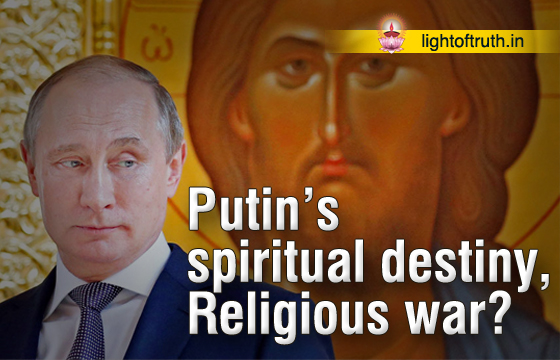
Putin’s spiritual destiny, Religious war?
Threatened by an uprising of his treacherous generals, the Christian Emperor Basil II, based in the glorious city of Byzantium, reached out to his enemies, the pagans over in the land of the Rus. Basil II was a clever deal maker. If Vladimir of the Rus would help him put down the revolt, he would give him the hand of his sister in marriage. This was a status changer for Vladimir: the marriage of a pagan to an imperial princess was unprecedented. But first Vladimir would have to convert to Christianity.
Returning to Kyev in triumph, Vladimir proceeded to summon the whole city to the banks of the river Dnieper for a mass baptism. The year is 988. This is the founding, iconic act of Russian Orthodox Christianity. It was from here that Christianity would spread out and merge with the Russian love of the mother-land, to create a powerful brew of nationalism and spirituality. In the mythology of 988, it was as if the whole of the Russian people had been baptised. Vladimir was declared a saint. When the Byzantine empire fell, the Russians saw themselves as its natural successor. They were a “third Rome”.
At the heart of this post-Soviet revival of Christianity is another Vladimir. Vladimir Putin. Many people don’t appreciate the extent to which the invasion of Ukraine is a spiritual quest for him. The Baptism of Rus is the founding event of the formation of the Russian religious psyche, the Russian Orthodox church traces its origins back here. That’s why Putin is not so much interested in a few Russian-leaning districts to the east of Ukraine. His goal, terrifyingly, is Kyev itself.
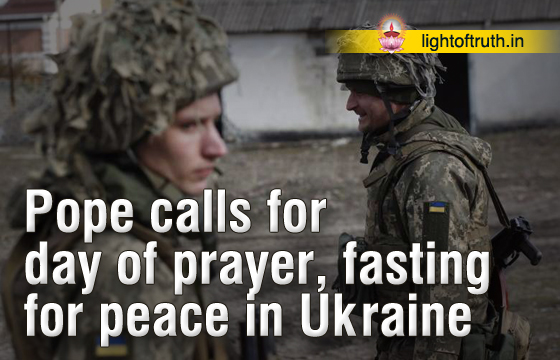
Pope calls for day of prayer, fasting for peace in Ukraine
As the threat of war loomed over the world, Pope Francis called on people to pray and fast for peace in Ukraine on Ash Wednesday.
Before concluding his general audience on Feb. 23, the pope called on believers and non-believers to combat the “diabolical insistence, the diabolical senselessness of violence” with prayer and fasting.
“I invite everyone to make March 2, Ash Wednesday, a day of fasting for peace,” he said. “I encourage believers in a special way to devote themselves intensely to prayer and fasting on that day. May the Queen of Peace protect the world from the folly of war.”
In his appeal, the pope said he, like many around the world, felt “anguish and concern” after Russian President Vladimir Putin recognized the independence of the eastern Ukrainian regions of Donetsk and Luhansk.
The pope said that due to the “alarming” developments in the region, “once again, the peace of all is threatened by partisan interests.”
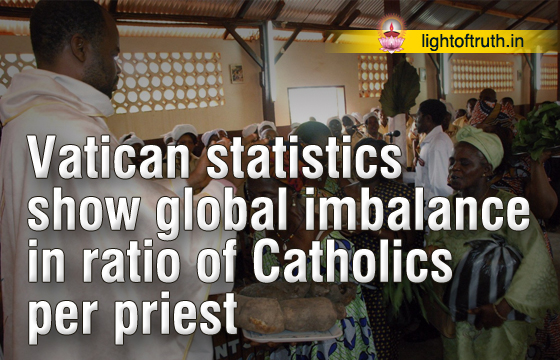
Vatican statistics show global imbalance in ratio of Catholics per priest
The number of Catholics and of Catholic men and women who devote their lives to serving them continues to grow in Africa and Asia, Vatican statistics show, but pastoral ministry is still much more readily available to Catholics in Europe.
At the end of 2020, the number of Catholics in the world reached 1.36 billion, an increase of 16 million over the previous year, according to the Vatican’s Central Office of Church Statistics, which published a brief overview of the global numbers in early February. While Catholics remained about 17.7% of the global population, their numbers grew in Africa by about 2.1% and in Asia by 1.8% while in Europe the increase was just 0.3%, said the summary, which was based on numbers reported Dec. 31, 2020. And while just over 20% of the world’s Catholics live in Europe, 40% of the world’s priests minister there. The Americas have 48% of the world’s Catholics, but only 29.3% of the world’s priests.

Make no Mistake, if There’s a War Between Russia and Ukraine, it Will be a Religious War
Putin has now ordered Russian troops into Donetsk and Luhansk. The first major conflict between two Orthodox Christian nations since the War of the Stray Dogs in 1925 has likely just begun. That conflict (the resolution of which was incidentally perhaps the only significant accomplishment of the League of Nations) was clearly and plainly a territorial dispute. On its surface so is the current conflict in Ukraine. But appearances can be deceiving. Make no mistake about it, if there is a war between Russia and Ukraine, it’ll be a religious war. The sooner those in the West recognize this reality and catch up on the details the better.
There is a very recent precedent for this. In the early part of this century, in the aftermath of 9/11, the rise of Islamic fundamentalism was—quite justifiably to be clear—given a significant amount of attention. At the same time, many rushed to assure the world that those young men who flew planes into buildings and stoned unveiled women in the street, did not represent “the real Islam.”
Far fewer made the much more accurate observation that both Osama bin Laden and Abdolkarim Soroush represent real and legitimate positions within Islam, be-cause traditions are complicated and people with vastly differing worldviews can believably lay claim to the same historical community. If you need further proof of this, remember that both Greg Locke (who believes witches have infiltrated his church) and leshia Evans (who peacefully stared down police at a protest of the killings of Alton Sterling and Philando Castile) are both devout Christians.
This reality sometimes leads to conflict, particularly in historical epochs characterized by significant change and instability. Western Christianity saw its tensions boil over during the Protestant Reformation and the subsequent Counter-Reformation, which not only resulted in permanent fissures within Western Christendom, but the Thirty Years’ War, which killed between 25% and 40% of the entire German population. Modern Russia also has designs on Africa, where it seeks to compete with China and the Western powers for influence on a continent of natural resources and growing markets. And there’s little doubt that Russia has, in recent years, sought increasingly to use the Russian Orthodox Church as an instrument of foreign influence: in Ukraine, Serbia, Western Europe, and the United States. A tactic only made possible by the Patriarchate of Moscow’s desire to establish itself as the leader of the conservative Orthodox cause.