
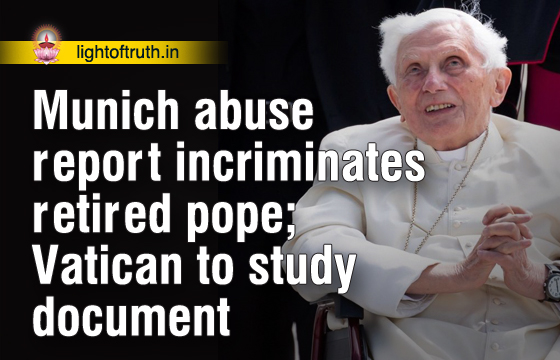
A law firm’s report on how abuse cases were handled in the Archdiocese of Munich and Freising incriminated retired Pope Benedict XVI, with lawyers accusing him of misconduct in four cases during his tenure as Munich archbishop.
Lawyer Martin Pusch of the law firm Westpfahl Spilker Wastl said the retired Pope had denied wrongdoing in all cases, reported the German Catholic news agency KNA.
Pusch expressed doubt about Pope Benedict’s claim of ignorance in some cases, saying this was, at times, “hardly reconcila-ble” with the files.
At the Vatican, Matteo Bruni, director of the Vatican press office, said, “The Holy See believes it has an obligation to give serious attention to the document” on cases of abuse in the Archdiocese of Munich and Freising, but it has not yet had a chance to study it.
“In the coming days, following its publication, the Holy See will review it and will be able to properly examine its details. Reiterating its sense of shame and remorse for the abuse of minors committed by clerics, the Holy See assures its closeness to all victims and confirms the path taken to protect the youngest, ensuring safe environments for them,” Bruni said.
From 2001, when St. John Paul II charged the Congregation for the Doctrine of the Faith — headed by then-Cardinal Joseph Ratzinger — with the authority to take over cases from local bishops for investigation, Pope Benedict was aware of many examples of abuse. It was his office in 2003 that expedited the process for laicizing priests guilty of sexually abusing minors.
Although he mostly stayed out of public view in retirement, in April 2019 the former Pope published what he described as “notes” on the abuse crisis, tracing the roots of the scandal to a loss of a firm faith and moral certainty that began in the 1960s. The church’s response, he insisted, must focus on a recovery of a sense of faith and of right and wrong.
The Munich investigation followed two years of research and covers the period from 1945 to 2019, centering on who knew what about sexual abuse and when, and what action they took, if any, KNA reported. The report identified 497 victims and 235 abusers, but the lawyers who conducted the study say they’re convinced the real numbers are much higher.
Four volumes with almost 1,900 pages comprise the “litany of horror” that lawyers presented. They spoke of the “total failure” of a system, at least until 2010.
Daily Archives: February 1, 2022
Bishop says Amazon Synod did little to tackle sacramental crisis in region
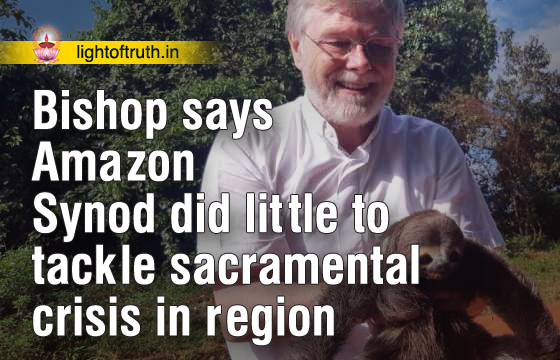
Bishop Eugenio Coter, an Italian who has been a missionary in Bolivia’s Amazon region since 1991, has a great sense of hu-mour: You ask him for a picture of himself, and he sends one in which he is holding a sloth.
Coter has been leading the Apostolic Vicariate of Pando since 2011. It’s a 64,000 square mile region with 260,000 inhabitants, 60,000 of whom live in 450 communities deep within the Amazon rainforest. To go from one community to the other, clergy and religious use small planes, boats, jeeps and motor-cycles.
The bishop spends a month a year living on a boat, but he says that is “fortunate,” since during most pastoral visits, he ends up staying in a tent or someone’s shed.
The primary source of inco-me for the inhabitants of this region come from the jungle, with almonds, plantains, acai and other fruits being the main products.
However, Coter says there are other “industries” of a more criminal nature, including “the seasonal trafficking in human beings,” a criminal endeavour that spiked in 2020 when thousands of Haitians and Cubans entered the region — they trek from Guyana, walking through Brazil and Bolivia as they head to Chile. The “coyotes” the bishop said, take advantage of the migrant’s desperation. Some of these criminals double as drug traffickers, another illegal industry in the Pando region.
South Sudan bishop’s initiative helps eliminate need for cattle raids
In a country at war, it’s a region at peace, thanks to a retired South Sudanese Catholic bishop who has championed friendship among those who once saw each other as enemies.
During the civil war between southern Sudanese and the government in Khartoum, Sudan, Bishop Paride Taban was bishop of Torit, working to keep people alive in the middle of a decades long struggle. Though imprison-ed and beaten by Sudan People’s Liberation Army rebels, he bore no grudges and worked to foster reconciliation when the rebels took power following a landmark 2005 peace agreement.
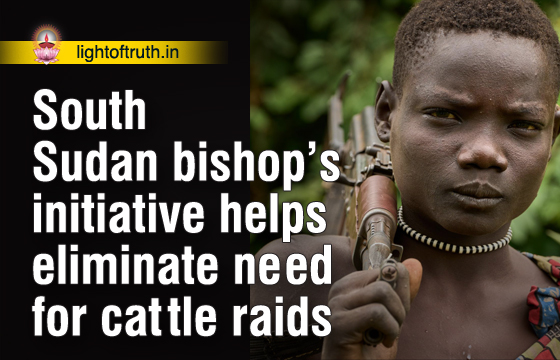
But Bishop Taban knew political agreements signed by politicians weren’t going to make much difference on the ground, especially among the nomadic pastoralists in his diocese who viewed other tribes as enemies, competitors for the only real thing of value in the parched landscape: cattle. The age-old tradition of cattle raiding, essentially a violent sport that allowed young men to obtain the cows they needed to buy a bride, had been transfor-med by the addition of high-powered weapons left over from war. What had once produced only occasional injuries from spears now frequently turned into a massacre.
In 2004, Bishop Taban resigned as head of the Torit Diocese. The following year he founded Holy Trinity Peace Village in Kuron, where, as bishop, he had built a bridge over a river that was impassable during the rainy season. While the bridge opened up transport to a neglected area of the country, it posed a dilemma.
Retired pope urged to make statement on German abuse report
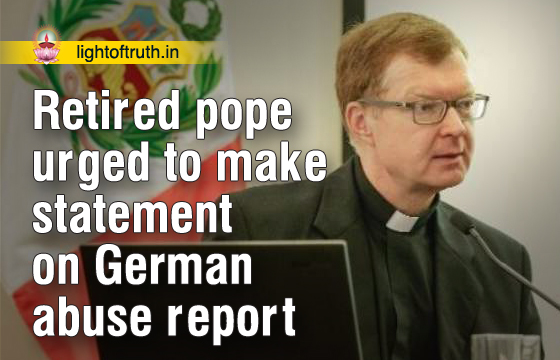
Following the publication of an experts’ report on how sexual abuse was handled in the Archdiocese of Munich and Freising, the German Catholic news agency KNA spoke to Jesuit Father Hans Zollner, a member of the Pontifical Commission for the Protection of Minors since its creation and president of the Institute of Anthropology: Interdisciplinary Studies on Human Dignity and Care at Rome’s Pontifical Gregorian University. Father Zollner said, “Each one individually should take a concrete, perceptible and understandable position and signal that they understand. The lawyer (Marion) Westpfahl said some-thing that I also noticed in my discussions with theologians: Church representatives give the impression that they do not believe in the power of the sacra-ment of reconciliation – the confession – when they deal with the sins and failures of those in position of responsibility. Examination of conscience – in this case: the experts’ report – confession, repentance and an act of compensation: All these are, according to classic Catholic teaching, a condition for forgiveness. This is true for individuals, but also for dioceses and bishops’ conferences.”

The 50 Countries Where It’s Hardest to Follow Jesus in 2022
Afghanistan is the new No. 1, according to the 2022 World Watch List (WWL), the latest annual accounting from Open Doors of the top 50 countries where it is most dangerous and difficult to be a Christian.
“This year’s findings indicate seismic changes in the persecution landscape,” said David Curry, president of Open Doors USA.
Since Open Doors began its tally in 1992, North Korea has led the ranking. But since Afghanistan’s takeover by the Taliban last August, Afghan believers have had to leave their country or relocate internally. Many lost everything they had, notes the report, while house churches were closed in their wake. “Before the Taliban, it was not great, but it was good,” said one evacuated Afghan, requesting anonymity in hopes that he may one day return. “[Now] Christians are living in fear, in secret, totally underground.”
Overall, 360 million Christians live in nations with high levels of persecution or discrimination. That’s 1 in 7 Christians worldwide, including 1 in 5 believers in Africa, 2 in 5 in Asia, and 1 in 15 in Latin America.
Last year, for the first time in 29 years of tracking, all 50 nations scored high enough to register “very high” persecution levels on Open Doors’ 84-question matrix. This year, all 50 again qualified—as did 5 more nations that fell just outside the cut-off. overall, the top 10 nations only shuffled positions from last year. Somalia held steady at No. 3, as did Libya at No. 4, Eritrea at No. 6, and India at No. 10. Yemen rose two spots to No. 5, replacing Pakistan which fell three spots to No. 8. Iran fell one spot to No. 9, and Nigeria rose two spots to No. 7, completing the group.
Violations of religious freedom in Nigeria are tied to a rapidly growing Islamist presence in the African Sahel. Mali rose to No. 24 from No. 28, and Open Doors fears it may increase further next year. Burkina Faso held steady at No. 32, and Niger jumped to No. 33 from No. 54. Nearby, the Central African Republic (CAR) rose to No. 31 from No. 35.
“The epicenter of international jihadism is now [in] the Sahel area,” said Illia Djadi, Open Doors senior analyst for freedom of religion and belief for sub-Saharan Africa. “This terrorism is moving south … and predominantly Christian countries like Benin, Togo, Ghana, Ivory Coast are now affected.” (None rank on the watch list.) Countries with Christian majorities rank relatively low in the top 50, and include Colombia (No. 30), Cuba (No. 37), Ethiopia (No. 38), the Democratic Republic of the Congo or DRC (No. 40), Mozambique (No. 41), Mexico (No. 43), and Cameroon (No. 44).
Of the top 50 nations:
11 have “extreme” levels of persecution and 39 have “very high” levels. Another five nations outside the top 50 also qualify as “very high”: Kenya, Sri Lanka, Comoros, United Arab Emirates, and Tanzania.
· 18 are in Africa (6 in North Africa), 29 are in Asia, 10 are in the Middle East, 4 are in Central Asia, and 3 are in Latin America.
· 34 have Islam as a main religion, 4 have Buddhism, 2 have Hinduism, 1 has atheism, 1 has agnosticism—and 10 have Christianity.

Dozens of Chinese warplanes fly near Taiwan after US-Japan show of naval might
Hong Kong (CNN) China sent 39 war-planes into Taiwan’s air defence identification zone (ADIZ) on January 24, Taiwan’s Defence Ministry said, the largest such incursion this year.
The flights by the People’s Liberation Army aircraft came a day after the United States and Japanese navies put on a massive show of force in the Philippine Sea, putting together a flotilla that included two US Navy aircraft carriers, two US amphibious assault ships and a Japanese helicopter destroyer, essentially a small aircraft carrier.
Two US guided-missile cruisers and five destroyers were also part of the exercise. The Philippine Sea is the area of the Pacific Ocean east of Taiwan, between the self-ruled island and the US territories of Guam and the Northern Mariana Islands. The Navy did not say how close the flotilla was to Taiwan.
Aircraft fly over a US-Japan naval flotilla that included two US aircraft carriers in the Philippine Sea on Saturday.
“Freedom at its finest! Nothing reaffirms our commitment to a #FreeandOpenIndo Pacific like 2 Carrier Strike Groups, 2 Amphibious Ready Groups sailing alongside our close friends from the Japan Maritime Self Defense Force,” Vice Adm. Karl Thomas, commander of the US 7th Fleet based in Japan, said in a tweet.
A US Navy statement said the mass of warships was “conducting training to preserve and protect a free and open Indo-Pacific region.”
Taiwan’s President: Threat from China is growing every day (October, 2021) 07:32
Taiwan and mainland China have been governed separately since the defeated Nationalists retreated to the island at the end of the Chinese civil war more than 70 years ago.
But China’s ruling Chinese Communist Party (CCP) views the self-ruled island as part of its territory — despite having never controlled it.
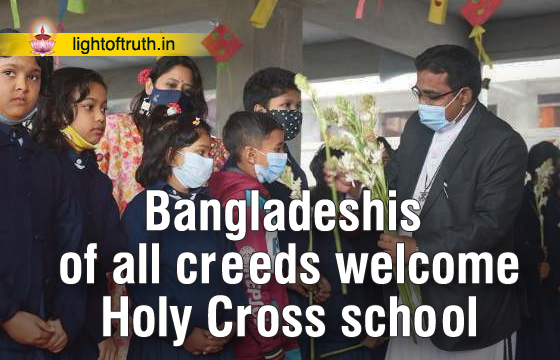
Bangladeshis of all creeds welcome Holy Cross school
A missionary-run school and college in Rajshahi city launched more than 30 years after the establishment of the Catholic diocese is committed to imparting human values as well as offering a solid academic education to Bangladeshi students.
Holy Cross Brothers, well known for their education apostolate, officially started their new ministry in Rajshahi on Jan. 18 with the aim of providing an inclusive education, welcoming new students at Holy Cross School and College in Rajsha-hi Diocese.
The educational institution started its journey with 106 students as the first Catholic missionary-run school and college in Rajshahi metropolitan city. Initially, it is admitting stu-dents at nursery, kindergarten, first, third, fourth and sixth gra-des but it will be gradually up-graded to 12th grade.
“Our first consideration is to ensure that pupils can learn in an open and student-friendly envi-ronment so that they can learn values. We want students to be 100% free from private depend-ence and attend class 100%,” said Brother Placid Rebeiro, principal of the institute.
“Students can learn leader-ship through humanitarian, moral development and extracurricular activities. In a word, we want to ensure an environment in which a fully fledged human child grows up, and we are committed to that.”

Laotian Catholics honour first lay martyr with new church
Catholic faithful in Laos joined clergy and religious to celebrate the dedication of a new church to the first layman from the ethnic Hmong community who was martyred for his faith six decades ago.
The church was dedicated to Blessed Paul Thoj Xyooj at Ban Nam Gnam village in Thulakhom district of Vientiane province, reported Fides new agency.
Born in 1941, Paul Thoj Xyooj was a Laotian teacher and catechist. He was killed by com-munist guerrillas in 1960 along with Italian Oblate missionary Father Mario Borzaga.
Pope Francis proclaimed them martyrs in 2015. Both were beatified on Dec. 11, 2016, along with 15 other martyrs by the pope’s special envoy, Oblate Cardinal Orlando Quevedo, archbishop of Cotabato in the Philippines, in Laotian capital Vientiane.
According to the Oblates of Mary Immaculate (OMI) congre-gation, communist forces killed 17 Catholics between 1954 and 1970: a young Laotian priest, five priests of the Paris Foreign Missions Society (MEP), six OMI priests (an Italian and five French) and five Laotian laymen.
Italian Oblate Father Angelo Pelis, who served in Laos for years as a missionary, told Fides that consecration of the new church was presided over by Cardinal Louis-Marie Ling Mangkhanekhoun, apostolic vicar of Vientiane. Catholic priests and Laotian Catholics also attended the ceremony.
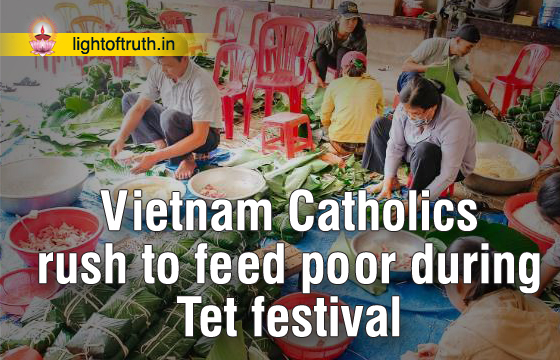
Vietnam Catholics rush to feed poor during Tet festival
Catholics in Vietnam are speeding up provision of basic food to allow people badly affected by Covid-19 to celebrate the coming Lunar New Year holiday. On Jan. 19, Caritas workers and parish council members from the parishes of Nhan Hoa and Xom Moi provided gifts for some 400 families whose members had died or lost jobs because of the pandemic, disabled people and street vendors regardless of their backgrounds. They were given money, rice, cooking oil, fish sauce, sugar, cakes and other items worth 1 million dong (US$45). Those people could not afford to get food for the five-day traditional festival starting Feb. 1.
“We are really appreciative of the generous gift from local Catholics who sympathize with our family,” Mary Vu Thi Loi said, adding that all her family members had suffered Covid-19 and her daughter had been left with partial paralysis.
Singapore Catholic charged with sexual abuse of teenagers
A court in Singapore has charged a former Catholic officer of a church-run school with committing unlawful sexual acts with at least two teenage boys more than a decade ago.
District Judge Terence Tay at the State Courts of Singapore accepted the charges on Jan. 10 but issued a ban against media revealing the identity of the accused, victims and the school involved, local media reports said. Court documents showed that the accused in his 60s had unnatural sex with a boy aged 14-16 some time between 2005 and 2006. He also committed the same act some time between April 2007 and December 2007 with a younger boy aged 14-15.
The accused faces two charges of carnal intercourse against the order of nature under Singapore’s Penal Code. He was also charged with two counts of sexual exploitation of a child or young person under the Children and Young Persons Act.
Under Singaporean Penal Code, a person convicted of each count of carnal intercourse against nature can be jailed for up to 10 years and fined.