

Vatican Secretary of State Cardinal Pietro Parolin smiles as he is welcomed by German President Frank-Walter Stein-meier for a meeting at the Belle-vue palace in Berlin, Germany on June 29, 2021. The European Commission on Tuesday Nov. 30, 2021, retracted internal communication guidelines that had proposed substituting the “Christmas period” with “holiday period” after an outcry by conservatives and the Vatican, which termed the document an attempt to “cancel” Europe’s Christian roots. Even the Vatican secretary of state, Cardinal Pietro Parolin, intervened with an unusually sharp critique.
The European Commission on Tuesday retracted internal communication guidelines that had proposed substituting the “Christmas period” with “holi-day period” after an outcry by conservatives and the Vatican, which termed the document an attempt to “cancel” Europe’s Christian roots.
The European Commissioner for Equality, Helena Dalli, said the draft document had been intended to highlight European diversity and showcase the “inclusive nature of the European Commission.” But in a statement, she said it didn’t meet Commi-ssion standards and failed to achieve its stated purpose.
“The guidelines clearly need more work,” she said, adding that a revised document would take into account concerns that had been raised.
Daily Archives: December 17, 2021

Two German bishops question church’s teaching on LGBT relationships
Two Catholic bishops in Germany, Franz-Josef Over-beck of Essen and Heinrich Timmerevers of Dresden, have called for major changes in the church’s teachings on sexual morality as part of contributions to a new book called Catholic and Queer.
Homosexual partnerships, transgender issues and diversity must be re-evaluated on the basis of new understandings of sexuality, Timmerevers wrote in the book, published this week.
For centuries, the church “misjudged people and left them alone with their situation and sensitivities and de facto put them on the side-lines,” the bishop said. “Here we have committed injustice and have also become guilty.”
In his essay, Overbeck said he rejects “the adherence to a sexual morality which, for example, wants to practically deny people who love someone of the same sex the possibility of a successful and fulfilling rela-tionship.” Bishop Franz-Josef Overbeck of Essen, Germany, is pictured in a Sept. 2, 2019.
He continued: “The life experiences and deep feelings of those who are homosexual or transgender have touched me very deeply.” Church teaching must integrate these concrete testimonies of life, Overbeck wrote.
Overbeck wrote that Pope Francis has made clear that same-sex partnerships deserve legal protection. In doing so, Overbeck said, the pope had expressed “a new form of appreciation that can be the starting point for a (local church) re-evaluation of homosexuality.”

ABp Aupetit at Paris farewell Mass: ‘I lost my life for the love of Christ’
At a farewell Mass in Paris on December 10 , Archbishop Michel Aupetit directly addressed media reports claiming that he had “lost himself for love.”
Preaching at a Mass of thanksgiving at the Church of Saint-Sulpice in the French capital on Dec. 10, the archbishop referred to a headline published by the magazine Paris Match.
“A journalist wrote ‘the archbishop of Paris lost himself for love,’” he said. “It’s true, it’s true. But she forgot the end of the sentence. The complete sentence is ‘the archbishop of Paris lost himself for love of Christ.’”
Aupetit’s words were applauded by the congregation of around 2,000 people gathered in the city’s second-largest church after Notre-Dame Cathedral.
The 70-year-old archbishop, who had a late vocation to the priesthood after working as a doctor, said: “Yesterday, I lost my life for the love of Christ when I entered the seminary. Today, I lost my life for the love of Christ. Tomorrow, I will again lose my life for the love of Christ. For I remember those words of the Lord, ‘whoever loses his life for my sake will save it.’”
Aupetit served as archbishop of Paris from his installation on Jan. 6, 2018, to December 2, when Pope Francis accepted his resignation.
He asked the Pope to decide his future after the French weekly magazine Le Point published a report portraying the archbishop as a divisive and authoritarian figure.
The report raised concerns about Aupetit’s contacts with a woman dating back to 2012, when he was vicar general of the Archdiocese of Paris. Aupetit told Le Point that he was not in a relationship with the woman.
He said: “My behaviour towards her may have been ambiguous, thus suggesting the existence between us of an intimate relationship and sexual relations, which I strongly refute … I decided not to see her again and I informed her.” Lust is not the worst of the seven deadly sins, according to Pope Francis.
“I accepted the resignation of Aupetit not on the altar of truth, but on the altar of hypocrisy.” “It was a failing against the sixth commandment (You shall not commit adultery) but not a total one, one of small caresses, massage given to his secretary — that is what the accusation is,” Francis clarified about Aupetit’s actions. “There is a sin there but not the worst kind.”
(See Focus)
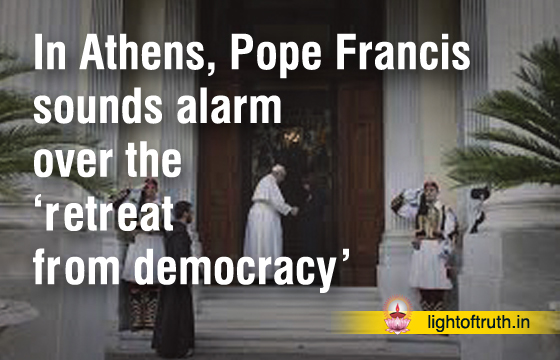
In Athens, Pope Francis sounds alarm over the ‘retreat from democracy’
As Pope Francis arrived in the birthplace of democracy on Dec. 4, he immediately sounded the alarm that democracy is under threat across the globe, as authoritarian leaders fuelled by populist and nationalistic interests are on the rise.
“Today, and not only in Europe, we are witnessing a retreat from democracy,” the pope said, warning that the common bonds of society are being severed by an increasing scepticism of institutions, hyper-individualism and partisanship — all heightened by social media that deepens divisions.
As he addressed Greece’s political leaders on Saturday, just over a mile from Athens’ iconic Parthenon, Francis kicked off his three-day visit to the nation by effectively offering a history lesson in the country’s democra-tic tradition and seeking to call Europe back to those roots.
“Democracy requires parti-cipation and involvement on the part of all. Consequently, it de-mands hard work and patience,” he said. “It is complex, whereas authoritarianism is peremptory and populism’s easy answers appear attractive.”
Over the last decade, Greece has been roiled by a severe financial crisis that plunged the country into political chaos, giving rise to both right-wing and left-wing populist move-ments that destabilized the country’s economy and nearly decimated its social programs.
In a spirited address that referenced the turmoil of recent years and one that was peppered with references to Greek philoso-phy and literature, the pope lamented how far the Western world has drifted from its heri-tage of a politics built around the common good.
A Requiem for the Disappearing Christians of Iraq, Syria, Egypt, and Gaza
“Islamic fundamentalist groups, in particular ISIS, have ravaged parts of Iraq and Syria and brought those countries’ already decimated Christian population to the verge of extin-ction. In Egypt, Christian Copts face legal and societal discrimi-nation. In Gaza, which in the fourth century was entirely Chri-stian, fewer than one thousand Christians remain.”
Sobering statistics like these set a grim backdrop for The Vanishing, war journalist Janine di Giovanni’s fearless account of what the book’s subtitle calls “Faith, Loss, and the Twilight of Christianity in the Land of the Prophets.” There can be few better suited or equipped to tell this story than di Giovanni, who has previously reported on the genocides in Bosnia, Rwanda, and Syria and is a senior fellow at Yale University’s Jackson Institute for Global Affairs.
The Vanishing is neither a chronological record of Christian withdrawal nor a geopolitical analysis of religious trends. Instead, di Giovanni offers a kind of requiem for a disappearing religious culture, a tale rendered all the more heart-wrenching for having been written during some of the worst months of the COVID-19 crisis.

For Those with Eyes to See, There Is Theological Truth in Church Architecture
God is bigger than a church building. He reveals himself to us in myriad ways: through the Bible savoured in silence or thundered in a sermon, through prayerful solitude or bread broken with others. He reveals himself in the contours of nature and whispers of wind. We do not rely on church buildings for divine encounter.
And yet churches can reveal God to us. If we pay attention.
As an architect, I am learning how to read buildings. In the same way musicians must be musically literate, architects must be architecturally literate. A musician must be constantly exposed to a range of composi-tions to develop musical literacy; an architect must engage all kinds of buildings to be able to read them. This isn’t simply a matter of naming specific styles or not-ing unique details. It’s learning to understand what statements or narratives are embedded within the design of a building.
So, I study churches. Church, of course, is a weekly rhythm of small group, choir practice, Bible study, Sunday school, and an inevitable potluck. Church is community and fellowship and belonging. More broadly, there is “one holy, catholic and apo-stolic church” that spans time and culture. But there are also these buildings that often hide in plain sight.
Embedded in every church is a theology that reminds us of our relationship to God through Chri-st. If we can learn to read the buildings architecturally, through their elevation, plan, and section, we can grasp what the structures are communicating about God.

Bahrain inaugurates Cathedral of Mary Queen of Arabia
The small Catholic commu-nity of the Emirate of Bahrain is preparing to celebrate the solemn opening of the largest Catholic Church in the Arabic Peninsula dedicated to their Patron Saint. The Cathedral of Mary Queen of Arabia will be inaugurated on December 9 – significantly, one day after the Solemnity of the Immaculate Conception – by King Hamad bin Isa Al Khalifa. It will be subsequently consecrated on December 10 by Cardinal Louis Tagle, Prefect of the Vati-can Congregation for the Evangelizations of Peoples. The consecration will be attended only by a small group of faithful, due to the COVID-19 pandemic.
The cathedral, seating 2,300 people, is located in Awali, a small town in the centre of Bahrain. The project dates back to February 2013 when King Hamad donated a 9,000 square-meter piece of land to the local Catholic community so it could build a church. The project was enthusiastically supported the then Apostolic Vicar of Northern Arabia, late Bishop Camillo Ballin, MCCI.
The new church is the second cathedral built in the Apostolic Vicariate (which includes Bahrain, Kuwait and, formally, Saudi Arabia).

France’s interior minister condemns threats against Catholics during procession
France’s interior minister on Saturday condemned threats made against Catholics taking part in a Marian procession in the western suburbs of Paris.
Gérald Darmanin deplored what he said were “unacceptable acts” during a torchlight procession in Nanterre on Dec. 8, the solemnity of the Immaculate Conception.
“Freedom of worship must be able to be exercised in all serenity in our country,” he wrote on his Twitter account on Dec. 11, expressing “support for Catholics in France.”
The French daily Le Figaro reported that on Wednesday evening around 30 Catholics were due to depart from the chapel of Saint-Joseph-des-Fontenelles on an annual procession to the parish of Sainte-Marie-des-Fontenelles, around half a mile away, along a route approved by the local autho-rities.
Jean-Marc Sertillange, a permanent deacon at Sainte-Marie-des-Fontenelles, told Le Figaro: “But shortly after 7 p.m., and while we had advanced only a few hundred meters, a band of unknown people on the path verbally attacked us at the time of the first prayer station.”
The newspaper reported that the threats included cries of “Kafirs,” an Arabic term meaning “infidels,” and “Wallah [I swear] on the Quran I will cut your throat.”
“They then threw water on us, then grabbed one of the torches which they then threw in our direction,” Sertillange said.
When the police arrived, the group of around a dozen people, with three reported ringleaders, ran away. The procession resumed, heading directly to the parish without making further stops.
Nanterre, a commune of around 97,000 people, is located in the Hauts-de-Seine department in northern France.

Pope: New meeting with Russian Orthodox patriarch possible
Pope Francis said on December 6 there were plans for a possible second meeting with the head of the Russian Orthodox Church, after their historic 2016 encounter in Cuba became a landmark in mending relations severed by the 1,000-year-old schism that divided Christianity.
Francis said he planned to meet next week with the Russian church’s foreign envoy “to agree on a possible meeting” with Patriarch Kirill. The Pontiff noted that Kirill is due to travel in the coming weeks, but Francis said he was also “ready to go to Moscow” even if diplomatic protocols weren’t yet in place.
“Because talking with a brother, there are no protocols,” Francis told reporters as he travelled home from Greece. “We are brothers. We say things to each other’s face like brothers.”
The two churches split during the Great Schism of 1054 and have remained estranged over a host of issues, including the primacy of the pope and Russian Orthodox accusations that the Catholic Church is poaching converts in former Soviet lands.

Catholic Priests Survey Finds Lower Morale, ‘Conservative Shift’ Among U.S. Clergy
A new survey released this month suggests a more “pessimistic” view of the Catholic Church among U.S. priests today as compared to 2002, as well as an increasing perception of “more theologically conser-vative or orthodox” young priests as compared to their older counterparts.
A Nov. 1 report summarized findings from the 2021 Survey of American Catholic Priests (SACP), which comprised 54 questions posed to 1,036 Catholic priests in the United States.
“If the major story of the SACP had to be summarized briefly it would be noticeable conservative shifts among U.S. priests over the last two decades coupled with a turn toward pessimism about the current state and trajectory of the Catholic Church in America,” write the report’s three resear-chers.
When asked about politics, the priests surveyed were significantly more likely to describe themselves as “conservative” as compared to respondents in 2002, the researchers say. In addition, the percentage of priest respondents overall who view younger priests as “much more conservative” than older priests increased from 29% in 2002 to 44% in the new survey.
To track changes in answers over time, the survey reused questions from a 2002 poll of Catholic priests conducted by the Los Angeles Times, and also a few questions from a survey of priests from 1970.
The priests were contacted in late 2020 via two unconnected email lists, one provided by the Official Catholic Directory and one provided by an unidentified “Catholic NGO.” Despite the small sample size, the authors say the results they garnered from the two email lists are “reassuringly similar,” both to each other, and to the 2002 results.
The researchers analyzed the data they collected, classifying each priest by his self-described political persuasion. They also classified the priests into “cohorts” based on their ordination year.
Brad Vermurlen, the survey’s co-author and a sociologist with the University of Texas at Austin, wrote in an article announcing the study that researchers observed a “relatively conservative cohort of priests ordained prior to 1960” followed by “more permissive or liberal men ordained to the priesthood in the 1960s and 70s.”