

The Vatican Congregation for the Oriental Churches has appointed an apostolic visitor for the Kerala-based Missionary Congregation of the Blessed Sacrament (MCBS).
An October 13 letter from the Apostolic Nunciature in Delhi to MCBS superior general Father Joseph Maleparampil said Rome has appointed Carmelites of Mary Immaculate Father Paul Achandy as the apostolic visiror to the 87-year-old congregation.
The appointment, done with Pope Francis’ knowledge, is “Ad Nutum Sanctae Sedis,” a Latin term meaning “at the disposition of the Holy See.” It refers to any circumstance involving a conflict of ecclesiastical jurisdiction, where Rome decides to take the matter under its own jurisdiction and reserves to itself the right to make a final judgment on the matter.
Father Achandy is currently the chancellor of the Bengaluru-Based Christ University. He is also the rector of the Dharmaram College, a major seminary managed by his congregation adjacent to the university.
The 57-year-old priest took over as the vice chancellor on September 21.
He is an alumnus of Dharmaram College and former staff of the university when it was a college. The congregation was raised to the pontifical status on December 2, 1989. The congregation has two provinces– Kottayam and Kozhikode – in Kerala and region, Satara in the western Indian State of Maharashtra.
The two places the congregation works outside the Kerala are Shimoga district in Karnataka and Satara and Solapur districts in Maharashtra. It has missions also in Rajasthan and Tamil Nadu, a residences in Italy and Germany. Its priests work in Australia, North America and the Philippines.
This is the second time this year that Rome intervenes in the administration of religious congregations in India. On May 16, the Claretian congregation replaced its Bangalore provincial with a Vatican official as the delegate of the superior general.
Daily Archives: November 3, 2020
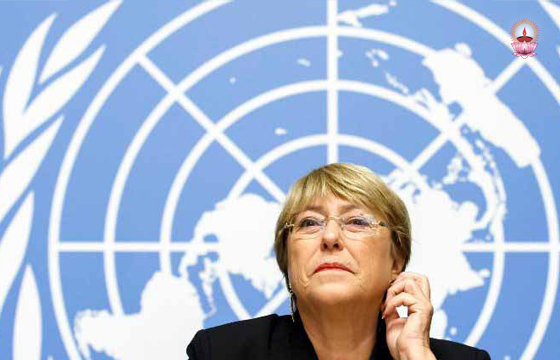
UN rights chief urges India to safeguard human rights
UN High Commissioner for Human Rights Michelle Bachelet on October 20 appealed to the Indian government to safeguard the rights of human rights defenders and NGOs, and their ability to carry out their crucial work on behalf of the many groups they represent.
Bachelet expressed regret at the tightening of space for human rights NGOs in particular, including by the application of vaguely worded laws that constrain NGOs’ activities and restrict foreign funding.
“India has long had a strong civil society, which has been at the forefront of groundbreaking human rights advocacy within the country and globally,” the High Commissioner said. “But I am concerned that vaguely defined laws are increasingly being used to stifle these voices.”
Bachelet, a former president of Chile, cited as worrying the use of the Foreign Contribution Regulation Act (FCRA), which a number of UN human rights bodies have also expressed concern is vaguely worded and overbroad in its objective. The Act prohibits the receipt of foreign funds “for any activities prejudicial to the public interest.”
The Act, which was adopted in 2010 and was amended in September this year, has had a detrimental impact on the right to freedom of association and expression of human rights NGOs, and as a result on their ability to serve as effective advocates to protect and promote human rights in India.
It is expected that the new amendments will create even more administrative and practical hurdles for such advocacy-based NGOs. Most recently, Amnesty International was compelled to close its offices in India after its bank accounts were frozen over alleged violation of the FCRA.
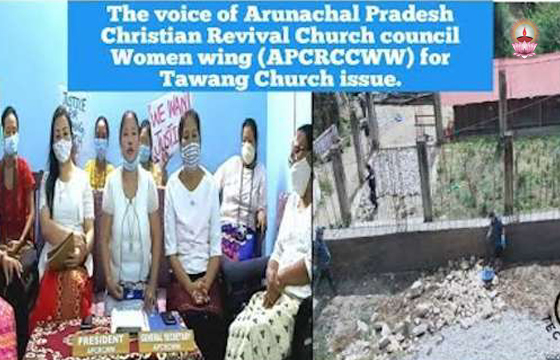
Christians angry over blocking of church construction in India
A Christian group in the Indian state of Arunachal Pradesh is mulling a protest after the state government prevented construct-ion of a church because it says it was illegal.
Arunachal Christian Forum (ACF) has asked the state govern-ment run by the pro-Hindu Bha-ratiya Janata Party (BJP) to qui-ckly resolve the issue in Buddhist-majority Tawang town.
“The present government says that the church is illegal as it is on public land, referring to the Supreme Court order that bars construction of religious structures in public places, but that is not the case here,” Father Felix Anthony, spokesman for the Catholic Church in north-eastern India, told.
“People here who are for or against the construction of the church are not for disturbing the peace of the community that has been prevailing for years. People want the issues sorted out ami-cably. There is no question of disobeying the law written in the constitution.”
Bishops in Kerala on hunger strike for Catholic education
Several bishops in Kerala held a day-long hunger strike October 20 to protest the state govern-ment’s withholding of funds from Catholic schools.
The hunger strike was held October 20 in front of the Kerala state secretariat. The prelates participating were Bishops Jo-shuah Kizhakkeveettil of the Syro-Malankara Eparchy of Mavelikara, chair of the Kerala bishops’ education commission; Paul Mullassery of Quilon, the vice chair; and Thomas Tharayil, an auxiliary of the Syro-Malabar Archeparchy of Changana-cherry.
Archbishop Maria Callist Soosa Pakiam of Trivandrum said the state government “curtails our rights as a religious minority to run education institutions through arbitrary orders and amendments to the existing laws,” UCA News reported.
Christians run about 5,000 of Kerala’s 13,000 schools. The government is required to provide financial aid to over half of these schools to support teachers’ salaries.
Father Charles Leon, secretary of the Kerala bishops’ education commission, told UCA News that “it is an indefinite protest.” Protests were held in each of Kerala’s 14 districts.
He also said the state government tried “to meddle in the appointment of teachers in the state-aided schools.”
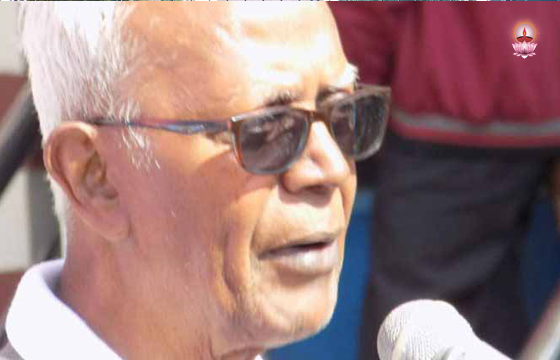
Father Stan Swamy’s bail plea rejected
A special court of the National Investigation Agency on October 23 rejected the bail plea of Jesuit Father Stan Swamy a tribal rights activist arrested for his alleged involvement in the 2018 Bhima Koregaon violence in Maharashtra.
The 83-year-old, who is under judicial custody, had sought bail on health grounds. He is now lodged in the quarantine ward at Taloja Jail, near Mumbai.
Father Swamy was picked up from his home in Ranchi, Jharkhand, on October 8 by a team of NIA officials from Delhi. His arrest had sparked an outrage across the country, evoking criticism from several circles. A court had sent him to judicial custody until on October 23.
“It (the NDA government) crossed all limits today when someone like Stan Swamy was arrested. He is someone who has been working in Jharkhand for years, in the remote faraway villages, wandering in the jun-gles, just so that the Adivasis, Dalits, and minority populations here could be reached,” Jharkhand Chief Minister Hemant Soren had said.

Ranchi archbishop leads human chain to demand Jesuit’s release
Archbishop Felix Toppo of Ranchi on October 16 joined priests, nuns and lay people to form a 5-kilometer human chain to denounce the arrest of an octogenarian Jesuit priest for alleged Maoist links. Many of the more than 1,000 protestors, who lined up in the Jharkhand State capital of Ranchi lit candles, terming it a symbol of hope against the attempts to silence intellectuals and rights activists such as Father Stan Swamy. The 83-year-old priest was arrested on October 8 from his residence near Ranchi by the National Investigation Agency, the federal body to counter terrorism. The priest was taken to Mumbai the following morning.
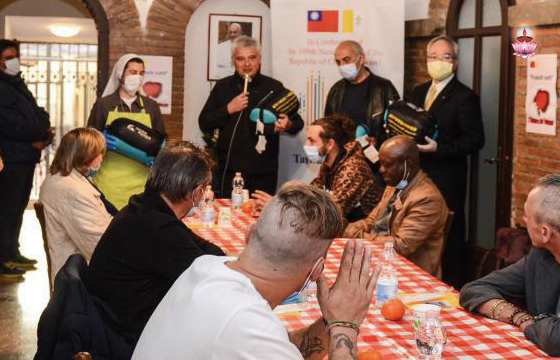
Homeless, Buddhists and Caritas: Taiwan’s national holiday in the name of ‘Fratelli tutti’
On October 10 is the national holiday of the Republic of China (Taiwan). Usually, the Taiwanese embassy to the Holy See invites friends and personalities to a gathering with a generous buffet. This year, in response to Pope Francis’s encyclical “Fratelli Tutti,” the way of celebrating the 109th anniversary of the Republic has radically changed.
With the collaboration of His Holiness’s almsgiver, Card. Konrad Krajewski, Caritas Rome and the Tzu Chi Buddhist Foundation were invited to a Taiwanese-style lunch with the homeless and abandoned people, who are “relegated to the peripheries and destined to become shadows” as the Pontiff often says.
The embassy donated “made in Taiwan” sleeping bags to the homeless and to Caritas, the Tzu Chi Foundation distributed tuna cans and ecological blankets, made from 100% recycled plastic bottles.
The two events took place on 8 October inside Palazzo Migliori, thanks to the assistance of Card. Krajewski, and on 7 October at the Casa Santa Giacinta of Caritas Rome, Fr Benoni Ambarus and Andrea Zampetti, director and general secretary of Caritas Rome.
Ambassador Matthew S.M. Lee says “it was an honour to share the spirit of National Day with our struggling brothers and sisters, as well as the values of inclusion, hospitality and friendship embraced by Taiwan. The Embassy wished to put into practice the Pope’s encouragement in ‘Fratelli Tutti’ in matters of fraternity: ‘Fraternity is not a trend or a fashion… but rather it is the demonstration of concrete acts,’ and to promote cooperation and exchanges interreligious in order to send humanitarian aid where it is most needed.”

Pakistan teen’s abduction, conversion sparks Christian outcry
A teenage Christian girl was kidnapped and forced to marry her Muslim abductor in Pakistan’s port city of Karachi, her family says.
A local Muslim man is accused of abducting 13-year-old Arzoo Masih while she was playing outside her home in Karachi’s St Anthony’s Parish. The Catholic girl is the youngest of four children in her family.
Arzoo’s mother, Rita Masih, said she and her husband were at work on October 13 when they received a phone call from a close relative that Arzoo had gone missing.
The family immediately filed a kidnapping complaint with the police. The crime is punishable by death or lengthy imprisonment in Pakistan.
However, on Oct. 15, the police summoned the family to the station where they were given marriage papers which claimed Arzoo was 18 and had willingly converted to Islam after marrying Ali Azhar, a local Muslim.
Raja Lal Masih, Arzoo’s father, said he was “deeply concerned” over his daughter’s safety. He wanted authorities to trace and bring her home. Masih told that Arzoo was below marriageable age under Pakistani law. “At the age of 13, she is too young to get married,” he said.
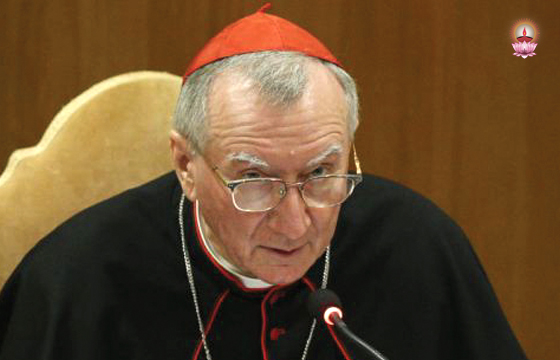
Vatican number two says deal with China on appointment of bishops will be renewed
The deal, which was first signed two years ago and expires, will be renewed for another two years, he said.
Asked by reporters on the sidelines of an event at a Rome university if it was a done deal, Parolin said: “Yes, I can anticipate to you that all will go well… I’ll leave you with a positive signal.”
The accord with Beijing gives the Pope final say over the appointment of Chinese bishops and the government allows all of them, including those hailing from a state-backed Church, to recognise the Pope’s authority.
The deal has been highly contested by the U.S. State Department and conservative Catholics, who say the Vatican has sold out to the communist government. Parolin said the final decision to renew had been made “in the last few days” after final contacts with the Chinese side. The deal would be extended without any new signatures because it was still an provisional deal.
The official announcement is due, he said.
Vatican officials say the agreement is not perfect but establishes a dialogue with Beijing after decades during which Chinese Catholics faithful to the Pope were driven underground.

Rights groups slam Pakistan senator’s forced conversion denial
Rights groups have condemned a Pakistani senator’s claim that a fact-finding team led by him could not find any proof of forced conversions among religious minorities in the Muslim-majority nation.
Senator Anwarul Haq Kakar is head of a parliamentary committee set up to look into the increasing incidents of Muslim men kidnapping Hindu and Christian girls and forcefully converting and marrying them.
“The committee, which also included members from other religions, did not find any trace of kidnapping and illegal confinement of Hindu girls who later gave statements in court. Most cases of forced conversions had some degree of willingness on the part of the girl,” Kakar told reporters earlier in Islamabad.
The Parliamentary Committee on Forced Conversions chief, rejected the validity of minority groups’ complaints. He said the marriages were “con-tracts involving willing girls and due to economic circumstances.”
His statement came after the fact-finding team visited Sindh, where most of the country’s Hindus live and where most complaints came from. The comments drew swift condemnation from rights groups.