Synods are not for deal-making, but for listening to Spirit, pope says

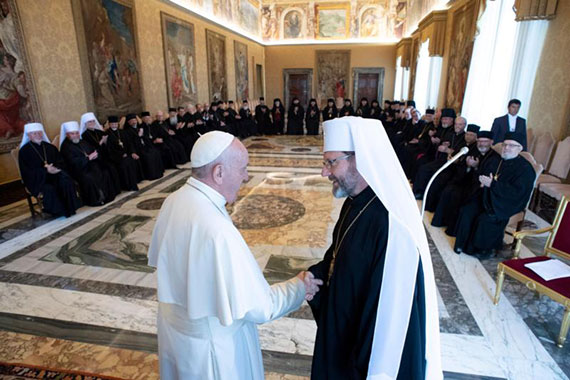
Before a Synod, bishops must learn what their people want and think and need, not so they can change church teaching, but so they can preach the Gospel more effectively, Pope Francis told the bishops of the Ukrainian Catholic Church.

Forty-seven bishops from Ukrainian dioceses in Ukraine and 10 other nations, including the United States, Canada and Australia, met the Pope on Sept. 2 during their Synod in Rome.

Archbishop Sviatoslav Shevchuk of Kyiv-Halych, head of the Ukrainian Catholic Church, told Francis that “every bishop and representative of our local communities has made his journey to Rome carrying with him the sufferings and hopes of the people of God entrusted to our pastoral care.”

The bishops, he said, want to be synodal – walking together with their people – “not only during our sessions but also when we return to our communities. Because, in fact, one cannot walk while seated!”

Speaking to the bishops, Francis focused on Shevchuk’s remarks and on how the Eastern Catholic Churches, like the Orthodox Churches, have a longer and uninterrupted history of decisions flowing from bishops’ Synods. “There is a danger,” the Pope said, which is “thinking today that making a synodal journey or having an attitude of ‘synodality’ means investigating opinions – what does this one and that one think – and then having a meeting to make an agreement. No! The Synod is not a parliament!”

While Synod members must discuss matters and offer their opinions, he said, the purpose is not “to come to an agreement like in politics: ‘I’ll give you this, you give me that.’”

Bishops must know what their lay faithful, priests and religious think, the Pope said, but it’s not a survey or a vote on what should change.

Evangelical missions a major threat to Amazon culture, Catholic leaders say

Historically a Catholic country, Brazil has been facing a religious transition since the 1990s, when what had been a steady growth of Evangelical Protestantism began to accelerate.

According to some experts, Brazilian Evangelicals could become a majority in the country as soon as 2032. This phenomenon is particularly strong in the Amazon, where some states have the biggest percentage of Evangelicals in the country.

Four of the six Brazilian States with the biggest proportion of Evangelicals are located in the Amazon, in the northern part of the country. In Rondônia, which is at the top of the list, there were 734,000 Catholics in 2010 – when the last data were released by the government – and 528,000 Evangelicals. Ten years before, in 2000, the number of Catholics was 793,000 and there were only 375,000 Evangelicals.

Jesuit devil debacle draws fire from exorcist across ecumenical lines

Father Erich Junger, an Anglican exorcist, has joined the chorus of those voicing concern over recent comments by Jesuit Father General Arturo Sosa saying the devil is not a real person, but a symbol.

Speaking to Crux, Junger, a member of the Anglican Church of North America (ACNA), said that while he is not a spokesman for his church, as a priest and exorcist he was “greatly shocked and disturbed” to see a person of such prominence in the Jesuit order refer to the devil as “a symbolic reality, not as a personal reality.”

Though not considered part of the Anglican Communion by the Archbishop of Canterbury, the ACNA is in communion with some Anglican provinces in the Global South. It follows the Anglo-Catholic tradition on exorcism, which adheres to more of the practices and rites of the Catholic Church, tending to use the Roman Catholic rite.

Sosa’s comments, Junger said, “are dangerous and inconsistent with the teachings maintained by the Roman Catholic Church as is codified by their own catechism.”

Though the Jesuits themselves did a fair amount of “damage control” after Sosa’s remarks, Junger said the comments were “very startling and unexpected” for many people.

Francis calls US Catholic criticism of his papacy an ‘honour’

Pope Francis has spoken in unusually frank terms about the theological divide in the U.S. Catholic Church, calling it an “honour” that some conservative Catholic groups in the country continue to criticize his papacy.

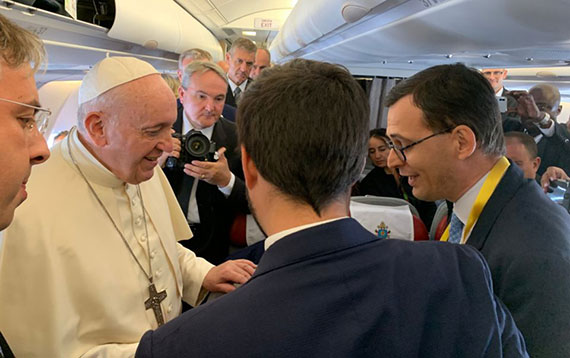
In a brief exchange with a journalist aboard his Sept. 4 flight from Rome for the beginning of a three-nation tour of Southern Africa, the Pope was presented with a new book that details years of efforts by conservative U.S. Catholics to influence his decision-making.

Francis told Senèze that he had heard about the book, published in France and titled How America Wanted to Change the Pope, but had yet to read it. Passing the volume to an assistant, the pontiff joked: “It’s a bomb!”

Criticism from conservative U.S. Catholics has been a staple of Francis’ six-year papacy, with right-wing outlets such as EWTN and First Things taking aim at many of his initiatives, such as his effort to fight global climate change and his focus on the merciful nature of God.

Shortly afterward, Vatican spokesman Matteo Bruni sought to downplay the importance of Francis’ remarks, saying the Pope was speaking in an “informal context” and “wanted to say that he always considers criticism an honor, especially when it comes from authoritative thinkers, in this case from an important nation.”Francis’ Sept. 4-10 voyage is only his second to sub-Saharan Africa. He will first visit Mozambique, and then the island nations of Madagascar and Mauritius.

Pope to create 13 new cardinals in October

Pope Francis announced he will create 13 new cardi-nals on Oct. 5, choosing prelates from 13 different nations as a sign of “the missionary vocation of the church that continues to proclaim the merciful love of God to all men and women of the earth.”

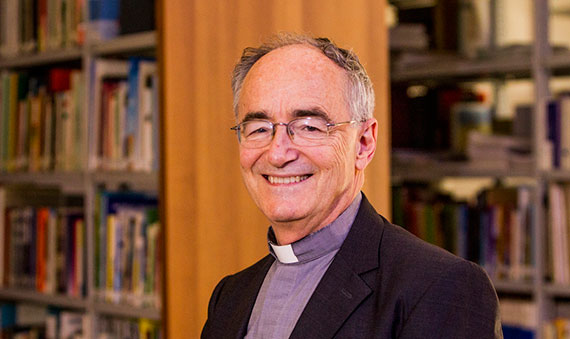
The only Canadian named was 73-year-old Jesuit Father Michael Czerny, undersecretary of the Section for Migrants and Refugees at the Dicastery for Promoting Integral Human Development. None of the new cardinals is from the United States.

Cardinal-designate Czerny, who Pope Francis had earlier named as a special secretary for the Synod of Bishops for the Amazon, was in Guararema, Brazil, when the announcement was made. He told Catholic News Service in a text message that he had not known he was going to be made a cardinal.

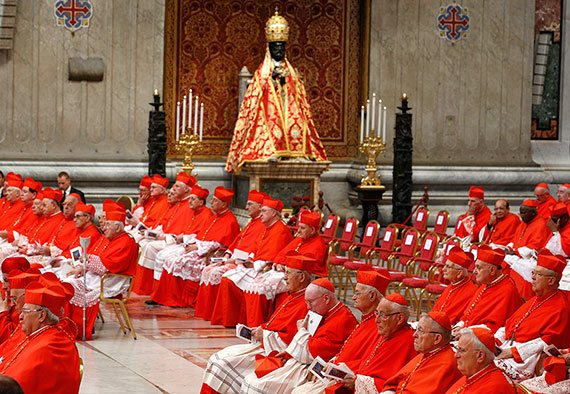
Announcing the names of the new cardinals Sept. 1, the Pope included 10 men who are under the age of 80 and therefore will be eligible to vote in a conclave to elect a new Pope. Three of the future cardinals are already over the age of 80, and the Pope said he chose them because of their service to the church.

One of the over-80 cardinals-designate is 82-year-old Archbishop Michael Fitzgerald, a Missionary of Africa born in England, who had served as president of the Pontifical Council for Interreligious Dialogue and later as Vatican nuncio to Egypt.

The others, in the order they were named by the Pope, were:

•    Archbishop Ignatius Suharyo Hardjoatmodjo of Jakarta, Indonesia, 69. • Archbishop Juan Garcia Rodriguez of Havana, 71. • Archbishop Fridolin Ambongo Besungu of Kinshasa, Congo, 59. • Archbishop Jean-Claude Hollerich of Lu-xembourg, 61.  • Bishop Alvaro Ramazzini Imeri of Huehuetenango, Guatemala, 72.  • Archbishop Matteo Zuppi of Bologna, Italy, 63.  • Archbishop Cristobal Lopez Romero of Rabat, Morocco, 67.  • Retired Archbishop SigitasTamkevicius of Kaunas, Lithuana, 80.  • Retired Bishop Eugenio dal Corso of Benguela, Angola, 80.

Vatican: German synod plans ‘not ecclesiologically valid’

In a letter sent to German bishops, the Vatican has said that plans for a binding Church Synod in Germany are “not ecclesiologically valid.”
Plans for a “binding synodal process” were first announced by Cardinal Reinhard Marx, head of the German episcopal conference, earlier this year.

CNA reported that draft statues for the planned “Synodal Assembly” were approved in August by the executive committee of the German bishops’ conference, ahead of a final hearing at a full meeting of German bishops, set to be held on Sept. 23-26. CNA also reported that small working groups connected to the Synod have already begun discussing a series of controversial Church topics.

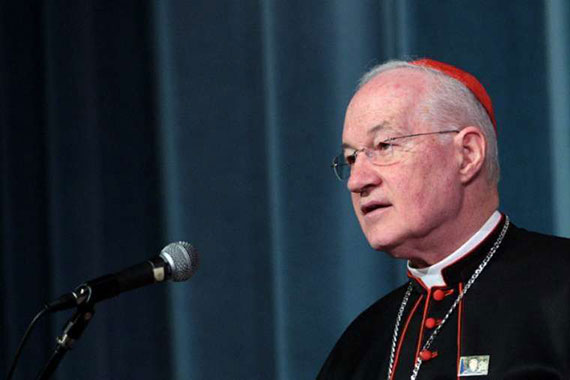
In a Sept. 4 letter addressed to Marx, Cardinal Marc Ouellet, head of the Vatican’s Congregation for Bishops, said that plans for a Synodal Assembly must conform to guidelines issued by Pope Francis in June, especially that a Synod in Germany could not act to change universal Church teaching or discipline.

Ouellet also sent Marx a four-page legal assessment of the German bishops’ draft statues. Both the letter from Cardinal Ouellet and the attached legal assessment were obtained by CNA.

The assessment, signed by the head of the Vatican’s Pontifical Council for Legislative Texts, says that the German bishops’ plans violate canonical norms and do, in fact, set out to alter universal norms and doctrines of the Church.

In his legal review of the draft statutes, Archbishop Filippo Iannone, head of the Pontifical Council for Legislative Texts, noted that the Germans propose to treat four key themes: “authority, participation, and separation of powers,” “sexual morality,” “the form of priestly life,” and “women in Church ministries and offices.”

“It is easy to see that these themes do not only affect the Church in Germany but the universal Church and – with few exceptions – cannot be the object of the deliberations or decisions of a particular Church without contravening what is expressed by the Holy Father in his letter,” Iannone wrote.

Catholic missionaries hit the streets to evangelize

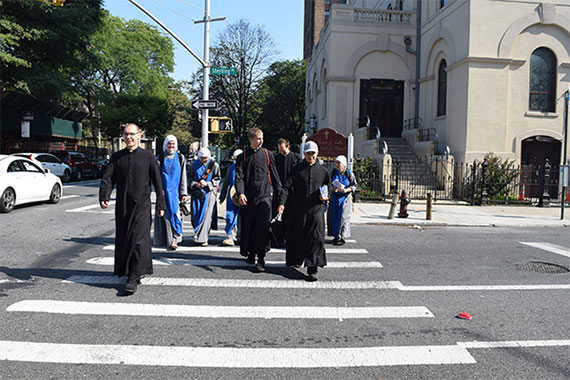
Missionaries from the Institute of the Incarnate Word have been pounding the pavement this September to invite Brooklynites around St Teresa of Avila, Crown Heights, and Co-Cathedral of St Joseph’s, Prospect Heights, to church.

The group of 40 religious brothers and sisters, most of them students, came from the Washington D.C. area. They begin each day in Brooklyn with a Mass and spend most of their days walking the streets around the north end of Prospect Park to invite people to Mass.

Mother Maria Aeiparthenos of the Servants of the Lord and the Virgin of Matará (SSVM), the sisters’ mistress of novices, said the missionaries initially went door to door, but after spending the first few days surveying the area, they decided it was better to encounter people on the streets.

Some sisters form a musical trio with guitar, violin and flute, taking the role of street performers, while others kick soccer balls and throw frisbees with children in the park, and others simply greet locals to engage them in conversation.

Pope celebrates Madagascar’s ‘living saint’, champion of the poor

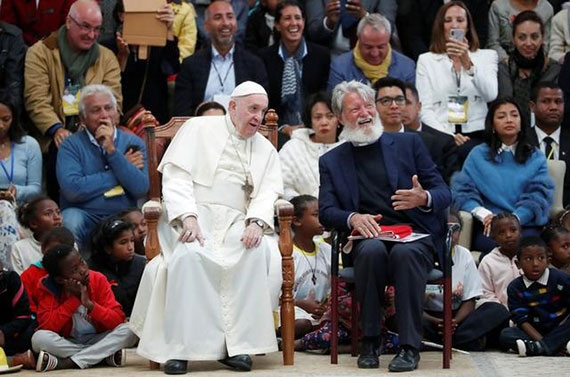
Pope Francis on Sept. 8 celebrated a former student of his who is now sometimes called Madagascar’s “living saint” for having changed the lives of thousands of poor people who once lived in garbage dumps.

Thousands of former slum dwellers, many of them children, gave the Pope an ecstatic welcome, leaving him seemingly overwhelmed by the experience, who only hours earlier defended the poor in the homily of a huge open-air Mass..

Francis taught Father Pedro Opeka theology at the Colegio Máximo de San Miguel in Buenos Aires in 1968 while Francis was completing his own studies for the priesthood.

Over the last 30 years, an organization founded by Opeka, whose parents emigrated to Argentina from Slovenia, has built homes for 25,000 people, 100 schools, six clinics and two football stadiums across the island nation. Next year, he plans to build a college for paramedics.

The white-bearded, jovial Opeka, 71, has been called a “living saint” along the lines of Mother Teresa of Calcutta by many in Madagascar because of his work in one of Africa’s poorest countries. He has been nominated for the Nobel Peace Prize.

The Pope met families living in Akamasoa, one of the first villages built by Opeka on the hills above Madagascar’s capital Antananarivo to re-house people living on the municipal dump in the valley below.

Church must seek new paths in Amazon, synod secretaries say

The Synod of Bishops for the Amazon will help the Catholic Church make its presence felt and voice heard in a region that is dangerously approaching “a point of no return,” said the special secretaries of the Synod.

“It is a great and continuing challenge for the Catholic Church to make the original Amazonian peoples feel part of it and contribute to it with the light of Christ and the spiritual richness that shines in their cultures,” Cardinal-designate Michael Czerny and Bishop David Martinez De Aguirre Guinea wrote in an article published on Sept. 12 in La Civilta Cattolica, the Jesuit journal.

Cardinal-designate Czerny, undersecretary of the Migrants and Refugee Section of the Vatican Dicastery for Promoting Integral Human Development, and Bishop Martinez, apostolic vicar of Puerto Maldonado, Peru, said the Synod will take place at a time when “both human and natural life are suffering serious and perhaps irreversible destruction.”

The Synod, scheduled for October 6-27, will focus on “Amazonia: New paths for the church and for an integral ecology.”

From inspiration to adoption: A story of working with Mother Teresa

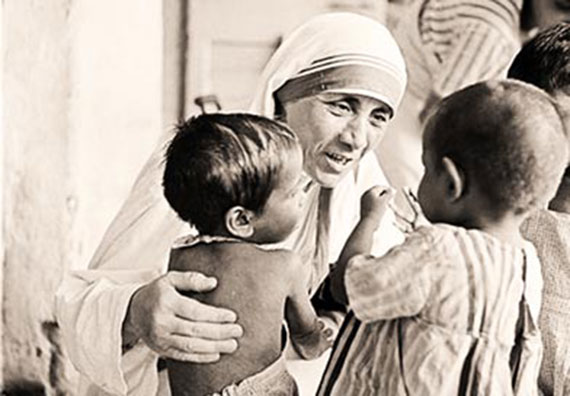
More than 20 years ago, Ann Pollak travelled to Calcutta, hoping to volunteer alongside Mother Teresa. The experience would spark a years-long process that would eventually lead her to adopt a severely handicapped child from one of the care centres run by the Missionaries of Charity.

“It has not been easy, at all, but the blessings have far, far outweighed the sacrifices,” Pollak told CNA. “Oddly, in adopting a blind child, I began seeing the world through my own eyes from a different perspective.”

Nearly 18 years ago, Pollak adopted a child from one of Mother Teresa’s orphanages. But adoption was not initially her intent.

In 1995, Pollak travelled to India in order to meet Mother Teresa. She spent two weeks doing volunteer work and was impressed with Mother Teresa’s constant smile, and the fact that despite winning a Nobel Prize and being globally famous, the religious sister was very approachable.

Pollak would return to do volunteer work numerous times in the years that followed. In 1997, about a month before Mother Teresa’s death, she was working with handicapped children. She was assigned to feed one little girl, Rekha, who was blind, autistic and mentally delayed.

“She had the sweetest smile on her face,” Pollak recalled of Rekha. “I just fell in love with her.” She also believed that the child had potential to develop and grow, if she was able to get the proper care and attention from a family.

A year later, Pollak returned to India to see if the little girl was still there. She was.

But as time went on, she became frustrated with her inability to find anyone to care for the girl. She began praying every day, asking God for a solution. Although she had not previously considered adoption, she began to feel an inner call to adopt Rekha. “I couldn’t find any other solution,” she reflected.