Christians the “most persecuted” religious group

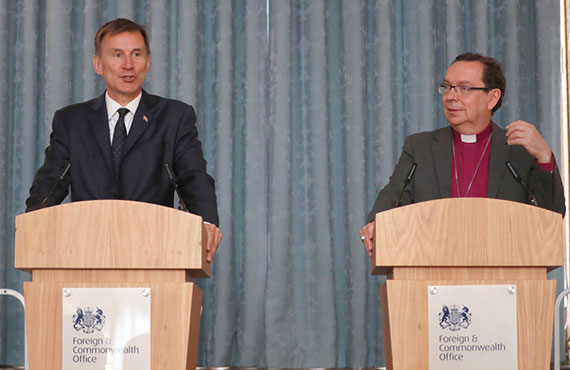
The British government should consider sanctions on countries where Christians are persecuted, according an independent review for the Foreign Secretary.

The report, by the Church of England Bishop of Truro Philip Mounstephen, reco-mmends the UK “be prepared to impose sanctions against perpetrators of Freedom of Religious Belief (FoRB) abuses.”

It also recommends the government explore how social media strategies can promote religious freedom and counter religious hate, and that a standard definition of FoRB be established.

Foreign Secretary Jeremys Hunt said that if he becomes prime minister, he would make sure all the recommendations were acted on.

It is estimated 5 that one third of the world’s population suffers from religious persecution in some form, with Christians constituting “by far the most widely per-secuted religion,” the report says.

Examples include the removal of crosses, the destruction of Church buildings and other Church symbols and the killing and abduction of clergy.

The report details how the eradication of Christians and other 33 minorities on pain of “the sword” or other violent means was revealed to be the stated objective of extremist groups in Syria, Iraq, Egypt, north-east Nigeria and the Philippines.

“The main impact of such genocidal acts against Christians is internal displacement and exodus. Christianity now faces the possibility of being wiped-out in parts of the Middle East where its roots go back furthest. In Palestine, Christian numbers are below 1.5 percent; in Syria the Christian population has declined from 1.7 million in 2011 to below 450,000 and in Iraq, largely through the ‘ethnic 37 cleansing’ of ancient Christian communities from the Nineveh Plains, Christian numbers have slumped from 1.5 million before 2003 to below 120,000 today. Christianity is at risk of disappearing, representing a massive setback for plurality in the region. It is that plurality which has been a key for security and stability in the region for hundreds of years.” Christianity is at existential risk in Iraq and other Middle Eastern countries. Since 2003, over 1 million Christians fled the country, reducing the size of the Christian population by nearly 80%.

Blessed John Henry Newman to be canonized on October 13

The Vatican announced  that Blessed Cardinal John Henry Newman will be canonized on October 13 in Rome.

During a consistory of cardinals on July 1, Pope Francis decreed that New-man and four other blesseds will be canonized together in St Peter’s Square.

Indian Sister Mariam Thresia, founder of the Congregation of the Sisters of the Holy Family; Italian Sister Giuseppina Vannini; Brazilian Sister Dulce Lopes Pontes, and Mar-guerite Bays, a Swiss consecrated virgin of the Third Order of St Francis will be canonized alongside Newman.

Their canonizations will take place during the 2019 Special Synod of Bishops from the Pan-Amazonian region to be held at the Vatican on Oct. 6-27.

Newman was a 19th century theologian, poet, Catholic priest and cardinal. Originally an Anglican priest, he converted to Catholicism in 1845 and his writings are considered among some of the most important Church-writings in recent centuries.

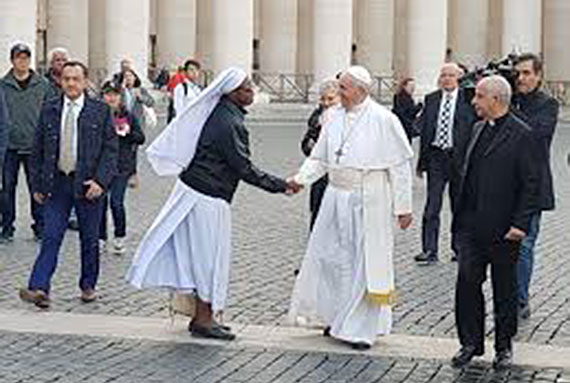
First women members of Vatican department that oversees religious orders appointed

Pope Francis has named the first women members of the Vatican department that oversees religious orders.

On 8 July 2019, it was announced the Pope had named a raft of new appointments to the board of the Congregation for Institutes of Consecrated Life and Societies of Apostolic Life, including seven women.

A Vatican spokesman confirmed  that they are the first female members to hold such a position on the body.

The women chosen include the following superiors general from religious order: Kathleen Appler of the Daughters of Charity, Yvonne Reungoat, of the Daughters of Mary Help of Christians (Salesian Sisters), Françoise Massy of the Franciscan Missionaries of Mary, Luigia  Coccia, of the Comboni missionary sisters, Simona Brambilla, Consolata Missionary Sisters, M. Rita Calvo Sanz, of the Order of the Company of Mary Our Lady. He also named Olga Krizova, general president of the Don Bosco Secular Volunteer Institute.

German cardinal says Amazon synod is ‘heretical’, must be ‘rejected’

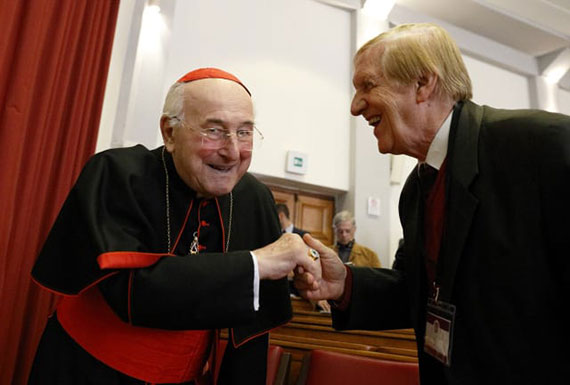
German Cardinal Walter Brandmüller, widely seen as a key opponent of Pope Francis, has penned a rare essay openly criticizing the upcoming Synod of Bishops on the Amazon, saying the official preparatory document breaks with Catholic teaching.

According to Brandmüller’s essay, published on June 27, on the Settimo Cielo blog of Italian journalist Sandro Magister, the Synod’s recently published preparatory document “burdens the Synod of Bishops, and finally the Pope, with a grave breach with the depositumfidei, which in its consequence means the self-destruction of the Church or the change of the Corpus Christi mysticum into a secular NGO with an ecological-social-psychological mandate.”

Published on June 17, the document, known as the instrumentum laboris, will set the ground work for the Synod of Bishops on the Amazon, that will take place in Rome on Oct. 6-27. Among other things, it opened a cautious door to the ordination of married “elders” as a possible solution to the region’s priest shortage. In his essay, Brandmüller insisted that “the Instrumentum Laboris contradicts the binding teaching of the Church in decisive points and thus has to be qualified as heretical.”

“Inasmuch as even the fact of Divine Revelation is here being questioned, or misunderstood, one also now has to speak, additionally, of apostasy,” he said, voicing grievances over the document’s take on liturgy, spirituality and priestly celibacy.

Women present at the altars in early Christianity, argues academic

The debate over female ordination inside the Catholic Church hinges on the role of women in early Christianity. When he addressed the question of women deacons, the Pope said a commission he set up to look at the historical origins of deaconesses, could not agree over whether they had received sacramental ordination or not.

He told a group of leaders of religious sisters last month: “I cannot make a sacramental decree without a theological, historical foundation.”
How much emphasis can be given to art or artefacts from the early church?

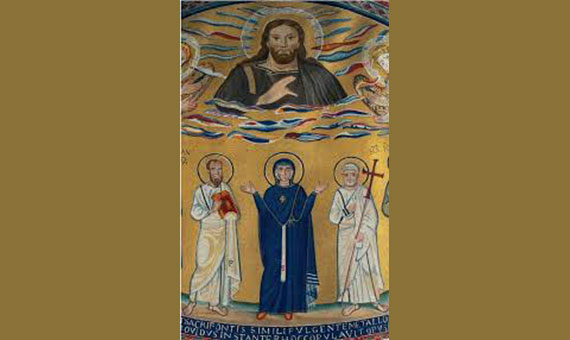
Dr Ally Kateusz, a research associate at the Wijngaards Institute and a historian, believes there is plenty of evidence to show women were present at the altars. She was in Rome to present her case at the Pontifical Gregorian University in a lecture and to discuss the findings in her book “Mary and Early Christian Women: Hidden Leadership,” published this year by Palgrave Macmillan.

In this book, Dr Kateusz examines fifth-century artefacts from Old Saint Peter’s Basilica, Rome, and the Hagia Sophia, Constantinople which appear to depict women in liturgical roles.

“They show the early Christian liturgy as it was performed at that time,” she told me while she was in Rome. “A gender parallel liturgy – men and women at the altar.”

“The overarching theology for the liturgy would have been ‘there is neither Jew nor Greek, because both Jew and Greek were leaders in the ecclesia; there is neither free nor slave, because both were leaders in the ecclesia; and there is neither male nor female, and both were leaders in the ecclesia’,” she says.

Church defends captain who defied Italy by bringing migrants to shore

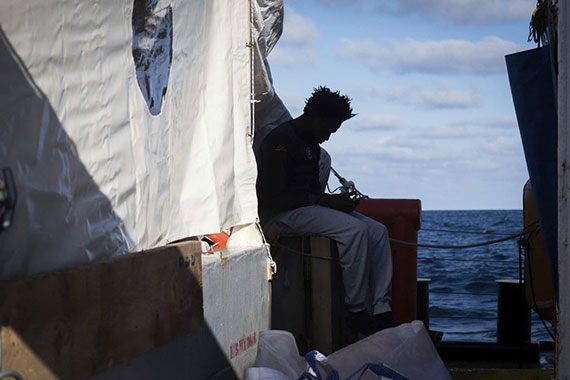
A much-watched migrant vessel finally docked at an Italian island on June 29 , following two weeks at sea. The captain of the “Sea Watch 3” divided public opinion in Europe when she defied Italy’s populist leader by bringing 40 immigrants to shore, but the Catholic Church is standing firmly by her side.

“I think that human life must be preserved in any way. This must be the North Star that guides us, everything else is secondary,” said Italian Cardinal Pietro Parolin, the Vatican’s Secretary of State, in a June 29 press conference.

The Sea Watch 3 NGO migrant vessel spent over two weeks in the Mediterranean Sea carrying more than 40 immigrants and 20 staff members, before German Captain Carola Rackete decided the ship couldn’t wait any longer and docked at Lampedusa, an island off the coast of Sicily, in the early hours of June 29.

The leader of Italy’s ruling right-wing populist party, Deputy Prime Minister and Interior Minister Matteo Salvini, has ordered all Italian ports to close their doors to vessels carrying immigrants in an effort he says to reduce migration flows into the peninsula and to combat human trafficking.

On June 26, Salvini said the Sea Watch’s attempt to approach the Italian coast was a “hostile act” and vowed to compel other European countries to take in the immigrants. While the vessel flies the Dutch flag, it’s run by a German NGO.

“I had to dock. I feared that some migrants might commit suicide,” said Rackete in a June 30 video interview with local daily Il Corriere Della Sera, adding that some passengers had tried to cause themselves harm.

“I was afraid. We were taking turns for days, even at night, out of fear that someone might throw themselves into the sea. For those who don’t know how to swim, it means suicide. I feared the worst,” she said.

After ramming patrol boats and docking, Rackete was arrested by Italian police  and she faces an investigation for favoring illegal immigration. She also risks a fine and the impounding of the vessel, but she said she will own up to the legal consequences of her “act of disobedience and not violence.”

One fifth of all Dutch churches now converted to secular use

More than one-fifth of all church buildings in the Nether-lands have now been converted into libraries, apartments, offices or other functions in line with the growing secularisation in the country, according to an inquiry by the Protestant daily ‘Trouw.’

Of the 6,900 Dutch church buildings, one-fifth of those built before 1800 –which makes them national monuments – have been secularised. Of those built since then, almost one-quarter have been given over to other uses.

Catholic Churches are less likely to be transformed than Protestant ones because of the different meanings the buildings have for the two communities, Trouw said.

“For Roman Catholics the church is sacred, for Protestants the church is useful. As a result, Roman Catholics are more reluctant to give their churches a different function,” it wrote.

That meant only about 15% of Catholic Churches have been desacralised compared to the one-quarter of Protestant Churches that are now serving other functions.

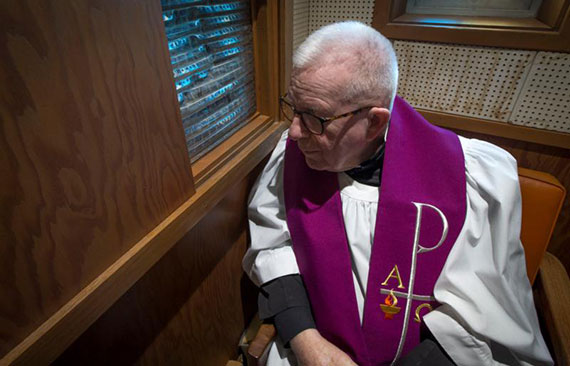
Defeat of California’s attempt to break seal of confession a victory for religious liberty

Defeat of California’s attempt to break seal of confession a victory for religious liberty.

Kathleen Domingo is Senior Director for the Office of Life, Justice and Peace and Director of Government Relations for the Archdiocese of Los Angeles. She helped to organize the opposition to a California bill that would have required priests to break the sacramental seal of confession in certain cases.

“SB 360, authored by Senator Jerry Hill, sought to strengthen reporting requirements for child abuse, a goal we share. However, to achieve that goal, it removed the privacy protection for the sacrament of confession in instances of child abuse. Even after the bill was amended, priests and lay people, like me, who work at the same location as priests, would be denied the privacy protection in the sacrament” said  Kathleen Domingo

“I want to practice my religion the way that I want to, and I want you to be able to do the same.”

After months of legislative meetings and grassroots organizing of Catholics throughout California, we prepared a show of force for the Assembly Public Safety Committee hearing, that would have been held on July 9. We delivered 140,000 signed letters to Assembly members and sent close to 17,000 emails from parishioners in the Archdiocese of Los Angeles alone.”

Curia reform: Changing attitudes, not just structures

Pope Francis’ plan for the reform of the Roman Curia will change the names of several offices and merge a few of them, but the biggest change it hopes to spark is one of attitude.

The last major reorganization of the Curia came with St John Paul II’s apostolic constitution, “Pastor Bonus” (The Good Shepherd) in 1988, which — in its very first sentence — spoke of Jesus entrusting the apostles with “the mission of making disciples in all nations and of preaching the Gospel to every creature.”

To facilitate that mission in the modern world, St John Paul had said, the church needs a structure to promote “communion,” which “glues the whole church together.”

Pope Francis’ successor document to “Pastor Bonus” is tentatively called “Praedicate Evangelium” (Preach the Gospel), and drafts of it were sent to bishops and a variety of experts for comment in the spring.

Of course, promoting the communion of the church and preaching the Gospel are essential tasks for the Popes. For Catholics they are inextricably bound together, and one makes little sense without the other. But when one is emphasized more than the other, priorities change. The energy of the Curia can be directed to promoting unity, offering direction and gathering suggestions and ideas, a some what inward gaze that could increase the perceived authority of curial officials. The risk is a tendency toward uniformity and thinking that the closer one is to the centre, the more authority he has.

‘Spiral of silence’ is at the heart of ongoing clerical sex abuse

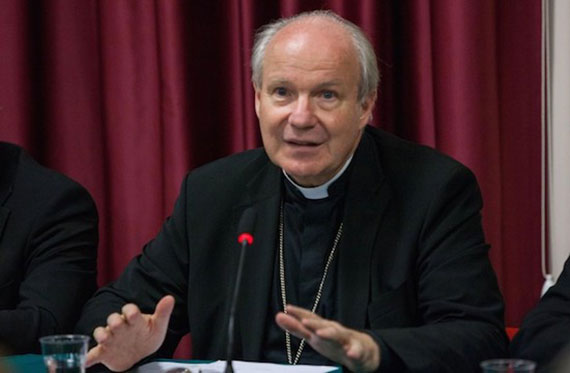
Cardinal Christoph Schönborn, the third most senior active cardinal in the worldwide Church, has called on bishops and other Catholic officials to better engage in listening to victims of clergy sex abuse.

At a lecture last month in the Austrian capital of Vienna, where he has been archbishop since 1995, Schönborn said listening to victims was essential to breaking the “spiral of silence” that has allowed such abuse to continue for so long.

“The victims have to overcome an enormously high threshold even to begin talking,” the 74-year-old cardinal said at a conference on “Sex & Crime” at the Religiosity in Psychiatry and Psychotherapy Institute at Vienna University.

He shared his own experience of what he described as the Austrian Church’s “25-year-long painful learning process” of clerical sexual abuse.

Schönborn, a Dominican theologian who became an auxiliary bishop of Vienna Archdiocese in 1991, recalled how it was not until he had actually met with and listened to victims that he was able to overcome his initial defensive reflexes, correct his wrong assumptions and completely change his awareness of clerical sexual abuse. But he said it was extremely difficult to get victims to talk about the abuse they had experienced. The cardinal said a number of victims had told him, “if only I hadn’t begun (talking about the abuse),” telling him they believed suppressing the memory of the painful trauma might spare them even greater suffering.