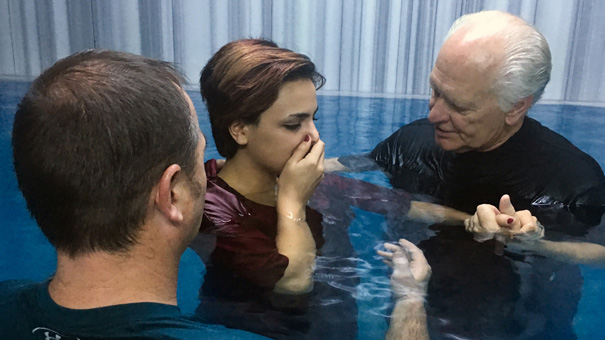
Iranians Are Converting To Evangelical

In a hotel conference room in Denizli, Turkey, about 60 Iranians sing along to songs praising Jesus mixed with Iranian pop music. When the music stops, American pastor Karl Vickery preaches with the help of a Persian translator.

“I’m not famous or rich. But I know Jesus. I have Jesus,” he says, with a Southern drawl. The Farsi-speaking Christian converts shout “Hallelujah!” and clap.

Vickery, who’s part of a visiting delegation from Beaumont, Texas, then offers to pray for each person in the room.

Women with hair dyed blond and short skirts and clean-shaven men in slacks stand up to pray in unison. Vickery puts his hand on one woman’s head and speaks in tongues. One man closes his eyes as tears fall. Another woman raises her hand and shouts “Isa,” Jesus’ name in Arabic and Persian. The room smells of sweat.

Among the parishioners are Farzana, a 37-year-old hairdresser from Tehran, and her daughter Andya, 3, who runs around, taking photos with her mother’s cell phone.

“It feels good. Our relationship to God becomes closer,” Farzana says. She doesn’t want to give her last name because she says her family in Iran might face persecution for her conversion. Her family knows she is a convert and they’re scared for their own safety inside Iran.

In Turkey and across the Middle East and Europe, evangelical Christians are converting Muslim refugees eager to emigrate to the West. The refugees in Turkey escaped Iran, where conversion to anything but Islam is illegal.

There are hundreds of thousands of Christians in Iran. Those considered part of the native Christian communities are permitted to practice their religion with restrictions, but a Muslim converting to Christianity is considered an apostate. The Iranian government jails converts, especially those who proselytize. The authorities see it as a Western plan to turn Iranians against Islam and the Islamic regime, according to converts in Turkey.


Fertility in 91 countries insufficient to maintain population

In 2017, the lowest TFR was in Cyprus, where on average, a woman would give birth to one child throughout her life.

Even as the world’s population grew by 87.2 million people annually from 2007 to 2017, 91 nations are not producing enough children to maintain their current populations, shows a new study by the Institute for Health Metrics and Evaluation (IHME).

Part of the annual Global Burden of Disease (GBD) study, the findings say that 91 countries, including Singapore, Spain, Portugal, Norway and South Korea, along with Cyprus, have a total fertility rate (TFR) of lower than two. TFR is a summary measurement representing the average number of children a woman would deliver over her lifetime. In 2017, the lowest TFR was in Cyprus, where on average, a woman would give birth to one child throughout her life

While global TFR declined since 1950, the world’s population grew in comparison with 81.5 million annually from 1997 to 2007. The study says that while in 1950, high-income countries accounted for 24 per cent of the global population, in 2017, the population of these countries accounted for 14 per cent.

The findings show that there is a baby boom just as there is a baby bust. In 104 countries, high birth rates are driving population increases. The highest TFR was in Niger, where a woman would give birth to seven children in her lifetime.

Apart from Niger, Mali, Chad, and South Sudan were among the 104 nations with fertility rates exceeding two births per woman. Singapore, Spain, Portugal, Norway and South Korea, along with Cyprus, had TFR rates lower than two.

Christians working with Syrians: U.S. withdrawal puts minorities at risk

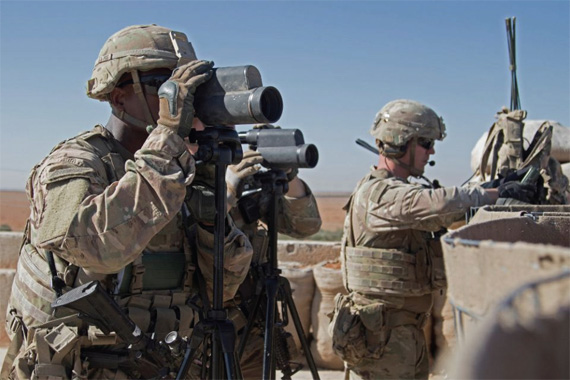
Several Mideast-based Christians working on the Syria crisis have joined a growing chorus about U.S. President Donald Trump’s decision to pull some 2,000 American troops from Syria. They say it puts Christians at risk and could force them to flee again, and they want the decision reversed. They added their voices to other Christian voices in Washington and Europe calling on Trump to reverse his decision, citing concerns for the fate of minorities and the risk they face from Islamic State.

Support independent Catholic journalism. Become an NCR Forward member for $5 a month.

“This U.S. decision to with-draw with no guarantees opens up the gates of hell” for the people of northern Syria, said Fr Ema-nuel Youkhana, a priest, or archimandrite, of the Assyrian Church of the East. He spoke to Catholic News Service by phone, pointing to the controversial military threats already made by Turkey to attack the area.

Arrested man eyed Xmas St Peter’s attack

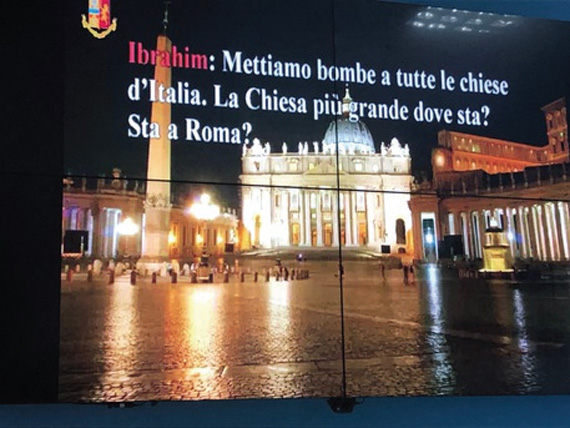
Bari, December 17-A 20-year-old Somali national arrested in Bari on terrorism charges allegedly wanted to stage an attack at St Peter’s Basilica in Rome at Christmas, according to wiretap recordings. Mohsin Ibrahim Omar, who also goes by the name Anas Khalil, is believed by DIGOS special security police in Bari to be linked to the Islamic State (ISIS) in Somalia and to be in contact with one of its opera-ting cells. “Dec. 25 is coming,” he allegedly said in recordings contained in case documentation.

“The 25th is Christmas… the churches are full. “Let’s put bombs in all the churches of Italy. Where is the biggest church? It’s in Rome?,” he said, according to the wiretap, apparently referring to St Peter’s. The FBI are assisting the investigation. A Somali man arrested on December 13 in Bari was allegedly found in a wiretap by Italian DDA anti-mafia and anti-terrorism forces to have called for bombs to be planted in churches. The alleged terrorist was arrested when trying to flee the Bari area on December 13.

“The Vatican’s Astronomer on God and the Stars”

“The Vatican’s Astronomer on God and the Stars: The Pope’s chief stargazer, Br. Guy Consolmagno, discusses what the Wise Men saw, how to deflect an asteroid, and why science and faith are more than compatible.”

“The idea that you read the Bible like it was the Chilton’s manual for how to repair your Volkswagen —that’s literalism. It’s a very modern idea,” says Dr Consolmagno. “You don’t find that in the church fathers. You don’t find that in the rabbis of the time of Jesus. That’s not the way they interpreted it. All literature in ancient times started out as poetry.”

Facing such questions, Dr Consolmagno offers a hypo-thesis: “Let’s assume that there’s a God that’s outside nature, who is responsible for the existence of the universe,” he says. “When I start with that axiom, does the universe make sense? Does the universe make more sense than if I assume it’s all done by random chance? Am I able to see things I couldn’t see before? Am I able to understand things I couldn’t understand before? Is it an axiom that works?

Financial corruption in Austrian diocese made public, despite Vatican order

The administrator of the Austrian diocese of Gurk-Kalgenfurt has released a report on financial irregularities under the administration of a former bishop, despite a Vatican directive that the report should be conveyed quietly to Rome. The report pointed to “massive public accusations” against Bishop Alois Schwarz, who headed the Gurk diocese 2001 until May of this year, when he was transferred to the Sankt Polten diocese. The charges involved financial deals which appeared to benefit a female staff member who had a close relationship with the bishop. Msgr Engelbert Guggenberger, who released the critical report, emphasized that he was doing so not in his role as apostolic administrator of the Gurk diocese, but as dean of the cathedral chapter, which had given its unanimous endorsement of the findings.

52,000 displaced by violence in western Niger: UN

“The UN refugee agency is becoming increasingly troubled by ongoing violence in Niger’s border areas with Mali and Burkina Faso,” the UNHCR said in a statement.

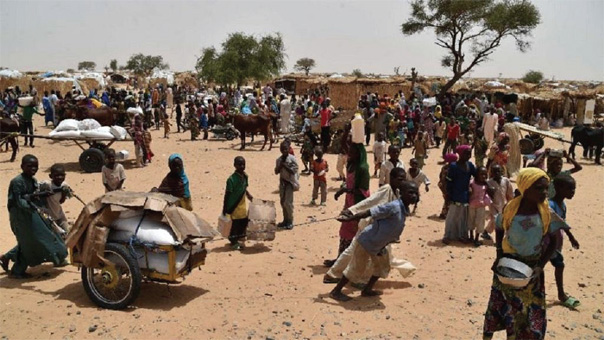
“Those displaced report fleeing horrific violence. Armed groups are said to be attacking villages, killing and abducting civilians, including community leaders, burning schools and looting homes, businesses and livestock.” The UN refugee agency is becoming increasingly troubled by on-going violence in Niger’s border areas with Mali and Burkina Faso.

The raids and plunder affect residents of the Tahoua and Tillaberi border regions, where the government has declared a state of emergency while troops of a five-nation G5-Sahel military task force fights insurgents.

“They kidnapped five people from my village who were later found dead,” cattle farmer Al-Bashir Gamo Gamo told the UN agency, saying that armed groups threatened the villagers with death if they did not leave within 12 hours.

“Nobody can sleep at night, walk anywhere or cultivate crops because of fear,” he added. In addition to inducing local residents to flee, the violence is affecting 53,000 refugees from Mali who live in Niger’s border regions. A previous count by the United Nations in October reported 42,000 people displaced by the activities of non-state armed groups and also by security measures aimed at halting “repeated infiltrations by terrorists” from Mali.

Foreign Secretary orders review into persecution of Christians

Foreign Secretary Jeremy Hunt has said the UK “must do more” to help persecuted Christians and has ordered an independent review to assess if the British Government is doing enough.

The Foreign Office review will be led by the Bishop of Truro, Rt Rev Philip Mounstephen, and will make recommendations on the practical steps the government can take to better support some of the 215 million Christians globally who faced persecution last year.

Mr Hunt said: “Britain has long championed international religious freedom.”

“So often the persecution of Christians is a telling early warn-ing sign of the persecution of every minority,” he continued.

Due to be published at Easter, the review will map the persecution of Christians in “key countries” in the Middle East, Africa and Asia; provide an analysis of current UK government support and offer recommendations for a “cohesive and comprehensive policy response.”

The Foreign Office said the review would “consider some tough questions and offer ambitious policy recommendations.”

Lord Tariq Ahmad, the Government’s special envoy on freedom of religion or belief, said: “This is an issue that resonates deeply: 70 years ago during the partition of India, my family had to leave their home and livelihoods simply because of their faith.

“Seventy years later religious persecution is on the rise around the world. Our government has prioritised freedom of religion or belief and the review we are announcing today is about providing an objective view of Britain’s support for the most vulnerable Christians globally.

Pope vows action on abuse, decries divisions in Church, in address to Roman Curia

Pope Francis renewed his promise to root out sexual abuse, and at the same time warned against divisions in the Church, in a December 21 address to leaders of the Roman Curia.

“Let us be clear that before these abominations the Church will spare no effort to do all that is necessary to bring to justice whosoever has committed such crimes,” the Pope said of sexual abuse. “The Church will never seek to hush up or not take seriously any case.” While acknowledging that in the past Church leaders have not acted decisively against abuse, he insisted: “That must never happen again.”

An abusive priest, the Pontiff said, is like “a vicious wolf ready to devour innocent souls.” In a speech marked by strong language, he said that the sins of such clerics “disfigure the countenance of the Church and undermine her credibility.” He said that at a Vatican meeting on abuse in February, “the Church will restate her firm resolve to pursue unstintingly a path of purification.”

The annual papal meeting with leaders of the Roman Curia, which was traditionally an exchange of Christmas greetings, has in recent years become an opportunity for the Pope to reflect on the challenges facing the Vatican. Pope Francis, in particular, has used the occasion to deliver stinging indictments of the “sicknesses” of the Curia (in 2014) and of “traitors” who opposed his programs of reform (in 2017). The prospect of another papal scolding may have explained an unprecedented phenomenon: the presence of many empty seats in the hall during the audience.

However, this year Pope Francis did not direct his criticism at the officials of the Roman Curia. In fact he began his address with a nod of appreciation for Archbishop Edgar Peña Parra, who as the new sustituto (Assistant Secretary of State) handles the day-to-day administration of the Vatican bureaucracy.

Pope Francis did warn against the presumption of religious leaders who “frequently come to think and act as if they were the owners of salvation and not its recipients.” But he made that point almost in passing, moving quickly on to look across the past year, in which he remarked that “the barque of the Church has experienced—and continues to experience—moments of difficulty, and has been buffeted by strong winds and tempests.”

Iran: Crackdown on Christians continues with reports of Beatings

Christian leaders in Iran have said that pressure on Christians increases every year around Christmas but that this year it is particularly severe.

At least seven Iranian Christian converts have been arrested in Iran, including two sisters who allegedly have been beaten.

Shima Zanganeh, 27, and her sister, Shokoufeh, 30, were arrested by Intelligence Service officials in their homes in Ahvaz, capital of Iran’s western Khuzestan province, on 2 December, reports Mohabat News.

They were taken to Amanayeh security offices in Ahvaz and then transferred to Sepidar Prison in Ahvaz on Wednesday, 12 December. The sisters appeared in court and were granted conditional release on a bail of 500 million tomans (approximately US $50,000) each.

The family was able to raise the necessary funds, but at each court appearance to secure the sisters’ release, they have been told “the judge is not in today,” the news service said.

It said a reason for the delay could be that authorities want the wounds and bruises of the beatings to fade away before releasing the women.

Prison authorities had informed the Zanganeh family that the sisters were beaten during one of the interrogation sessions and the sisters confirmed this in a later phone call. On the same day the Zanganeh sisters were arrested, security authorities also raided the homes of Farzad Behzadizadeh, 30, and Abdollah Yousefi, 34, and confiscated Christian books, phones and computers, according to Mohabat.