

Have the monks from one of the last monasteries in eastern Turkey finally won their battle? In 2014, fifty properties belonging to the Syrian Orthodox Church were expropriated by the government in southeast Turkey. Among them were several ancient monasteries where a dozen monks continue to live. Since then, the monks have launched a series of legal cases to recover their properties. A recent decree may finally grant them victory, according to a report in the Hürriyet Daily News in early February.
Daily Archives: March 9, 2018

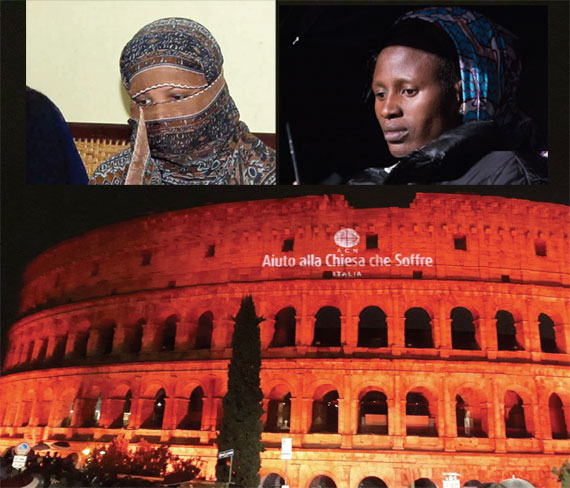
ASIA BIBI FAMILY APPEAL TO POPE FRANCIS FOR HELP
Pope Francis says a Catholic woman sentenced to death under Pakistan’s blasphemy laws and a Nigerian woman who was captured by Jihadist militants Boko Haram are both “martyrs.”
He made the remarks during a private audience in the Vatican with the husband and daughter of Asia Bibi, imprisoned since 2009 for an alleged offence against the Prophet Mohammed. Asia Bibi has always denied the offence.
The family was also joined by Rebecca Bitrus, who told the Pope how she had been raped by one of her Boko Haram kidnappers and later gave birth to his son.
“Rebecca’s testimony and that of Asia Bibi represent models for a society that today is afraid of pain,” Francis said according to a statement from the Italian branch of Aid to the Church in Need (ACN) whose president and founder were present during there meeting. “They are two martyrs.”
The Pope met the group in the Apostolic Palace hours before Rome’s Colosseum is lit up in red, an event aimed at highlighting the persecution of Christians which has been
steadily on the rise in the Middle East, parts of Asia and Africa. Before the papal audience Ashiq Masih said he wanted to appeal to Francis to do “everything he can” to have his wife released, and at the end of the audience asked the Pope to pray for his wife “and all persecuted Christians.”
Ms Bitrus has described in the past how she had been taken from her husband, saw her 3-year-old son drowned by kidnappers and told she be made to “work for Allah.” She was later imprisoned where one of her captors “forced himself” on her and she became pregnant. “After that I tried to kill myself,” she explained. But the wife of a Pastor, herself abducted from Gwoza, pleaded with me not to take my life. She already had two children fathered by the militants. When the time came for me to give birth, I delivered at home, alone.”

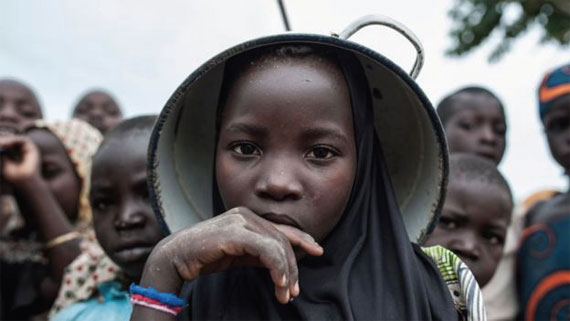
NIGERIA’S BOKO HARAM CRISIS: COURT FREES 475 SUSPECTS
When mechanics Taye and Kehinde Hamza agreed to service a vehicle at their workshop in Nigeria’s Bauchi State in 2010, they could never have imagined the years of hell which would follow. The car, it turned out, belonged to a Boko Haram fighter, and the job was enough to get the twins arrested.
It would be another eight years until they were free again, cleared along with 473 others of terrorism charges.
At a previous mass trial, held in October, more than 400 suspects were released, with just 45 jailed for their roles in the Boko Haram insurgency which has killed more than 20,000 people and displaced millions of others.
Justice Minister Abubakar Malami told the BBC that the released suspects would be rehabilitated before being allowed to return to their families.
But while these judges are making headway into the backlog of people awaiting trial, there are still another 5,000 people are still waiting for their own dates to be set.
The judges have found 205 people guilty of terror-related offences – including the “master- mind” behind the abduction of the Chibok girls.
But while convictions like this offer the hope of justice for Boko Haram’s many victims, campaign group Amnesty International has questioned the method of the trial.

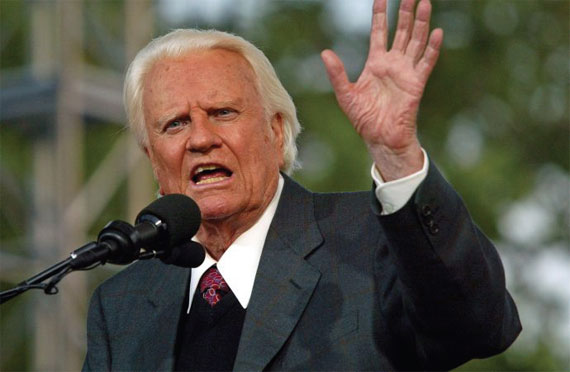
REV. GRAHAM DIES; WORLD FAMOUS EVANGELIST WAS ADMIRED BY MOST AMERICANS
The Rev.Billy Graham, a fiery Baptist preacher who was easily the most famous evangelist of the 20th century and for decades one of the world figures most admired by Americans, died early Feb. 21 at his home in Montreat, according to the Billy Graham Evangelistic Associa- tion. He was 99.
He had suffered from Parkin- son’s disease for many years,
although he continued to lead crusades until 2005, when he held his last one in New York. In recent years, he also suffered from cancer, pneumonia and other ailments.
Graham welcomed represen- tatives of other denominations, including Catholics, to attend his crusades. In many places local Catholic authorities welcomed him and formed pastoral follow- up programs to welcome lapsed Catholics who were prompted by the preacher to return to the church. In 1964, Card. Richard J. Cushing of Boston said that no Catholic who heard Graham preach “can do anything but become a better Catholic.”
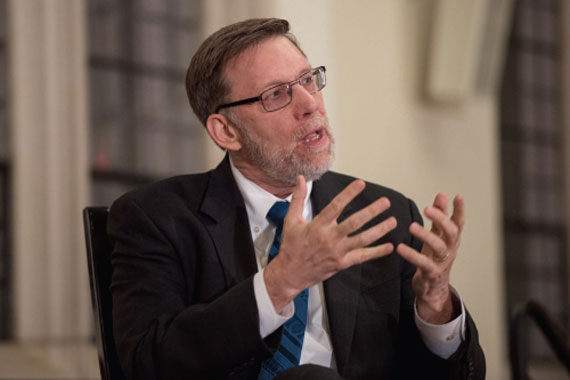
THEOLOGIAN: CHURCH DOCTRINE MUST BE LIFE-GIVING, NOT OPPRESSIVE
Richard Gaillardetz is the Joseph Professor of Catholic Systematic Theology at Boston College. He is the author of By What Authority? Foundations for Understanding Authority in the Church; the revised edition was just released by Liturgical Press, and An Unfinished Council: Vatican II, Pope Francis, and the Renewal of Catholicism. Last month he was awarded the Yves Congar Award for Theological Excellence by Barry University. He spoke to Charles Camosy.
In an interview he said “One of the more daunting challenges facing the Church today comes from many young adults, in particular, for whom the idea of adhering to a normative religious tradition appears both unnecess- ary and irrelevant to their lives. The Church needs to offer an account of its tradition that makes evident the authentic human flourishing that tradition makes possible while affirming the value of questioning, doubt and dis- agreement. Such an account might build on the biblical meta- phor of Jacob’s wrestling with an angel in the book of Genesis to propose what it might mean to “wrestle “with the Church’s
normative tradition.” The Church no good to deny or white- wash this feature of our tradition. Nevertheless, for Catholic Chri- stians, doctrine cannot be reduced to those power.”
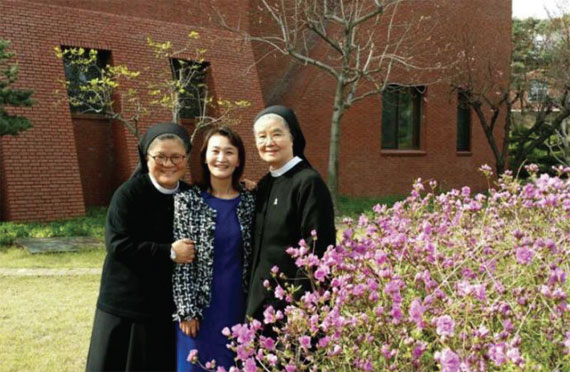
FROM NORTH KOREA TO CATHOLICISM: MI JIN’S ANSWERED PRAYER
During her childhood in North Korea, Mi Jin Kang never believed in the existence of God, until one person began to spark her curiosity.
“From school education, I learned that religion is a drug,” Mi Jin told CNA, “However, I heard the story of God from a girl that I met in North Korea before my escape. This was the first step to belief.”
“Before escaping North Korea, the story of God was a curiosity and miraculous,” said Mi Jin who decided to escape North Korea in 2009, at the age of 40. “When I escaped from North Korea, I prayed with my two hands,” remembered Mi Jin, “When my prayer to God at the moment of escape was answered, I decided to be a child of God.”
“It was especially this prayer to God at the moment of escaping from North Korea that led me to be a believer during the process of settling in South Korea.” Though she did not share details of her escape, many North Korean defectors are helped to South Korea by a network supported by Chinese Christians.
In South Korea, an order of Korean religious sisters taught Mi Jin and other North Korean defectors about the Catholic faith. Mi Jin learn- ed about Saint Therese the Little Flower from the sisters.
At her baptism, Mi Jin took a new Christian name, as is the custom for Korean Catholics. She became Teresa.
“I wanted to be like Saint Teresa, who lived a faithful life,” Mi Jin said. When Pope Francis visited South Korea in 2014, Mi Jin was invited by the Korean bishops to see Francis face-to-face, in the front row of the beatification Mass for 124 Korean martyrs. She also attended the Pope’s Mass in Seoul’s historic Myeongdong Cathedral.
“I got to experience the glory of a Mass close to the Pope,” said Mi Jin.
Mi Jin especially encouraged prayer for North Korea. “I hope that Kim Jong Un’s regime in North Korea realizes economic democratization for North Korean’s true freedom and life by giving up nuclear weapons.”
She also “hopes to see the unification Korea as the relationship between North and South Korea has developed in a positive way like recently.”
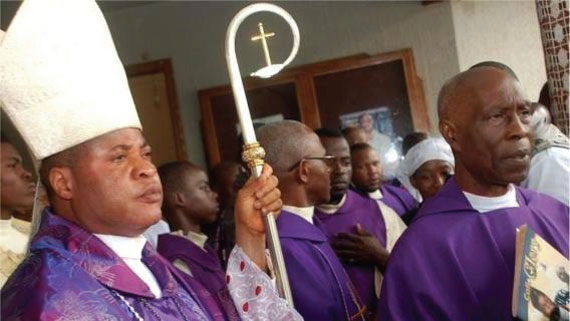
POPE FRANCIS BACKS DOWN IN NIGERIAN BISHOP ROW
Pope Francis has accepted the resignation of a diocesan bishop in Nigeria who has been at the centre of a long-running dispute in which local priests refused to accept his oversight. In its daily press bulletin, the Holy See said Pope Francis had accepted the “renunciation” or resignation of the Bishop of Ahiara in Nigeria, Peter Ebere Okpaleke.
Bishop of Umuahia, Lucius Iwejuru Ugorji, has been appointed Apostolic Admi- nistrator. Bishop Okpaleke was appointed in 2012 by the Pope Benedict. He has struggled to function as bishop since because the majority of priests have refused to work with him because he is not a local man. He even had to be installed outside his cathedral because protestors blocked him from entering.
Ahiara is in Mbaise, a region of Imo State in southern Nigeria. Bishop Okpaleke is from Anambra State, which borders Imo to the north. Mbaise has more than 400,000 Catholics and one protest petition against the appointment described it as “mind-boggling” that no priest from Mbaise had been made a bishop. Last summer, Pope Francis delivered an ultimatum, giving the priests of the diocese 30 days to write a letter promising obedience to him and accepting the bishop appointed to
their diocese in 2012. Priests who refused to write as instructed faced being suspended. Dozens of priests obeyed, but not enough to restore unity to the diocese. This was the Pope’s second attempt to order the priests to accept the bishop. In a letter dated June 29 2014, Francis warned them to end their “grave act of disobedience.”
Agenzia Fides reported that Pope Francis received letters from a number of individual priests promising obedience and fidelity. Some priests, however, pointed out their psychological difficulty in collaborating with the Bishop after years of conflict. Taking into account their repentance, Pope Francis decided not to proceed with the canonical sanctions and instructed the Congregation for the Evangelisation of Peoples to respond to each of them.

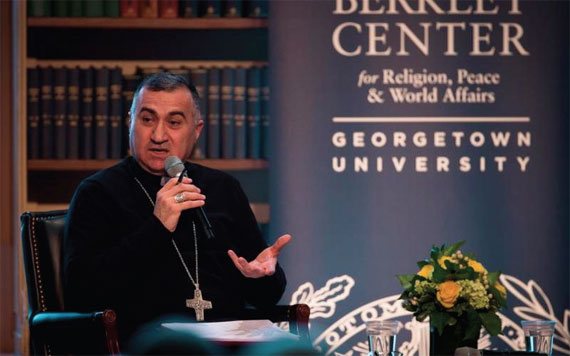
IT’S TIME TO BE ‘HONEST’ IN DIALOGUE WITH MUSLIMS, SAYS CHALDEAN ARCHBISHOP
If Christians in the Middle East are going to be “honest” with their Muslim dialogue partners, said Chaldean Arch-bishop Bashar Warda of Irbil, Iraq, Muslims will have to acknowledge that the persecution of Christians in the region did not start with the Islamic State’s rise to power in 2014.
“We experienced this not for the last four years, but 1,400 years,” Archbishop Warda said during a speech at Georgetown University in Washington, sponsored by the Religious Freedom Research Project of the university’s Berkley Centre for Religion, Peace & World Affairs. Christians are partly to blame, too, in the dialogue, according to Archbishop Warda. “We did not push back against the recurring periods of terrorism that inflicted cruel pain upon our ancestors,” he said. He added that Christianity also needs to return to a “pre-Constantine vision” of the church, recalling Jesus’s words shortly before his crucifixion: “My kingdom is not of this world.”
Archbishop Warda added, “We object that one faith has now the right to kill another. There needs to be a change and a correction within Islam.”

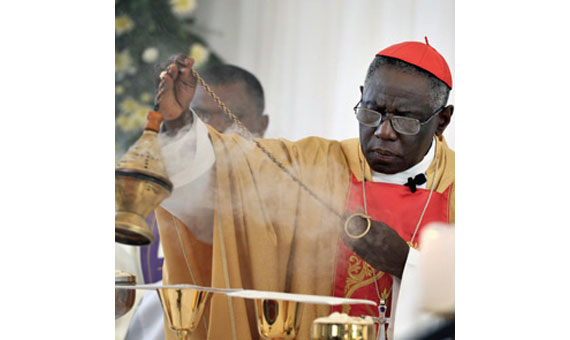
RECEIVING COMMUNION ON THE HAND IS PART OF ‘DIABOLICAL ATTACK’ ON THE CHURCH, SAYS SARAH
The Vatican’s most senior liturgical official says the pra- ctise of receiving communion on the hand is part of a “dia- bolical attack” on the Church which diminishes reverence to God.
Cardinal Robert Sarah, Prefect for the Congregation for Divine Worship and Discipline of the Sacraments, is now calling for Catholics to start receiving the host kneeling and on the tongue which he says is “more suited” to the sacrament.
“Truly the war between Michael and his Angels on one side, and Lucifer on the other, continues in the heart of the faithful: Satan’s target is the Sacrifice of the Mass and the Real Presence of Jesus in the consecrated host,” the Guinean Prelate, 72, writes in a forward to a book by Fr Federico
Bortoli, “The distribution of Communion in the hand: a historical, juridical, and pastoral overview.”
Receiving communion in the hand was practised by the early Christians and re-emerged in the years following the Second Vatican Council, the 1962-65 gathering of the world’s bishops which voted for changes in the liturgy including the use of vernacular languages.
Nevertheless, the Holy See has allowed a large number of countries across the world to allow communion to be given in the hand, and in those places it has become the widespread practise. Some of these include: the United States, England and Wales, Canada, Scotland, Zimbabwe, Zambia, Australia, New Zealand, Papua New Guinea, Ireland, Pakistan and Malaysia and Singapore.
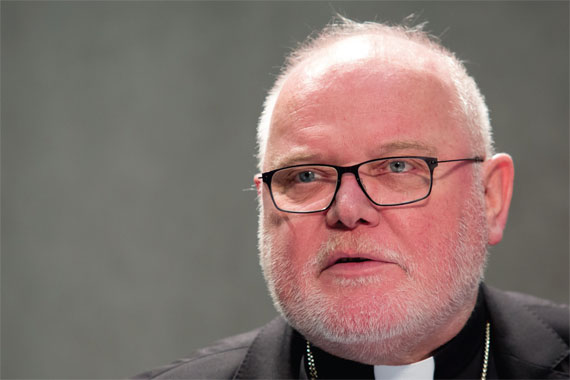
GERMAN BISHOPS DISCUSS INTERCOMMUNION OF LUTHERAN, CATHOLIC SPOUSES
German bishops have voted “overwhelmingly” in favour of producing a “guide” for Protes- tant spouses on reception of Holy Communion under certain conditions.
At their spring conference in Ingolstadt, the German bishops’ conference agreed that a Pro- testant partner of a Catholic can receive the Eucharist after having made a “serious examination” of conscience with a priest or ano- ther person with pastoral respon- sibilities, “affirms the faith of the Catholic Church,” wishes to end “serious spiritual distress,” and has a “longing to satisfy a hunger for the Eucharist.”
Cardinal Reinhard Marx, president of the German bishops’ conference, said that such a guide was a “positive step.” He said there had been an “intense debate” during which “serious concerns” had been raised, according to Katholisch.de, the website of the German bishops’ conference.
He added the bishops were not giving general approval but that the guide pertained to individual decisions. He said the
bishops wanted to continue with this issue “in a high profile way,” but that the guide would merely be a “pastoral hand-out” and that “we don’t want to change any doctrine.”