Nineveh Christians rebuild their homes, but threats remain in Iraq

With towns and cities such as Qaraqosh and Bashiqa in Iraq’s Nineveh Plains now liberated from Islamic State (IS) forces and their original inhabitants begin-ning to return, there is confidence among some local Christian leaders that life is slowly beginning to get back to normal.

“I am optimistic, yes, very optimistic,” says Qaraqosh’s Syriac Catholic Archbishop Yohanna Petros Mouche. “When you look around the villages you see that life is back again.”

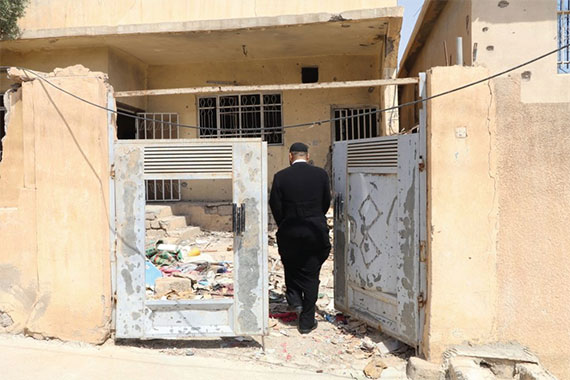
A drive through Qaraqosh proves his point. A young boy cycles by, carrying a plastic bag full of bread, while Arabic graffiti on the wall of a house in Bashiqa burnt down by retreating IS forces reads: “Tomorrow will be more beautiful.” The return of Nineveh’s Christians is most visible in Qaraqosh. About 1,500 families – more than 20% of the total Christian population before IS came – have now gone back. A local priest, Father George, has helped facilitate the return through a Centre for Support and Encouragement, a project based in Nineveh’s liberated towns to help returnees who fled the IS invasion.

Three Kenyan Christians ‘called out by name,’ then beheaded by suspected Al-Shabaab

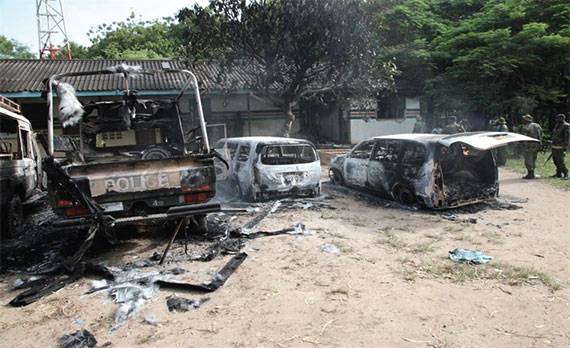
On 15 June 2014, twin attacks by Al-Shabaab on Mpeketoni left 52 people dead. The attackers killed all who could not recite Muslim prayers, before destroy-ing their homes. A group of around 30 heavily armed men in military gear, suspected to be Al-Shabaab militants, killed three men in Lamu West, near Hindi, at about 1.30 am on September 6.

In eastern coastal Kenya, along the Somali border, Lamu has been beset by Islamist attacks for years. This has instilled fear in regions where Christians are the minority. Wednesday’s attackers, armed with AK-47 rifles, surrounded homes in Bobo village and called out the names of the non-Muslim men, according to local sources.

When the men came out, the assailants ordered them to show their ID cards, before beheading them. The three victims were all Christians.

Gerald Wanjohi was one victim; his wife Catherine climbed onto the roof when the attackers broke down their door. “They were speaking in Somali and broken Swahili,” she testified. Al-Shabaab has targeted Kenyan Christians for years, attacking churches, public places and buses.

On 18 August, three Kenyan Christians were hacked to death by Al-Shabaab militants after they refused to recite the Islamic prayer of faith. A fourth Christian – the mentally challenged older brother of one of the three – was also killed.

In July, the radical Islamist group beheaded nine Kenyans – some of whom belonged to a local church – in the Pandaguo area of Lamu West. This practice appears to be a change of strategy for the group, which has used Improvised Explosive Devices (IEDs), guns and grenades in the past to attack Kenyan Christians.

As World Watch Monitor reported last month, Al-Shabaab has set up bases in Boni, a forest that straddles the Kenyan-Somali border. The group has been using the forest as a cover to attack villages on the Kenyan side, according to security sources.

Pope Francis moves to develop a more decentralized church

“All roads do not need to go through Rome!” – Deligne.

Everything is clear for the former president of the Argentine Bishops Conference who has become Pope. Decisions in the Church do not necessarily need to go through Rome.

“Excessive centralization, rather than proving helpful, complicates the Church’s life and her missionary outreach,” he lamented in §32 of Evangelii gaudium, the document that is the program for his pontificate.

For several months, the C9 (the nine cardinals who advise him on the reform of the Curia) have tackled the question of Church decentralization.

During its latest meeting in mid-June, the group studied “the possibility of transferring certain faculties of the Roman dicasteries to local bishops or bishops conferences in a spirit of healthy decentralization.”

The example given then was that of permanent deacons who currently need to ask authorization from Rome to remarry if they are widowed or wish to be ordained as priests if they are widowers or celibate.

Such authorizations could eventually be given by bishops conferences and no longer by the Congregation for the Clergy.

But according to Greg Burke, director of the Holy See Press Office, this is just one of many examples of decentralization currently being considered by the C9.

“In many dicasteries, there are things of this nature that depend on Rome but which need not necessarily do so,” he explained.

The Pope’s recently published “motu proprio” on liturgical translations, Magnum principium, is typical of this desire.

As a result of John Paul II’s Liturgiam authenticam the work of liturgical translation became blocked, with the Congregation for Divine Worship responsible for verifying that the original Latin was “translated integrally and very precisely.” The outcome was that it ended up imposing its decisions on bishops conferences. By recalling that the work of “faithfully preparing the versions of the liturgical books in current languages” needs to be carried out in a “collaboration full of reciprocal, attentive and creative confidence” between the bishops conferences and Rome, Pope Francis has transformed this situation.

In the Curia, however, certain offices have seen these changes as a loss of Rome’s power to make decisions that are binding for all dioceses.

Welcoming Lord Ganesha into church in Spain costs priest’s job

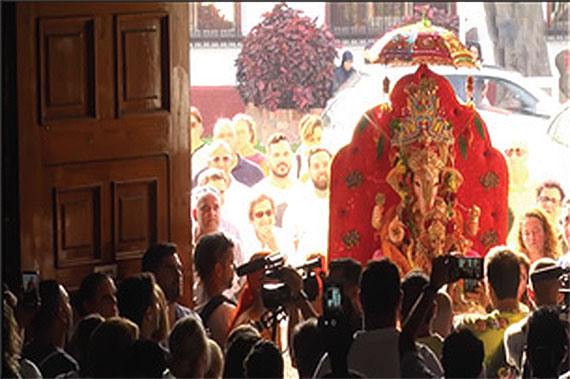
A Catholic priest in Spain was forced to resign on Aug 28, a day after he welcomed a Hindu procession into the cathedral.

As per reports, local Hindus, carrying out a Ganesh Chaturthi procession, originally wanted to leave some floral offerings at the entrance of the church as a gesture of respect to Christians.  However, Vicar General Father Juan Jose Mateos Castro opened the doors of the church for the idol Ganesha and the procession. The video of the incident has gone viral on social media. However, it did not go down well with the people.

On Aug 28, Bishop Rafael Zornoza Boy issued a statement apologizing and expressing “deep sorrow for this unfortunate fact that has caused damage, confusion or scandal in the Christian community.”

Defying Vatican, Belgian religious brothers continue to offer euthanasia 

The board of the Belgian Brothers of Charity announced on September 13, it will continue offering euthanasia to patients in their psychiatric centres, despite being ordered by the Vatican to stop doing so.

The “Broeders van Liefde” board had been given until the end of August to comply with the Vatican order, which was seen and approved by Pope Francis. Brothers of the order were also asked to sign a joint letter to their general superior, Brother René Stockman, confirming their adherence to Church teaching.

In a Sept.12 statement the organization defied the Vatican request and said it “continues to stand by its vision statement on euthanasia for mental suffering in a non-terminal situation.”
Furthermore, it claims that in adhering to this vision, the organization “is still consistent with the doctrine of the Catholic Church. We emphatically believe so.”

The Catechism of the Catholic Church, in paragraph 2277, states that: “Whatever its motives and means, direct euthanasia consists in putting an end to the lives of handicapped, sick, or dying persons. It is morally unacce-ptable.” The Brothers of Charity in Belgium run 15 psychiatric hospitals with 5,000 patients. The board controlling these institutions, which consists of a few Brothers but primarily of lay members, announced in the spring that they would permit euthanasia in their facilities.

POPE RELEASES NEW LITURGICAL LAW PAVING WAY FOR REVISION OF ENGLISH MISSAL

The new law says that bishops now have the power to complete translations of the Mass from Latin into local languages. Pope Francis has issued a new law returning authority to bishops’ conferen-ces over liturgical translations, paving the way for the current English missal to be revised.

The new law, which is part of the Argentinian Pontiff’s attempts to shore up the reforms to Catholic worship started by the Second Vatican Council, says that bishops now have the power to complete translations of the Mass from Latin into local languages.

The Pope’s order “Magnum Principium” amends Canon Law (Canon 838.3) to say bishops are required to “faithfully” prepare and “approve” translations which are then confirmed by Rome. The words “faithfully” and “approve” are both new. This throws open the possibility that the 2011 English Roman Missal – which became mired in disagreement with claims that the Vatican had overly controlled the process – could be changed. The onus will now be on local bishops to take the initiative. Francis’ law also reverses moves by his predecess-ors to centralise the translation process, which saw Vatican officials editing, and re-writing the work of bishops’ confe-rences. The foundation stone to his new law, Francis explai-ned, is the “great principle” of Vatican II which stressed that “liturgical prayer be accommodated to the compre-hension of the people so that it might be understood.” This task, he pointed out, had originally been entrusted to the bishops in countries across the world.

White Christians now minority in the United States of America

There have been “seismic shifts” in America’s religious landscape over the last few decades with white Christians now being a minority, reveals a survey of 101,000 Americans.

Racial and ethnic changes are transforming nearly all major Christian denominations, stated the Public Religion Research Institute (PRRI) in a survey that it declared was the largest of its type focusing on American religious and denominational identity.

“Today, only 43% of Ameri-cans identify as white Christian, and only 30% as white Protest-ant,” said PRRI about the survey results released Sept. 6. “In 1976, roughly eight in ten (81%) Americans identified as white and identified with a Christian denomination. A majority (55%) were white Protestants.”

The survey found a large shift in the makeup of the American Catholic Church with a large rise of Hispanics faithful in recent years.

In 1991, 87% of Catholics were white, non-Hispanic. Today they account for 55%. “Among Catholics under the age of 30, fewer than four in ten (36%) are white, non-Hispanic, compared to 52% who are His-panic,” said PRRI.

America’s 70 million Catho-lics make up 22% of the country’s 322 million people.

While Christians make up nearly 70% of Americans, the survey found a sharp increase in the numbers of the religiously unaffiliated who make up around a quarter of the population. The religiously unaffiliated includes atheists, agnostics, and those who don’t identify with any specific religion.

FUNERAL WORKERS NEED MORE COUNSELLING AND FACE GREATEST DISTRESS, SAYS SURVEY

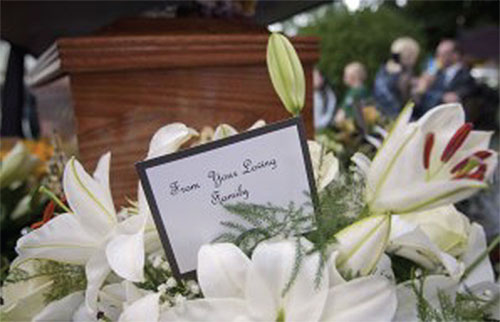
Funeral directors should have access to professional counselling and they face more sadness than any other profession, according to a new survey commissioned by The Art of Dying Well website, run by the Catholic Church in England and Wales. The survey is designed to highlight a new Online guide to Catholic Funerals and Cremations which sets out a step-by-step guide to anyone who is organising a Catholic funeral. According to the poll of 2000 adults, almost half (44%) think that funeral directors should have access to professional counselling. More than a third (36%) feel that funeral directors must struggle with the constant theme of death and grief while almost 40% of people believe that they face more sadness than other professions.

As German police attempt to deport refugees, hundreds of churches are trying to shelter them

Two guitar players strummed and sang in Farsi as a stream of Afghans and Iranians knelt at the front of Trinity Lutheran Church, sipping wine from a shared Communion cup. Most of the congregants had arrived in Germany within the last two years, part of the refugee influx that’s brought more than a million asylum seekers to the country since 2015.

At the peak of the crisis two years ago, this Lutheran Church was holding mass baptisms of more than 200 people at a time, said the pastor, Gottfried Martens. “This church went from just a few hundred members to more than 1,300 Iranians and Afghans,” Martens said. “All converts.”

When Germany opened its doors to refugees in 2015, churches and church-affiliated organizations played a critical role in the response. Most of them took care to separate religion from humanitarian aid, especially those implementing state-funded relief projects. More than two years later, however, some churches are more actively defending refugees, even housing rejected asylum seekers in churches so German police cannot deport them, while submitting legal appeals for their cases. Many of these “church asylum” beneficiaries have also converted, a controversial act that’s drawn criticism from Islamic groups and scepticism from German authorities. There are 351 church asylum locations in Germany, according to Asyl in der Kirche, a network of German parishes offering safe houses. They host 551 people, including 127 children and 301 Dublin cases. Legally, German police can deport both Dublin cases and rejected asylum seekers, a phenomenon that has increased for Afghans in particular. Germany started deporting hundreds of Afghans in 2016, sending them on charter flights back to Afghanistan, despite the country’s growing instability. If refugees are living on church grounds, however, police won’t enter.

Churches in Pakistan: solidarity with Rohingya Muslims in Myanmar and immediate truce

Strong condemnation of the attacks suffered by the people of Rohingya in Myanmar, and full solidarity and closeness to the Muslim population: this is a de-claration signed by the President of the Catholic Bishops’ Confer-ence of Pakistan, Archbishop Joseph Coutts, and by the Presi-dent of the National Commission “Justice and Peace” (NCJP), Bishop Joseph Arshad.