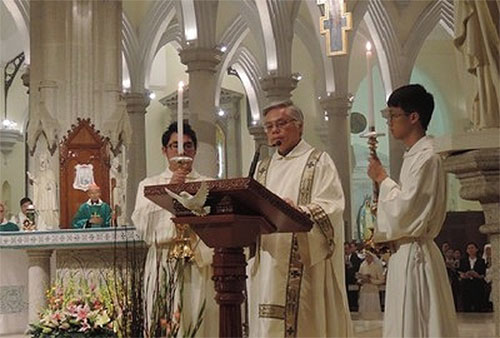
Hong Kong releases survey on diaconate ministry

A new survey by the Hong Kong Diocese has found that parishioners accept perma-nent deacons but do not fully understand their ministry.

The survey was conducted by the Catholic Studies Centre of the Chinese University of Hong Kong over three years and was released on April 23 with a more detailed version coming in June. It interviewed over 4,000 parishioners, clergy, deacons, nuns and seminarians. Hong Kong Diocese in 1997 became the first Asian Diocese of the Latin rite to ordain permanent deacons.

“The latest survey is the first research on the ministry since the last one was done 25 years ago in 1992 when the ministry was under preparation,” said Father Dominic Chan, Vicar General of Hong Kong Diocese. “We feel grateful now that well over 90 percent of the clergy and faithful have accepted laymen to become permanent deacons. Less than 20 percent of the clergy accepted this in 1992,” he told ucanews.com.

Although 70 percent of respondents welcomed permanent deacons in their parish, Father Louis Ha, head of the research project, suggested more education was needed as many interviewees said they did not know the details of the diaconate ministry.

“The lay respondents thought that there was not much difference between permanent deacons and lay church workers as they do similar tasks. This shows that they do not have a clear vision of the ministry devised in the Second Vatican Council,” he said.

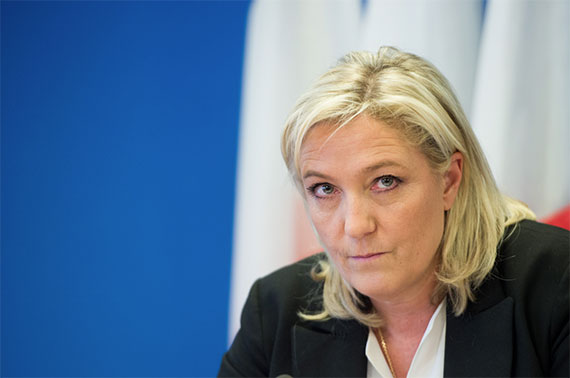
French presidential candidate Le Pen: ‘I am angry with the Church’

French presidential candidate Marine Le Pen told the daily La Croix: “I am angry with the Church because I think it interferes with everything except what it should really be concerned with.”

Le Pen said that she has a “strong faith, and I am fortunate that I have never doubted it.” But she was blunt in her criticism of Pope Francis, particularly on the issue of immigration. She insisted that charitable activities should be the responsibilities of individuals, while states should pursue their national interests. When the Pope urges nations to accept immigrants without restrictions, she said, “this falls within the realm of politics and even interference.”

Le Pen said that if she is elected as president of France, she will “with great pleasure” invite Pope Francis to visit. “And I will tell him exactly what I have just told you,” she added.

Pollsters in France have consistently rated Le Pen as likely to emerge as a finalists in the presidential race. The first round of balloting will take place and unless one candidate wins a majority—a highly unlikely outcome—the two leading vote-getters will pair off for a final contest on May 7.

In her interview with La Croix, Le Pen took a strong stand for the French tradition of secularity in government and in public affairs generally. She argued that religious symbols such as the Islamic veil should not be allowed in public, explaining: “Secularism means that one can pass someone in the street without either one knowing what faith the other follows.”

When asked whether religious leaders have a right to enter into public debates, Le Pen replied: “I don’t get involved with what the Pope should say to his followers. I don’t think religious should tell the French people how to vote.” She complained that the French bishops’ conference—which has clearly signaled a distaste for Le Pen’s National Front—has also overstepped its proper bounds.