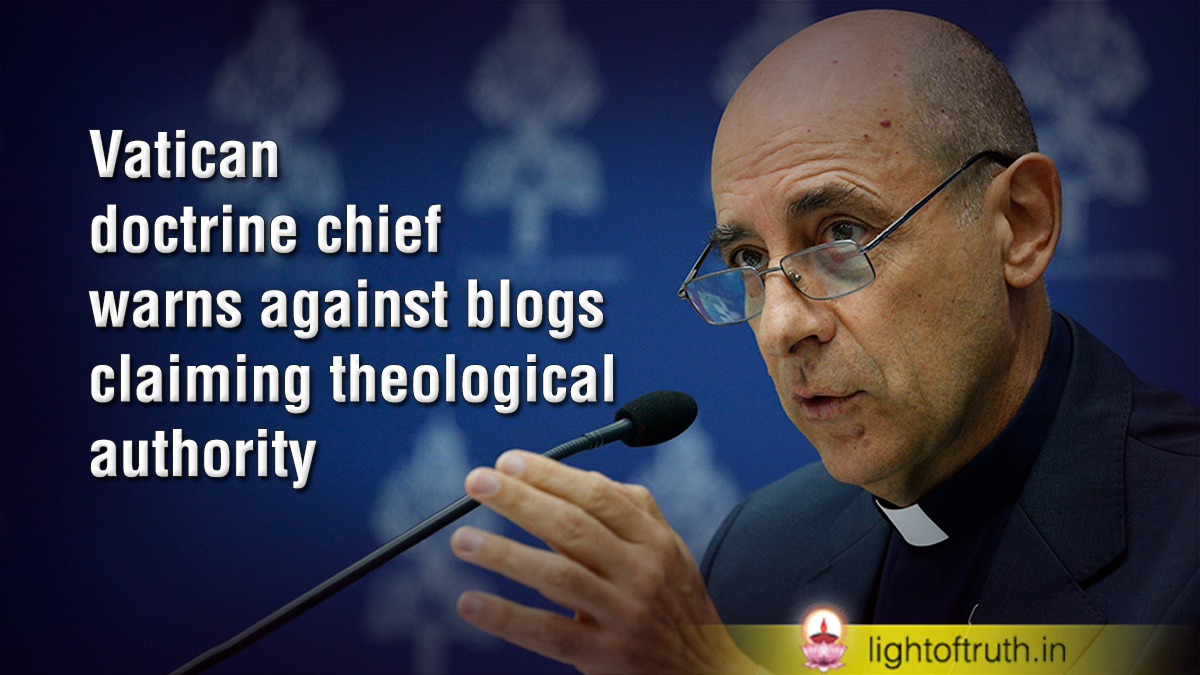
The Vatican’s doctrine chief warned that blogs and online commentators increasingly claim a theological authority they do not possess, narrowing the church’s ability to holistically engage faith and reality.
Opening the plenary assembly of the Dicastery for the Doctrine of the Faith on Jan. 27, Cardinal Víctor Manuel Fernández, dicastery prefect, said theologians risk “losing the breath of our perspective” when their work becomes narrowly focused on isolated topics.
“But the issue is even more serious since today, on any blog, anyone — even without having studied much theology — can express his or her opinion and condemn others as if speaking ex cathedra,” or with infallibility, he said.
Fernández framed the problem as a failure to recognize the limits of human knowledge. “The more science and technology advance, the more we must keep alive the awareness of our limits and our need for God, so as not to fall into a terrible deception,” he said. “Indeed, the very same one that led to the excesses of the Inquisition, the world wars, the Shoah, and the massacres in Gaza: all of which rely on fallacious arguments for their justification.”
Fernández, who has often been a target of Catholic blogs since his appointment as prefect in 2023, urged dicastery members to acknowledge those limits, invoke God’s guidance in illuminating them and remain open to the perspectives of others.
The cardinal cited Pope Leo XIV’s October homily for the Jubilee of Synodal Teams and Participatory Bodies, in which the pope called for “a church that does not close in on itself, but remains attentive to God so that it can similarly listen to everyone.”
Several Catholic blogs have been sharply critical of synodality, the shift toward a more participatory and listening church championed by Pope Francis, often arguing that it risks drifting from Catholic doctrine and blurring distinctions between clergy and laity in church decision-making.
Fernández’s call for the dicastery members to “reflect, think, and analyze reality, but while also listening to others” echoed the language of synodality promoted by the pope.