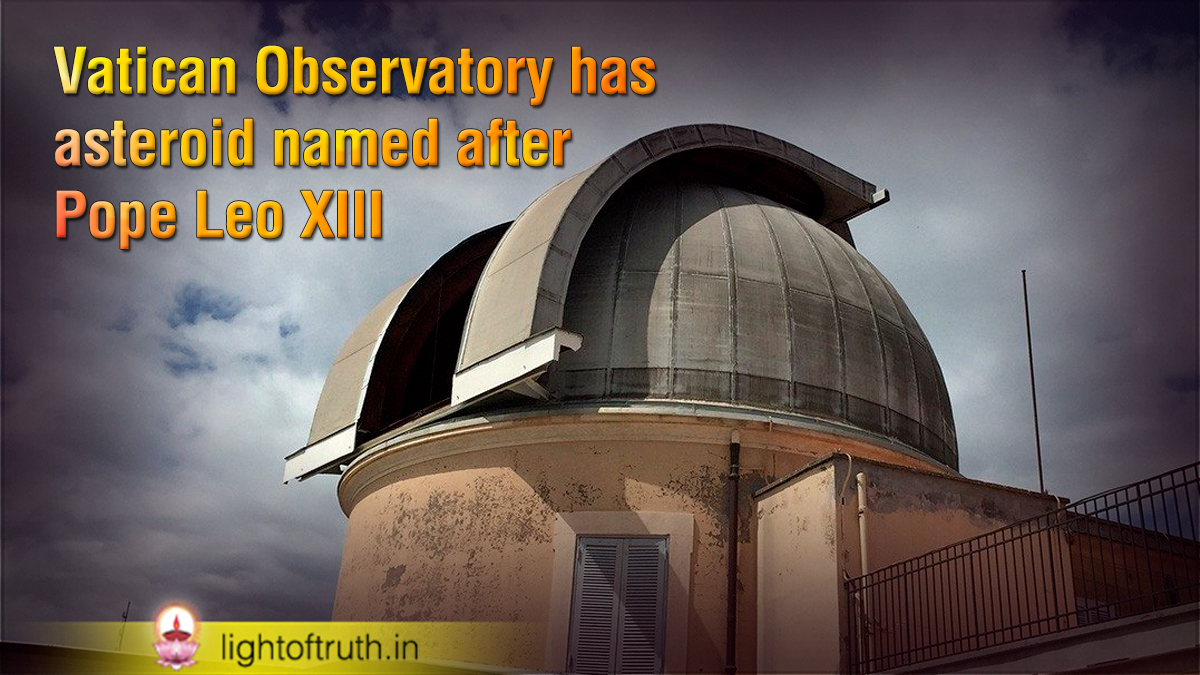
The Vatican Observatory announced that four asteroids have been named after important figures in its history-including Pope Leo XIII, who re-founded the organization in 1891-in a press release published on Wednesday, April 29.
All four asteroids were discovered by Lithuanian astronomer Kazimieras Černis and Vatican Observatory astronomer Father Richard P. Boyle, using the Observatory’s Vatican Advanced Technology Telescope (VATT), located on Mount Graham in Arizona, United States.
The asteroids are “(858334) Gioacchinopecci”, “(836955) Lais”, “(836275) Pietromaffi”, and “(688696) Bertiau”, and the names were recently announced in Volume 6, issue 4, of the International Astronomical Union’s WGSB Bulletin, the statement explains.
The “(858334) Gioacchinopecci” honors Pope Leo XIII, baptized Gioacchino Vincenzo Raffaele Luigi Pecci, who was Pope from 1878 until his death in 1903.
Pope Leo XIII was instrumental to the development of the Vatican Observatory, as he re-established it following the loss of papal territories and the highly productive astronomical facilities that had been located within them.
This included the observatory of Father Angelo Secchi, which was located atop the Church of St. Ignatius in Rome. Photographs of the Vatican in the early 20th century also show the domes of observatory telescopes atop the walls of the Vatican and the “Tower of the Winds”.
In the 1930s, because of electric lighting brightening the night skies over Rome, the telescopes were moved to the Apostolic Palace in Castel Gandolfo, around an hour south of Rome. Their domes are still there, visible for kilometers in all directions. Further brightening of the Roman skies led to the construction of the Vatican Advanced Technology Telescope on Mount Graham in Arizona in the 1990s.
The statement notes that in his 1891 Motu Proprio “Ut Mysticam” establishing the Vatican Observatory, Pope Leo XIII highlighted how this entity would help to show the world that the Church’s current and historic attitude toward “true and solid science” was to “embrace it, encourage it, and promote it with the fullest possible dedication,” contrary to what detractors had been stating.
He underlined that the Observatory would be “helping to promote a very noble science which, more than any other human discipline, raises the spirit of mortals to the contemplation of heavenly events.”
This is not the first case of an asteroid being named after a Pope. “(560974) Ugoboncompagni” honors Pope Gregory XIII for his work on reforming the calendar and was also discovered with the Vatican Advanced Technology Telescope. In 2000, German astronomer Lutz Schmadel named “(8661) Ratzinger”, after Pope Benedict XVI, who at the time was a Cardinal and had not yet been elected Pope. It was named after him in honour of his work to open the Vatican archives in 1998, in order to allow researchers to investigate judicial errors against Galileo.