Vincent Kundukulam
Recently, I came across an excellent work of contextual theology entitled “Between the Sea and the Sky” authored by P.T. Mathew SJ. The book is published by Fortress Press, Minneapolis and interestingly, it deals with the religious living of the Mukkuvar in the southern west coast of Kerala. The work researches on how these oceanic people developed a religiosity of their own in the midst of their political, ethnic and religious experiences. The author judiciously analyses the cosmic visions, astronomical knowledge, divinities, rituals, symbols and even omens, taboos and manthras of the Mukkuva families, with the help of the tools of social and theological sciences.
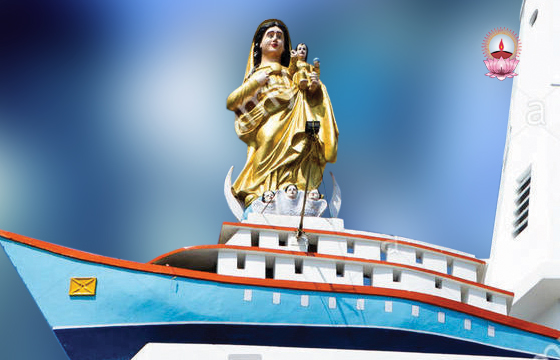
The main hypothesis argued in the volume is that the remarkable degree of daring spirit that the fishermen show at the moment of disasters and the resilience afterwards, partly owe to a symbiotic spirituality which is consisted of complex and conflicting features of the saints they worship. The Cintathira Matha, a version of Mother Mary worshipped at Vizhinjam Church, is of ambivalent nature, which is also a feature of Mukkuvas. Matha stimulates in the adepts both the militant and peaceable emotions. The combative feature of Cintathira Matha might be emerging from the terrifying Dravidian goddess Bhadrakali whom the ancestors of fisher folk would have been venerating in their pre-conversion era. And the benevolent feature of Cintathira Matha might be drawn from the docile Indic goddesses like Laksmi and Parvati who have been venerated by their Hindu counterparts. The study also shows how the Christian warrior saints like St. Michael have adopted virulent features from the Hindu warrior divinities.
The ambivalent nature of Cintathira Mata – both docile and militant – is not merely a symbol of Christian inculturation. It has serious implications on the social and political behavior of oceanic people. The Matha of Good Voyage is representative of the ambivalent nature with which the Mukkuvas struggled to protect their identity against other power centers. In the transition from the Neithal religion to the Catholicism, the Mukkuvas succeeded in resisting against the coercive methods of Catholic priests. They went to the extent of beating certain priests and controlling them with the help of Hindu Raja. It means, while they enjoyed the new social identity received by conversion they refused to submit fully to the imposing ecclesiastical structures. They ensured certain continuity with the past belief-systems and practices in order not to lose their individuality in the midst of universal Catholic configurations. That means, the integration of the militant nature of the goddess Kali into Mother Mary is indicative of the Mukkuva strategy of playing the double role of reconciliation and confrontation.
The Neithal religiosity once again invites our attention to the inseparable bond between religion and culture. Religious worship and man’s culture are closely related. Liturgical celebrations define man’s culture and inversely the myths and symbols of life define the forms of human worship. Rituals and life-visions influence and determine each other. The Cintathira Matha reflects their tactful use of strategy of ambivalence. As Cintathira Matha plays with the double role – annihilating the evil and protecting the good, the Mukkuvar also synchronize in them the centripetal and centrifugal movements that underlie in individuals and in religions. Given religions function as social identity givers, there is a chance that they turn to be rigid and narrow in their doctrines and attitudes towards others in a multi-religious context. This temptation for shrinkage has to be countered with the spiritual content in religions which is basically universal and pluralist. The Neithal religiosity is a model for such a creative synthesis of exclusive and inclusive tendencies in the religion.
kundu1962@gmail.com